

What makes art dark: a guide for enthusiasts and creators
TL;DR:
- Dark art is a language expressed through light and shadow, psychological confrontation, and historical symbolism. Techniques like tenebrism and chiaroscuro shape its emotional intensity, while abject themes challenge viewers by confronting taboo and mortality. Its enduring cultural relevance lies in providing catharsis, identity, and resistance within a sophisticated visual tradition.
Most people assume what makes art dark is a palette of blacks and grays, maybe some fog and a skull thrown in for good measure. That assumption misses almost everything. Darkness in art is a language, one built from light and shadow, psychological confrontation, centuries of theological symbolism, and technical choices invisible to the casual eye. Whether you collect it, practice it, or simply feel pulled toward it, understanding dark themes in art means learning to read that language at depth. This guide breaks it down, technique by technique, theme by theme.
Table of Contents
- The art of shadow: tenebrism and chiaroscuro explained
- Exploring the grotesque: abject art’s role in dark artistic expression
- Gothic modernism: historical and psychological roots of dark art themes
- Techniques and symbolism: bringing darkness alive in dark art practice
- Psychological impact and cultural relevance of dark art today
- Rethinking darkness: what most people miss about dark art
- Explore dark inspiration with Goth.Market’s curated gothic collections
- Frequently asked questions
Key Takeaways
| Point | Details |
|---|---|
| Tenebrism defines darkness | Extreme light and shadow with mostly dark canvas creates drama and mystery in dark art. |
| Abject art provokes | Challenging taboos through grotesque themes evokes complex emotions and confronts beauty norms. |
| Gothic themes persist | Dark art draws from medieval and modern history exploring trauma, mortality, and psychic shadow. |
| Symbolism deepens impact | Layered motifs and luminous shadows add emotional and narrative complexity to dark artwork. |
| Dark art offers catharsis | It provides emotional release and identity expression, resisting conformity in culture today. |
The art of shadow: tenebrism and chiaroscuro explained
Before anything else, darkness in visual art lives in contrast. Two classical techniques define how artists have weaponized light and shadow for centuries: chiaroscuro and tenebrism.
Chiaroscuro (Italian for “light-dark”) is the gradual modeling of form using transitional tones between light and shadow. Think of it as sculpture through paint. It gives figures volume, weight, and presence. Tenebrism is its far more extreme cousin. Tenebrism uses extreme darkness covering two-thirds or more of the canvas to generate drama and mystery. Where chiaroscuro illuminates and clarifies, tenebrism consumes.
Caravaggio is the undisputed master here. His Calling of Saint Matthew places a single shaft of light cutting through a pitch-black room. The figures it touches feel electrified. The rest disappears. That void is not emptiness. It is pressure. Rembrandt worked differently. His shadows are warm, layered, amber. They feel like dusk, not night. Both achieved darkness, but with entirely different emotional registers.
| Feature | Chiaroscuro | Tenebrism |
|---|---|---|
| Transition | Gradual, smooth | Abrupt, stark |
| Shadow coverage | Partial | 66% to 90% of canvas |
| Emotional tone | Contemplative, sculptural | Theatrical, confrontational |
| Key figures | Leonardo da Vinci, Raphael | Caravaggio, Artemisia Gentileschi |
| Light source | Ambient or diffused | Single, theatrical point |
The emotional impact of dark art executed through tenebrism is immediate. It forces the eye. It creates hierarchy. Whatever the light hits becomes the only thing that matters.
- Extreme shadow builds psychological tension before the viewer consciously registers it
- Single-source lighting implies danger, divine intervention, or isolation
- Deep voids leave narrative gaps the viewer’s imagination fills
- High contrast registers emotional extremes: guilt, revelation, terror, grief
Pro Tip: If you’re painting dark tones, avoid reaching for pure black pigment from the tube. Mix Prussian blue with burnt sienna or alizarin crimson to build shadows that breathe. Pure black flattens. Mixed darks vibrate. The role of art in gothic style has always depended on this kind of technical restraint, and the masters understood it instinctively. For a deeper look at contemporary dark painting craft, Tekton LA offers relevant resources on modern dark art practice.
Exploring the grotesque: abject art’s role in dark artistic expression
Beyond visual shadow, darkness in art also emerges from confronting the unsettling realities of human existence. This is where abject art enters the conversation, and it is not for the faint-hearted.
Abject art, coined by Julia Kristeva, evokes darkness by exploring degradation and the grotesque using bodily fluids, waste, and taboo matter, actively challenging beauty norms. Artists like Kiki Smith, Cindy Sherman, and Mike Kelley worked in this territory. The materials are often as disturbing as the imagery. The point is not aesthetic pleasure. It is confrontation.
What makes this approach genuinely dark rather than merely shocking is how it operates psychologically. Julia Kristeva’s abjection theory holds that abjection triggers horror and disgust while simultaneously generating fascination, because it blurs the border between self and other, subject and object. You want to look away and cannot. That paradox is the entire mechanism.
Common materials and motifs in abject art include:
- Bodily fluids, hair, and biological waste as literal media
- Decayed organic matter referencing mortality and impermanence
- Distorted or fragmented figures that deny bodily wholeness
- Domestic objects reframed as sites of violence or shame
- Medical imagery stripped of clinical detachment
How does abject art encourage viewers to confront deeper emotions?
- It removes the comfortable distance between art and lived experience
- It implicates the viewer’s own body in the discomfort
- It forces acknowledgment of things culture trains us to repress
- It destabilizes the idea that beauty is art’s primary obligation
- It creates lasting psychological residue long after the gallery visit ends
“The abject is what disturbs identity, system, order. What does not respect borders, positions, rules. The in-between, the ambiguous, the composite.” — Julia Kristeva, Powers of Horror
The symbolism in goth fashion draws from this same well, using imagery of decay and transgression to communicate identity. Dark art and dark aesthetics are never as far apart as they look. Abject motifs also appear in gothic accessories with far more historical intentionality than most wearers realize.
Gothic modernism: historical and psychological roots of dark art themes
Having explored psychological and physical darkness, we now see how historical and modern movements intertwine dark artistic expression across centuries. What defines dark art is never invented from scratch. It inherits.
Medieval art used darkened, suffering bodies as sites of theology and politics as early as the mid-13th century. Darkness was not decoration. It was doctrine. A shadow over Christ’s face carried eschatological weight. The body in pain was a political argument about endurance, salvation, and power. Those theological roots never fully disappeared from Western art. They transformed.
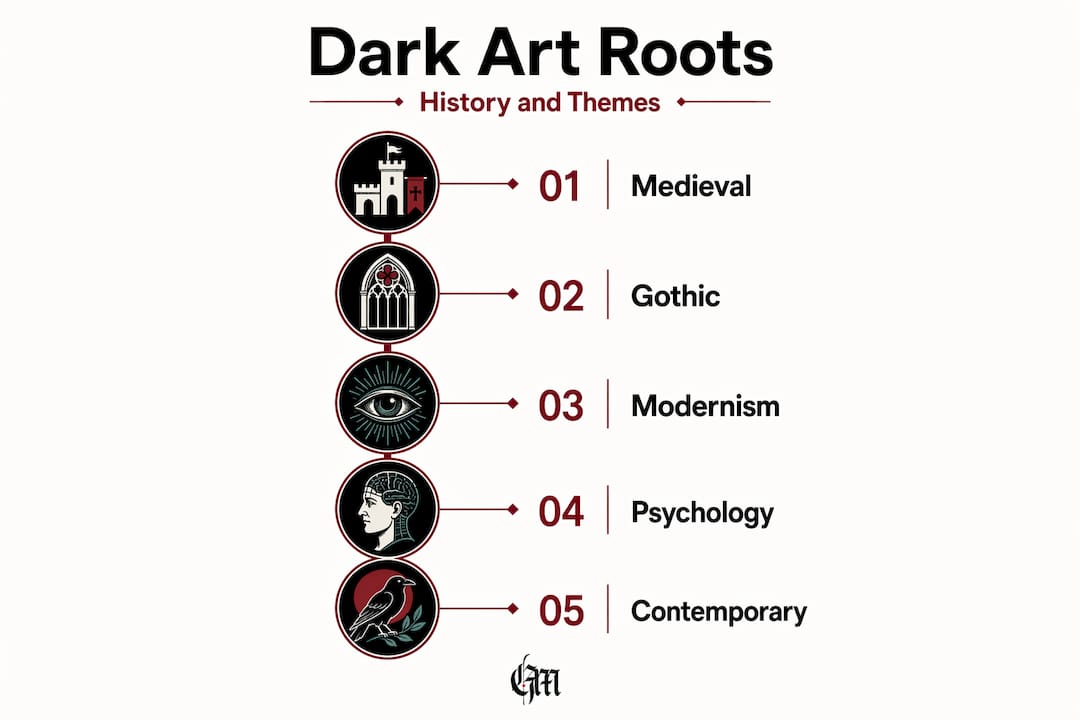
By the 19th and early 20th centuries, Gothic Modernism absorbed those older registers of darkness and pointed them at new horrors. Gothic Modernism exhibitions from 2024 to 2026 document artists responding to industrialism and the catastrophe of World War I with the same dark themes, now translated through trauma, psychic disintegration, and collective grief.
Key artists and themes in Gothic Modernism include:
- Edvard Munch: anxiety, existential dread, dissolution of the self
- Käthe Kollwitz: war grief, maternal loss, bodies destroyed by poverty and conflict
- Max Klinger: erotic horror, mythological darkness, the unconscious made visible
- Franz von Stuck: sin personified, serpentine evil rendered as visual seduction
- Odilon Redon: symbolist nightmare imagery rooted in biological and psychological unease
Running alongside this, Carl Jung’s shadow self theory drives many artists to dark themes as a form of psychic integration and visual catharsis. The shadow self, in Jungian terms, is the unconscious repository of everything the conscious mind rejects. Dark art externalizes it. Making it visible does not make it worse. It makes it possible to process.
| Period | Dark theme type | Core concern |
|---|---|---|
| Medieval (1200s) | Theological suffering | Salvation, sin, political power |
| Baroque (1600s) | Tenebrism, mortality | Vanitas, human frailty |
| Romantic (1800s) | Gothic horror, sublime | Nature’s terror, the irrational |
| Early Modern (1900s) | Trauma, psychic shadow | War, industrialism, Jungian self |
| Contemporary | Abject, digital gothic | Identity, resistance, catharsis |
The symbolism in gothic art carries all of these layers. A skull in a contemporary dark painting is not just edgy. It carries 800 years of memento mori tradition. That weight is what separates resonant dark art from theater. Goth home decor works the same way when it draws on genuine iconographic tradition rather than surface aesthetic.
Techniques and symbolism: bringing darkness alive in dark art practice
Let’s move from historical and thematic foundations to practical methods that breathe life into darkness on the canvas. Knowing the history matters, but what defines dark art in practice comes down to specific, learnable choices.
Start with color. Skilled artists mix multiple pigments rather than reaching for black to create luminous shadows, adding life to dark areas rather than flat blackness. A mix of indigo, dioxazine purple, and raw umber creates a dark that seems to absorb light from within. That quality of inner luminosity is what separates atmospheric darkness from mere murkiness.
Symbols in dark art carry specific cultural and psychological freight. Knowing them lets you read dark work at the level its creator intended:
- Wilting or black roses: love in decay, beauty’s impermanence, the gothic romance with ending
- Cracked mirrors: fractured identity, the unreliable self, broken perception
- Moths and dead insects: mortality, attraction to destruction, the drawn toward flame
- Empty chairs or beds: grief, absence, the haunting residue of what was
- Hourglasses and clocks: time’s pressure, the memento mori tradition, urgency before death
- Windows in darkness: thresholds, the watched versus the watching, surveillance and the uncanny
Dark art layers textures and symbols subtly, using motifs like wilting roses or cracked mirrors to build atmosphere in ways that surprise viewers expecting overt horror. The most effective dark work builds slowly. It rewards sustained looking. It earns its emotional impact through accumulation, not assault.
Texture also carries narrative. Cracked paint surfaces suggest decay. Thick impasto over smooth glazes builds unease through contradiction. Washes of translucent color over dark grounds create the sensation of something seen through water or smoke.
Pro Tip: Avoid the temptation to make every symbol obvious. A single cracked mirror in an otherwise ordinary domestic scene is more unsettling than a room full of skulls. Restraint is the dark artist’s most powerful tool. Explore unique gothic accessory ideas for examples of how symbolism translates from canvas to wearable form.
Psychological impact and cultural relevance of dark art today
Understanding techniques and symbolism, we can now grasp why dark art resonates so powerfully with contemporary audiences and why its cultural moment is far from over.
Dark art provides catharsis through Aristotelian emotional release and thrill arousal, with measurable increases in heart rate occurring in safe gallery settings. This is not metaphor. It is physiology. The body responds to convincingly dark imagery the way it responds to real threat, but in a context where no actual danger exists. That combination of arousal and safety is uniquely pleasurable, and it explains why horror, grief, and the grotesque have attracted audiences for as long as art has existed.
Dark art also functions as a powerful vehicle for identity expression. Collectors of gothic and dark work are not simply buying aesthetics. They are claiming membership in a tradition of resistance and refusal.
Key psychological and social functions of dark art today:
- Provides emotional vocabulary for experiences mainstream culture refuses to name
- Creates community between people who recognize the same symbolic language
- Legitimizes grief, trauma, and existential dread as worthy subjects
- Challenges the mandatory optimism of commercial visual culture
- Offers a space where ugliness and beauty are not opposites but collaborators
Dark art counters hyper-conformity and technocratic power through what critics call revanchist aesthetics, offering genuine cultural resistance. In a visual landscape dominated by algorithmic cheerfulness and sanitized imagery, dark art insists on the full range of human experience.
“To look unflinchingly at darkness in art is to practice a form of courage. What we refuse to see does not disappear. It waits.”
The benefits of collecting gothic art go deeper than aesthetics. And for those ready to build a serious collection, understanding how to start a gothic art collection begins exactly with the kind of historical and psychological grounding this guide provides.
Rethinking darkness: what most people miss about dark art
Here is the thing most commentary on dark art gets wrong: it treats darkness as the subject when darkness is actually the method.
The artists who define this tradition, Caravaggio, Kollwitz, Smith, Munch, were not interested in darkness for its own sake. They were interested in what darkness makes visible. Shadow is not the absence of light. It is the shape light carves when it encounters resistance. Technical mastery in layering and pigment choice makes darkness emotionally inhabited rather than merely black, and that distinction separates work that haunts from work that simply looks gloomy.
The psychological dimension is equally misread. Many viewers assume dark art is about nihilism, depression, or shock. Jungian analysis suggests the opposite. Engaging seriously with dark themes is integrative work. It is how psyches process what rational daylight cannot accommodate. Artists drawn to darkness are not necessarily in pain. Many describe their practice as deeply stabilizing, even joyful.
Common misunderstandings about dark art:
- “It’s only about death and horror”: Dark art covers trauma, sexuality, political dissent, grief, the sublime, and the unconscious
- “Black palette equals dark art”: Color is the least important variable. Intent and symbolic layering define the category
- “Dark art is a modern subculture”: The tradition is at least 800 years old and spans every major Western art movement
- “It requires shock to be effective”: Restraint and subtlety produce deeper, more lasting emotional impact than assault
- “Darkness and beauty are opposites”: The most powerful dark work holds both simultaneously
The modern impact of gothic art is inseparable from this psychological complexity. When you collect or create within this tradition, you are not decorating with gloom. You are participating in one of the oldest and most sophisticated conversations in human visual culture.
Explore dark inspiration with Goth.Market’s curated gothic collections
If this guide sparked your passion for dark art, you already know the feeling: a hunger to surround yourself with objects that carry symbolic weight, that speak the language of shadow and meaning rather than mere trend. That’s exactly what Goth.Market was built for.

Our gothic jewelry collection draws directly from the iconographic traditions covered in this guide, featuring pieces that use tenebrism-inspired metalwork, abject motifs, and gothic symbolism to create wearable art with real depth. The celestial chain choker with moon pendant is a perfect example: cosmic darkness made physical, the kind of piece that speaks to collectors who know their symbols. For those who want to explore the lighter, more whimsical side of gothic aesthetics, the whimsygoth collection offers curated pieces that blend dark artistry with playful imagination. Every purchase supports independent creators working within this tradition.
Frequently asked questions
What is the main difference between tenebrism and chiaroscuro?
Tenebrism uses pitch-black voids consuming most of the background with abrupt single-light transitions, while chiaroscuro involves gradual shading to model forms with transitional light and shadow.
Why do some artists choose abject themes in their work?
Artists use abject themes to challenge traditional beauty by exploring degradation and the grotesque, provoking emotional reactions that confront taboo subjects most culture actively suppresses.
How does dark art provide catharsis for viewers?
Dark art triggers catharsis through emotional release and measurable thrill arousal, giving viewers the physiological experience of fear or grief in a safe setting where those emotions can be fully felt and released.
What role does symbolism play in dark art?
Symbols in dark art, from wilting roses to cracked mirrors, build layered atmospheric meaning that accumulates over time, creating depth and psychological resonance far beyond the surface imagery.
How can I start collecting dark or gothic art?
Begin by learning the historical and symbolic foundations, medieval theology, tenebrism, Jungian shadow theory, then seek out curated collections featuring artists who work with genuine iconographic intention rather than surface aesthetic alone.