

Gothic art symbolism: meanings, motifs & inspiration
Gothic art has a reputation problem. Most people assume it’s purely about darkness, death, and dramatic aesthetics. But the symbols carved into cathedral walls, cast in stained glass, and embedded in floor plans were never just decorative. They were a language. From the 12th century onward, Gothic artists and architects built a visual system so precise that an illiterate peasant could walk into a cathedral and understand theology, morality, and cosmic order without reading a single word. This guide unpacks that symbolic language and shows you how to use it today.
Table of Contents
- Setting the stage: What is Gothic art and why does symbolism matter?
- Core motifs in Gothic art: Reading the symbolic alphabet
- The architecture of meaning: Space, geometry, and hidden narratives
- Sacred storytelling: Stained glass, sculpture, and iconography
- Multiple meanings: Debates, evolutions, and modern echoes
- From medieval cathedrals to your studio: Applying Gothic symbolism now
- Explore modern symbolism with Goth.Market
- Frequently asked questions
Key Takeaways
| Point | Details |
|---|---|
| Visual storytelling | Gothic symbols turned buildings into stories for those who could not read. |
| Recurring motifs | Common themes like light, animals, and geometry carried deep meaning. |
| Debate and evolution | Interpretations of Gothic symbolism vary, fueling ongoing creative expression. |
| Modern inspiration | Contemporary art and style often revive or adapt medieval Gothic symbols. |
| Personal application | Anyone can use symbolic thinking from Gothic art for richer, more meaningful creations. |
Setting the stage: What is Gothic art and why does symbolism matter?
Gothic art emerged in Western Europe roughly between the 12th and 16th centuries, born from the Romanesque tradition but reaching far higher, literally and figuratively. It encompassed architecture, sculpture, stained glass, manuscript illumination, and panel painting. What unified all these forms was an intense commitment to meaning. Nothing was accidental.
Symbolism was the engine of Gothic art because most medieval Europeans could not read. Religious teachings and moral lessons had to be communicated visually, and Gothic artists rose to that challenge with extraordinary sophistication. A carved lamb wasn’t just a lamb. A pointed arch wasn’t just a structural choice. Every element carried theological weight.
Here’s what made Gothic symbolism so powerful:
- Accessibility: Visual symbols crossed language and literacy barriers instantly
- Layered meaning: A single motif could carry spiritual, moral, and political messages simultaneously
- Emotional impact: Scale, light, and geometry created awe that reinforced the symbolic message
- Community identity: Shared symbols built collective understanding across entire regions
“Symbolism in Gothic art primarily served to convey religious teachings, moral lessons, and spiritual aspirations to largely illiterate medieval audiences through visual narratives.”
This same richness is exactly why Gothic motifs still captivate us. The symbolism in goth fashion worn by subculture members today draws directly from this deep well of meaning, even when the wearer doesn’t realize it.
Core motifs in Gothic art: Reading the symbolic alphabet
Gothic symbolism operated across multiple mediums, each with its own visual vocabulary. Understanding the motifs by medium helps you decode them faster.
Pointed arches, ribbed vaults, and flying buttresses weren’t just engineering solutions. They enabled taller walls and larger windows, which symbolized humanity’s aspiration toward heaven and the presence of divine light. The higher the structure, the closer to God.
Stained glass was the most narrative medium. Light symbolizing divine presence made these windows far more than decoration. They were called the “Bible of the poor” because they told biblical stories in vivid color to people who had never seen a written page.
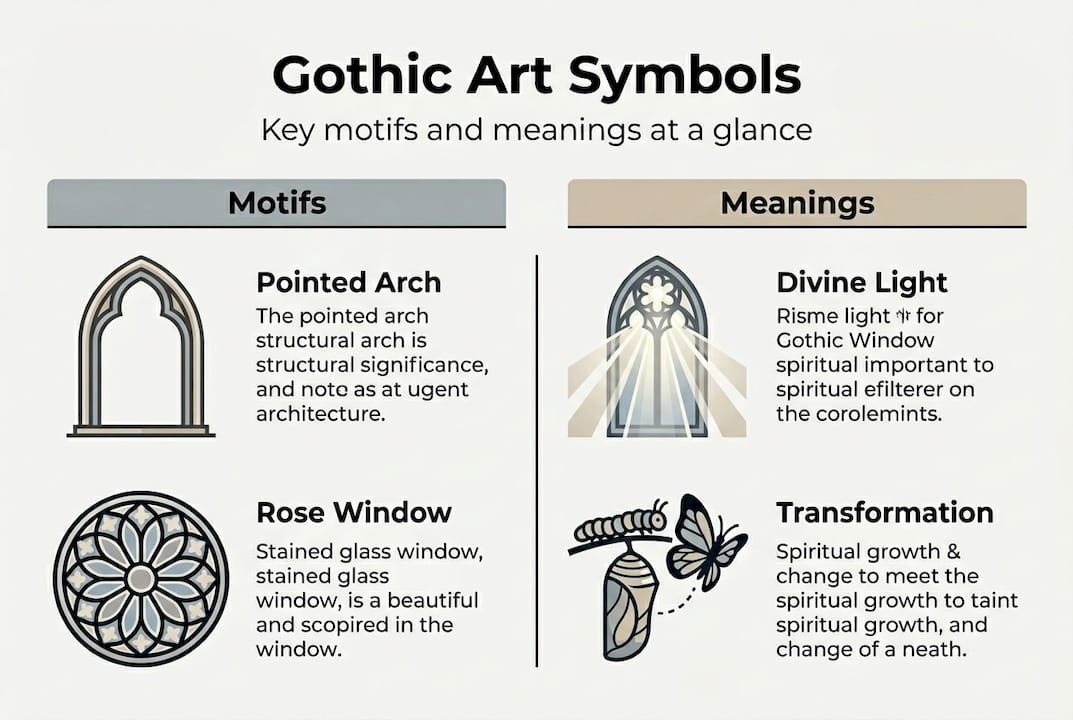
| Motif | Visual form | Symbolic meaning |
|---|---|---|
| Pointed arch | Upward-tapering stone arch | Aspiration toward heaven |
| Rose window | Circular window with geometric tracery | Cosmic order, eternity, the Virgin Mary |
| Gargoyle | Stone creature projecting from walls | Warding off evil spirits |
| Lamb | Carved or painted young sheep | Christ, innocence, sacrifice |
| Lion | Sculpted stone beast | Strength, resurrection, royalty |
| Ribbed vault | Intersecting stone ribs on ceiling | Divine structure, celestial canopy |
Animal and geometric motifs carried especially dense meaning:
- Pelican: Self-sacrifice and Christ’s atonement
- Owl: Wisdom or, in darker readings, heresy
- Trefoil: The Holy Trinity
- Quatrefoil: The four Gospels
- Serpent: Temptation, but also healing when paired with a staff
These symbols appear not just in gothic symbols in jewelry from the medieval period but in contemporary pieces too. You’ll also find them woven into gothic symbols in accessories across modern subculture design. The Gothic cathedrals that housed these motifs were essentially encyclopedias in stone.
The architecture of meaning: Space, geometry, and hidden narratives
Individual symbols are fascinating, but Gothic architecture went further. Entire buildings were designed as immersive symbolic experiences. The layout, proportions, and geometry of a cathedral were themselves a form of scripture.
Cathedral layouts in cruciform plans symbolized Christ’s body. The nave represented the body, the transepts the outstretched arms, and the choir the head. Walking through the building was meant to be a physical act of devotion. Rose windows and geometric patterns represented cosmic order and eternity, reinforcing the idea that the building itself was a model of the universe.
Semiotics, the study of signs and symbols, treats cathedrals as spatialised scripture where vaults and structural elements signify theological concepts through layered meaning. In other words, the building doesn’t just contain symbols. It is a symbol.
| Cathedral | Symbolic layout feature | Unique detail |
|---|---|---|
| Notre-Dame de Paris | Classic Latin cross plan | West facade with three portals representing Trinity |
| Chartres Cathedral | Labyrinth in nave floor | Pilgrimage path symbolizing journey to Jerusalem |
| Cologne Cathedral | Double-tower west facade | Towers symbolizing gateway between earth and heaven |
| Sainte-Chapelle | Near-total glass walls | Light as total immersive divine presence |
Pro Tip: When visiting or studying a Gothic building, look for repeating numbers. Three appears constantly (Trinity), as does four (Gospels) and twelve (Apostles). These aren’t coincidences. They’re intentional codes embedded by architects who understood geometry as divine language.
Don’t overlook the margins either. Artisans sometimes carved grotesques and marginalia with subtle personal commentary, small jokes, local faces, or social critiques hidden in plain sight. These edge cases remind us that Gothic art was made by humans with opinions, not just pious automatons. You can find echoes of this spirit in gothic home decor meanings and gothic wall art symbolism that blend reverence with irreverence.
Sacred storytelling: Stained glass, sculpture, and iconography
If architecture was the frame, stained glass and sculpture were the story. These surfaces carried the most direct narrative content in Gothic art, and they were designed to be read in sequence.
Chartres Cathedral alone contains stained glass covering 2,600 square meters of surface area. That’s not decoration. That’s a library. Each window told a story, from the life of a saint to scenes from the Old and New Testaments, all rendered in color that shifted with the time of day and season.
Here’s how a medieval viewer was meant to experience these spaces:
- Enter through the west portal, where sculptures depicted the Last Judgment, a reminder of mortality and consequence
- Move through the nave, reading the lower windows that showed earthly stories and moral lessons
- Approach the choir, where higher windows depicted heavenly figures and divine light intensified
- Reach the altar, the symbolic meeting point between earth and heaven
- Look back, seeing the rose window above the entrance, representing eternity and the completeness of the journey
Sculptures reinforced these lessons. Gargoyles warded off evil, while animals like the lamb (representing Christ) and the lion (representing strength and resurrection) provided moral instruction. Grotesques served an apotropaic function, meaning they were believed to protect the sacred space by frightening away malevolent forces.
Pro Tip: Modern artists can borrow this sequential storytelling technique. Design your work so that the viewer’s eye moves through a deliberate narrative arc, from tension to resolution, from darkness to light. This is pure Gothic iconography applied to contemporary dark mystical decor ideas or personal art projects.
Multiple meanings: Debates, evolutions, and modern echoes
Gothic symbolism isn’t a closed book with one correct reading. Scholars have debated its meanings for centuries, and those debates are still alive.
The core tension is this: were Gothic cathedrals primarily engineering achievements that happened to look spiritual, or were they intentional symbolic programs where every structural choice served a theological message? The answer, most likely, is both.
- Structural camp: Points to the practical necessity of flying buttresses and ribbed vaults for building taller structures
- Symbolic camp: Argues that the choice to build taller was itself a theological statement about reaching toward God
- Integrated view: Technological and mystical interpretations aren’t mutually exclusive; structure and symbol reinforced each other
“Gothic architecture represents a fusion of engineering ambition and spiritual aspiration, where the technical and the transcendent were never truly separate.”
This tension between structure and meaning is part of what makes Gothic art so enduring. It refuses simple categorization. And that quality translates directly into the modern gothic subculture, where skulls appear in 60% of modern gothic artworks as echoes of the medieval memento mori tradition, a reminder that death gives life its meaning.
For creators, this is the real gift of Gothic symbolism. It gives you a vocabulary for expressing duality, transformation, and mortality without being heavy-handed. The goth modern fashion trends that dominate alternative subcultures today are built on exactly these themes. Even authentic gothic style tips for wardrobe building reference the same symbolic logic that medieval artisans used.
From medieval cathedrals to your studio: Applying Gothic symbolism now
Knowing the history is one thing. Using it is another. Here’s how to bring Gothic symbolic thinking into your own creative practice.
- Choose a theme first. Mortality, transformation, duality, protection. Pick one core idea before selecting any visual elements.
- Research the motif’s original meaning. A gargoyle means something specific. Using it intentionally creates depth. Using it randomly creates noise.
- Layer your symbols. Gothic art rarely used a single motif in isolation. Combine elements so they reinforce each other, just as medieval artisans did.
- Consider the viewer’s journey. How will someone move through or experience your work? Design the sequence deliberately.
- Subvert when it serves the story. Medieval artisans hid subtle commentaries in marginalia and grotesques. You can do the same. Irony and subversion have always been part of Gothic art.
Pro Tip: Start with a single symbol that resonates personally and research its full history. You’ll almost always find layers of meaning you didn’t expect, and those layers become the foundation for genuinely original work. The bold dark aesthetics guide is a great starting point for translating symbolic thinking into wearable or decorative form.
The best modern goth symbolism doesn’t copy the past. It converses with it. When you understand what a cross or a skull or a pointed arch originally meant, your reinterpretation carries real weight.
Explore modern symbolism with Goth.Market
If this deep dive into Gothic symbolism has sparked something in you, you’re not alone. The same impulse that drove medieval artisans to encode meaning into every stone and pane of glass drives independent creators today.
At Goth.Market, you’ll find curated collections where historical symbolism meets contemporary design. From gothic-inspired jewelry that reinterprets medieval motifs like crosses, serpents, and celestial geometry, to the whimsygoth collection that blends dark aesthetics with playful personal expression, every piece carries intentional meaning. Independent creators on the platform bring the same layered symbolic thinking you’ve just explored into wearable and decorative art. Browse the collections and find the motifs that speak to your own story.
Frequently asked questions
How did symbolism help people understand Gothic art?
Symbolism turned visual motifs into storytelling tools, making religious and moral lessons accessible for those who couldn’t read. A carved image communicated what a written text could not reach.
What are the most common symbols in Gothic art?
Common symbols include pointed arches, crosses, rose windows, gargoyles, and animal motifs. Gargoyles warded off evil, while lambs represented Christ and lions symbolized strength and resurrection.
Why do modern gothic artists use so many symbolic motifs?
Modern creators use symbols like skulls or crosses to echo themes of mortality, duality, and transformation. Skulls in 60% of modern gothic artworks directly reference the medieval memento mori tradition.
Can Gothic symbolism be applied to home decor or fashion?
Absolutely. Motifs like arches, dark geometry, and animal imagery appear throughout modern gothic decor and style. Symbolism in goth fashion shows how these historical references translate into contemporary personal expression.
What is the difference between structural and symbolic interpretations of Gothic art?
Some scholars emphasize technical innovation like flying buttresses and ribbed vaults, while others focus on layered symbolic intent. Technological and mystical interpretations are not mutually exclusive and together reveal the full depth of Gothic creativity.
Recommended
- Symbolism in goth fashion: what your dark attire reveals – GothMarket
- Role of Art in Gothic Style – Inspiring Modern Dark Aesthetics – GothMarket
- What Does Gothic Aesthetic Mean? 12th Century Origins Explained – GothMarket
- Why Choose Gothic Style: Self-Expression and Aesthetic Impact – GothMarket
- Oxford Architecture: Stories Behind the Dreaming Spires