

How folklore shapes dark art: inspiration and depth
TL;DR:
- Folklore provides the symbolic and emotional foundation for dark art, making it resonate beyond shock value.
- Throughout history, artists have used folk tradition—such as skulls, haunted landscapes, and ritual objects—to evoke collective fears and cultural memory.
Dark art has a reputation problem. Most outsiders assume it exists purely for shock value, trading in gore, gloom, and gothic clichés. That reading misses everything that makes the genre genuinely powerful. The real engine running beneath the surface is folklore, an ancient reservoir of supernatural beings, ritual knowledge, and cultural memory that artists have drawn from for centuries. This guide unpacks that relationship in full, showing both enthusiasts and independent creators how folklore gives dark art its symbolic language, emotional weight, and enduring relevance.
Table of Contents
- How folklore shapes the language of dark art
- A brief history: Folklore’s presence in dark art through the ages
- Folklore mechanics: Building atmosphere and meaning in dark art
- Practical inspiration: Using folklore for your own dark art
- Beyond cliché: Why folklore-infused dark art still matters
- Find your folklore-inspired dark aesthetic
- Frequently asked questions
Key Takeaways
| Point | Details |
|---|---|
| Folklore builds meaning | Folklore gives dark art rich symbols and narratives, reaching beyond shock value. |
| Historical roots run deep | From medieval to modern times, dark art has drawn on folklore for enduring inspiration. |
| Structured creativity | Frameworks like the Folk Horror Chain help artists create powerful, layered works. |
| Ethical creation matters | Combining respectful research with personal style yields authentic, innovative dark art. |
| Dark art sparks dialogue | Folklore-infused dark art encourages cultural reflection and creative subversion. |
How folklore shapes the language of dark art
With the key misconception about dark art addressed, let’s examine how folklore provides the narrative and symbolic foundation for many works in this genre.
Folklore is not decoration. It is infrastructure. When an artist places a skull in a composition, that choice carries centuries of folk tradition about mortality, memento mori rituals, and the thin boundary between living and dead. When a painting features a lone figure at the edge of a haunted wood, it draws on generations of folk tales that coded the forest as a liminal space where ordinary rules dissolve. These are not random aesthetic choices. They are a shared visual language that creators and viewers recognize even without consciously knowing why.
Folklore provides supernatural entities, motifs, and symbolic meanings central to dark art’s exploration of the uncanny, mortality, and human fears, serving as a framework for Gothic and macabre aesthetics. That framework makes even genuinely experimental or indie dark art instantly readable within the genre because the symbols carry pre-loaded meaning.
Consider how this functions in practice. A piece might feature:
- Skulls and bones: Rooted in medieval folk practices around death and remembrance, now signifying transformation as much as ending.
- Fairies and fae creatures: Drawn from British and Irish folk tradition, where fairies were not whimsical but genuinely dangerous, capable of theft, madness, and death.
- Haunted landscapes: Dense woods, marshes, and crossroads all carry specific folk associations with spirits, bargains, and transitions.
- Ritual objects: Candles, mirrors, herbs, and circles borrow directly from folk magic traditions across cultures.
“The power of folklore in dark art is not nostalgia. It is recognition. When you encounter a symbol rooted in folk tradition, something older than your conscious mind responds to it.”
Understanding gothic symbols and meanings gives creators the ability to build work that resonates on multiple levels at once. The same depth extends into how goth fashion symbolism borrows from folk traditions, proving that this is not just a fine art concern but a living, wearable aesthetic.
A brief history: Folklore’s presence in dark art through the ages
To fully appreciate folklore’s impact on dark art, it’s essential to see how this relationship has developed through history.
Dark art did not emerge from nowhere. Its roots run straight into the medieval period, when artists were already mining folklore and supernatural belief for imagery that stirred fear, wonder, and spiritual reflection.
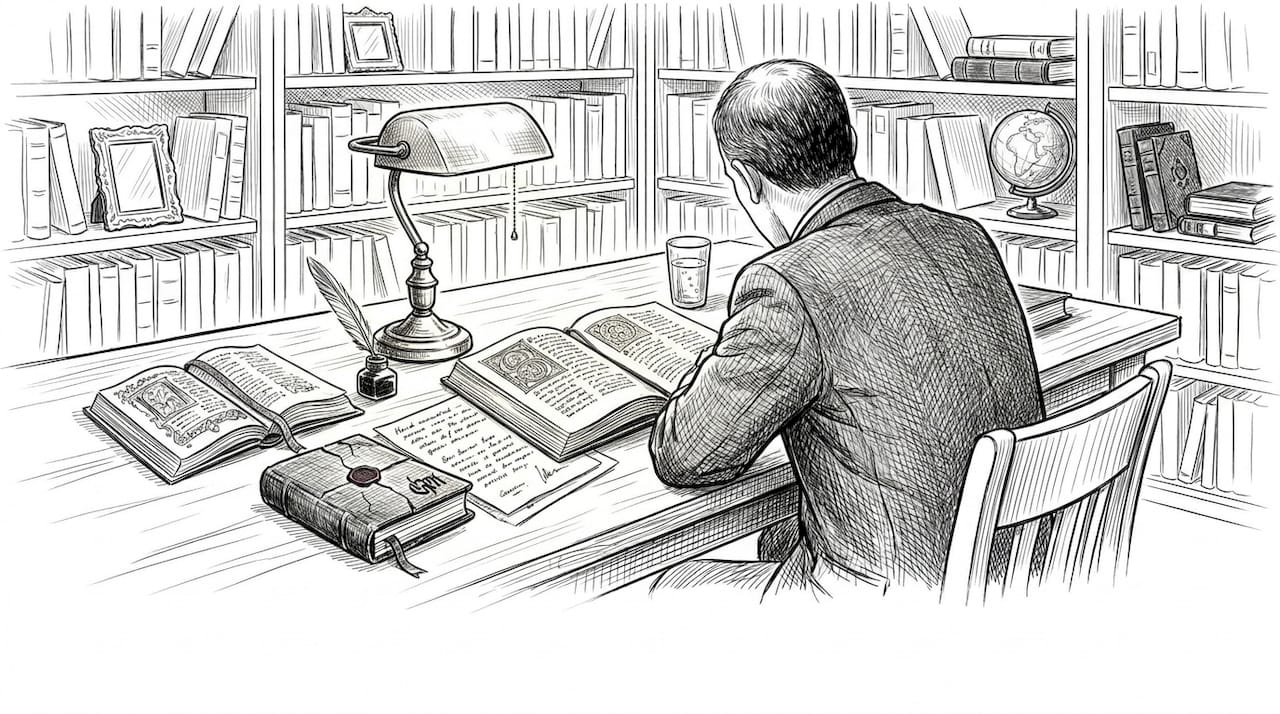
Folklore scenes in medieval illuminated manuscripts and alchemical illustrations fueled underground markets for macabre imagery, including the famous Dance of Death woodcuts that spread across Europe in the 14th and 15th centuries. These were not simply artistic experiments. They were cultural products responding to lived fears about plague, hell, and the supernatural, all drawn from folk tradition.
The Victorian era brought a dramatic shift in tone but not in source material. Victorian illustrators like Arthur Rackham and Aubrey Beardsley drew folklore fairies and myths with precise lines and washes to depict liminal worlds between rationality and magic. Their work appeared in mass-market books, making folklore-dark art accessible to general audiences for the first time while still preserving its uncanny edge.
The modern folk horror revival, which gained significant momentum in the 1960s and accelerated dramatically post-2010, brought landscape, ritual, and isolated community back to the center of dark visual culture. Films, graphic novels, and fine art all began leaning into the eerie and the rural again, rediscovering what medieval artists had known instinctively.
| Art period | Notable styles | Recurring folklore elements |
|---|---|---|
| Medieval (1200–1500) | Illuminated manuscripts, woodcuts | Danse Macabre, demons, folk saints |
| Renaissance (1500–1700) | Alchemical illustration, Vanitas painting | Death symbols, occult geometry, memento mori |
| Victorian (1837–1901) | Book illustration, Gothic fiction art | Fairies, witches, liminal nature scenes |
| Symbolist (1880–1910) | Dreamlike oil painting | Mythology, the femme fatale, folklore creatures |
| Folk horror revival (1960–present) | Film art, graphic novel, digital illustration | Rural ritual, pagan symbols, landscape dread |
- Medieval period: Artists used folklore to process collective fears about death, divine punishment, and the supernatural world beyond the village edge.
- Victorian crossover: Illustrators merged scientific rationalism with folk superstition, producing work that felt both modern and ancient simultaneously.
- Symbolist movement: Painters like Gustave Moreau and Franz von Stuck drew on classical and folk myth to create charged, psychologically complex imagery.
- Folk horror revival: Contemporary creators revisit pagan and rural folklore to comment on modernity, belonging, and the return of the repressed.
Pro Tip: If you are researching dark art history for your own practice, the gothic merchandise guide offers context on how historical motifs translate into wearable and collectible aesthetics today.
Folklore mechanics: Building atmosphere and meaning in dark art
With history covered, let’s examine how folklore’s structures and devices enable artists to create powerful meanings in dark art.
Folklore does not just supply images. It supplies structures. One of the most useful analytical tools for dark art creators is the Folk Horror Chain, a concept from academic horror studies. The Folk Horror Chain consists of three linked elements: isolating landscape, skewed beliefs, and ritual. When all three appear together, they create a specific sense of dread that is distinct from simple horror. Applied to visual art, this chain becomes a compositional strategy.
An artist working within this framework might choose a composition where:
- Landscape feels oppressive, overgrown, or unnaturally still rather than simply dark.
- Belief systems are suggested through symbols, ritual arrangements, or figures in ceremonial postures.
- Ritual action anchors the image in a specific folk tradition, even if that tradition is invented or hybridized.
Hauntology is another powerful mechanism. Coined by philosopher Jacques Derrida and adapted by cultural theorists for dark aesthetics, hauntology describes the feeling of being haunted by a past that never fully arrived. In visual terms, it appears as decayed beauty, anachronistic imagery, or the sense that something essential has been lost. Dark art that uses hauntology effectively creates emotional resonance that goes far beyond shock value.
| Motif | Folklore origin | Dark art application |
|---|---|---|
| Severed or crowned head | Celtic mythology, folk sacrifice lore | Power, martyrdom, transformation |
| White flowers (lily, hawthorn) | Death and bride folklore, fae association | Purity corrupted, grief, liminality |
| The crossroads | Global folk tradition, deal-making spirits | Choice, danger, supernatural encounter |
| The mirror | European folk magic, soul symbolism | Self-deception, portal, trapped identity |
| The crow or raven | Nordic, Celtic, and Indigenous traditions | Prophecy, death, intelligence |
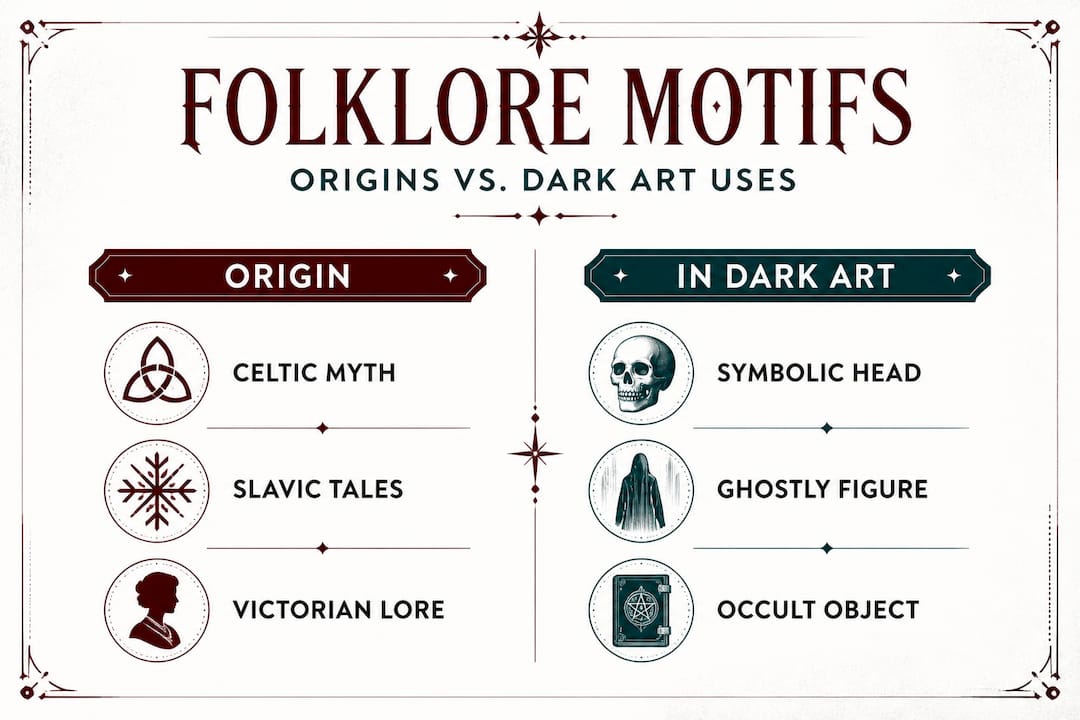
The concept of gothic accessory history illustrates perfectly how these motifs move from folk tradition through fine art and into wearable expression. A raven pendant is not just edgy jewelry. It carries Odin’s messengers, Edgar Allan Poe’s obsession, and centuries of folk associations with death and knowing. Understanding this layering is how gothic identity expression becomes genuinely meaningful rather than purely decorative.
Pro Tip: When designing a new piece, ask yourself which element of the Folk Horror Chain it most engages. Landscape, belief, or ritual? Identifying that early helps you build a more coherent symbolic world around it. The advantages of gothic accessories in self-expression become most visible when the symbolism is intentional and layered.
Practical inspiration: Using folklore for your own dark art
Now that we’ve seen how folklore operates within dark art, here’s how you can actively draw from these traditions in your own works or creative process.
Inspiration from folklore is available to every creator, but taking it responsibly makes the difference between work that resonates and work that falls flat or, worse, causes harm. Research primary folklore sources, collaborate with cultural experts, credit inspirations ethically, and blend with personal narratives for unique expressions that subvert expectations rather than simply reproduce them.
Here is a practical step-by-step approach:
- Research deeply, not broadly. Do not skim Wikipedia for a list of folklore creatures. Find primary sources, regional folk tale collections, and academic texts. The specificity of your research will show in the specificity of your work.
- Identify your personal connection. What aspect of this folklore genuinely moves or unsettles you? Work from that emotional truth rather than from what you think looks cool. The Pre-Raphaelites succeeded because they were genuinely obsessed with their source material, not just referencing it.
- Design with symbolic intent. Before finalizing any motif, know what it meant in its original context. Then decide whether you want to honor that meaning, subvert it, or transform it. All three are valid creative choices, but unconscious replication is not.
- Merge with your own symbols. The most original dark art blends folklore’s inherited vocabulary with personal imagery. Your own fears, memories, and obsessions are legitimate material. Folklore gives you the grammar; your life experience gives you the content.
- Credit your sources. In artist statements, product descriptions, and social media posts, name the traditions you have drawn from. This is not just ethical. It also deepens the audience’s connection to your work and demonstrates genuine engagement with the material.
- Avoid common pitfalls. Romanticizing a tradition without understanding its context, flattening complex cultural practices into aesthetics, and lifting sacred symbols without acknowledgment are all ways that folklore use becomes folklore misuse.
Pro Tip: Reach out to cultural organizations, university folklore departments, or community groups connected to the tradition you are exploring. A brief conversation with someone who grew up with a folk tradition will give you more usable insight than hours of online research alone. For creators exploring how these approaches connect to contemporary styling, standout gothic accessories 2026 shows how folklore-informed design is shaping the cutting edge of dark aesthetics right now.
Beyond cliché: Why folklore-infused dark art still matters
There is a persistent critique of folklore in dark art that we should address directly: the accusation that it is all nostalgia, escapism, or naive romanticism. That critique misses the point so completely it almost proves the opposite argument.
Folklore as a symbiotic horror source sits in direct tension with fine art’s historical dismissal of folk material as “naive,” while pagan rituals occupy a space between fear and cultural preservation simultaneously. That tension is exactly where the most interesting dark art lives. When creators engage folklore critically, they are not reaching backward into a simpler time. They are pulling forward the unresolved cultural anxieties, suppressed spiritual knowledge, and collective fears that mainstream culture decided to bury.
Think about what it means when a contemporary dark artist depicts a folk ritual not as primitive superstition but as a legitimate form of community knowledge. That is a political act as much as an aesthetic one. It challenges the hierarchy of what counts as valid cultural expression. It asks whose knowledge systems get coded as “art” and whose get coded as “craft” or worse, as “naivety.”
The best folklore-infused dark art does not simply reproduce the past. It uses the past as a lens for examining the present. A piece featuring a traditional mourning ritual might be commenting on how contemporary culture has stripped death of communal meaning. A painting of a fae creature performing a folk bargain might be examining the transactional nature of modern relationships.
The aesthetic trends in goth markets consistently show that consumers and collectors are drawn to work that carries genuine symbolic weight, not just surface darkness. That is the market confirming what creators already know: depth sells, and folklore delivers depth that no amount of pure aesthetic cleverness can replicate.
Folklore also gives creators a way to sanctify the taboo, which is one of dark art’s most powerful functions. By placing difficult subjects within a folk narrative structure, artists can approach grief, trauma, sexuality, and death in ways that feel archetypal rather than gratuitous. The tradition legitimizes the content, and the content refreshes the tradition.
Find your folklore-inspired dark aesthetic
Inspired to infuse your own style or collection with folklore vibes? Explore curated finds for the modern dark art enthusiast.
At Goth.Market, we curate pieces that carry real symbolic weight, not just dark aesthetics for their own sake. Whether you’re drawn to ritual-inspired jewelry, folk-horror motif accessories, or wearable art that channels centuries of dark tradition, the collections here are built for people who understand the difference between looking gothic and meaning gothic.
Browse our occult jewelry for pieces that reference genuine folk symbolism, or explore horror merchandise that channels the Folk Horror Chain into wearable form. If your aesthetic leans ethereal and strange, the whimsygoth collection blends fairy folk tradition with dark sensibility in ways that feel entirely current. Every vendor on Goth.Market is an independent creator, which means your purchase directly supports the kind of authentic, symbolically intentional work this article is all about.
Frequently asked questions
What is folk horror, and how does it relate to dark art?
Folk horror draws on folklore’s themes like ritual, isolation, and the uncanny, forming the core of many dark art narratives. The Folk Horror Chain of landscape, skewed beliefs, and ritual gives visual artists a ready-made compositional and emotional structure.
How can I use folklore ethically in my dark art?
Research primary sources, collaborate with cultural experts, and credit your inspirations openly. Blending borrowed symbols with your own personal narrative is what transforms reference into genuine creative expression.
Why are symbols like skulls or fairies common in dark art?
These motifs have deep roots in folklore, and supernatural entities in folklore connect works to universal themes like mortality, transformation, and the supernatural. Their repeated appearance is not coincidence but cultural continuity.
Has folklore always influenced dark art, or is this a modern trend?
Folklore has shaped dark art since at least the medieval era, when macabre imagery in illuminated manuscripts circulated through underground markets across Europe. The specific styles change, but the underlying folk source material remains a constant creative foundation.
What’s the difference between using folklore and copying it?
Using folklore means interpreting it through your own perspective, transforming its symbols into something that carries both inherited meaning and new context. Copying is direct replication without transformation or credit. Aim for respectful, intentional reinvention rather than surface-level reproduction.
Recommended
- Dark subculture art: origins, themes, and collector appeal – GothMarket
- Explaining dark aesthetic art: Origins, styles, symbolism – GothMarket
- Role of Art in Gothic Style – Inspiring Modern Dark Aesthetics – GothMarket
- Horror aesthetics explained: Art, fashion, and dark appeal – GothMarket
- Skab unik kunst: Derfor er gammelt og nyt en stærk kombination