

Explaining dark aesthetic art: Origins, styles, symbolism
TL;DR:
- Dark aesthetic art emphasizes mood, symbolism, and emotional depth over graphic horror.
- Its roots trace back to Dark Romanticism, Gothic symbolism, and medieval spiritual themes.
- Contemporary scenes include galleries, online communities, and NFT markets, fostering ongoing cultural relevance.
Many classic Gothic works were once dismissed as “barbaric” by critics who saw only darkness without depth. Today, those same works inspire thriving alternative communities, coveted art collections, and a global subculture built on shadow and meaning. Dark aesthetic art encompasses visual styles exploring shadowed, macabre, and introspective themes through haunting imagery, high-contrast lighting, and moods of decay and mortality. But it is far more than gloom for gloom’s sake. This guide walks you through the origins, techniques, major styles, and cultural power behind dark aesthetic art so you can engage with it as the sophisticated visual language it truly is.
Table of Contents
- Defining dark aesthetic art: Key themes and influences
- Core techniques and hallmark imagery
- Origins and evolution: From medieval manuscripts to modern digital dark art
- Styles within the dark aesthetic: A comparative overview
- Dark aesthetic art in practice: Community, controversy, and collecting
- A nuanced view: What most miss about dark aesthetic art
- Bring the dark aesthetic to your own space
- Frequently asked questions
Key Takeaways
| Point | Details |
|---|---|
| Beyond shock value | Dark aesthetic art is driven by mood, symbolism, and philosophical depth rather than simply seeking to disturb. |
| Rooted in history | Its lineage spans medieval to modern times, evolving through centuries of artistic and cultural change. |
| Diverse stylistic strands | Gothic, macabre, occult, noir, and surrealist approaches offer distinctive visual cues and meanings. |
| Subcultural resonance | It acts as a ‘coded language’ among gothic enthusiasts, collectors, and alternative communities. |
| Modern collecting tips | Collectors benefit from understanding symbolism, authenticity, and the evolving digital art marketplace. |
Defining dark aesthetic art: Key themes and influences
Dark aesthetic art is not horror art wearing a more stylish coat. The distinction matters. Where horror art reaches for visceral shock, dark aesthetic art operates through shadowed, introspective themes that draw you inward rather than jolt you out of your seat. It prioritizes mood, symbolism, and emotional texture over graphic imagery.
At its core, this art form explores a cluster of interrelated moods and themes:
- Melancholia: A heavy, reflective sadness that invites contemplation rather than despair
- Decay: The beauty found in things fading, rotting, or transforming
- Mortality: An honest reckoning with death as part of the human experience
- The uncanny: That unsettling feeling when something familiar becomes strange
- The sublime: Awe mixed with a trace of dread, common in Gothic landscapes
These themes are not accidental. They trace back to Dark Romanticism, a 19th-century literary and visual movement that pushed back against the optimism of mainstream Romanticism. Think Edgar Allan Poe, Francisco Goya, and Caspar David Friedrich. Each used shadow and symbol to say what polite society would rather avoid.
The Gothic tradition runs even deeper, pulling from medieval architecture, folklore, and a fascination with the spiritual unknown. Symbolism as a movement added another layer, using images such as serpents, hourglasses, and withered roses to encode philosophical ideas about time, sin, and beauty.
“Dark aesthetic art functions as a ‘coded language’ of shadows mirroring the collective unconscious, fostering subcultural bonds through taboo exploration and catharsis.”
For collectors and enthusiasts, this coded quality is the whole point. Understanding gothic art symbolism transforms a dark painting from a decorative object into a conversation, a confession, or even a quiet act of resistance.
Core techniques and hallmark imagery
Knowing the themes is one thing. Recognizing the craft behind them is what separates a casual observer from a genuine connoisseur. Dark aesthetic artists rely on a specific toolkit that creates their unmistakable signature.
Lighting is everything. Chiaroscuro, the Italian technique of sharp contrast between light and dark, gives dark aesthetic works their dramatic weight. Shadows are not background elements; they are active participants. Artists use high-contrast lighting to isolate figures, suggest hidden truths, or create a sense that something exists just beyond your line of sight.
Color palette reinforces mood. Common schemes include:
- Monochrome black and white with selective gray tones
- Deep blacks paired with blood reds or bruised purples
- Desaturated, washed-out palettes that suggest age and decay
- Occasional gold or silver accents to evoke the sacred within the sinister
Symbolic props and motifs carry meaning. High-contrast lighting, desaturated palettes, and symbolic props are the central techniques that make this genre instantly readable to its audience. Skulls represent mortality and the memento mori tradition. Ravens signal omen and intelligence. Wilted flowers speak to beauty in decline. Hourglasses count down time. Mirrors reflect alternate realities or the soul.
Textural detail adds physical weight. Cracked surfaces, moss-covered stone, aged parchment, and tarnished metal all communicate passage of time and the presence of decay. Even digital dark art mimics these textures to create the sensation of something ancient.
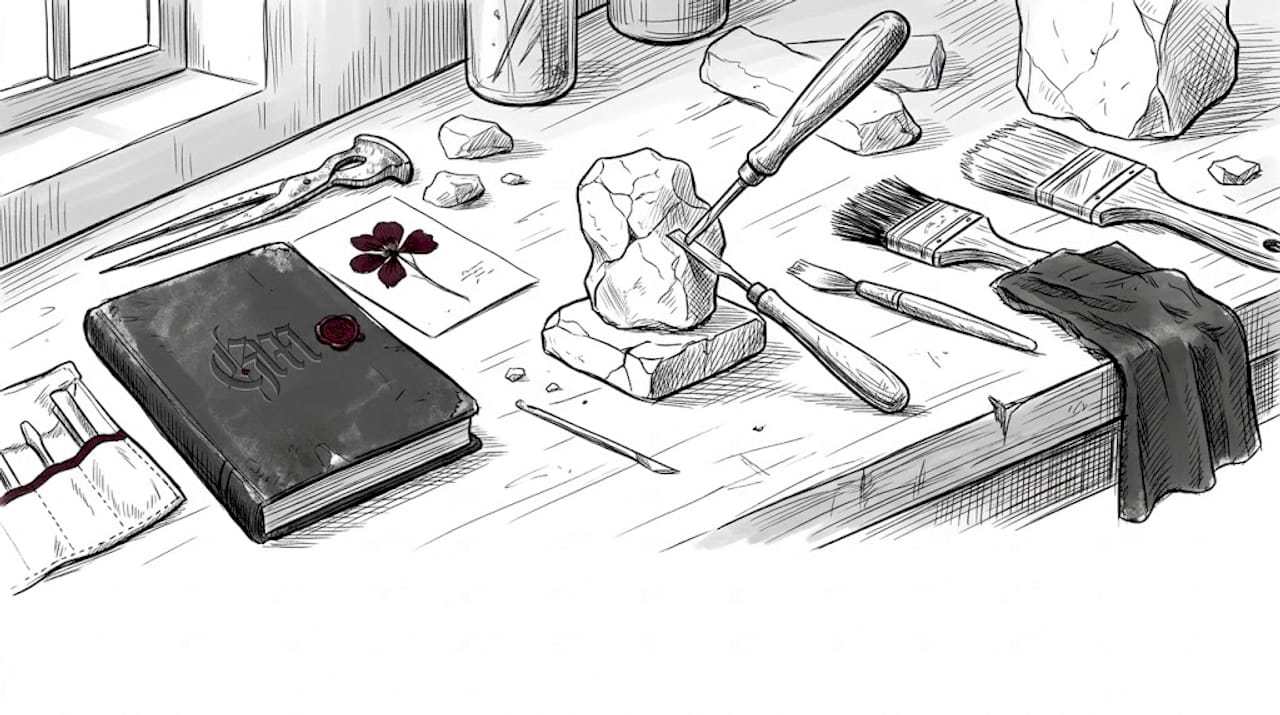
Pro Tip: When evaluating whether a dark aesthetic piece is authentic or simply trend-chasing, look at how the artist uses negative space and shadow play. Genuine dark aesthetic work uses darkness as a compositional tool, not just a color choice. If the shadows feel intentional and load-bearing to the image, you are likely looking at something with real craft behind it.
Studying the modern gothic art impact helps you see how these techniques evolved from oil and canvas into photography, illustration, and digital formats without losing their emotional core. A well-curated gothic wall art guide can also show you how these techniques translate into livable, displayable pieces.
Origins and evolution: From medieval manuscripts to modern digital dark art
Dark aesthetic art did not emerge from nowhere. Its roots stretch back centuries, and understanding that timeline makes modern works richer and more meaningful.
Historical roots trace to 14th-century illuminated manuscripts filled with alchemical symbols and folklore motifs. From there, the tradition passed through several defining eras:
- Medieval period (1300s to 1400s): The Dance of Death, or Danse Macabre, depicted skeletons leading people of all social classes toward death, a radical equalizer in a stratified society
- Gothic Revival (1800s): Architecture, literature, and visual art embraced pointed arches, shadowed interiors, and supernatural themes as a reaction to industrialization
- Symbolism and Decadence (1880s to 1900s): Artists like Odilon Redon and Gustave Moreau used mythological and occult imagery to explore the unconscious
- Surrealism (1920s to 1940s): Salvador Dali and Max Ernst brought dream logic and psychological disorientation into mainstream consciousness
- 20th-century Existentialism and Gothic Subculture (1970s onward): Dark aesthetic art merged with punk, post-punk, and goth music subcultures, becoming a full lifestyle aesthetic
- Digital and NFT Era (2010s to present): Artists now create dark aesthetic works in entirely digital spaces, reaching global audiences and new collector markets
| Era | Key motifs | Notable figures |
|---|---|---|
| Medieval | Danse Macabre, memento mori | Anonymous illuminators |
| Gothic Revival | Ruins, supernatural beings | Caspar David Friedrich |
| Symbolism | Mythology, occult symbols | Odilon Redon |
| Surrealism | Dream imagery, distortion | Salvador Dali |
| Digital Dark Art | Glitch aesthetics, dark fantasy | Various independent artists |
The evolution of dark romanticism shows how themes of mortality and the uncanny persist across every technological shift. You can see this same persistence in gothic home decor styles today, where medieval motifs appear alongside contemporary design sensibilities.
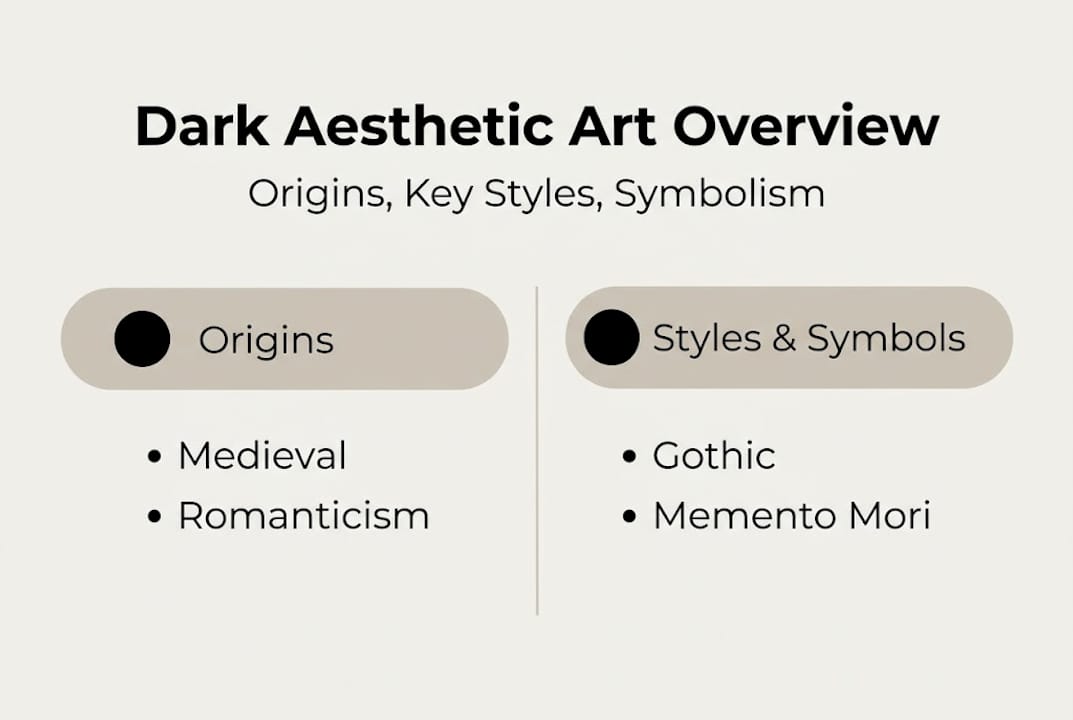
Styles within the dark aesthetic: A comparative overview
Dark aesthetic art is not a single unified style. It is a family of related approaches, each with its own visual language, emotional register, and historical roots.
Key styles include Gothic, Macabre Symbolism, Occult Portraiture, Noir Abstractions, and Surreal Dreamscapes. Here is how they compare:
| Style | Core motifs | Period or revival | Tone |
|---|---|---|---|
| Gothic | Gargoyles, ruins, shadows | Medieval, revived 1800s and 1980s | Awe, dread, reverence |
| Macabre Symbolism | Skulls, decay, death figures | 1400s, revived 1880s onward | Melancholy, acceptance |
| Occult Portraiture | Sigils, ritual objects, symbolic eyes | 1600s to present | Mystery, power, hidden knowledge |
| Noir Abstraction | Shadow play, urban geometry | 1930s to present | Isolation, moral ambiguity |
| Surreal Dreamscape | Distorted figures, impossible spaces | 1920s to present | Unease, wonder, psychological depth |
Each style serves a different emotional function. Gothic art evokes the sublime and the sacred-sinister. Macabre Symbolism confronts mortality without flinching. Occult Portraiture treats knowledge as something dangerous and beautiful. Noir Abstraction finds loneliness and complexity in geometric shadow. Surreal Dreamscape destabilizes your sense of what is real.
“The word ‘dark’ in dark aesthetic art has shifted from a pejorative to a celebrated descriptor, marking a cultural reclamation by communities who find beauty, identity, and meaning in shadow.”
For collectors, understanding these distinctions matters enormously. The cultural significance of gothic collectibles shifts depending on which style a piece belongs to. An art curation guide can help you build a collection with internal coherence and genuine meaning, rather than just assembling pieces that look similar on the surface. Major institutions are also catching up: a recent Gothic in modern art exhibition examined how these styles are now taken seriously in fine art contexts.
Dark aesthetic art in practice: Community, controversy, and collecting
Dark aesthetic art does not exist in a vacuum. It lives and breathes inside communities, controversies, and collecting cultures that give it ongoing vitality.
Historically, driven underground by censorship from the 16th through 19th centuries, dark aesthetic artists used coded symbols to communicate dissent and forbidden spiritual ideas. That underground character is still present today, even as the art form gains mainstream recognition.
The contemporary dark aesthetic scene spans several distinct spaces:
- Gallery exhibitions: Dark aesthetic art now appears in respected fine art galleries, especially works by surrealist-influenced and Gothic Revival artists
- Online communities: Platforms like Instagram, DeviantArt, and Tumblr have built massive audiences for independent dark aesthetic creators
- NFT markets: Digital dark aesthetic art found an early and enthusiastic audience in NFT spaces, with some works fetching significant prices
- Independent creator marketplaces: Niche platforms connect collectors directly with artists working in Gothic and occult styles
Controversy follows the genre. Critics debate where psychological depth ends and gratuitous content begins. Cultural appropriation concerns arise when symbols from specific spiritual or indigenous traditions appear without proper context. These ethical concerns over taboo subjects are genuine and worth taking seriously as a collector.
Pro Tip: When starting a gothic art collection, prioritize works where you can trace the artist’s intent. Look for creators who articulate their symbolism and cultural references. A piece with a clearly communicated framework carries more long-term value, both aesthetically and ethically, than one that uses dark imagery purely for visual shock.
The thriving market via galleries, NFTs, and online communities signals that dark aesthetic art is not a passing trend. Its cultural resonance is durable because it addresses experiences that are permanently human: loss, mystery, identity, and the search for meaning in a world that does not always offer easy answers.
A nuanced view: What most miss about dark aesthetic art
Here is the perspective you will rarely see in a mainstream art guide. Dark aesthetic art gets dismissed in two opposite ways. Critics call it nihilistic. Newcomers treat it as pure edginess, a visual pose with no deeper content. Both readings miss the point entirely.
The real function of dark aesthetic art is constructive. It creates a framework for processing emotions that mainstream culture prefers to suppress: grief, rage, existential fear, and the strange comfort of mortality. It says, out loud, that these experiences are real and worthy of beauty.
Dark aesthetic art also functions as a coded language fostering subcultural bonds through catharsis. When you collect or create within this tradition, you are not just acquiring objects. You are participating in a centuries-long conversation about what it means to face the darker sides of existence without looking away.
The most authentic dark aesthetic works, whether they are oil paintings, digital illustrations, or handmade jewelry, carry a quality of hard-won honesty. They do not pretend that life is simple or that death is far away. That honesty is what connects deep gothic symbolism across generations and keeps this tradition alive and vital.
Bring the dark aesthetic to your own space
Understanding the history, techniques, and meaning behind dark aesthetic art changes how you live with it. You move from passive appreciation to active engagement with a visual tradition that has real depth and staying power.
At Goth.Market, we curate pieces that carry genuine dark aesthetic intent, not mass-market imitations. Whether you are drawn to gothic symbols, occult motifs, or macabre elegance, our collections offer meaningful ways to bring this art into your daily life. Explore our gothic jewelry collection for wearable dark aesthetic pieces, or consider specific standouts like the celestial chain choker and the dark aesthetic ring set. Each piece connects to the symbolic traditions you just read about, giving you a direct line into the art form itself.
Frequently asked questions
What distinguishes dark aesthetic art from horror art?
Dark aesthetic art relies on mood, symbolism, and introspection rather than visceral shock, making it an emotionally layered experience rather than a reactive one. Horror art prioritizes immediate fear; dark aesthetic art invites sustained reflection.
How did dark aesthetic art become popular among alternative subcultures?
It offers a coded language of rebellion and emotional depth that creates strong bonds among people who feel outside mainstream culture. Its symbolism allows communities to communicate shared values without explicit declaration.
Are there ethical boundaries in dark aesthetic art?
Yes. While the genre explores taboo and psychological themes, serious collectors and artists debate limits around taboo subjects and representation, particularly regarding cultural borrowing and gratuitous imagery. Intent and context matter significantly.
What are the most collectible genres within dark aesthetic art?
Gothic, macabre, and occult-inspired styles are the most sought after, especially works with strong symbolic coherence and emotional resonance. Pieces that communicate a clear artistic framework tend to hold the most long-term collector value.