

What is Gothic Revival? Origins, features, and impact
TL;DR:
- Gothic Revival emerged as a reaction to industrialization, emphasizing light, craftsmanship, and moral symbolism.
- Key features include pointed arches, ribbed vaults, flying buttresses, and decorative polychrome brickwork.
- Its influence persists today in architecture, interior design, fashion, and media with deeper historical and philosophical roots.
Gothic Revival is one of the most misunderstood movements in architectural history. Most people picture gloomy castles and horror movie sets, but the real story is far richer. Born from a genuine love of medieval craftsmanship and a reaction against the cold logic of industrialization, Gothic Revival was actually celebrated for its soaring light-filled interiors, moral symbolism, and technical ambition. This article traces the movement from its 18th-century roots through its boldest Victorian expressions, examines its defining features, and shows how its influence still shapes architecture, design, and personal style today.
Table of Contents
- Understanding Gothic Revival: Historical context and origins
- Core features: Styles, materials, and construction techniques
- Key phases and variations: Romantic, High Victorian, and beyond
- Legacy and modern influence: Gothic Revival in today’s culture
- Why Gothic Revival’s complexity is often misunderstood
- Explore Gothic Revival style in your life
- Frequently asked questions
Key Takeaways
| Point | Details |
|---|---|
| Origins | Gothic Revival began as a romantic reinterpretation of medieval architecture in the late 1700s. |
| Defining features | Signature elements include pointed arches, ribbed vaults, and ornate details often reimagined with modern materials. |
| Phases and styles | The movement evolved from picturesque romanticism to precise, scholarly adaptation and international variations. |
| Modern impact | Gothic Revival continues to influence architecture, decor, and personal style in the 21st century. |
Understanding Gothic Revival: Historical context and origins
Gothic Revival did not emerge from a desire to make buildings look scary. It grew out of a deep cultural longing for meaning in an age of rapid industrial change. By the late 18th century, factories were reshaping cities, and many intellectuals felt that something human and spiritual was being lost. Medieval architecture, with its handcrafted detail and religious symbolism, offered a powerful counter-image.
The Romantic movement in literature and art fed this fascination. Writers like Horace Walpole and later John Ruskin framed the Middle Ages as a golden era of authentic craftsmanship. Walpole’s own home, Strawberry Hill, built from the 1750s onward, became one of the earliest and most influential examples of the style. He prioritized atmosphere and feeling over structural accuracy, creating a playful, picturesque version of Gothic that inspired generations.
As the movement matured, national differences became pronounced. In England, Gothic Revival carried strong moral and religious overtones, championed by architects like Augustus Pugin who believed Gothic was the only truly Christian style. In France, the movement tied to national identity and the restoration of medieval monuments. In Germany, it emphasized artisanal training and craft guilds. Each country used the same visual language to say something different.
Gothic Revival in Europe shows how these national threads wove together into a genuinely international phenomenon. The movement was never monolithic. It was a conversation across borders about what architecture should mean.
Key triggers that launched the movement include:
- Disillusionment with industrialization and mass production
- Romantic literature romanticizing the medieval past
- Religious reform movements seeking moral architecture
- Archaeological discoveries revealing the sophistication of medieval building
- National pride and the search for cultural identity
As the RIBA notes, key methodologies involved scholarly study of medieval buildings, archaeological accuracy, and adaptation of original structural techniques. This was not mere nostalgia. It was serious historical research applied to living buildings.
“Gothic Revival was, at its core, an argument about what civilization should look like.”
For those drawn to gothic home decor, understanding these roots adds real depth to every pointed arch and tracery window you bring into your space.
Core features: Styles, materials, and construction techniques
With historical context set, we can now examine what truly makes Gothic Revival visually and technically distinctive.
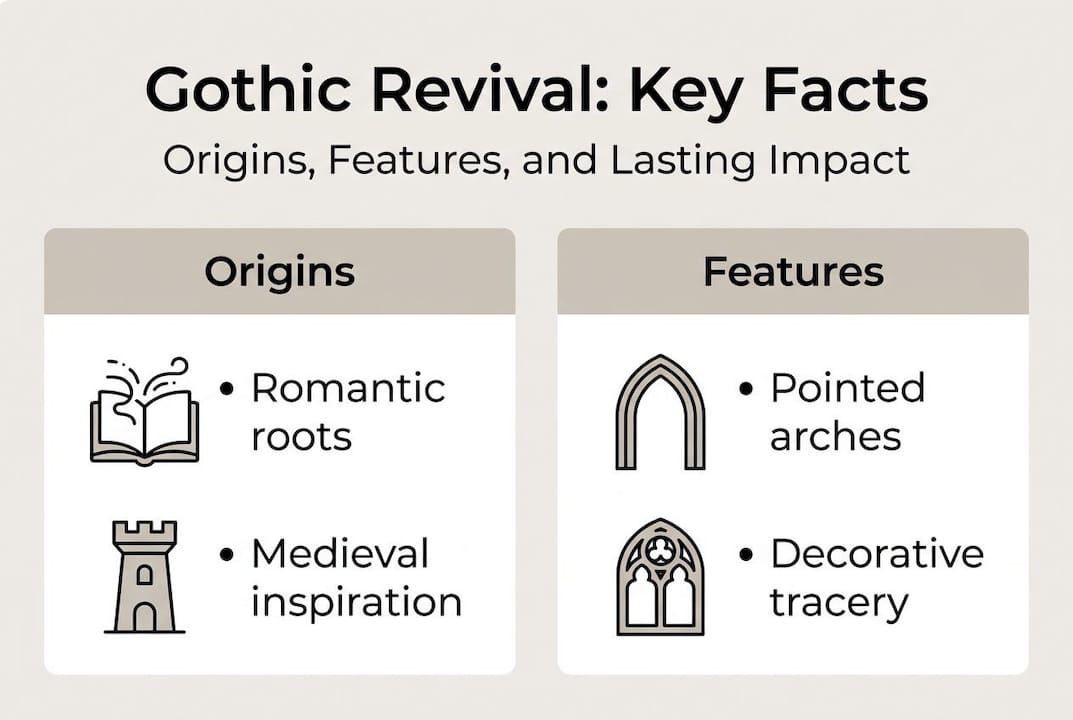
The most recognizable features are structural. Pointed arches replace the rounded Roman arch, directing weight downward more efficiently and allowing walls to be taller and thinner. Ribbed vaults distribute the load of a ceiling across a web of stone ribs, freeing up space between them for large windows. Flying buttresses, those dramatic external stone arms, transfer the outward thrust of a high roof away from the wall so it can be pierced with glass. Together, these three elements create the signature Gothic effect: height, light, and apparent weightlessness.
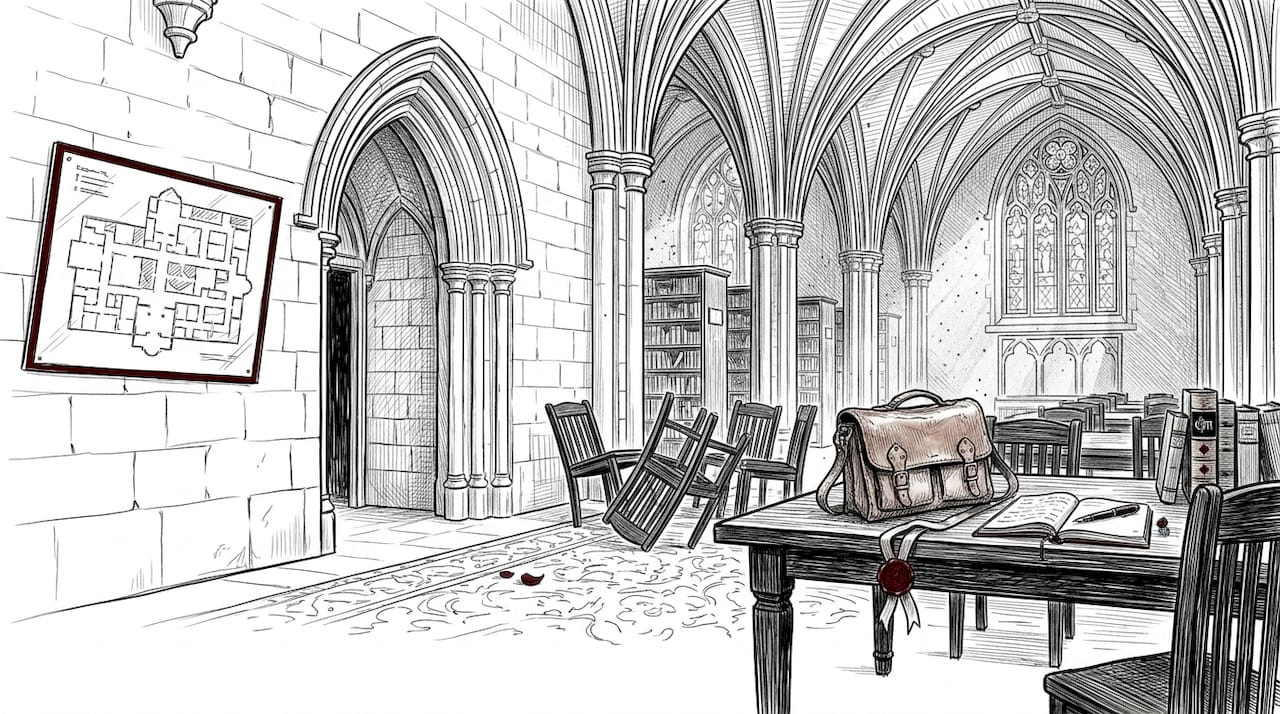
What made Gothic Revival distinct from the original medieval style was its use of modern materials. Pointed arches, ribbed vaults, and flying buttresses were structurally adapted using modern materials including iron and steel frames, machine-cut stone, and prefabricated elements. This allowed architects to achieve Gothic effects at speeds and scales impossible in the Middle Ages.
Decorative elements were equally important. Polychrome brickwork, using different colored bricks to create patterns, became a hallmark of High Victorian Gothic. Tracery, the ornamental stonework in windows, ranged from simple geometric patterns to elaborate flowing designs. Ornate moldings, carved foliage, and gargoyles completed the visual vocabulary.
Pro Tip: When you spot a building with a pointed arch, look up. If there are also ribbed vaults inside and external stone supports pushing away from the walls, you are almost certainly looking at Gothic Revival influence, not just a decorative nod.
Here is a quick comparison of romantic versus scholarly Gothic Revival approaches:
| Feature | Romantic/Picturesque | Scholarly/High Victorian |
|---|---|---|
| Primary goal | Atmosphere and feeling | Historical accuracy |
| Materials | Traditional stone, brick | Iron, steel, polychrome brick |
| Detail level | Loose, imaginative | Rigorous, researched |
| Key figures | Horace Walpole | Augustus Pugin, George Gilbert Scott |
| Typical use | Domestic, garden buildings | Churches, public buildings |
For a deeper look at Gothic Revival architecture features, the range of surviving examples across Europe and North America is genuinely staggering. The movement touched everything from cathedrals to train stations.
If you love the visual language of the style, exploring gothic decorating motifs and the gothic accessories history shows just how directly these architectural details translated into personal and domestic aesthetics.
Key phases and variations: Romantic, High Victorian, and beyond
Beyond broad features, let’s break down the movement’s major phases and national flavors.
Gothic Revival did not stay the same across its roughly 150-year lifespan. It evolved through distinct phases, each with its own priorities and debates.
- Romantic/Picturesque phase (c. 1750 to 1840): Architects and wealthy patrons used Gothic forms for their emotional and atmospheric qualities. Accuracy mattered less than mood. Strawberry Hill is the defining example.
- High Victorian Gothic (c. 1840 to 1870): Scholars and moralists took over. Pugin’s writings demanded archaeological rigor. Churches became laboratories for structural and decorative experiment. Bold color, honest materials, and visible construction became ideals.
- Return to refinement (c. 1870 onward): Architects like G. F. Bodley pulled back from the boldness of High Victorian work, favoring quieter English Perpendicular models and greater restraint.
The scholarly High Victorian Gothic phase drew sharp criticism even at the time. Detractors called it impractical, expensive, and overly academic. Supporters argued it was the only honest way to build.
National variations added further complexity. The national variations of Gothic Revival across Europe show that French architects like Viollet-le-Duc approached the style as a structural system to be rationalized, while American architects used it to signal civic ambition and religious seriousness.
Here is a summary of the three main phases:
| Phase | Period | Key characteristic | Example |
|---|---|---|---|
| Romantic/Picturesque | 1750 to 1840 | Mood over accuracy | Strawberry Hill |
| High Victorian Gothic | 1840 to 1870 | Scholarly rigor, bold color | All Saints, Margaret Street |
| Return to refinement | 1870 onward | Restraint, English models | All Saints, Cambridge |
Understanding these phases matters because it changes how you read a building. A church from 1860 and one from 1890 can look superficially similar but express completely different architectural philosophies. The symbolic meanings of Gothic Revival run far deeper than surface ornament.
Legacy and modern influence: Gothic Revival in today’s culture
Having outlined its historical bounds, let’s reveal Gothic Revival’s modern echoes and ongoing appeal.
Gothic Revival never really ended. It transformed. The movement’s visual language proved so flexible and emotionally resonant that it kept reappearing in new contexts long after the original scholarly debates faded. Today, its influence is visible in architecture, interior design, fashion, jewelry, and popular media.
Gothic Revival influenced modern design, from home decor trends to symbolic motifs in jewelry and media. Pointed arch mirrors, tracery-inspired metalwork, and lancet window silhouettes appear in everything from high-end interior design to independent jewelry makers.
The tension between handcraft and mass production that defined the original movement has not gone away either. The economic and cultural impacts of Gothic Revival show how debates about authentic craft versus industrial reproduction shaped not just architecture but entire consumer cultures, a debate that feels very current today.
Here is where you can spot authentic Gothic Revival influence versus stylized borrowing:
- Authentic influence: Structural use of pointed arches, visible ribbed vaulting, genuine tracery patterns in stone or metal
- Stylized borrowing: Pointed arch shapes used purely decoratively, Gothic fonts, bat and gargoyle motifs without structural context
- Personal style: Layering both authentically, understanding the history behind the aesthetic
Pro Tip: When building a Gothic-inspired space or wardrobe, start with one structural reference point, like an arched mirror or a piece of modern gothic accessories with genuine tracery detail, and build outward from there. Depth comes from knowing your references.
For those who want to bring real craft into their spaces, handmade gothic decor connects directly to the movement’s original insistence on skilled, intentional making over cheap reproduction.
Why Gothic Revival’s complexity is often misunderstood
Here is the uncomfortable truth: most people, including many architecture students, encounter Gothic Revival through its most dramatic and theatrical examples. Haunted houses, horror films, and Halloween aesthetics have colonized the public image of the style. This flattens something genuinely rich into a single emotional note.
The real movement was obsessed with light. Those enormous windows, the tracery, the thin walls made possible by flying buttresses, all of it existed to flood interiors with color and radiance. Modern media often misrepresents Gothic Revival as purely dark and ominous, overshadowing its real innovations and light-filled origins. That misrepresentation matters because it cuts people off from the movement’s actual emotional range.
Gothic Revival was also a deeply optimistic project in many ways. Its architects believed that beautiful, honest buildings could improve society, lift spirits, and reconnect people with meaning. That is not a dark philosophy. It is a hopeful one.
For those of us drawn to gothic aesthetics today, engaging with this complexity makes the style richer, not less appealing. Understanding Gothic home decor and identity through the lens of the original movement gives every design choice more weight and intention.
Explore Gothic Revival style in your life
If this article sparked your fascination, you can bring elements of Gothic Revival style into your life without needing to renovate a cathedral.

At Goth.Market, we curate pieces that carry genuine Gothic Revival DNA, from jewelry with tracery-inspired metalwork to decor that echoes the movement’s love of dramatic contrasts and handcrafted detail. Our Gothic jewelry collection features independent makers working directly with the visual language of the movement. If you want something a little more playful and layered, our Whimsygoth accessories blend Gothic Revival motifs with modern sensibility. Every piece connects back to a tradition of intentional, meaningful making.
Frequently asked questions
How is Gothic Revival different from original Gothic architecture?
Gothic Revival reinterpreted medieval Gothic designs using modern materials and new construction methods, often mixing accuracy with innovation. Unlike the original, it integrated industrial technology and sometimes mass production, creating ongoing debates between purists and pragmatists.
What are some iconic examples of Gothic Revival buildings?
Famous examples include the Houses of Parliament in London, St. Patrick’s Cathedral in New York, and Strawberry Hill in England. These represent two distinct phases: the early picturesque domestic style and the later scholarly public works.
Why did Gothic Revival decline in popularity?
Interest faded as architectural trends shifted toward functionalism and modernism in the late 19th to early 20th centuries. The style declined post-1870s with the rise of functional design but continued to influence modern Gothic aesthetics.
How does Gothic Revival influence modern decor and fashion?
Contemporary design and accessories often draw on Gothic Revival’s motifs, like pointed arches, ornate details, and dramatic contrasts. Gothic Revival influenced modern design across home decor, jewelry, and pop culture in ways that are still evolving today.
Recommended
- Why Choose Gothic Style: Self-Expression and Aesthetic Impact – GothMarket
- Role of Art in Gothic Style – Inspiring Modern Dark Aesthetics – GothMarket
- Why Gothic Fashion Endures: Evolution, Meaning & Appeal – GothMarket
- Gothic art symbolism: meanings, motifs & inspiration – GothMarket
- History of horror literature: From folklore to fiction