

What are dark aesthetics? Origins, styles, and meaning
TL;DR:
- Dark aesthetics originate from gothic literature, Victorian mourning, and punk rebellion, emphasizing symbolic meaning.
- They focus on confronting darkness, blending softness with decay, and societal alienation as a form of self-expression.
- The movement persists through online communities, fashion influence, and its role as a cultural valve during societal instability.
Most people assume dark aesthetics are just about wearing all black, slapping on some eyeliner, and calling it a goth phase. That assumption misses almost everything that matters. Dark aesthetics emerged from goth subcultures, Victorian mourning rituals, and gothic literature, carrying centuries of symbolic weight. This guide breaks down what dark aesthetics actually are, where they came from, how the style works, and why millions of people still find genuine meaning in them. Whether you're new to the scene or deepening your understanding, you'll walk away with a clear framework for what this movement really represents.
Table of Contents
- What are the origins of dark aesthetics?
- What are the core elements of a dark aesthetic?
- What are the different dark aesthetic substyles?
- Why do dark aesthetics still matter in modern culture?
- Are dark aesthetics just a trend?
- Explore dark aesthetic products and style your next look
- Frequently asked questions
Key Takeaways
| Point | Details |
|---|---|
| Cultural roots | Dark aesthetics started as a rebellious subculture rooted in history, literature, and music. |
| Style mechanics | Layered textures, monochrome palettes, and symbolic accessories define the visual language. |
| Substyle diversity | From goth to dark academia, there are many variations with unique symbols and philosophies. |
| Modern relevance | Dark aesthetics endure in mainstream and alternative circles, adapting with each new generation. |
What are the origins of dark aesthetics?
Dark aesthetics didn't appear out of nowhere. They grew from a collision of Victorian grief culture, 19th-century gothic literature, and the raw energy of punk rebellion. Writers like Edgar Allan Poe and Mary Shelley built entire worlds around dread, beauty, and the unknown. Victorian mourning attire, with its jet jewelry, black crepe fabrics, and elaborate funeral rituals, gave physical form to the idea that darkness deserves its own visual language.
By the late 1970s and early 1980s, these influences fused with post-punk music to create something new. Bands like Siouxsie and the Banshees and Bauhaus pulled gothic literature's mood into sound and stage performance. The visual style followed: dark clothing, dramatic makeup, and a deliberate rejection of mainstream cheerfulness. Dark aesthetics originated from these late 1970s and 1980s goth and punk movements, with roots stretching back through Victorian mourning and gothic literature.
Berlin became one of the movement's most important incubators. The term 'Schwarze Szene', meaning Black Scene, was coined in late 1980s Berlin to describe the growing community of people united by dark music, fashion, and philosophy. This wasn't just a style club. It was a countercultural response to consumerism, political tension, and social conformity.
"Dark aesthetics are not about celebrating death. They're about refusing to look away from it, and finding beauty in what most people fear."
The philosophy underneath all of this is what separates dark aesthetics from simple trend-chasing. Key values include:
- Confronting darkness rather than pretending it doesn't exist
- Symbolic contradiction, blending softness with aggression, beauty with decay
- Societal alienation as a creative force rather than a problem to fix
- Intentional self-expression, where every visual choice carries meaning
- Poetic aggression, using art and style as a form of quiet rebellion
Exploring the full arc of gothic fashion evolution shows just how consistently these values have guided the movement across decades.
What are the core elements of a dark aesthetic?
Understanding these roots makes it easier to appreciate what sets dark aesthetics apart from mainstream trends. The style isn't random. Every element serves a purpose, and learning to read those elements helps you build a look that actually means something.
Texture is everything in dark aesthetics. Velvet signals old-world luxury and melancholy. Leather brings edge and defiance. Lace adds fragility and romance. PVC creates a futuristic, almost confrontational surface. Layering these materials together creates the visual tension that defines the aesthetic. A velvet corset over a sheer lace blouse over a leather jacket is a statement about contradiction, not just an outfit.
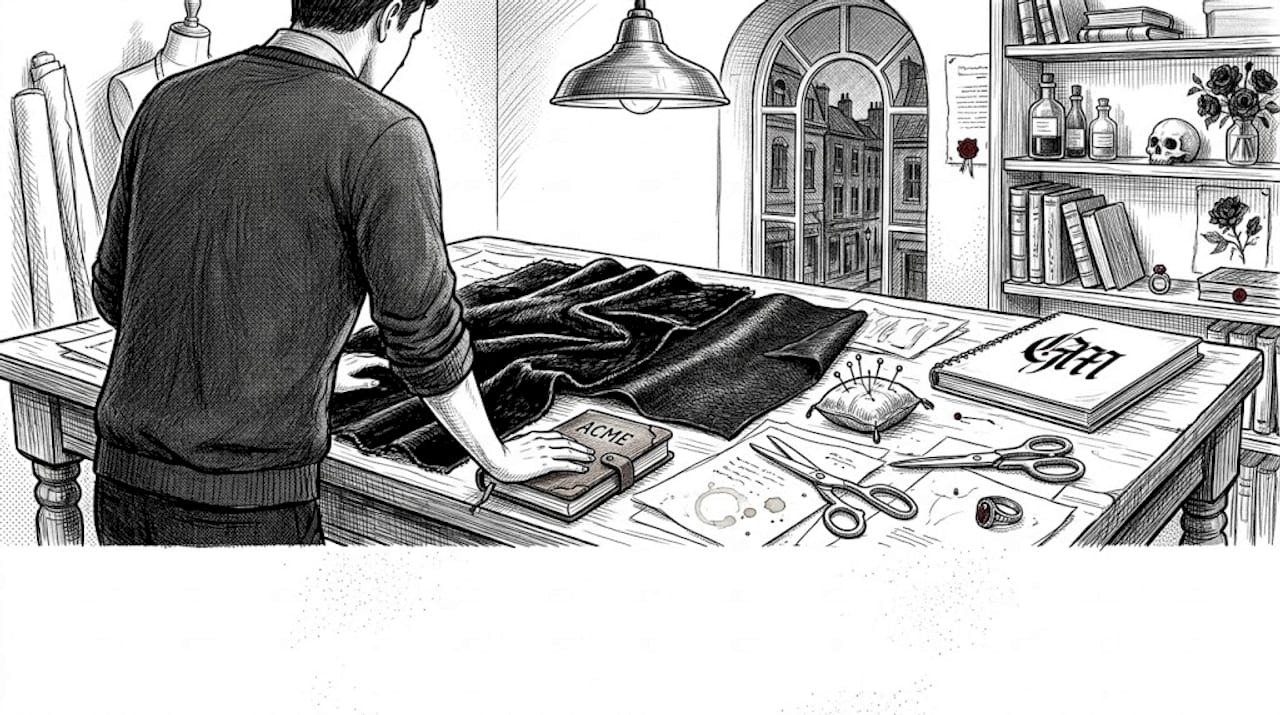
The core mechanics include layering textures, monochromatic palettes, symbolic accessories, dramatic makeup, and specific footwear. The color palette typically runs from deep black through charcoal, burgundy, forest green, and occasional stark white. Statement accents like blood red or electric purple add intensity without breaking the mood.
Signature accessories carry heavy symbolic weight. Skulls reference mortality and the acceptance of death. Crosses and pentagrams speak to spiritual questioning and occult interest. Silver jewelry, particularly chunky rings and layered chains, adds a raw, almost medieval quality. Boots, especially platform or combat styles, ground the look literally and symbolically.
Makeup follows the same logic. Pale foundation creates a deliberate contrast with dark eyeliner and deep lip colors. The goal isn't to look conventionally attractive. It's to look intentional.
| Element | Traditional dark aesthetic | Modern dark aesthetic |
|---|---|---|
| Fabric | Velvet, lace, wool | PVC, mesh, technical fabrics |
| Color | All black, deep jewel tones | Black with neon or metallic accents |
| Footwear | Victorian boots, creepers | Platform sneakers, chunky boots |
| Jewelry | Silver crosses, cameos | Geometric silver, resin pieces |
| Makeup | Classic pale and dark | Graphic liner, bold editorial looks |
Pro Tip: Thrift stores and vintage markets are your best resource for authentic dark aesthetic pieces. A worn velvet blazer or a Victorian-era brooch adds genuine history that fast fashion can never replicate. Pair thrifted finds with symbolic goth accessories to build a look with real depth. For a structured starting point, a gothic wardrobe checklist can help you fill gaps without overbuying.
What are the different dark aesthetic substyles?
While the core mechanics unite the movement, the details shift dramatically depending on the substyle and scene. Dark aesthetics are not monolithic. The movement contains multitudes, and that diversity is part of its strength.
Traditional Goth, Romantic Goth, Cyber Goth, Industrial Goth, Bloodcore, and Dark Academia each offer distinct styles and philosophies. Here's how they compare:
| Substyle | Key influences | Signature look | Common symbols |
|---|---|---|---|
| Traditional Goth | Post-punk, Bauhaus | Black layers, dramatic makeup | Bats, crosses, ankhs |
| Romantic Goth | Victorian literature | Lace, corsets, rich fabrics | Roses, moons, coffins |
| Cyber Goth | Industrial music, sci-fi | Neon accents, gas masks, PVC | Circuit patterns, UV elements |
| Industrial Goth | German industrial music | Military, utilitarian, dark metal | Gears, chains, gas masks |
| Bloodcore | Horror aesthetics | Deep red, distressed fabrics | Blood motifs, thorns |
| Dark Academia | Classic literature, academia | Tweed, plaid, muted tones | Books, quills, hourglasses |
Dark academia deserves special mention because it surprises people. It pulls from the visual world of old universities, autumn libraries, and classical literature rather than from music subcultures. The result is a dark aesthetic that feels more melancholy and intellectual than rebellious. It proves that not all dark aesthetics are overtly occult or aggressive.
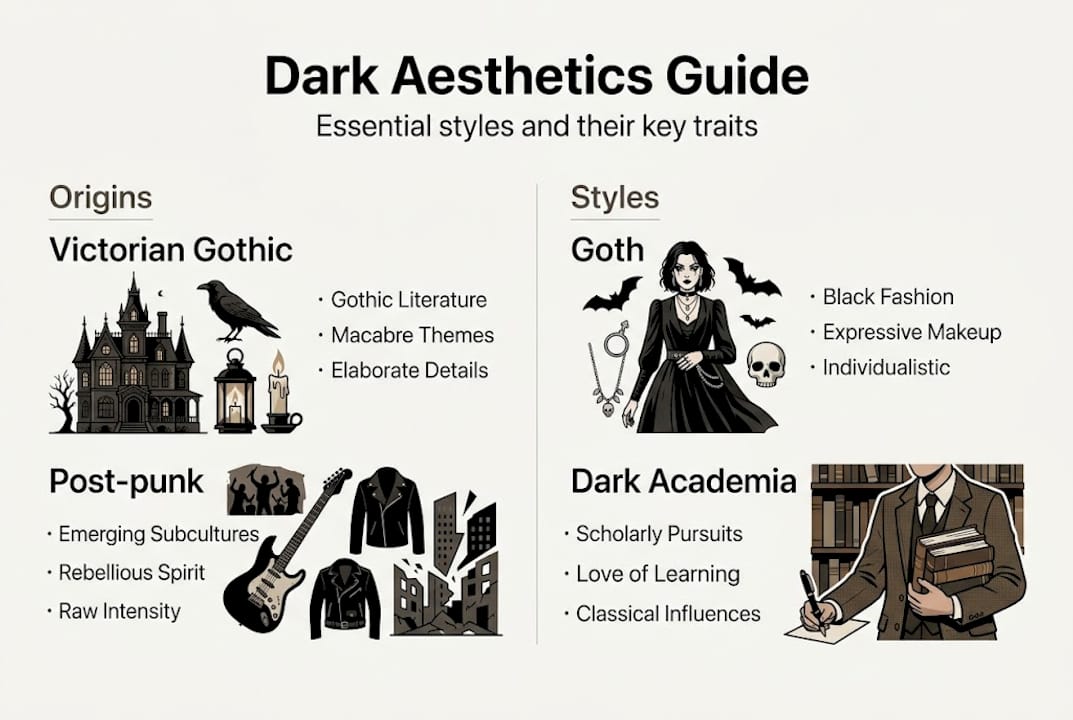
TikTok and Instagram have played a massive role in spreading substyle awareness beyond traditional goth communities. Younger audiences discover Bloodcore or Dark Academia through short video content, often without any connection to the original music scenes. This has created a shift from music-driven identity to visually-driven identity. Some longtime community members see this as a loss of depth. Others see it as growth.
Key things to understand about substyle diversity:
- Each substyle has its own community norms and reference points
- Crossover between substyles is common and encouraged
- Visual platforms have accelerated the creation of new micro-substyles
- Not every dark aesthetic practitioner identifies with goth music or culture
For a deeper look at how these categories break down, types of gothic fashion offers a practical overview. Understanding goth clothing features helps you identify which substyle resonates most with your own sensibility.
Why do dark aesthetics still matter in modern culture?
With these substyles defined, you might wonder how dark aesthetics persist and why they're more popular now than ever. The answer is rooted in something deeper than fashion cycles.
Dark aesthetics function as a cultural pressure valve. When society feels unstable, alienating, or dishonest, people gravitate toward aesthetics that acknowledge those feelings rather than paper over them. Goth visibility rises during economic downturns and remains strong through festivals, online communities, and even mainstream designers. Rick Owens, Alexander McQueen, and Ann Demeulemeester have all drawn heavily from dark aesthetic principles on major runways, bringing the movement's visual logic into luxury fashion.
"The mainstream borrows the look. The subculture keeps the meaning."
Digital platforms have made it easier than ever to participate. Online communities share styling tips, debate substyle boundaries, and connect people across geography. Events like Wave-Gotik-Treffen in Leipzig draw tens of thousands of attendees annually, proving the culture is alive and organized.
Media stereotypes still persist, linking dark aesthetics to violence or Satanism. Those links are largely false and have been consistently rejected by the community itself. The aesthetic is about confronting darkness symbolically, not endorsing harm.
Here are three practical steps to incorporate dark aesthetics into your own life:
- Start with one signature piece. A single velvet jacket, a pair of platform boots, or a statement silver ring anchors your look without requiring a full wardrobe overhaul.
- Study the substyles. Spend time understanding what resonates with you before committing to a specific direction. Dark academia and Romantic Goth require very different wardrobes.
- Engage with the community. Follow independent creators, attend local events, and explore modern goth fashion trends to stay connected to where the culture is moving.
For those interested in merchandise and collectibles that go beyond clothing, a gothic merchandise guide covers the full range of ways to express dark aesthetics through objects, art, and decor.
Are dark aesthetics just a trend?
After years of watching, researching, and participating in alternative art and fashion, here's what we've come to believe: dark aesthetics are fundamentally life-affirming. That sounds contradictory. It isn't.
The movement's core act is honesty. It refuses to pretend that life is only bright, comfortable, and optimistic. That refusal creates space for people who feel alienated, misunderstood, or drawn to complexity. The style is the visible layer of a deeper framework for self-understanding.
Subcultural gatekeeping, the insistence that you must know every band and follow every rule to belong, has always been the movement's weakest impulse. It protects authenticity but drives away people who could genuinely benefit from the community. Mainstream embrace dilutes meaning but expands access. Neither extreme serves the culture well.
The future of dark aesthetics belongs to people who mix influences freely and build their own visual language rather than copying a rigid template. A bold dark aesthetics guide can help you find that personal direction without losing the movement's depth.
Pro Tip: Experiment without guilt. Wearing Dark Academia tweed one week and Cyber Goth PVC the next isn't a contradiction. It's exactly what the movement's philosophy of personal expression is meant to enable.
Explore dark aesthetic products and style your next look
If you're ready to put this knowledge into action and develop your own look, the right pieces make all the difference. At Goth.Market, we curate gothic and dark aesthetic products from independent creators who understand the culture from the inside. Every item is chosen for authenticity, not mass-market appeal.

Our gothic jewelry collection features silver rings, occult pendants, and layered chains that carry genuine symbolic weight. If you're building a foundation, our dark aesthetic ring sets are a perfect starting point. Browse the full catalog and find pieces that speak to your specific substyle and sensibility.
Frequently asked questions
What does 'dark aesthetic' mean?
A dark aesthetic is a visual style and cultural movement rooted in gothic, punk, and alternative subcultures, emphasizing moody colors, symbolism, and personal expression. Its origins trace back to gothic, post-punk, and Victorian influences.
How is dark academia different from goth?
Dark academia focuses on intellectual, scholarly fashion with muted tones, while goth emphasizes rebellion, occult themes, and often uses black with dramatic elements. They are distinct substyles with different visual references and community histories.
Are dark aesthetics only about fashion?
No, dark aesthetics include art, literature, music, and attitudes toward symbolism, darkness, and contradiction, not just clothing choices. The movement is rooted in multiple forms of creative expression.
Why do dark aesthetics become more popular during economic crises?
Goth and dark aesthetics often surge in visibility during tough times as a response to pessimism and alienation, providing a sense of community. Goth visibility rises in economic crises as people seek honest frameworks for processing difficulty.
Is dark aesthetic the same thing as goth?
Not exactly. Goth is one specific substyle within the broader dark aesthetic movement, alongside dark academia, whimsigoth, and others. Dark aesthetic is the umbrella term for the shared philosophy of confronting darkness and symbolic self-expression; goth is one of its oldest and most recognizable branches.
How do I start building a dark aesthetic wardrobe on a budget?
Start with thrifted or secondhand pieces rather than fast fashion, a worn velvet blazer or vintage brooch carries real texture and history that new items can't fake. Add one or two symbolic accessories (a silver ring, a pendant) before investing in full outfits, then build outward from there as your personal style becomes clearer.