

Tips for Dark Art Collecting: Ethical, Practical Guidance
TL;DR:
- Collecting dark art requires careful evaluation, provenance, and ethical consideration due to its fragile materials and cultural significance. Proper planning for display, conservation, and risk management is essential before making a purchase to ensure long-term value and respect for sensitive subjects. Reputable sources and specialized platforms like Goth’s marketplace offer vetted opportunities aligned with responsible collecting practices.
Collecting dark art demands the same fundamentals as any serious collecting practice: rigorous evaluation, documented provenance, and intentional display. What separates this category from others is the additional weight of ethics, material fragility, and the psychological conditions you create when you bring these works into a space. Get those right, and a dark collection becomes one of the most intellectually alive things you can own.
Before any purchase, run through this checklist:
- Request a full condition report and ask specifically about material stability
- Ask what conservation needs the work has now and in five years
- Obtain complete provenance documentation, including exhibition history
- Plan your lighting and installation before you commit to the purchase
- Flag any cultural sensitivity concerns and research the object’s origins
- Budget a conservation reserve on top of the purchase price
- Confirm insurance coverage for fragile or bio-based materials
- Ask whether the artist or gallery provides installation documentation
Pro Tip: Buy with display in mind. If you cannot answer where the work will hang, what light it will receive, and whether your walls can support it, you are not ready to buy it.
Pro Tip: Require written conservation documentation with every acquisition. A seller who cannot provide care instructions for a wax-based or mixed-media piece is a seller to walk away from.
Table of Contents
- Why do collectors pursue dark art, and what does dark expressionism do differently?
- How do you evaluate dark and dark-expressionist works before you buy?
- What ethical concerns should dark art collectors take seriously?
- Where can you source dark art safely?
- Display, lighting, and installation: plan before you buy
- How do you conserve and handle fragile macabre and mixed-media works?
- How should you budget, document, and insure a dark art acquisition?
- Collector-ready checklist for evaluating any dark art acquisition
- Key Takeaways
- The part most collectors skip until it’s too late
- Where to find more: useful sources for dark art collectors
- Goth is where dark collectors find what they are actually looking for
Why do collectors pursue dark art, and what does dark expressionism do differently?
Dark art is not a mood. It is a formal strategy. The works that hold serious collectors’ attention over years operate through indirection and formal elegance: a painting that makes you feel something you cannot immediately name, a sculptural object that shifts meaning each time you pass it. Darkness performed without rigor collapses quickly into shock or sentimentality, and experienced collectors learn to tell the difference fast.
The sustained discomfort that strong dark expressionist work creates is precisely what makes it different from decorative art. It asks something of the viewer on every encounter. That quality shapes collecting strategy in a direct way: works that provoke sustained reflection require careful contextualization, deliberate display, and a collector who has thought through what it means to live with them.
Macabre collecting has deep historical roots that inform contemporary practice. Victorian mourning jewelry, memento mori objects, witch bottles, and reliquaries were all collected with ritual and contextual meaning intact. Collectors of macabre objects have always prized contextual information: find location, period consistency, and the story the object carries. That tradition is alive in how serious collectors approach dark art today, whether they are buying a 19th-century mourning brooch or a contemporary mixed-media assemblage.
Before you spend money, clarify your own motivation. Are you drawn to dark work for its aesthetic intensity? Are you building a research-focused collection around a cultural or historical theme? Are you thinking about long-term value and market positioning? Or are you looking for community and identity within the gothic and alternative subculture? The answer shapes every decision that follows, from which channels you use to how much you budget for conservation. Goth’s guide to why collectors pursue dark art is a useful starting point for working through those questions.
How do you evaluate dark and dark-expressionist works before you buy?
Evaluation criteria matter more in this category than in most. Condition, provenance, and the quality of the specific work within an artist’s practice are the variables that separate a strong acquisition from an expensive mistake. Technical control, formal strategy, material stability, and conservation needs all require scrutiny before you commit.
When assessing a work, look at:
- Artist intent and critical narrative: Can the artist or gallery articulate what the work is doing formally and conceptually? Vague answers are a warning sign.
- Technical mastery: Examine brushwork, compositional structure, and the relationship between material and meaning. Dark subject matter does not excuse weak draftsmanship.
- Material types and stability: Wax, latex, found organic matter, and assemblage components all have different lifespans and conservation demands. Know what you are buying.
- Edition and editioning details: Named-artist limited editions in the 100–500 range consistently outperform anonymous production pieces in long-term value.
- Condition and conservation needs: Ask for a written condition report. Photograph any existing damage before purchase.
- Exhibition history and institutional validation: Works with strong institutional exhibition histories carry more critical weight and tend to hold value better.
- Provenance and documentation: A clean chain of ownership matters, especially for historical objects or works that incorporate found materials.
Pro Tip: Evaluate mood under the lighting conditions you plan to use at home, not the gallery’s flattering spots. Bring a small UV flashlight to check for repairs or overpainting on works on paper or canvas.
For in-person viewings, photograph the work from multiple angles, document any existing condition issues, and ask the gallery to show you the back of the work. For online listings, request high-resolution detail shots, a scan of the condition report, and a short video of any three-dimensional object. Beginners are well-served by starting with limited editions and prints to learn the genre’s material demands before moving to fragile or high-cost originals. Goth’s starter guide for new collectors covers this entry strategy in practical detail.
What ethical concerns should dark art collectors take seriously?
Collectors must balance curiosity with responsibility. That means verifying provenance, avoiding illicit materials, and providing contextual framing for difficult subject matter. The ethical stakes in dark art collecting are real and specific.
The most common red flags:
- Human remains and ancestral objects: Skulls, bones, and funerary objects may be subject to the Native American Graves Protection and Repatriation Act (NAGPRA) or other federal and state protections. Acquiring such objects without verified legal title is both an ethical failure and a legal risk.
- Cultural patrimony: Objects with ceremonial or sacred significance to living communities require community consultation, not just paperwork.
- Objects tied to criminal acts or violence: Weapons, instruments associated with documented crimes, and similar objects carry reputational and legal risk.
- Problematic provenance: Gaps in ownership history between 1933 and 1945 are a specific red flag for works that may have been looted during World War II.
- Sensationalized shock pieces: Work that exploits trauma, marginalized communities, or real victims without critical framing is ethically compromised regardless of its market value.
Contextualization is not optional. When you display difficult work, write a short wall label that explains the work’s historical or cultural context. For particularly sensitive pieces, a brief interpretive text or trigger warning is appropriate. Working with a curator or community representative when acquiring objects of cultural significance is not just good practice; it is the minimum standard serious collectors should hold themselves to.
When you acquire sensitive material, seek community input before display, obtain all available provenance paperwork, and restrict public display if the originating community requests it. Goth’s resource on cultural significance in gothic collecting addresses many of these tensions directly and is worth reading before you buy anything with historical or ceremonial weight.
Where can you source dark art safely?
The most reliable channels are specialist galleries with documented artist relationships, museum-backed art fairs, vetted auction houses with transparent provenance policies, reputable estate dealers, artist-direct sales, and vetted online marketplaces. Each channel has specific questions you should ask before you buy.
Specialist galleries: Ask for the artist’s CV, exhibition history, and any conservation notes the gallery holds. A reputable gallery will have this material ready.
Auction houses: Request the full provenance record and condition report before bidding. Ask whether the house has conducted due diligence on cultural patrimony claims. Established houses maintain searchable provenance databases.
Estate dealers: Macabre and historical objects often surface through estates. Contextual information such as find location and period consistency strongly affects value. Ask for documentation of how the object entered the estate.
Artist-direct sales: Buying directly from artists is often the cleanest provenance path. Ask for a signed certificate of authenticity, a condition report, and written installation or care instructions. Goth’s guide to artist-direct sales in gothic marketplaces explains what to expect from this channel.
Online marketplaces: Seller red flags include no paperwork, pressure to close quickly, unverifiable provenance, inconsistent condition reporting, and sellers who refuse to discuss conservation needs. For any online listing, request:
- High-resolution detail photographs (front, back, edges, any damage)
- A scanned condition report
- A short video of three-dimensional objects showing all surfaces
- Written provenance documentation
- Installation or care instructions
Seasonal demand spikes around Halloween can push prices up on macabre collectibles without any corresponding increase in quality or provenance. Long-term value in this category aligns to institutional exhibition history and scholarly attention, not calendar timing.
Display, lighting, and installation: plan before you buy
Display is part of the object. A dark expressionist painting that relies on low-key lighting to hold its mood will look flat and lifeless under the wrong conditions. A wax-based sculpture placed near a heat source will not survive the year. Planning lighting, sightlines, scale, and installation needs before purchase is not a nice finishing step; it is part of the acquisition decision.
Material sensitivity to light is the most common display mistake collectors make. Sensitive pigments, wax, latex, and organic matter all respond to UV exposure and heat. As a general guideline, works on paper and light-sensitive materials should receive only low illumination, and UV-filtering glazing or UV-filtering LED fixtures are worth the cost. For more robust works, stronger illumination with UV-filtered sources is appropriate. Museum-grade display workflows are adaptable to domestic installations and give collectors a reliable framework.
Before you buy, work through this checklist:
- Wall strength and anchor points for the work’s weight
- Environmental controls: temperature stability (ideally 65–70°F), relative humidity (45–55%)
- Footprint and clearance for sculptural or installation-based works
- Access for professional installation if the work requires it
- Electrical and ventilation needs for light-based or electronic works
Two practical examples: A large figurative oil painting in dark tones benefits from a single warm LED track light at a 30-degree angle, positioned to avoid glare and hot spots. A light-based installation, by contrast, requires dedicated electrical circuits, blackout conditions in the surrounding space, and the artist’s exact technical specifications for projector or LED placement.
Pro Tip: Contact the artist or their studio directly to request installation documentation before purchase. Many artists will provide a one-page technical spec sheet. If the gallery cannot produce this, treat it as a gap in the sale.
Goth’s guide on displaying gothic collectibles safely covers practical mounting and environmental guidance for fragile and theatrical objects.
How do you conserve and handle fragile macabre and mixed-media works?
Many dark works use unstable or fragile materials. Plan a conservator consultation and obtain written care instructions before acquisition, not after something goes wrong.
Follow this sequence for every new acquisition:
- Intake condition report: Document the work’s condition on arrival with photographs of all surfaces, edges, and any existing damage. Note material types.
- Photographic record: Create a dated digital archive. Store copies in at least two locations.
- Short-term stabilization: Keep the work in a stable environment (65–70°F, 45–55% relative humidity) while you assess long-term display or storage options.
- Packing for transport: Use acid-free tissue, custom-cut foam, and rigid crating for fragile works. Never transport wax, taxidermy, or assemblage pieces in a vehicle without climate control.
- Climate control: Avoid exterior walls, vents, and direct sunlight. Basements and attics are unsuitable for most art.
- Scheduled inspections: Examine the work every six months and document any changes.
Signs that require a conservator: active flaking, mold, pest activity, structural instability, fading, or any change you cannot explain. Commission a condition assessment before attempting any cleaning or repair yourself. A conservator will provide a written estimate and a treatment proposal; ask for both before authorizing work.
For unusual materials: wax objects should never be handled without cotton gloves and should be kept below 70°F. Organic matter and taxidermy may require quarantine documentation and, in some cases, permits under the Migratory Bird Treaty Act or the Convention on International Trade in Endangered Species (CITES). Biological materials crossing state lines may trigger additional regulations; verify before transport. Expert preservation workflows from museum-grade sources give collectors a reliable checklist to adapt.
Pro Tip: Maintain a conservation file that travels with the work: a physical folder and a digital copy containing the intake condition report, all treatment records, installation specs, and provenance documents. When you sell or loan the work, this file goes with it.
How should you budget, document, and insure a dark art acquisition?
Pricing in this category reflects variables that do not apply to most decorative purchases. Conservation burden, edition size, exhibition history, and condition vulnerabilities all affect what a work is worth and what it will cost to maintain.
Build your budget around these line items:
- Purchase price: The starting point, not the total cost.
- Framing and installation: Custom framing for works on paper, professional installation for large or complex pieces.
- Conservation reserve: Set aside 10–15% of the purchase price annually for conservation needs, more for works with known instabilities.
- Insurance: Fine art insurance covers agreed value, not replacement cost. Get a written appraisal before you insure.
- Storage and transport: Climate-controlled storage and professional art transport are non-negotiable for fragile works.
- Appraisal fees: Budget for a qualified appraisal every three to five years, or after any significant market event.
Documentation is what protects value over time. Every acquisition should be accompanied by:
- Bill of sale with purchase price, date, and seller details
- Condition report (pre-purchase and intake)
- Conservation reports and treatment records
- Installation specifications
- Exhibition and provenance records
- Certificate of authenticity (for editioned works)
When presenting a claim to an insurer, lead with the appraisal, the condition report, and the provenance record. Ask your insurer specifically whether the policy covers fragile or bio-based materials, what the claims process looks like for works that cannot be replaced, and whether agreed-value coverage is available. Top-performing dark-theme works at auction consistently carry strong critical narratives and institutional exhibition histories; that documentation is also what makes a work insurable at its true value.
Collector-ready checklist for evaluating any dark art acquisition
Use this at the point of sale or when reviewing an online listing. Print it, keep it on your phone, or save it to your notes app.
| Stage | Action | Red Flag |
|---|---|---|
| Before viewing | Research artist CV, exhibition history, and any published criticism | No verifiable exhibition history or critical attention |
| Condition | Request written condition report; photograph all surfaces | Seller refuses or cannot provide a condition report |
| Provenance | Obtain full ownership chain; check for gaps 1933–1945 | Gaps in provenance, vague “private collection” with no detail |
| Materials | Ask specifically about material types and known instabilities | Seller cannot name materials or conservation needs |
| Ethics | Verify no cultural patrimony or NAGPRA concerns; ask about origins | Seller dismisses ethical questions or cannot document origins |
| Display | Confirm lighting, wall strength, and environmental controls before purchase | No installation documentation available |
| Conservation | Request written care instructions; budget conservation reserve | No care instructions; seller unaware of conservation needs |
| Insurance | Get appraisal; confirm agreed-value coverage for fragile materials | Insurer unfamiliar with bio-based or mixed-media works |
| Post-purchase | Create conservation file; schedule six-month inspection | — |
Goth’s dark art collecting checklist and curation guide are printable resources that expand on each of these stages. When a work raises ethical or conservation questions you cannot resolve yourself, contact a conservator through the American Institute for Conservation (AIC) or consult a curator with experience in the relevant category.
Key Takeaways
Collecting dark art well requires integrating ethics, conservation, and display into the acquisition decision itself, not treating them as afterthoughts.
| Point | Details |
|---|---|
| Evaluate rigorously | Assess technical mastery, material stability, exhibition history, and provenance before any purchase. |
| Document everything | Obtain condition reports, provenance records, conservation notes, and certificates of authenticity with every acquisition. |
| Plan display before buying | Confirm lighting, wall strength, and environmental controls before you commit; display is part of the object. |
| Budget for conservation | Set aside 10–15% of the purchase price annually for conservation; fragile materials cost more to maintain. |
| Contextualize ethically | Provide wall labels, interpretive text, and community consultation for culturally sensitive or historically charged works. |
| Use Goth’s resources | Goth’s curated marketplace and collector guides connect you with vetted dark art and practical acquisition tools. |
The part most collectors skip until it’s too late
The conventional wisdom in dark art collecting is that the hard part is finding the work. It is not. Finding dark art is easy. Finding dark art with clean provenance, stable materials, and a seller who can answer basic conservation questions is where most collectors hit a wall.
What gets overlooked consistently is the relationship between acquisition and display. Collectors buy a piece, get it home, and then figure out where to put it. That sequence is backwards. The work’s material needs, its scale, its lighting requirements, and the psychological conditions it creates in a room are all part of what you are buying. A wax-based sculpture that you cannot keep below 70°F is not a good acquisition regardless of how striking it looks in a gallery. A figurative painting that requires low-key lighting to hold its mood will look wrong under the wrong conditions, and you will stop engaging with it.
The other thing most guides understate is the ethical dimension. Dark art collecting is not inherently problematic, but it attracts objects that are. Human remains, ancestral objects, culturally significant items, and works with gaps in their provenance history all surface in this market. The collector who does not ask hard questions before purchase is the one who ends up holding something they cannot display, cannot sell cleanly, and cannot feel good about owning.
The practical answer is to treat every acquisition as a research project. Ask the uncomfortable questions early. Build the conservation file before you need it. And use the resources available to you, including Goth’s gothic art curation guide, to stay current on best practices.
Where to find more: useful sources for dark art collectors
These are the most useful resources for collectors who want to go deeper on any of the topics covered above.
- The Art of Living With Beautiful Darkness — The Collection: The strongest single resource on what dark expressionist work demands from collectors in terms of display, material sensitivity, and critical evaluation. Read this before your first major purchase.
- Collecting the Macabre, the Morbid, and the Marvelous — Antique Trader: Practical guidance on historical macabre objects, provenance expectations, and the contextual information that drives value in this category.
- Horror Collecting in 2026: Market Trends — Studio Everart: Useful for understanding the premium tier of limited-edition dark and horror art, edition sizing, and documentation standards.
- How to Start Collecting Dark Art — Dark Art Gallery: A beginner-focused guide that covers entry strategies, print collecting, and learning the genre’s material demands before buying originals.
- Cohesive Art Displays at Home — ARTIFY: Museum-grade display and installation workflows adapted for domestic collectors; practical and specific.
- Goth’s Dark Art Collecting Checklist: A printable, collector-ready checklist covering evaluation, provenance, display, and conservation steps tailored to the gothic and dark art niche.
- American Institute for Conservation (AIC): The primary professional body for art conservators in the United States. Use their Find a Conservator directory to locate specialists in your region or for your specific material type.
For vetted dark art listings and collector resources in one place, Goth’s marketplace at goth.market connects collectors with independent creators and curated works across the gothic, occult, and dark art categories.
Goth is where dark collectors find what they are actually looking for
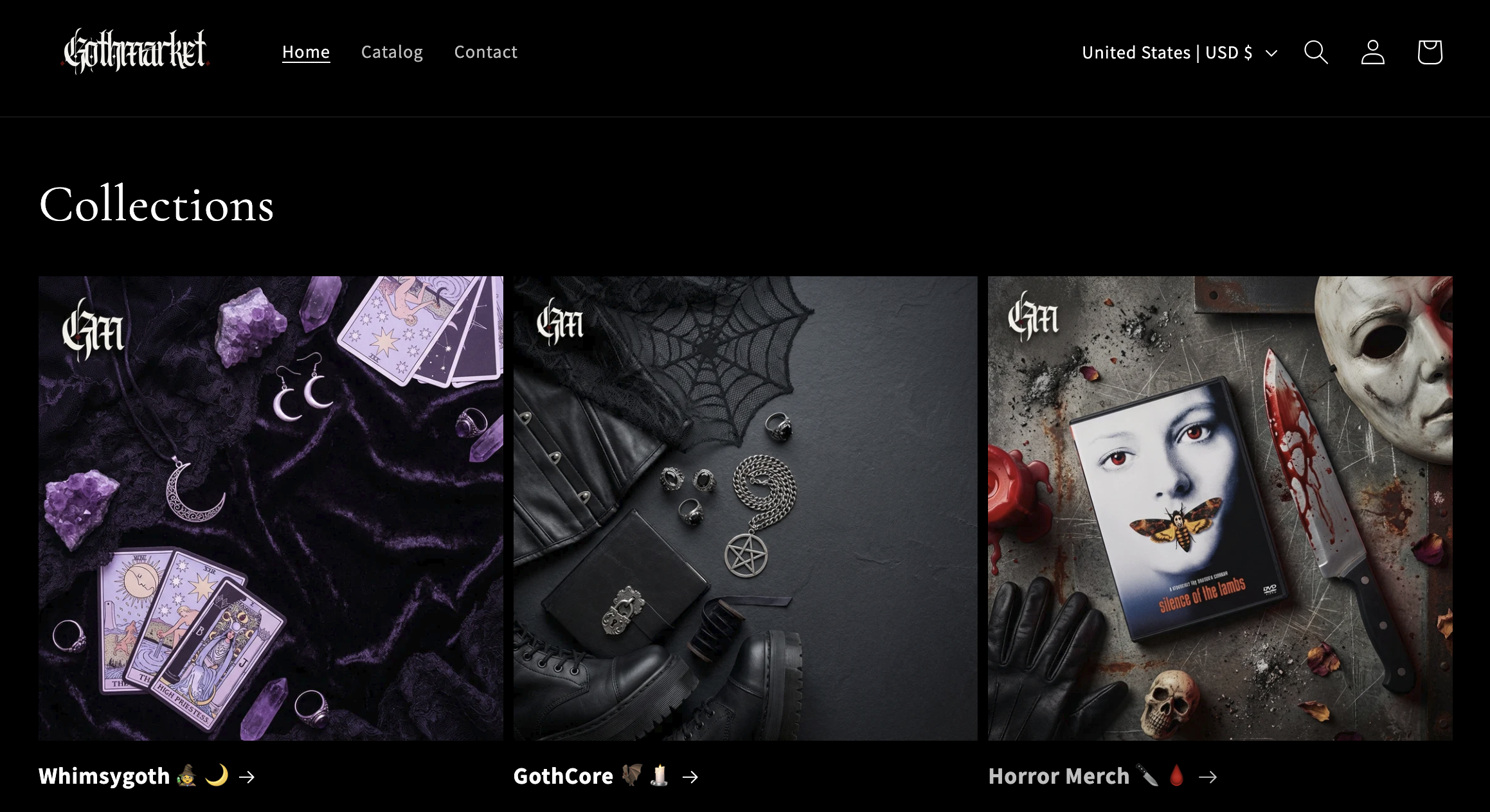
Most online art marketplaces were not built for this category. They treat dark, gothic, and occult art as a subcategory of “alternative decor,” which means collectors end up sorting through mass-produced prints and unlicensed reproductions to find anything worth owning. Goth is built differently: it is a curated marketplace specifically for the gothic, dark, and alternative subculture, connecting collectors directly with independent artists and artisans who work in these aesthetics by choice, not by trend.
For collectors coming from this article, the practical advantage is specificity. The works listed on Goth come from creators who understand the material and cultural weight of what they make. You are not explaining to a seller why provenance matters or why you need care instructions; that context is already part of how the platform operates. Browse the dark art and collectibles section to find vetted listings, or start with Goth’s dark subculture art guide to orient yourself in the category before you buy.