

Occult Symbolism Explained: Meanings, History, and Modern Uses
TL;DR:
- Occult symbols are visual signs representing hidden knowledge, spiritual forces, and transformation rooted in ancient mystical traditions. They serve as protective talismans, identity markers, and artistic expressions across cultures and history, emphasizing personal interpretation and intent. Today, these symbols are widely used in jewelry, fashion, and ritual practices, fostering meaningful connection and community beyond superficial aesthetics.
Most people hear “occult symbolism” and immediately think of horror movies, moral panic, or shadowy conspiracies. That reaction is understandable, but it’s also completely wrong. Occult symbols are visual signs representing hidden knowledge, spiritual forces, protection, transformation, and esoteric concepts drawn from ancient mystical traditions. Far from being tools of darkness, these symbols carry layered meanings that span thousands of years of human spiritual history. They show up in fine art museums, high fashion runways, tattoo studios, and the jewelry boxes of millions of people who feel a genuine, personal connection to what they represent.
Table of Contents
- What is occult symbolism?
- Origins and history of occult symbols
- Meaning behind popular occult symbols
- How occult symbolism is used today
- The deeper impact of occult symbolism: What people miss
- Explore occult symbolism in jewelry, fashion, and art
- Frequently asked questions
Key Takeaways
| Point | Details |
|---|---|
| Symbols have deep meaning | Occult symbols often represent spiritual forces, transformation, and hidden knowledge. |
| Popular in various subcultures | Occult symbolism finds expression in goth, witchcraft, alternative art, and fashion. |
| Interpretations vary | The same symbol can have personal, spiritual, or purely aesthetic significance depending on intent. |
| Use is rooted in tradition | Occult symbols are guided by history, tradition, and personal experience rather than scientific data. |
What is occult symbolism?
The word “occult” simply means “hidden” in Latin. It refers to knowledge or forces that exist beyond ordinary perception, not to evil or harm. Symbolism, on the other hand, is the practice of using images or marks to represent something larger than their physical form. Together, occult symbolism becomes a visual language for communicating ideas about the universe, the self, and the invisible forces that shape existence.
These symbols function across several overlapping roles:
- Protective talismans worn or displayed to guard against negative energy
- Devotional markers used in spiritual practice to focus intention or honor a deity
- Identity signals that communicate belonging to a particular belief system or subculture
- Artistic shorthand for complex philosophical or spiritual ideas
- Tools for ritual that help practitioners enter altered states of awareness or intention
“Occult symbolism consists of visual signs and images representing hidden knowledge, spiritual forces, protection, transformation, and esoteric concepts from mystical traditions.” — SymbolHub
What makes these symbols so enduring is that they resist simple, single definitions. The same symbol can mean different things to a practicing witch, a gothic fashion collector, and a scholar of Renaissance alchemy. That richness is precisely why they matter. If you’re interested in exploring occult-inspired design, you’ll quickly find that the visual grammar of these traditions runs deep and rewards serious attention.
Understanding occult symbolism also connects directly to gothic accessories history, where centuries of symbolic meaning have been woven into wearable art. The cross, the skull, the serpent, the eye. These aren’t random choices. They’re deliberate selections from a long and sophisticated symbolic vocabulary.
Origins and history of occult symbols
Occult symbols didn’t appear out of nowhere. Their roots reach back thousands of years across multiple civilizations, each contributing its own visual and spiritual vocabulary to the broader tradition.
Here’s a timeline of major developments:
- Ancient Egypt (3000 BCE onward): The Egyptians gave us the ankh (symbol of eternal life), the Eye of Horus (protection and royal power), and the scarab (transformation and rebirth). These weren’t decorative. They were embedded in religious practice, funerary art, and daily life as genuine protective forces.
- Classical antiquity (800 BCE to 400 CE): Greek and Roman traditions introduced planetary symbols, elemental associations, and early astrological glyphs. The pentagram appears in Pythagorean philosophy as a symbol of mathematical perfection and the five elements.
- Medieval alchemy (700 to 1600 CE): Alchemists developed an entire coded system of symbols representing metals, chemical processes, and stages of spiritual transformation. Their imagery blended science with mysticism in ways that still echo in modern occult practice.
- Renaissance esotericism (1400 to 1700 CE): Scholars like Heinrich Cornelius Agrippa and John Dee synthesized Jewish Kabbalah, Hermeticism, and astrology into elaborate symbolic systems that became the foundation of Western occultism.
- 19th and 20th century revivals: Groups like the Hermetic Order of the Golden Dawn and Aleister Crowley’s Thelema brought occult symbolism into modern spiritual movements. From there, it moved into counterculture, punk, and eventually the gothic and alternative subcultures of the 1980s onward.
| Era | Primary tradition | Key symbols introduced |
|---|---|---|
| Ancient Egypt | Religion and funerary practice | Ankh, Eye of Horus, scarab |
| Classical antiquity | Philosophy and astronomy | Pentagram, planetary glyphs |
| Medieval alchemy | Proto-chemistry and mysticism | Elemental symbols, sulfur, mercury |
| Renaissance | Hermeticism, Kabbalah | Sigils, sacred geometry |
| 19th to 20th century | Ceremonial magic, Thelema | Baphomet, Sigil of Baphomet |
| Modern subcultures | Art, fashion, identity | Adapted versions of all above |
This lineage matters because it shows that goth fashion symbolism draws from a genuinely ancient and sophisticated tradition, not from shock value or trend chasing. When someone wears an ankh or a pentagram, they’re connecting to a visual language with a richer history than most mainstream fashion could claim. The symbols also traveled across cultures through trade, conquest, and religious exchange, which is why similar imagery appears in traditions that had no direct contact with each other.
Meaning behind popular occult symbols
With that historical context in place, let’s decode the meaning behind some of the most recognized occult symbols. Many of them carry meanings that might genuinely surprise you.
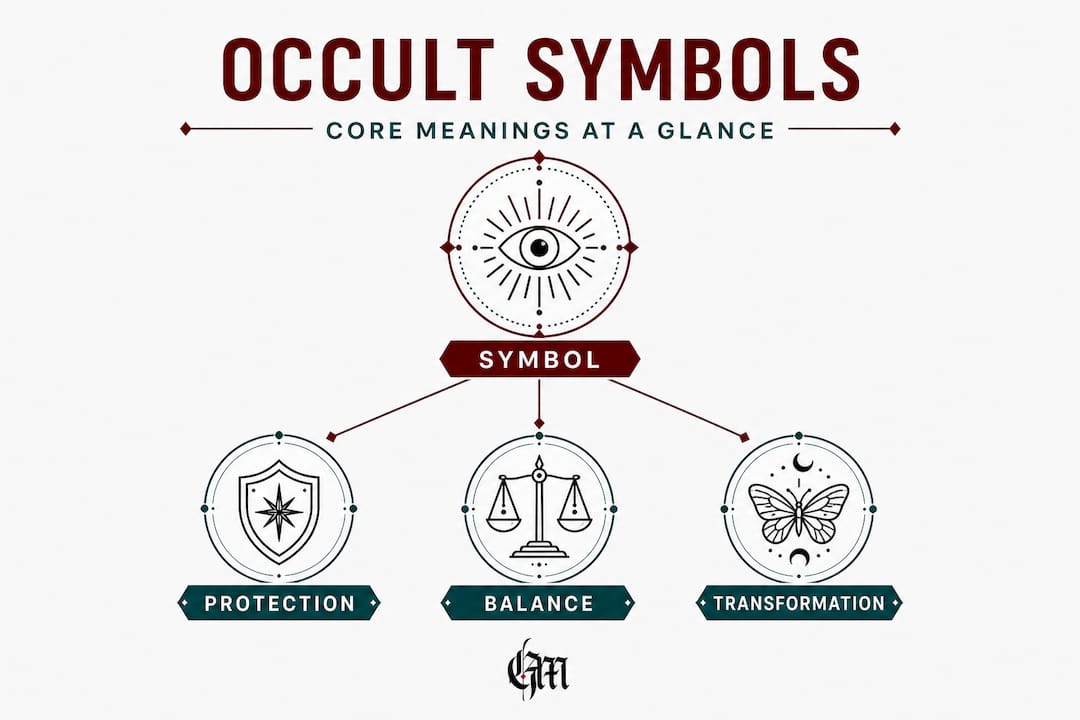
| Symbol | Core meaning | Common use in subcultures |
|---|---|---|
| Pentagram | Five elements, protection, harmony | Wicca, gothic jewelry, ritual practice |
| Baphomet | Balance of opposites, integration | Satanic aesthetics, philosophical art |
| All-seeing eye | Divine awareness, consciousness | Conspiracy art, gothic tattoos |
| Ankh | Eternal life, divine feminine | Witchcraft, dark fashion, Egyptology |
| Triple moon | Maiden, mother, crone; lunar cycles | Wicca, feminist spirituality, jewelry |
| Ouroboros | Infinity, self-renewal, cycles | Alchemy-inspired art and accessories |
| Sigil of Saturn | Time, discipline, transformation | Ceremonial magic, dark decor |
The pentagram is probably the most misunderstood symbol in this group. An upward-pointing pentagram represents the four physical elements (earth, air, fire, water) governed by spirit. It has been used as a protective symbol in Christian contexts, Jewish Kabbalistic practice, and modern Wicca alike. An inverted pentagram carries different energy, often representing matter over spirit, but even that carries philosophical meaning rather than inherent evil.
Baphomet generates the most fear among people unfamiliar with its actual history. The symbol represents equilibrium of opposites, including male and female, light and dark, material and spiritual, making it a symbol of integration rather than evil. The image was popularized by occultist Eliphas Lévi in 1856, drawn as a winged, androgynous figure meant to represent the unity of all dualities. Philosophers and artists have long used it as a meditation on wholeness.
The all-seeing eye, often called the Eye of Providence, predates any conspiracy theory by millennia. It appears in ancient Egyptian imagery as the Eye of Horus and was adopted in Christian iconography to represent divine omniscience. Its appearance on the US dollar bill dates to 1782 and was originally meant as a reference to God watching over the new nation.
Pro Tip: When choosing occult symbols for jewelry or art, research the specific tradition that symbol comes from. A symbol like the ankh carries very different energy depending on whether you’re approaching it through Egyptian spirituality or gothic fashion, and knowing the difference makes your choice more intentional and meaningful.
Exploring meanings in occult jewelry is one of the most direct ways to connect with this symbolic tradition, because wearing a symbol brings it into constant contact with your personal energy and daily life.
How occult symbolism is used today
Now that we’ve defined and decoded these symbols, how do people actually use them in contemporary culture? The answer is broader and more varied than you might expect.
Occult symbols appear throughout modern life in ways that range from deeply intentional to casually aesthetic:
- Jewelry and accessories: Pentagrams, moons, serpents, and eyes appear on rings, necklaces, earrings, and bracelets. Many wearers choose pieces for spiritual reasons; others are drawn to the visual language without necessarily practicing any tradition.
- Tattoo art: Occult tattoos have surged in popularity, with blackwork and fine-line styles making ancient symbols feel contemporary. The ouroboros, sacred geometry, and sigils are particularly popular choices.
- Fashion and streetwear: Gothic and alternative fashion brands regularly incorporate occult imagery into prints, embroidery, and hardware. This bridges the gap between subcultural identity and mainstream fashion influence.
- Ritual practice: Practitioners of Wicca, ceremonial magic, Chaos Magick, and other traditions use symbols in physical rituals, meditation, altar construction, and spellwork. Here, symbols aren’t decorative but functional, serving as focal points for intention and energy.
- Home decor and art: Tapestries, candles, prints, and sculptures featuring occult imagery create environments that reflect personal spiritual or aesthetic values.
What makes all of these uses legitimate is the principle that occult symbolism operates through tradition, intent, and subjective experience rather than any fixed, external authority. There’s no governing body that decides who can use a pentagram or what it must mean. The meaning emerges from the relationship between the person and the symbol.
This is one of the most liberating aspects of occult symbolism for people in alternative subcultures. It offers a rich visual and spiritual vocabulary that belongs to no single institution, religion, or commercial brand. The symbols exist in the space between the ancient and the personal.
Dark aesthetics in art and the broader world of alternative subculture meaning both demonstrate how occult symbolism functions as more than decoration. It’s a form of communication that signals values, beliefs, and community belonging.
Pro Tip: Don’t feel pressured to adopt a symbol because it looks cool if it doesn’t resonate with you personally. The most powerful use of any occult symbol comes from genuine connection. Spend time with a symbol before committing to it in permanent or prominent form.
The deeper impact of occult symbolism: What people miss
Most conversations about occult symbols get stuck at surface level. People either dismiss them as edgy aesthetics or treat them as inherently dangerous. Both reactions miss what’s actually happening when someone genuinely engages with this symbolic tradition.
The conventional view focuses on appearance: a person wearing a pentagram necklace or a Baphomet shirt is making a fashion statement or trying to shock. And yes, sometimes that’s true. But underneath the visible layer of style, something more psychologically significant is often at work. Symbols function as anchors for identity. When you consistently wear or display a symbol that carries meaning for you, it becomes a daily affirmation of what you believe, value, and aspire to become.
We’ve seen this pattern in the communities that gather around gothic and occult aesthetics. People don’t just collect pieces for their visual appeal. They build personal symbolic systems that help them navigate identity, community, loss, transformation, and power. A triple moon necklace might represent a relationship with the cycles of change in someone’s own life. A sigil ring might mark a commitment to a specific intention or practice.
This psychological function is ancient. Humans have been using symbols to externalize inner states and commitments since before written language. What’s modern is the level of conscious choice involved. Today’s practitioners and collectors aren’t simply inheriting a tradition from a closed religious community. They’re actively choosing symbols from across multiple traditions, adapting meanings, and creating personal symbolic vocabularies.
As occult symbolism relies on tradition, intent, and subjective experience rather than fixed external rules, this personal approach isn’t a departure from the tradition. It’s entirely consistent with how esoteric knowledge has always worked: passed between individuals, adapted to context, and kept alive by living practice.
The community dimension matters too. When you share symbolic language with others, whether in an online space, a local coven, or a festival, you create genuine connection. These symbols function as a visible form of belonging that doesn’t require a formal institution or membership card. That kind of organic, symbol-based community is one of the most resilient forms of human connection, and it’s exactly what makes the gothic accessories and symbolism space feel so vital and alive right now.
The real power of occult symbolism isn’t mystery or fear. It’s meaning, freely chosen and personally held.
Explore occult symbolism in jewelry, fashion, and art
If reading through this symbolic landscape has sparked something in you, whether curiosity about a specific symbol or a desire to find pieces that genuinely resonate with your own practice and aesthetic, you don’t have to look far.
Goth.Market brings together independent creators and collectors who understand that a piece of jewelry or a wearable symbol isn’t just decoration. It’s a statement of identity, a daily talisman, and a connection to something much older and deeper than fashion trends. Browse the curated occult jewelry collection for rings, necklaces, and earrings crafted with genuine symbolic intention. If your aesthetic leans toward the whimsical side of dark, the whimsygoth collection offers pieces that balance darkness with playfulness in ways that feel fresh and personal.
Frequently asked questions
Are occult symbols evil or satanic by nature?
No. Most occult symbols are ancient signs representing balance, hidden knowledge, and transformation. Even Baphomet symbolizes equilibrium of opposites rather than evil, emphasizing integration over malevolence.
What are the most common occult symbols?
The most recognized examples include the pentagram, Baphomet, the all-seeing eye, the ankh, and the triple moon. These visual signs represent hidden knowledge, spiritual forces, and esoteric traditions spanning thousands of years.
Can anyone use occult symbols in their art or fashion?
Yes. Because occult symbolism relies on tradition, intent, and personal experience rather than institutional authority, these symbols have been freely adopted into art, fashion, and subcultures worldwide.
How do I pick an occult symbol for myself?
Choose a symbol that genuinely resonates with your personal beliefs, intentions, or aesthetic sensibility, because meaning is shaped by subjective experience and intent above all else.