

Why Collect Witchcraft Art: History, Meaning, and Value
TL;DR:
- Witchcraft art reflects centuries of cultural fears, gender politics, and spiritual resistance through powerful imagery. Collectors value it for its deep historical symbolism, psychological resonance, and evolving aesthetic language. Its growing institutional recognition confirms its significance as a meaningful and culturally rooted genre.
Witchcraft art is defined as a genre of visual art that uses the witch figure, ritual symbolism, and occult imagery to encode cultural anxieties, gender politics, and spiritual resistance across centuries. Collectors are drawn to it not for shock value but because witch imagery reflects shifting social fears and later becomes a symbol of reclamation and power. The Stanford Cantor Arts Center’s landmark exhibition on cunning folk and witch imagery frames this genre as one of the most culturally loaded in Western art history. If you are asking why collect witchcraft art, the answer is that no other genre carries this density of historical meaning, psychological resonance, and aesthetic force in a single image.
Why collect witchcraft art: the historical and cultural case
The witch figure in Western art did not begin as a symbol of power. It began as a projection of fear. From the 15th century onward, artists like Albrecht Dürer and Hans Baldung Grien depicted witches as transgressive, naked, and threatening, using visual strategies that encoded social anxieties about femininity, sexuality, and the unknown. The MDPI study of the Necromancer of Endor demonstrates how early modern visual culture deliberately constructed the witch body through concealment, gesture, and spectral threat, making her simultaneously an object of desire and a figure of danger.
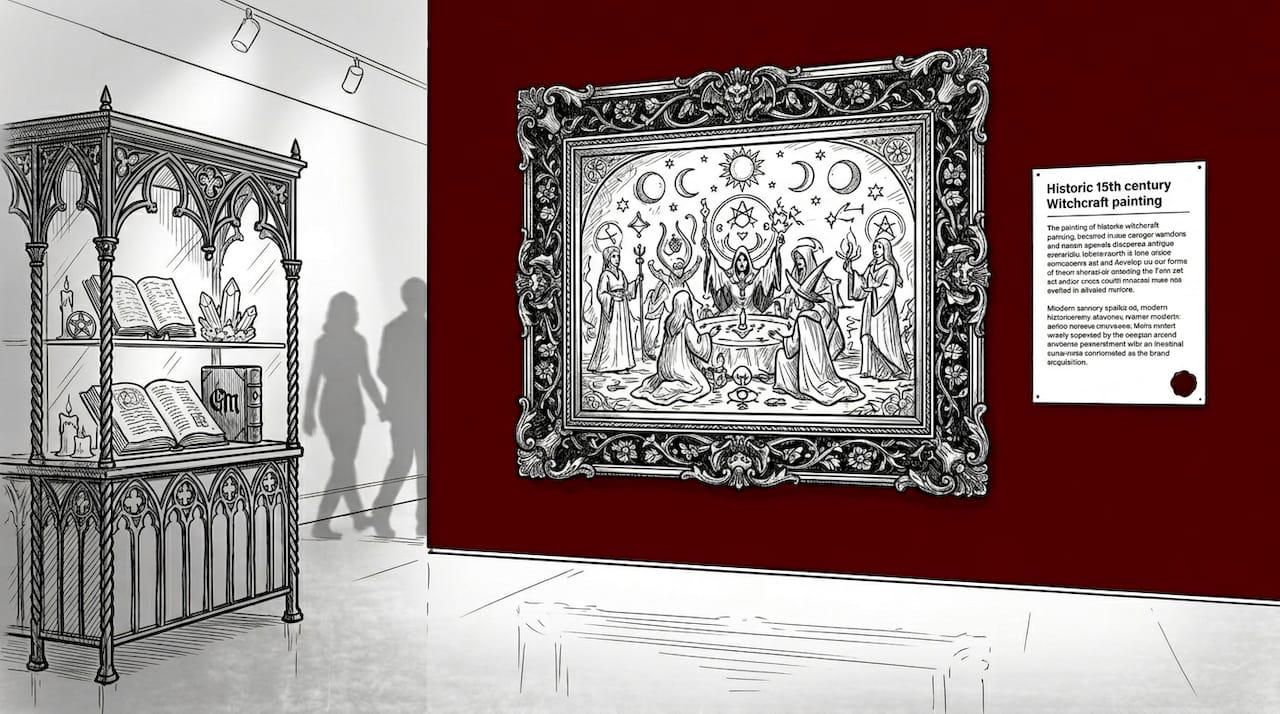
This dual coding is what makes historic witchcraft art so rich for collectors. The iconography was never accidental. Artists used codified visual techniques to position the witch outside social norms while also granting her a kind of terrifying agency. Dürer’s The Four Witches (1497) and Baldung Grien’s sabbath scenes are not folk illustrations. They are sophisticated arguments about power, gender, and the limits of institutional control.
By the Romantic and Pre-Raphaelite periods, the witch had begun her transformation. Artists like John William Waterhouse reframed her as a figure of melancholy beauty and hidden knowledge rather than demonic threat. This shift mirrors broader cultural changes around gender and autonomy. Collecting across these periods means building a visual argument about how societies construct and reconstruct the “other” over time.
Here is what that historical arc looks like as a collecting framework:
- Renaissance demonization (15th to 17th century): Witch imagery encodes fear of female autonomy and non-Christian practice, often commissioned by church or civic authorities.
- Romantic reinterpretation (late 18th to 19th century): The witch becomes melancholic, wise, and sympathetic, reflecting Enlightenment skepticism and Romantic fascination with the irrational.
- Modernist reclamation (20th century onward): Feminist and queer artists reclaim the witch as a symbol of resistance, grounding her in real persecution history and marginalized identity.
“Engagement with witchcraft art benefits from curiosity about everyday magical practices rather than sensationalized violence.” — Curator Frier, Stanford Cantor Arts Center, as cited in the Stanford Daily review of the Cunning Folk exhibition.
That curatorial principle matters for collectors. The most meaningful witchcraft art collections are built around cultural dialogue, not spectacle.
What makes witchcraft art a distinct aesthetic language?
The role of witchcraft in art today is less about narrative and more about atmosphere. Contemporary witchcraft aesthetics rely on symbolic objects and mood rather than literal spell casting, creating a contemplative visual language that resonates across belief systems. This is why witchcraft art appeals to collectors who have no personal connection to occult practice. The imagery communicates something universal: intuition, hidden knowledge, and the boundary between the visible and invisible world.
Artists working in this mode use a specific symbolic vocabulary:
- Plants and herbs: Belladonna, mugwort, and mandrake appear as markers of folk knowledge and feminine power rather than decoration.
- Lunar imagery: Crescent and full moon shapes signal cyclical time, mystery, and the non-rational.
- Ritual objects: Cauldrons, mirrors, candles, and bones function as props in a visual grammar of transformation.
- Animals: Owls, ravens, cats, and serpents carry centuries of symbolic weight across European and non-European traditions.
- Night landscapes: Darkness and liminal spaces (forests, crossroads, thresholds) create the sense of a world operating outside daylight logic.
Contemporary artists like Ksenia Odintsova design surreal symbolic environments with oversized plants, lunar shapes, and fluid spatial boundaries that enhance witchcraft’s emotional register without illustrating any specific magical act. The result is art that functions as a mood rather than a story. It invites the viewer into a psychological state rather than a narrative sequence.
Pro Tip: When evaluating contemporary witchcraft art, ask whether the symbolic elements are doing specific cultural work or simply decorating a surface. A raven perched on a skull means something different in a work that references Poe, Norse mythology, or Celtic tradition. Context transforms symbol into argument.
This mood-driven quality also explains why witchcraft art fits so naturally alongside occult-inspired design in living spaces. The aesthetic creates environments that feel charged with meaning without requiring the viewer to hold any particular belief.
Why do collectors value witchcraft art psychologically and culturally?
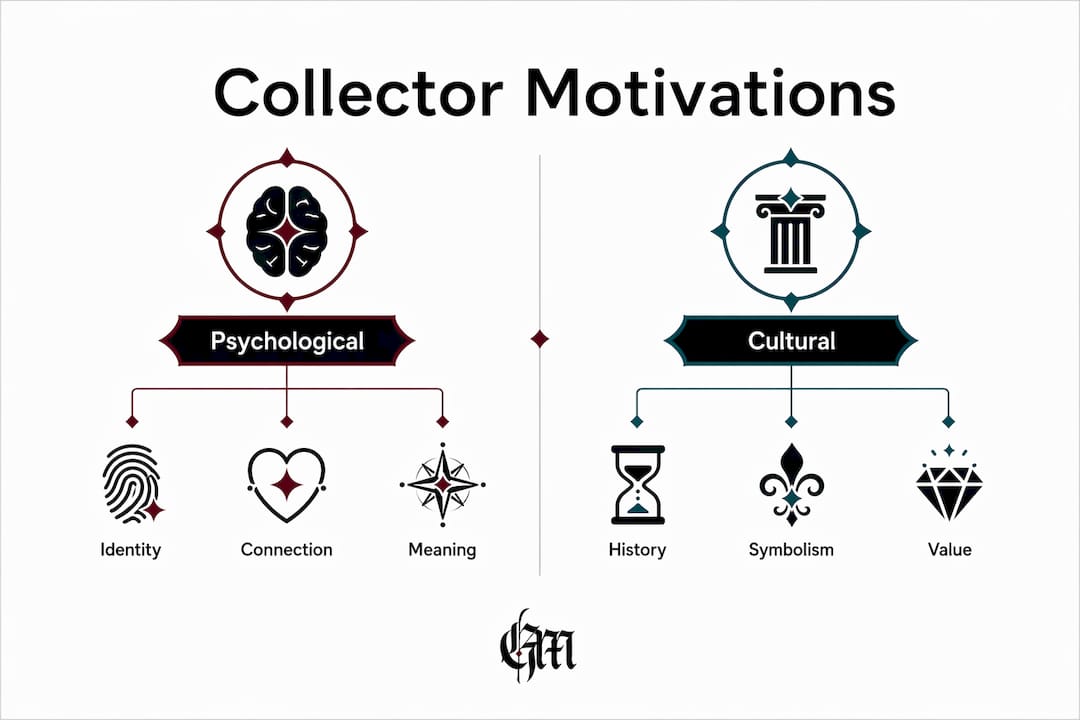
The psychology of collecting witchcraft art connects to two well-documented mechanisms. The first is the neuropsychological SEEKING circuit, which drives the urgent desire to locate and acquire objects that complete a meaningful pattern. The second is extended self theory, which holds that collectors repair identity by filling gaps in their collections. Witchcraft art activates both. It is rare enough to trigger the hunt, and culturally loaded enough to feel identity-defining when acquired.
Beyond individual psychology, witchcraft art carries collective cultural meaning that few genres can match. The New York Historical Center’s discussions of queer and feminist witch imagery connect the witch figure directly to histories of persecution, resistance, and reclamation by marginalized communities. Collecting this art is not a neutral aesthetic choice. It is a way of engaging with that history and honoring the people it represents.
Here is how the motivations compare across collector types:
| Collector type | Primary motivation | What witchcraft art provides |
|---|---|---|
| Art historian | Cultural and iconographic depth | Centuries of shifting symbolic meaning in a single genre |
| Identity collector | Personal narrative and self-expression | Connection to feminist, queer, and resistance traditions |
| Aesthetic collector | Visual and atmospheric impact | Mood-driven imagery with high symbolic density |
| Investment collector | Rarity and cultural relevance | Growing institutional interest and exhibition history |
The importance of witchcraft art as a collecting category is also growing institutionally. The Stanford Cantor Arts Center exhibition in 2026 signals that major academic institutions now treat this genre as serious art history rather than subcultural curiosity. That institutional recognition typically precedes broader market appreciation.
Pro Tip: Build your collection around the historical evolution of witch symbolism rather than a single aesthetic moment. A collection that spans Renaissance demonization, Romantic reinterpretation, and contemporary reclamation tells a far more compelling story than one that stays within a single period or style.
For collectors interested in dark subculture art more broadly, witchcraft art represents the genre’s most historically grounded and culturally resonant category.
How to evaluate and curate witchcraft art with real depth
Evaluating witchcraft art for genuine significance requires moving past surface aesthetics. The MDPI research on early modern witch imagery identifies specific iconographic operations that distinguish meaningful works from decorative ones. These include concealment (what is hidden and why), gaze distribution (who looks at whom and with what power), and ritual agency (which figure controls the symbolic action). Applying these criteria to any witchcraft artwork reveals whether it is making a cultural argument or simply using witch imagery as shorthand for “dark and mysterious.”
When building a collection, consider these evaluation principles:
- Trace the symbol’s origin. A cauldron in a 16th-century German woodcut carries different meaning than the same object in a 21st-century feminist painting. Know the difference.
- Assess the gaze. Works where the witch returns the viewer’s gaze with authority read very differently from works where she is observed as spectacle. This distinction maps directly onto the historical shift from demonization to empowerment.
- Check for ritual agency. Who controls the symbolic action in the image? A witch who commands the scene is a different cultural statement than one who is acted upon.
- Balance historical weight with interpretive care. The Stanford Cantor exhibition deliberately excluded graphic witch-trial violence to keep focus on cultural meaning rather than trauma. Apply the same principle when curating your own collection.
- Use scholarly frameworks. Exhibition catalogs from institutions like the Metropolitan Museum of Art, the British Museum, and the Cantor Arts Center provide iconographic context that transforms a decorative purchase into a historically grounded acquisition.
The benefits of owning witchcraft art extend beyond aesthetics when you collect with this level of intentionality. Each piece becomes a node in a larger argument about cultural history, gender, and the construction of the “other.”
Key takeaways
Witchcraft art is the most historically layered and psychologically resonant genre available to collectors who want their acquisitions to carry genuine cultural meaning.
| Point | Details |
|---|---|
| Historical depth | Witch imagery spans Renaissance demonization through feminist reclamation, offering centuries of symbolic evolution. |
| Aesthetic language | Contemporary witchcraft art uses plants, lunar shapes, and ritual objects to create mood rather than narrative. |
| Collector psychology | The SEEKING circuit and extended self theory explain why acquiring witchcraft art feels urgent and identity-defining. |
| Cultural reclamation | Queer and feminist communities have grounded witch imagery in real persecution history, adding ethical weight to collecting. |
| Evaluation criteria | Iconographic operations like concealment, gaze, and ritual agency separate meaningful works from decorative ones. |
The layered power of witchcraft art, from my perspective
I have spent years watching collectors approach witchcraft art as if it were a single thing: dark, atmospheric, vaguely occult. The ones who build truly compelling collections treat it as what it actually is: a centuries-long argument about who gets to hold power and who gets labeled dangerous for doing so.
The witch figure is one of the most durable symbols in Western visual culture precisely because she absorbs whatever a given era most fears or desires. In the 15th century, she embodied the threat of female autonomy. In the 19th century, she became a vehicle for Romantic longing. Today, she is a figure of deliberate reclamation by communities that recognize their own histories in her persecution. A collection that traces that arc is not just aesthetically interesting. It is historically honest.
What I find most undervalued in this genre is the contemporary work. Artists working in the witchcore aesthetic are not simply decorating with witch imagery. They are building a visual language for intuition, resistance, and the knowledge that exists outside institutional validation. That is a serious artistic project, and it deserves serious collecting attention.
The collectors who will look back with the most satisfaction are those who connected individual pieces to the larger cultural narrative rather than treating each acquisition as a standalone object. Witchcraft art rewards that kind of thinking more than almost any other genre.
— Rey
Explore witchcraft-inspired art and collectibles at Goth
If this article has deepened your interest in collecting witchcraft art, Goth.Market is the natural next step for building out your collection with complementary pieces.
Goth curates a selection of witchcraft-themed jewelry and occult-inspired collectibles from independent creators who work directly within the symbolic traditions this article covers. These are not mass-market pieces. They are objects made with the same iconographic intentionality that distinguishes meaningful witchcraft art from surface-level decoration. The platform also carries a dedicated whimsygoth collection of mystical and witch-inspired items that pair naturally with art acquisitions, extending the aesthetic into wearable and decorative form.
FAQ
Why is witchcraft art historically significant?
Witchcraft art is significant because it encodes centuries of cultural anxiety about gender, power, and the unknown. The Stanford Cantor Arts Center frames witch imagery from the Renaissance through the modern period as a record of evolving social fears and later resistance symbols.
What types of witchcraft art collections exist?
Collections typically organize around historical period, symbolic theme, or cultural reclamation. The most compelling span Renaissance demonization through contemporary feminist and queer reinterpretation, tracing the witch figure’s evolution as a cultural symbol.
How do I evaluate the quality of a witchcraft artwork?
Apply iconographic criteria: assess concealment, gaze direction, and ritual agency within the image. Works where the witch commands the scene with deliberate symbolic authority carry more cultural depth than those that use witch imagery as generic decoration.
Should I collect witchcraft art if I have no occult beliefs?
Witchcraft art does not require any personal belief in magic to be meaningful. Contemporary witchcraft aesthetics function as a mood-driven visual language about intuition and hidden knowledge, making the work accessible and resonant across belief systems.
Is witchcraft art increasing in collector and market value?
Institutional recognition is growing. Major exhibitions at venues like the Stanford Cantor Arts Center signal that the academic and museum world now treats witchcraft art as serious art history, which typically precedes broader market appreciation for a genre.