

What Is Horror Art? History, Styles, and Meaning
TL;DR:
- Horror art employs grotesque and unsettling imagery to confront universal human fears like mortality and trauma. It originated from traditions such as the Danse Macabre and medieval grotesque art, evolving to critique social power structures. Contemporary horror art spans various media, emphasizing psychological unease, aesthetic complexity, and social reflection.
Horror art is not about shock. Most people assume the genre exists to disgust or terrify, but what is horror art at its core is something far more sophisticated. It is a centuries-old tradition of using monstrous, grotesque, and unsettling imagery to confront the truths we prefer to avoid: mortality, trauma, power, and the darker mechanisms of the human mind. From the skeletal processions of 14th-century paintings to the formaldehyde sculptures of Damien Hirst, horror art has always been a serious aesthetic conversation. This guide traces its origins, unpacks its defining styles, and reveals why it matters more now than ever.
Table of Contents
- Key Takeaways
- What is horror art and where it began
- Core styles and aesthetics in horror art
- Why horror art matters beyond shock value
- Horror art in contemporary culture and media
- My take on what most people miss about horror art
- Explore horror art through gothic collectibles and more
- FAQ
Key Takeaways
| Point | Details |
|---|---|
| Horror art has ancient roots | The genre traces back to the Renaissance grotesque and medieval Danse Macabre traditions. |
| Terror and horror are distinct | Terror is psychological dread before an event; horror is visceral revulsion after. Both are tools, not accidents. |
| Style drives meaning | Grotesque, sublime, body horror, and abject art each create different emotional and psychological effects. |
| It functions as social critique | Artists like Goya used horror imagery to expose fear as a mechanism of social control, not supernatural spectacle. |
| It lives in modern culture | Horror art extends today into photography, fashion, illustration, and niche markets like gothic collectibles. |
What is horror art and where it began
The definition of horror art starts with a word most people misunderstand: grotesque. The term “grotesque” originated in the Renaissance when workers excavating the ruins of Nero’s Domus Aurea discovered bizarre hybrid wall decorations in cave-like chambers. Artists and scholars called these strange, half-human, half-plant forms grottesco, after the Italian word for cave. By the 18th century, the term had traveled far from decoration. It came to describe anything disturbingly unnatural or monstrous in form.
Before grotesque became an aesthetic category, the medieval world had already developed its own visual language of horror. The 14th-century Danse Macabre used skeletons and decaying corpses in allegorical processions to confront the universality of death during the Black Death era. These images were not made to terrify randomly. They were built to remind every social class, from kings to peasants, that death made no distinctions. That was a radical act of artistic and political leveling.
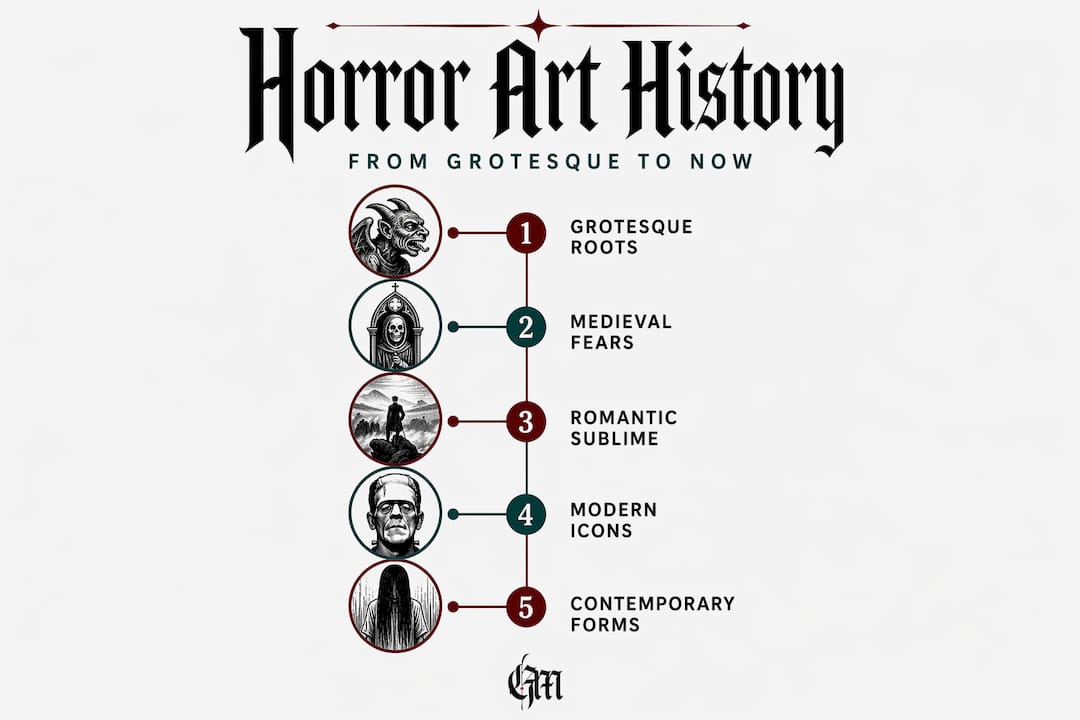
Horror art’s trajectory from the Middle Ages to the modern era follows a consistent logic: it appears most forcefully when society is under stress.
Francisco Goya understood this completely. His Black Paintings, created between 1819 and 1823 when he was elderly, deaf, and disillusioned, stand as some of the most psychologically devastating works in Western art history. Saturn Devouring His Son does not invite admiration. It demands a response. Goya’s grotesque imagery critiques social fear and superstition, depicting collective terror as a mechanism of control rather than supernatural reality.
“Horror art reflects the society that made it. When Goya painted fear, he was painting the political climate of his time in the most honest medium available to him.”
Pro Tip: When studying horror art history, look at the political and social context first. The imagery almost always makes more sense once you understand what the artist was afraid of losing, or what power they were challenging.
Core styles and aesthetics in horror art
Understanding horror art meaning requires knowing the specific visual and emotional tools artists use. These are not interchangeable. Each style produces a distinct psychological effect, and recognizing them changes how you experience the work.
The four central aesthetics are the grotesque, the sublime, body horror, and abject art. Here is how they differ and what each one does to a viewer:
| Style | Visual Approach | Primary Emotional Effect |
|---|---|---|
| Grotesque | Hybrid, distorted, or monstrous forms | Unease, dark humor, repulsion |
| Sublime horror | Vast, overwhelming, awe-inspiring threat | Terror combined with fascination |
| Body horror | Transformation, violation, or mutilation of the human form | Visceral revulsion and identity anxiety |
| Abject art | Use of taboo materials or subject matter (waste, decay, bodily fluids) | Confrontation with what society represses |
The distinction between terror and horror is one of the most useful frameworks in the entire genre. Terror expands perception. It is the dread you feel before something terrible happens, the creaking door, the shadow that should not be there. Horror freezes and overwhelms. It is the revulsion after the fact. Great horror art often creates both states deliberately, moving the viewer from one to the other within a single piece.
Damien Hirst’s shark sculpture, a tiger shark suspended in formaldehyde, is sublime horror made physical. You are safe from the creature, yet every instinct tells you otherwise. The scale and stillness of it create awe and dread simultaneously. That tension is not accidental. It is the entire point.
Cindy Sherman’s body distortion photography works in a completely different register. Her Untitled Horrors series transforms identity until the human form becomes uncanny, recognizable but wrong. She is working in body horror territory, using self-portraiture to interrogate how identity is constructed, performed, and ultimately fragile.
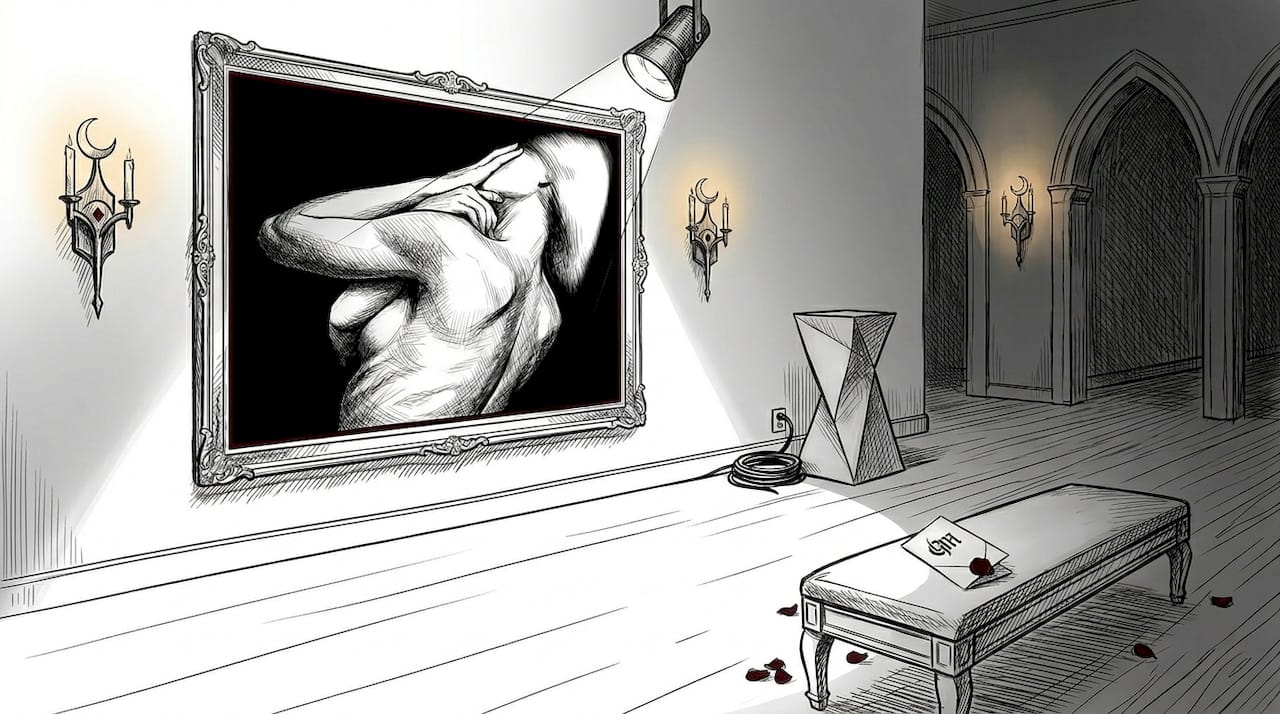
Then there is Louise Bourgeois, whose spider sculptures evoke the primal fear of arachnids while simultaneously representing maternal protection. Horror and comfort occupy the same physical object. That is what separates serious horror art from simple shock content.
Pro Tip: When analyzing a horror artwork, ask yourself whether it creates terror, horror, or both. Then ask which came first in your viewing experience. That sequence tells you a great deal about how the artist structured the emotional impact.
Why horror art matters beyond shock value
Horror art functions as a mirror reflecting social anxieties and trauma, challenging viewers to reckon with the fragility and constructed nature of human identity. That is not a minor artistic ambition. It is one of the most demanding things art can ask of an audience.
The importance of horror art becomes clear when you look at what it consistently chooses to examine. Across centuries and cultures, horror art returns to the same core themes:
- Mortality. From the Danse Macabre to Hirst’s formaldehyde works, death is a recurring obsession. Horror art refuses the cultural habit of pretending death does not exist.
- Trauma and the body. Sherman, Bourgeois, and contemporary guro artists use the body as both subject and material. Guro art interrogates human fragility and societal norms about health and beauty through deliberate distortion.
- Power and social control. Fear as a social construct used for control is a recurring subtext. Goya knew it. Contemporary political horror art knows it too.
- Identity and the uncanny. When the familiar becomes strange, when a face is almost right but not quite, horror art exposes how much of identity is performance and assumption.
- The subconscious. Surrealist horror art pulls from dreamlike imagery to externalize fears that conscious thought suppresses.
Art-horror as a contemporary genre prioritizes psychological unease and existential dread over cheap scares. It uses taboo materials and confrontational imagery to address deep human experiences, not to offend, but to break through the numbness that polished, comfortable art can create.
This is why horror art has never been a fringe concern. Edvard Munch’s The Scream hangs in major museums precisely because anxiety is a universal human experience. The painting does not show a monster. It shows the feeling of being overwhelmed by existence. Horror art naming that feeling, giving it form, is a profound act of solidarity with the viewer.
“The most powerful horror art does not show you the monster. It shows you your own face reflected in something you cannot bear to look at directly.”
Horror art in contemporary culture and media
The horror art styles that originated in painting and sculpture have expanded into nearly every creative field today. The genre is not confined to gallery walls, and that expansion has made it more accessible and more influential.
Here is where horror art shows up most prominently in contemporary culture:
- Digital illustration and concept art. Horror illustration for games, book covers, and editorial work has become a major professional field. Artists like Zdzisław Beksiński, whose surreal biomechanical hellscapes still influence the genre decades later, set a standard that digital artists are actively building on.
- Horror photography. Photographers working in the tradition of Cindy Sherman use staged, uncanny imagery to explore body horror and psychological unease. The accessibility of digital tools has opened this medium to independent artists.
- Animation and film concept design. Horror aesthetics in animation, particularly in studios producing dark or gothic content, draw directly from the grotesque and sublime traditions.
- Gothic and macabre fashion. The visual language of horror art translates directly into dark gothic fashion, from memento mori jewelry to garments referencing body horror or surrealist imagery.
If you are interested in how to create horror art, contemporary horror artists generally recommend studying the historical traditions first. Understanding the Danse Macabre before attempting body horror illustration, or learning what made Goya’s compositions so unsettling before applying similar techniques digitally, produces work with genuine depth rather than surface-level darkness.
- Study historical horror art movements before developing a personal style.
- Identify which emotional register you want to work in: terror, horror, the grotesque, or the sublime.
- Choose your medium based on what it can do that others cannot. Photography produces uncanny realism. Illustration allows impossible forms.
- Develop a thematic focus. The strongest horror artists are not just making scary images. They are making arguments about human experience.
- Engage with the community and niche markets where horror art is taken seriously as a creative tradition.
My take on what most people miss about horror art
I have spent years immersed in dark aesthetics, and the single most persistent misunderstanding I encounter is that horror art is for people who enjoy being disturbed. That framing is backwards. Horror art is for people who refuse to look away from the difficult parts of being human.
What I find genuinely underappreciated is how optimistic horror art actually is, in a strange way. When Goya painted a society paralyzed by superstition and fear, he was not celebrating that state. He was exposing it, which is the first step toward challenging it. When Sherman transforms her body into something uncanny, she is making an argument about how unstable and socially constructed identity really is. That is not nihilism. That is critique.
I also think the beauty-versus-repulsion tension in horror art is one of the most sophisticated creative challenges in any visual medium. Getting a viewer to feel both awe and revulsion at the same moment, to want to look and look away simultaneously, requires extraordinary control over composition, scale, color, and form. It is harder than making something simply beautiful, because you are working against instinct.
My honest advice for anyone approaching horror art for the first time: resist the urge to categorize it quickly as either “too much” or “just shock value.” Sit with the discomfort. Ask what the artist was afraid of, or what they wanted you to confront. The answer is almost always worth finding.
— Rey
Explore horror art through gothic collectibles and more
If the history and aesthetics of horror art have caught your attention, the conversation does not have to stay theoretical. Goth is a curated marketplace built for people who take dark aesthetics seriously, whether you are an artist, a collector, or someone who wants to wear their aesthetic on their sleeve.
The themes discussed throughout this article, the grotesque, memento mori, body horror, the sublime, translate directly into the handmade and independent products you will find at Goth. From gothic horror jewelry that draws on memento mori and occult iconography to horror-inspired collectibles, the marketplace connects independent creators working in dark traditions with an audience that genuinely understands what those traditions mean. Browse the horror merchandise collection to find pieces that reflect the artistic lineage this article has traced, made by creators who know exactly what they are referencing.
FAQ
What is the definition of horror art?
Horror art is a visual genre that uses grotesque, monstrous, uncanny, or disturbing imagery to explore psychological, social, and existential themes. It prioritizes emotional and intellectual engagement over simple shock or entertainment.
How is horror art different from dark art?
What is dark art covers a broader aesthetic of shadow, mystery, and the macabre without requiring the specific psychological mechanisms of terror or horror. Horror art is a subset of dark art with more direct engagement with fear, the monstrous, and the abject.
What are the main themes in horror art?
The core themes in horror art include mortality, trauma, identity, social control through fear, and the subconscious. These themes appear consistently across centuries and across very different visual styles.
Who are some important artists in horror art history?
Francisco Goya, Edvard Munch, Damien Hirst, Cindy Sherman, and Louise Bourgeois are all central figures. Goya’s Black Paintings and Munch’s anxiety-driven work laid foundations that contemporary horror artists still build on directly.
Can horror art be beautiful?
Yes, and that tension is central to the genre. Sublime horror in particular creates simultaneous awe and dread, which means beauty and terror occupy the same object. Damien Hirst’s preserved shark is one of the clearest examples of this dynamic in contemporary art.