

What Is Occult Influence? History, Effects, and Signs
TL;DR:
- Occult influence involves hidden forces shaping beliefs and actions beyond ordinary perception through ritual, suggestion, or group dynamics. It has roots from ancient mystery schools and experienced a modern revival via media, social platforms, and cultural movements. Recognizing subtle patterns like reliance on divination, social withdrawal, or intrusive symbolism helps identify its impact on individuals and society.
Occult influence is defined as the use of hidden, supernatural, or secret forces to shape human decisions, beliefs, and behaviors beyond ordinary perception. The word “occult” derives from the Latin occultus, meaning concealed or secret, and the concept spans ritual magic, divination, spirit contact, and psychic manipulation. Understanding occult influence matters because it operates not just in fringe spiritual circles but across mainstream culture, personal psychology, and even digital environments. Whether you approach it from a spiritual, academic, or cultural angle, the forces at work are real in their effects on people and communities.
What is occult influence and where does it come from?
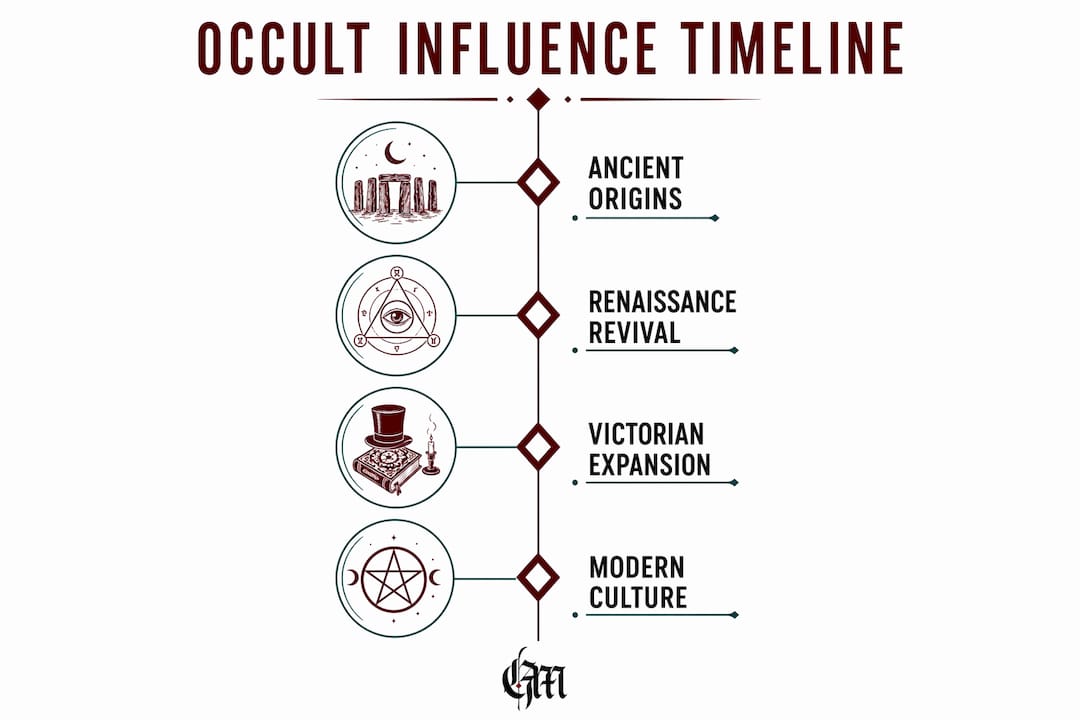
Occult influence traces its roots to ancient mystery traditions, but its modern form took shape during the Renaissance, when scholars began recovering Hermetic, Kabbalistic, and Neoplatonic texts. The Victorian era became the golden age of organized occult interest, producing movements like the Hermetic Order of the Golden Dawn, Theosophy, and Spiritualism. This period established the secretive, hierarchical structure that still defines occultism today, where truth is revealed only to initiates and knowledge functions as power.
The decline of traditional religious authority in Western societies created what scholars call a “spiritual vacuum.” As institutional Christianity lost its cultural grip through the 18th and 19th centuries, people sought alternative frameworks for meaning, healing, and connection with the unseen. Occultism stepped into that gap, offering structured systems of secret knowledge that promised direct access to hidden realities without requiring institutional faith.
By the 20th century, figures like Aleister Crowley, Dion Fortune, and Israel Regardie had codified occult practice into teachable systems. Today, the resurgence is visible in everything from academic religious studies programs to TikTok spirituality. The occult’s secretive structure controls who receives knowledge, layering initiation with power dynamics rather than pure truth, which is precisely what makes it compelling and, for some, dangerous.
Here is a brief timeline of key shifts in occult influence:
- Ancient world: Mystery schools in Egypt, Greece, and Rome preserve hidden knowledge for initiates
- Renaissance (1400s to 1600s): Recovery of Hermetic texts sparks intellectual occultism across Europe
- Victorian era (1800s): Golden Dawn, Theosophy, and Spiritualism formalize occult systems
- 20th century: Crowley, Fortune, and Wicca bring occultism into popular culture
- 21st century: Social media, #WitchTok, and streaming platforms normalize occult aesthetics globally
| Era | Key Development |
|---|---|
| Renaissance | Hermetic and Kabbalistic texts revived in Europe |
| Victorian era | Organized occult orders and Spiritualist movement peak |
| Early 20th century | Thelema, Wicca, and ceremonial magic codified |
| Post-2000 | Digital platforms accelerate mainstream occult visibility |
How does occult influence work?
Occult influence operates through several distinct mechanisms, ranging from ritual practice to collective psychology. The most direct form involves ritual magic and divination, where practitioners use symbolic actions, tools like tarot cards or pendulums, and invocations to contact or direct unseen forces. These practices are understood within occult traditions as genuine interactions with energies or entities that exist beyond physical reality.
A more subtle and psychologically interesting mechanism involves what occultists call egregores. An egregore is a collective psychic entity created by sustained group focus, and it can make externally generated impulses feel like personal will. Religious movements, political ideologies, and even brand communities generate egregores. The entity resists dissolution and causes group-driven impulses to feel deeply personal, which is why people inside powerful movements often cannot distinguish their own thoughts from the group’s influence.
Influence magick takes this further at the individual level. Subtle, indirect influence is considered more effective than overt control because forceful manipulation triggers natural resistance. Sending an idea through a dream, a repeated symbol, or a carefully timed suggestion allows the target to perceive the thought as their own. This mirrors intelligence tradecraft methods like seeding narratives and exploiting confirmation bias.
Modern environments add another layer. Algorithmic and location-based manipulation functions as a contemporary form of subtle occult influence, limiting perspectives and suppressing synchronicities in ways that isolate individuals and shape perception without their awareness. Whether you interpret this as energetic or purely technological, the behavioral effect is the same.
The core mechanisms of occult influence can be summarized as follows:
- Ritual practice: Direct symbolic action intended to invoke, direct, or bind unseen forces
- Divination: Reading signs, symbols, or omens to access hidden knowledge about past, present, or future
- Egregoric influence: Collective psychic pressure from groups that feels like personal conviction
- Subtle suggestion: Planting ideas perceived as one’s own thoughts through indirect means
- Environmental manipulation: Using space, objects, or digital environments to shape perception
Pro Tip: If you want to understand occult influence in your own life, start by auditing which beliefs feel most “obviously true” to you. Egregores and subtle suggestion are most effective on ideas you have never questioned.
What are the effects of occult practices on individuals and culture?
The effects of occult influence split into personal and cultural dimensions, and both are measurable. At the personal level, seven primary longings drive individuals toward occult involvement: healing, control, guidance, trust, justice, community, and the desire for “something more.” These are not fringe motivations. They are universal human needs that Western materialism consistently fails to address. Occult practices offer structured responses to each of them.
The cultural effects are equally concrete. Pop culture normalizes occult influence through media, social platforms, and celebrity endorsements. The #WitchTok movement on TikTok, Netflix productions like Wednesday, and public celebrity rituals have moved occult aesthetics from subculture to mainstream. This normalization lowers the barrier to entry and increases the number of people experimenting with practices they may not fully understand.
The comparison between occult and traditional religious frameworks is instructive:
| Dimension | Occult influence | Traditional religion |
|---|---|---|
| Knowledge access | Hierarchical, earned through initiation | Generally open, communal |
| Authority source | Individual will and secret tradition | Scripture, clergy, community |
| Goal | Personal power, hidden truth | Salvation, communal belonging |
| Risk profile | Spiritual vulnerability, isolation | Institutional control, rigidity |
From a traditional Christian perspective, divination and magic are condemned as offenses against divine sovereignty, particularly when intended to harm others. The Catechism of the Catholic Church treats them as aggravated sins when used for manipulation. Early Christian writings describe occult influence as a concealed force that incites conflict, especially against spiritually strong individuals.
The psychological risk is real regardless of your theological position. Occult practices often leave individuals more hurt and spiritually vulnerable than before, even when the initial experience feels empowering. The promise of control frequently produces dependency, and the promise of community can create isolation from outside relationships.
What are the signs of occult influence?
Recognizing occult influence in yourself or others requires looking at behavioral and psychological patterns rather than dramatic supernatural events. The signs are usually subtle and cumulative, which is precisely what makes them easy to miss.
Common behavioral signs include:
- A growing preoccupation with secret knowledge or the belief that hidden forces govern your life
- Increasing social withdrawal combined with intense involvement in a specific spiritual group or practice
- Decision-making that relies entirely on divination tools like tarot, astrology, or pendulums rather than reason or community input
- A sense that certain thoughts or urges are not your own, or that you are being directed by an external will
- Emotional volatility following ritual practice, including fear, euphoria, or a persistent feeling of being watched
In cultural contexts, signs of occult influence in daily life include the normalization of practices like manifesting, shadow work, and energy clearing in mainstream wellness spaces. These terms carry occult roots even when they appear in secular self-help content. The occult allure arises from a spiritual vacuum created by modern materialism, which means the influence often enters through the door of legitimate personal need.
From a Christian perspective, occult influence is recognized as a spiritual struggle with moral and relational consequences. From a secular psychological perspective, the same patterns map onto dependency, magical thinking, and susceptibility to high-control groups.
Pro Tip: Understanding occult symbolism in the objects and media around you is one of the most practical ways to recognize influence. Goth’s guide to occult symbolism explained is a solid starting point for building that literacy.
Key takeaways
Occult influence works through hidden mechanisms, from egregores and subtle suggestion to algorithmic environments, and recognizing it requires understanding both its historical roots and its modern forms.
| Point | Details |
|---|---|
| Core definition | Occult influence uses hidden, supernatural forces to shape beliefs and behaviors beyond ordinary awareness. |
| Historical roots | The concept evolved from Renaissance Hermeticism through the Victorian occult revival to today’s digital spiritual culture. |
| Primary mechanisms | Egregores, subtle suggestion, ritual practice, and algorithmic environments all function as channels of occult influence. |
| Cultural effects | Pop culture normalization via TikTok, Netflix, and celebrity culture has made occult influence a mainstream phenomenon. |
| Personal risk | Occult practices often amplify vulnerability rather than resolve the seven core longings that draw people to them. |
Why occult influence deserves serious attention, not just fear
I have spent years reading across traditions, from academic religious studies to practitioner accounts, and the one thing that consistently surprises people is how ordinary occult influence actually is. It does not require a ritual circle or a grimoire. It operates through the same psychological channels as advertising, political messaging, and social media algorithms. The egregore concept alone explains more about modern group behavior than most social psychology textbooks.
What I find most worth noting is the honesty gap in both directions. Skeptics dismiss occult influence as superstition and miss the genuine psychological and social mechanisms at work. True believers sometimes overstate the supernatural and understate the very human dynamics of power, dependency, and group pressure. Neither position serves the person trying to understand what is actually happening to them.
The seven longings framework from the Oxford Centre for Christian Apologetics is one of the most useful analytical tools I have encountered for understanding occult influence in daily life. It explains why intelligent, grounded people get drawn in. It is not gullibility. It is unmet need meeting a structured offer. The risk is real, but so is the need. Treating the subject with that kind of seriousness, rather than mockery or panic, is the only approach that actually helps people.
The alternative subculture trends of 2026 show that occult aesthetics and genuine spiritual inquiry are converging in ways that make this conversation more relevant than ever.
— Rey
Explore occult-inspired style and symbolism at Goth
Goth curates a marketplace where occult symbolism moves from concept to craft. Whether you are drawn to the history behind a sigil ring, the meaning encoded in a pentagram pendant, or the atmosphere of dark decor that reflects your worldview, Goth connects you with independent creators who take the symbolism seriously. Browse occult jewelry with genuine meaning behind every design, or explore occult homeware that brings the aesthetic into your space with intention. Every piece on the platform comes from makers who understand the culture, not mass-market manufacturers chasing a trend. Visit Goth.Market to find what resonates.
FAQ
What is the simplest definition of occult influence?
Occult influence is the effect of hidden, supernatural, or secret forces on human beliefs, decisions, and behaviors. The term comes from the Latin occultus, meaning concealed, and covers practices from ritual magic and divination to psychic suggestion.
How does occult influence differ from religion?
Occult influence operates through hierarchical, secret knowledge accessible only to initiates, while traditional religion generally offers open, communal access to its teachings. Occultism centers on individual will and hidden power; religion typically centers on communal belonging and submission to a higher authority.
Can occult influence affect someone who does not practice it?
Yes. Egregores, cultural normalization through media, and subtle environmental suggestion all operate on people regardless of personal belief or practice. Pop culture exposure through platforms like TikTok and streaming services spreads occult influence to audiences who have never engaged with it intentionally.
What are the most common signs of occult influence?
The most common signs include growing reliance on divination for decisions, social withdrawal combined with intense group involvement, a sense that certain thoughts are externally directed, and emotional instability following spiritual practice. These patterns often develop gradually rather than appearing all at once.
Is occult influence always harmful?
Not by definition, but the research consistently shows that occult practices often leave individuals more spiritually vulnerable than before, even when the initial experience feels positive. The seven core longings that draw people to occult influence, including healing, community, and guidance, are legitimate needs that occult systems address inconsistently and sometimes exploitatively.