

Types of Occult Jewelry: Symbols, Meanings, and Forms
TL;DR:
- Occult jewelry features symbols rooted in mystical traditions, serving purposes like protection or spiritual alignment. The choice of materials, symbols, and jewelry forms influences their meaning, which is shaped by wearer intent and cultural context. Building a meaningful collection requires deliberate selection based on purpose, symbolism, and personal connection.
Occult jewelry is defined as wearable pieces that carry symbols, materials, or intentions rooted in mystical, spiritual, or esoteric traditions. The types of occult jewelry span from ancient Egyptian eye symbols to Wiccan pentagrams, protective medals, and crystal-set talismans. Each category draws from a distinct symbolic lineage and serves a different purpose, whether that is protection, spiritual alignment, or identity expression. Understanding these categories helps you choose pieces that carry genuine meaning rather than empty aesthetic appeal.
1. Types of occult jewelry by symbol family
The most practical way to categorize occult jewelry is by the symbol families they draw from, since symbol families and meanings determine both the spiritual function and the visual language of each piece.
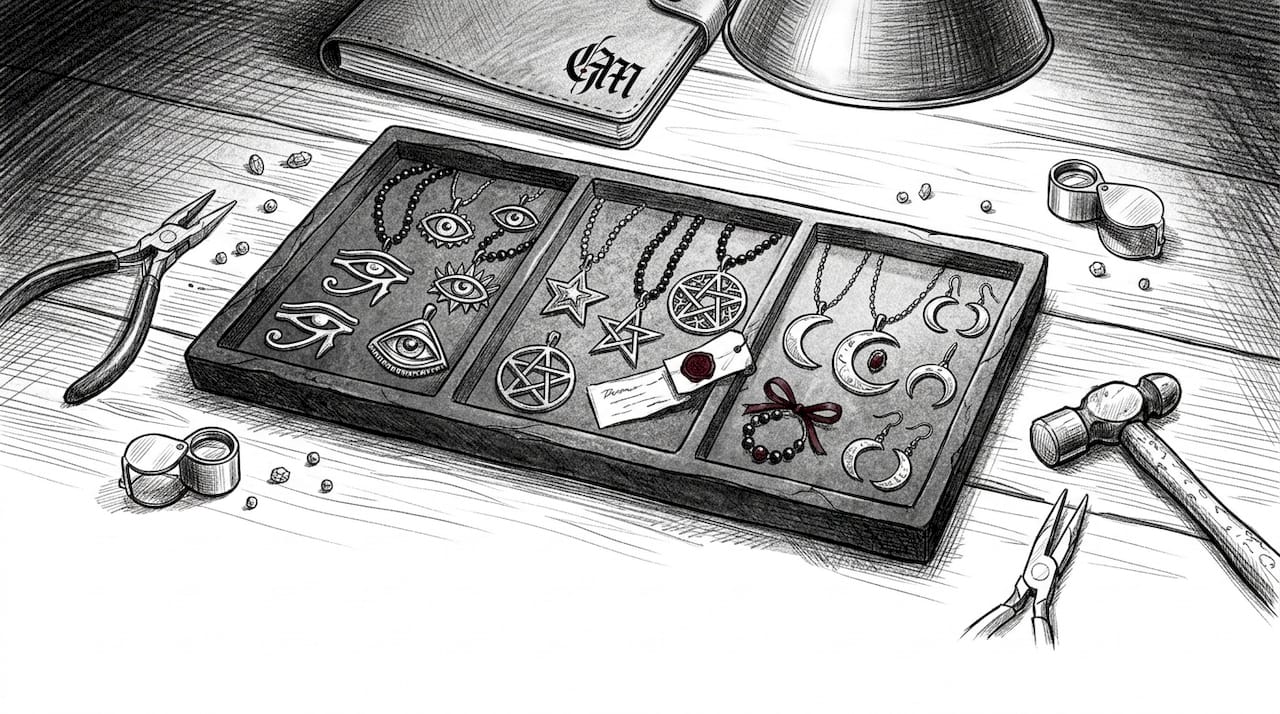
Eye symbols: protection and insight
Eye-symbol jewelry is one of the oldest and most widely recognized categories. The All-Seeing Eye, the Eye of Horus, and the Eye of Isis each carry distinct but related meanings centered on protective wisdom and healing. The Eye of Horus, originating in ancient Egypt, represents royal protection and the restoration of wholeness. The All-Seeing Eye, popularized through Freemasonry and later Western esotericism, signals divine watchfulness and spiritual awareness. Wearing either as a pendant or ring communicates an alignment with insight and warding off negative forces.
Stars and elemental symbols
The pentagram is the defining symbol of Wicca and elemental occultism. It explicitly signals alignment with occult spiritual paths and the five classical elements: earth, air, fire, water, and spirit. The compass rose, originally a navigational tool, carries symbolic weight as a guiding symbol in modern occult jewelry, representing direction, purpose, and the search for one’s path. Both symbols appear frequently on rings, pendants, and earrings across gothic and witchcore aesthetics.
Lunar and divine feminine symbols
Crescent moons and goddess motifs represent cycles, intuition, and feminine spiritual power. These symbols appear across multiple traditions, from ancient Greek worship of Selene to modern Wiccan practice. Crescent moon pendants and triple goddess rings are among the most popular pieces in the witchcore and mystical style categories.
Protective seals and religious medals
The Saint Benedict medal is one of the most layered protective symbols in occult-adjacent jewelry. It combines exorcism prayers with spiritual tradition, functioning simultaneously as a Christian amulet and a broader protective talisman worn across cultures and belief systems. Layering a Saint Benedict medal with a nazar or cornicello reflects a sophisticated personal protection strategy rather than a single-tradition commitment.
Pro Tip: When layering protective symbols from different traditions, choose pieces that share a common material, such as silver, to create visual cohesion without diluting the individual meaning of each symbol.
2. Materials and craftsmanship in occult jewelry
The material a piece is made from carries as much symbolic weight as the symbol itself in most occult traditions.
Gold is associated with solar energy, divine authority, and abundance. It appears frequently in Egyptian-inspired pieces featuring the Eye of Ra or scarab motifs. Silver connects to lunar energy, intuition, and psychic protection, making it the dominant metal in moon-symbol and Wiccan jewelry. Alternative metals like brass and copper carry their own associations: brass with Venus and attraction, copper with energy conduction and healing.
Crystals and gemstones add another layer of meaning. Crystals are marketed for energy cleansing and healing properties, and whether you hold those claims literally or metaphorically, the stones do carry centuries of symbolic association. Black tourmaline is used for protection and grounding. Amethyst signals spiritual clarity and psychic development. Labradorite is associated with transformation and magic. These associations shape how wearers relate to their pieces and how others read them.
Modern occult jewelry merges gothic style with spiritual symbolism, creating wearable art that expresses inner beliefs through design. Handcrafted pieces from independent makers carry a different energy than mass-produced alternatives, not because of any mystical property, but because the maker’s attention and intention are embedded in the object’s history. For collectors, provenance and craft quality matter as much as the symbol itself.
- Handcrafted pieces: Higher cost, unique variation, stronger sense of personal connection
- Mass-produced pieces: Consistent quality, lower price, widely available but less distinctive
- Vintage or antique occult jewelry: Carries historical weight and often features discontinued symbols or techniques
3. Jewelry forms and what they communicate
Each jewelry form serves a different role in occult expression, from commitment and power to subtle identity signals.
| Form | Primary symbolism | Best use |
|---|---|---|
| Rings | Commitment, power, elemental alignment | Daily wear, ritual practice, statement pieces |
| Necklaces and pendants | Core belief, protection, spiritual guidance | Displaying primary symbols close to the heart |
| Earrings | Subtle identity expression, framing the face | Everyday wear, layered looks, secondary symbols |
| Bracelets | Talismanic protection, charm accumulation | Layering multiple symbols, energy work |
Rings in occult culture carry the weight of commitment. A pentagram ring signals active spiritual alignment. A sigil ring, engraved with a personal or traditional magical seal, functions as a portable ritual tool. Many practitioners wear a specific ring on a specific finger based on planetary correspondence: Saturn on the middle finger, Jupiter on the index, Venus on the ring finger.
Necklaces and pendants are the most visible form of occult jewelry and the most direct statement of belief or aesthetic. A celestial moon pendant worn at the throat communicates lunar alignment to anyone who notices it. Pendants displaying the Eye of Horus, pentagram, or Hamsa hand function as both personal protection and public identity markers.
Earrings offer a subtler entry point. A small crescent moon stud or a tiny Eye of Horus drop earring lets you carry occult symbolism without making it the centerpiece of your look. This makes earrings ideal for workplaces or social contexts where you want to express identity without inviting commentary.
Bracelets excel at layering. Stacking a black tourmaline bead bracelet with a silver charm bracelet featuring moon phases and a cord bracelet knotted with protective intentions creates a personal talisman system that builds over time.
4. How wearer intent shapes meaning
The same symbol carries entirely different meanings depending on who wears it and why. A pentagram on one person signals Wiccan practice; on another, it is a gothic aesthetic choice with no spiritual claim attached. Symbols become meaningful through wearer intent rather than through any intrinsic property of the object itself.
This distinction matters when you are building a collection. Aesthetic use is completely valid. Wearing an Eye of Horus because you find it beautiful and historically compelling is a legitimate reason. Wearing it as an active protective amulet with daily intention-setting practice is a different relationship with the same object. Neither is more correct, but knowing which relationship you want helps you choose the right piece.
Marketing shapes this dynamic significantly. Crystal sellers, gothic jewelry brands, and spiritual supply shops all frame their products through specific narratives. A labradorite ring described as “awakening psychic gifts” is the same stone as one described as “a striking dark gemstone with iridescent flash.” The stone does not change. Your relationship to it does, based on the story you accept.
Pro Tip: Before purchasing a piece for spiritual use, write down the specific intention you want it to carry. This practice forces clarity and prevents impulse buying that leaves you with symbols that conflict with each other energetically or aesthetically.
5. Comparing popular occult jewelry types by purpose and budget
Choosing between occult jewelry types becomes clearer when you map symbols against purpose and price point.
| Symbol or type | Primary purpose | Price range | Best wearer profile |
|---|---|---|---|
| Eye of Horus pendant | Protection, healing, insight | $15 to $150 | Anyone drawn to Egyptian mysticism |
| Pentagram ring | Elemental alignment, Wiccan identity | $20 to $200 | Active practitioners or gothic aesthetes |
| Saint Benedict medal | Spiritual armor, exorcism protection | $10 to $80 | Cross-tradition collectors, protective layering |
| Crystal-set talisman | Energy work, intention setting | $30 to $300 | Practitioners who work with gemstone energy |
| Crescent moon necklace | Lunar connection, divine feminine | $15 to $120 | Witchcore enthusiasts, everyday wearers |
For everyday wear, silver or sterling silver pieces with a single clear symbol are the most practical. They resist tarnish better than brass, photograph well, and pair with most clothing. For ritual use, the material correspondence matters more: gold for solar work, silver for lunar, copper for Venusian.
Layering works best when you follow one of two approaches. Either keep all pieces within the same symbol family, such as all lunar symbols, or choose pieces from different families that share a common protective function. Mixing a nazar, a Saint Benedict medal, and an Eye of Horus creates a layered protection system that draws from three distinct traditions without visual or symbolic conflict.
- Start with one anchor piece that represents your primary spiritual or aesthetic alignment
- Add secondary pieces that complement rather than compete with the anchor
- Limit active ritual pieces to three at a time to maintain intentional focus
Key takeaways
Occult jewelry carries meaning through its symbols, materials, and the wearer’s conscious intent, making informed selection the foundation of a meaningful collection.
| Point | Details |
|---|---|
| Symbol families define function | Eye symbols protect, stars align, lunar motifs connect to intuition, seals armor against harm. |
| Materials carry their own symbolism | Silver serves lunar and psychic work; gold serves solar and divine authority; crystals add layered intention. |
| Jewelry form shapes expression | Rings commit, pendants declare, earrings suggest, bracelets accumulate and layer meaning over time. |
| Intent determines meaning | The same symbol serves aesthetic, identity, or spiritual purposes depending entirely on the wearer’s relationship to it. |
| Layering requires strategy | Combine symbols from the same family or shared function to build coherent personal talisman systems. |
Why I think most people approach occult jewelry backwards
Most people pick a piece because it looks striking, then search for a meaning that justifies the purchase. That is not wrong, but it produces collections that feel scattered rather than intentional. After years of working with occult aesthetics and watching how people build their collections, I have found that the most satisfying pieces are chosen in reverse: start with a question or a need, then find the symbol that answers it.
The Eye of Horus did not become meaningful to me because I read about it. It became meaningful because I was looking for something that represented both protection and clarity at the same time, and that symbol delivered both in a single image with thousands of years of use behind it. That history matters. A symbol worn by millions of people across millennia carries a kind of cultural gravity that a newly invented sigil simply does not have.
The other thing I would push back on is the idea that occult jewelry is becoming more mainstream and therefore less meaningful. The symbols have not changed. The Eye of Horus means what it has always meant. If anything, wider exposure gives you more opportunities to find well-crafted pieces from independent makers who understand the symbolism in gothic fashion and take it seriously. Build slowly. Choose deliberately. Wear what you actually believe in, whether that belief is spiritual, aesthetic, or historical.
— Rey
Find your next piece at Goth
Goth curates occult and gothic jewelry from independent creators who understand the difference between a symbol and a decoration. The Whimsygoth collection brings together rings, necklaces, earrings, and bracelets spanning lunar motifs, eye symbols, pentagrams, and crystal-set talismans. Every piece is selected for its symbolic integrity and craft quality, not mass-market appeal. Whether you are building your first intentional collection or adding to an existing practice, Goth connects you with makers who take the work seriously.
Browse the full range of occult and gothic jewelry and find the piece that answers the question you have been carrying.
FAQ
What are the main types of occult jewelry?
The main types are eye-symbol jewelry, star and elemental pieces, lunar and goddess motifs, protective seals and medals, and crystal-set talismans. Each category draws from a distinct spiritual tradition and serves a different purpose, from protection to identity expression.
What does a pentagram mean in occult jewelry?
The pentagram is the primary symbol of Wicca and elemental occultism, representing the five classical elements and explicit alignment with an occult spiritual path. It functions as both a spiritual identifier and a gothic aesthetic statement depending on the wearer’s intent.
How do I choose occult jewelry that matches my intent?
Identify the function you want first, whether protection, spiritual alignment, or aesthetic expression, then select a symbol with a documented history in that role. Materials matter too: silver for lunar and psychic work, gold for solar energy, and specific crystals for targeted intentions.
Can you layer different occult symbols together?
Layering multiple symbols like the Eye of Horus, nazar, and Saint Benedict medal reflects a nuanced personal protection strategy and is a recognized practice in occult traditions. Keep layered pieces within the same function or material family for visual and symbolic coherence.
Is handcrafted occult jewelry better than mass-produced?
Handcrafted pieces carry a stronger sense of personal connection and often feature more precise symbolic detail, but mass-produced pieces are consistent and accessible. For ritual use, provenance and maker intention matter more than production method.