

Why Choose Occult Jewelry: Symbolism, Style, and Self
TL;DR:
- Occult jewelry has deep historical roots across various cultures, symbolizing protection and spiritual connection.
- Its meaning varies with user intent and context, serving aesthetic, protective, or identity purposes.
Most people who see a pentagram necklace assume they know what it means. They’re usually wrong. The question of why choose occult jewelry goes far deeper than aesthetic preference. It touches on identity, cultural history, personal ritual, and the very human desire to wear your values on your skin. Whether you’re drawn to runic pendants, crescent moon rings, or serpent chokers, understanding what you’re wearing and why makes the difference between a costume piece and something that genuinely resonates. This guide breaks down the history, the symbolism, the psychology, and the practical choices you’ll face.
Table of Contents
- Key Takeaways
- Why Choose Occult Jewelry: the historical case
- How meaning changes with intent and context
- Occult jewelry as identity and personal armor
- Practical choices: style, scale, and material
- My perspective on what makes occult jewelry matter
- Find your piece at Goth
- FAQ
Key Takeaways
| Point | Details |
|---|---|
| Deep roots in history | Occult symbols in jewelry trace back thousands of years across many world cultures. |
| Meaning shifts with intent | The same symbol can be decorative, spiritual, or identity-based depending on wearer and context. |
| Identity and confidence | Wearing occult jewelry builds a visible sense of self within alternative communities. |
| Material and scale matter | Size, material, and design detail shape how a piece reads socially and personally. |
| Informed choice is better | Understanding a symbol’s history protects against misreadings and strengthens personal connection. |
Why Choose Occult Jewelry: the historical case
Before occult jewelry became a staple of alternative fashion, it was doing serious cultural work. Protective amulets and symbol-laden pendants appear across virtually every ancient civilization. Egyptian scarabs, Greek Gorgon medallions, Celtic knotwork torcs, and Norse Thor’s hammer pendants all served similar purposes: to connect the wearer to protective forces, mark group membership, or carry compressed spiritual meaning in a portable form.
Here’s what most modern buyers don’t know. Archaeologists have found that Viking amulets varied dramatically in how they were worn and used. Some were kept close to the body through constant use. Others were mounted in homes or paired with Christian crosses, showing that early wearers moved fluidly between spiritual frameworks without apparent contradiction. That nuance is worth carrying into modern choices.
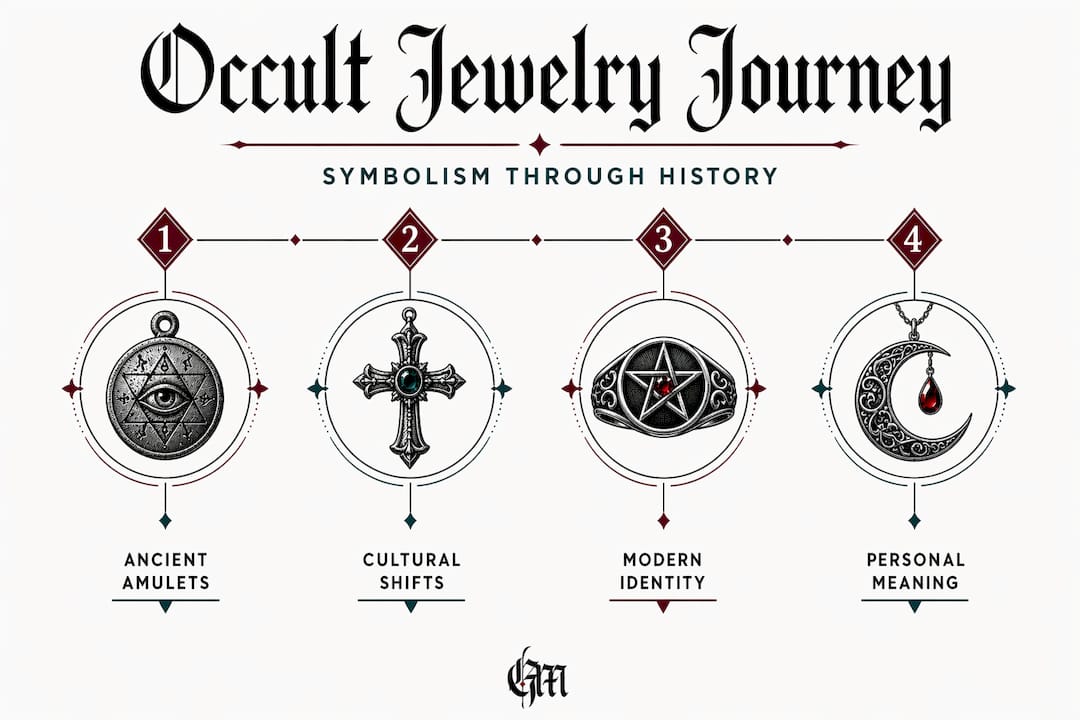
The table below shows how major occult symbols evolved across time and culture:
| Symbol | Origin culture | Historical function | Modern use |
|---|---|---|---|
| Pentagram | Ancient Mesopotamia and Greece | Mathematical harmony, protective geometry | Wiccan faith, gothic aesthetics |
| Crescent moon | Near East, ancient Rome | Lunar deity connection, feminine power | Witchcraft, celestial fashion |
| Runes | Germanic and Norse peoples | Divination, communication, protective inscription | Norse spirituality, alternative jewelry |
| Eye of Horus | Ancient Egypt | Healing, protection from evil | Spiritual protection, streetwear |
| Serpent / Ouroboros | Egypt, Greece, alchemy | Cycles of life, death, and rebirth | Occult, philosophical identity wear |
The word “occult” itself simply means “hidden.” For centuries, occult knowledge referred to any system of understanding that fell outside mainstream religious doctrine. Alchemy, astrology, and ritual magic all qualified. Wearing symbols tied to these traditions was, in many historical periods, a quiet declaration of alternative thinking. That thread connects directly to why people wear occult jewelry today.
Pro Tip: Before purchasing a symbol-based piece, spend ten minutes researching its documented historical origins. You’ll wear it with more confidence and be able to speak to its meaning if someone asks.
How meaning changes with intent and context
This is where things get genuinely interesting. A pentagram pendant means something different on a Wiccan practitioner than on a heavy metal fan than on a teenager who just thinks it looks cool. None of those interpretations is wrong. But they’re not the same thing either.
Occult symbol meaning depends heavily on the wearer’s intent and the social context in which the piece is worn. A symbol displayed in a spiritual ritual space communicates something entirely different from the same symbol worn to a job interview. This isn’t a flaw in occult jewelry. It’s one of its defining qualities.
Here’s the practical breakdown of how intent shapes meaning:
- Decorative: You love the geometry of a pentagram or the elegant spiral of a triquetra. No specific spiritual claim is attached. The piece is aesthetic first.
- Protective: You believe the symbol carries defensive energy or connects you to protective forces. Protective symbol jewelry functions as a grounding ritual object and a tangible source of reassurance.
- Identity-based: The symbol marks your belonging to a tradition, subculture, or philosophical lineage. It tells others something about your worldview without you having to say a word.
- Spiritual practice: The piece is used in ritual, meditation, or intentional energy work. Its meaning is active and participatory rather than passive.
Context and marketing claims about energy or manifesting also shift how viewers perceive a piece. A pendant sold in a “manifestation” context carries different cultural signals than the same design sold as gothic fashion, even if the object is physically identical.
The risk of misinterpretation is real but manageable. Some Norse symbols, for instance, have been appropriated by political groups in recent decades, meaning wearers may face social misreadings they did not intend. Understanding that history before choosing a piece is basic informed practice, not overcaution.
Pro Tip: If a symbol matters to you spiritually, read about its documented origins across cultures before buying. The context you understand is the context you can communicate.
Occult jewelry as identity and personal armor
Jewelry has always been social technology. It signals wealth, status, and belonging. Occult jewelry adds another layer: it signals who you are inside, not just what group you belong to externally.
Gothic and alternative jewelry functions specifically as identity armor. That phrase captures something real. When you put on a piece that reflects your actual values and aesthetic, your posture changes. Your presence in a room shifts. The psychological effect is not trivial.
Here’s how occult jewelry for spiritual growth and self-expression typically works in practice:
- Claiming a visible identity. Wearing an eye of Horus pendant or a lunar crescent ring tells other people something true about you before you open your mouth. That efficiency matters, especially in alternative communities where shared symbols build instant recognition.
- Building confidence through alignment. When your external appearance matches your internal sense of self, the dissonance that drains energy disappears. That alignment is one of the real advantages of wearing occult jewelry that rarely gets discussed.
- Layering complexity. Consumers who layer multiple symbolic pieces reflect multiple aspects of identity and intention simultaneously. A crescent moon for spirituality, a serpent for transformation, and a rune pendant for protection worn together tell a richer story than any single piece can.
- Marking personal milestones. Many wearers choose occult pieces to mark transitions. A new moon ring acquired during a period of personal change becomes a physical record of who you were becoming.
“Gothic jewelry shifts self-perception and influences how others respond. It’s not just about looking different. It’s about feeling like yourself.” — insight drawn from identity armor research
You can explore how this connection between jewelry and personal identity plays out in the occult jewelry meaning guide from Goth to understand how different symbols serve different self-expression functions.
Practical choices: style, scale, and material
Knowing why you want occult jewelry is half the work. The other half is choosing well. And that requires understanding a few practical dimensions that most buying guides skip.
Scale communicates a lot. Documented Norse jewelry, for example, shows that 2 to 3 cm pendants read as personal and discreet, while 5 to 6 cm pieces function as clear statement jewelry. The size you choose affects whether your piece starts a conversation or simply reinforces your personal sense of self.
| Style | Best for | Symbolic weight | Social visibility |
|---|---|---|---|
| Small pendant necklace | Daily wear, subtle symbolism | Personal / private | Low to medium |
| Statement ring | Self-expression, ritual wear | Identity marking | Medium |
| Layered necklaces | Complex identity, spiritual layering | Multiple intentions | Medium to high |
| Choker with symbol | Gothic aesthetic, subcultural signal | Community belonging | High |
| Cuff or bracelet | Everyday protection symbolism | Protective intent | Low to medium |
Material choices carry their own signals. Sterling silver has centuries of association with lunar energy and protection in Western occult tradition. Brass and bronze read as more ancient, connecting to alchemical and historical aesthetics. Blackened or oxidized metals communicate gothic sensibility clearly. The material is not just about durability. It participates in the meaning.
The costume piece problem is real. A cheaply made pentagram pendant with no finishing or weight to it reads differently than a well-crafted piece from an independent artist who actually works in the tradition. This is not about price alone. It’s about whether the piece feels like it was made with intention or churned out to capitalize on a trend. Goth’s occult symbolism history guide can help you develop the visual literacy to tell the difference.
One more consideration: public perception. If you work in an environment with dress codes or conservative social expectations, a small lunar symbol reads very differently from a large inverted pentagram. Neither choice is wrong, but making it consciously keeps you in control of your own story.
My perspective on what makes occult jewelry matter
I’ve thought about this a lot, and my honest take is that occult jewelry’s most underrated quality is how it forces you to commit to intentionality. Most fashion choices are purely reactive: you like how something looks, you buy it, you wear it, you forget it. Occult jewelry resists that pattern.
When I see someone wearing a carefully chosen runic pendant or a well-made serpent ring, what I’m actually seeing is evidence of self-inquiry. They asked themselves what they believe, what they value, what they want to project and protect. That process is worth more than the object itself.
What I’d caution against is wearing symbols you haven’t examined. Not because there’s anything dangerous in it, but because you lose the actual advantage. The whole point of occult jewelry for spiritual growth is that the symbol keeps its meaning active in your daily awareness. If you don’t know what it means, it can’t do that work.
I’m also genuinely skeptical of the idea that any piece of jewelry is inherently “dark.” The crescent moon was sacred to dozens of ancient cultures long before it became a goth staple. The serpent appears in protective, healing, and wisdom traditions across every inhabited continent. Understanding that complexity turns a piece of jewelry from a signal into a conversation.
— Rey
Find your piece at Goth
If you’ve made it this far, you already know more about occult jewelry than most people who wear it. That knowledge is exactly what Goth’s curated collection was built for.
Goth’s jewelry collection brings together independent makers and artists who work specifically within gothic, occult, and alternative traditions. You’ll find everything from delicate crescent pendants designed for daily wear to larger statement rings built for subcultural visibility. The pieces are made with material awareness and symbolic intention, not just aesthetic trend-chasing. For those drawn to the whimsical side of occult aesthetics, the whimsygoth collection offers moon-and-magic inspired pieces that blend spiritual symbolism with a lighter, playful sensibility. Start with what resonates and build from there.
FAQ
What does occult jewelry actually symbolize?
Occult jewelry draws from ancient traditions across cultures, with symbols like pentagrams, runes, and lunar crescents historically representing protection, spiritual connection, and philosophical worldviews. The specific meaning depends on the symbol’s origin and the wearer’s intent.
Why do people wear occult jewelry?
Why people wear occult jewelry varies widely. Motivations include aesthetic preference, subcultural identity, spiritual practice, and the psychological grounding that comes from wearing symbols that reflect personal values.
Is occult jewelry connected to religion or spirituality?
Some wearers use occult jewelry as part of active spiritual or ritual practice, while others wear it purely for aesthetic or identity reasons. Wearer intent and context determine meaning far more than the symbol itself.
What are the practical advantages of wearing occult jewelry?
The core advantages of wearing occult jewelry include visible self-expression, psychological alignment between inner values and outer appearance, community belonging within alternative subcultures, and a daily reminder of personal beliefs or intentions.
How do I choose occult jewelry that won’t be misunderstood?
Research the documented history of any symbol you’re considering, be aware of contemporary social associations, and choose scale and style appropriate to your environment. Some Norse symbols have been appropriated in ways that can cause misreadings, so informed selection protects your intended meaning.