

Types of Witchy Motifs: A Guide to Symbolic Design
TL;DR:
- Witchy motifs are symbolic designs rooted in elemental forces, lunar cycles, protective symbols, and cosmic patterns used in spiritual and aesthetic practices. These categories serve different functions, such as conveying intentions, providing protection, or representing universal connections, and are most effective when combined intentionally. Personal sigils, layered motifs, and consistent use of meaningful symbols enhance magical power, emphasizing that intent is more important than the motif itself.
Witchy motifs are symbolic designs rooted in elemental forces, lunar phases, protective emblems, and cosmic patterns used in witchcraft and alternative aesthetics. The four core categories are elemental, lunar, protective, and cosmic symbols, and each one carries distinct meaning for spiritual practice, fashion, and decor. Whether you are building an altar, choosing jewelry, or designing a tattoo, understanding these categories gives you a framework for making choices that are both visually powerful and personally meaningful.
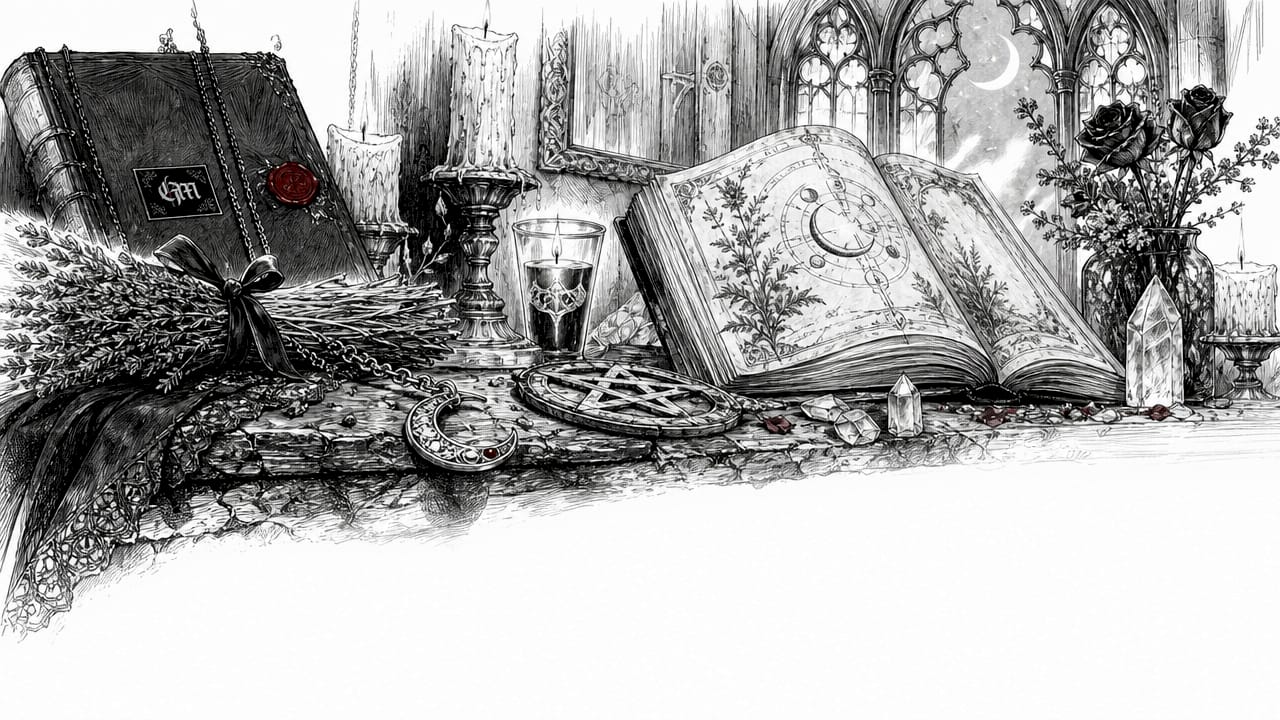
1. What are the elemental witchy motifs and their meanings?
Elemental symbols are the foundation of witch symbolism, and the Pentagram sits at the center of this category. Each point represents one of five forces: Earth, Air, Fire, Water, and Spirit. The Pentacle, which is the Pentagram enclosed in a circle, is one of the most widely recognized symbols in witchcraft and is used for protection and harmony. Its circular border signals wholeness, making it a natural choice for rings, pendants, and embroidered jacket patches.
Beyond the Pentacle, elemental motifs include:
- Earth symbols: Stones, roots, and downward-pointing triangles representing grounding and stability
- Fire symbols: Upward-pointing triangles, flames, and salamander imagery representing transformation and will
- Water symbols: Chalices, crescent bowls, and wave patterns representing intuition and emotion
- Air symbols: Feathers, spirals, and swords representing intellect and communication
- Spirit symbols: The full Pentagram, the Ankh, and the Ouroboros representing the divine and the eternal cycle
These motifs appear across witchcore fashion in embroidered patches, printed fabrics, and cast metal hardware. A fire triangle on a belt buckle reads as bold and transformative. An earth-toned stone pendant reads as grounded and quiet. The visual language is consistent once you know what each shape signals.
Pro Tip: Layer two or three elemental motifs that correspond to your personal intention. Pairing a water chalice necklace with a fire triangle ring creates a visual tension that reflects balance rather than contradiction, and that contrast is exactly what makes the combination interesting.
2. How do lunar witchy motifs convey spiritual phases and cycles?
Lunar motifs are among the most recognizable spiritual motifs examples in witchcraft, and the Triple Moon is the most loaded of them all. The Triple Moon signifies the maiden, mother, and crone phases, representing the full lifecycle and the cycles of intuition. Popularized in 20th-century Wicca, it appears in moon cycle workings and goddess-oriented altar setups. On a practical level, it translates beautifully into jewelry, wall art, and embroidered textiles.
The broader lunar category includes several distinct motifs:
- Waxing crescent: Growth, intention-setting, and new beginnings
- Full moon: Power, clarity, and manifestation at its peak
- Waning crescent: Release, banishing, and letting go
- Triple Moon: The complete goddess cycle, unity of all three phases
- Black moon: Rare lunar events associated with deep shadow work and hidden knowledge
Applying lunar motifs in decor works best when you treat them as a sequence rather than isolated images. An altar shelf displaying waxing, full, and waning moon ceramics tells a story of cyclical energy. In jewelry, the Triple Moon pendant worn close to the throat connects the symbol to voice and intuition, which aligns with its traditional meaning. Occult-inspired jewelry frequently uses oxidized silver settings for lunar pieces because the dark metal reinforces the moon’s association with night and mystery.
3. What roles do protective witchy motifs play in magic and aesthetics?
Protective symbols are the category most directly tied to function in magical practice. The Witch’s Knot and Evil Eye serve binding and protective functions and appear in Italian folk magic and other traditions. The Witch’s Knot is drawn in one continuous line, which is why it carries associations with binding and unbroken defense. The Evil Eye, known in Turkish as Nazar, deflects harmful intentions directed at the wearer.
Common protective motifs and their primary functions:
- Witch’s Knot: Binding, protection from harm, and containment of negative energy
- Evil Eye (Nazar): Deflection of ill will and envy, widely used in Mediterranean and Middle Eastern traditions
- Hamsa: Palm-shaped amulet representing divine protection, shared across Jewish, Islamic, and North African traditions
- Hex signs: Geometric circular designs from Pennsylvania Dutch folk art used to bless and protect homes
- Runes: Specifically Algiz (protection) and Thurisaz (defense) from the Elder Futhark alphabet
These motifs move easily from magical practice into everyday fashion. A Hamsa embroidered on a tote bag, a Nazar bead sewn into a jacket lining, or a Witch’s Knot stamped onto a leather cuff all carry protective intent while reading as intentional design choices. Occult homeware frequently incorporates protective symbols into door hangings, window decals, and threshold objects, which aligns with the folk tradition of marking boundaries with these emblems.
Pro Tip: Create a personal protective motif by combining two symbols that resonate with you. Draw the Witch’s Knot inside a circle and add a single rune at the center. This layered approach produces a symbol that is both historically grounded and uniquely yours.
4. Why are geometric and cosmic symbols central to witchy motif design?
Geometric and cosmic symbols represent the largest category of occult design elements, and they carry the most visual versatility. The Solar Cross, Triquetra, and Tree of Life represent unity, continuity, and cosmic balance, and they appear across jewelry, homeware, and fashion. Their geometric precision makes them scale well from a small pendant to a large wall tapestry without losing visual impact.
| Symbol | Core meaning | Best application |
|---|---|---|
| Solar Cross | Unity of the four directions and solar cycles | Wall art, floor rugs, embroidered outerwear |
| Triquetra | Trinity, continuity, and the three realms | Jewelry, book covers, altar cloths |
| Tree of Life | Connection between earth and cosmos | Large-format prints, carved wood decor |
| Metatron’s Cube | Sacred geometry containing all Platonic solids | Geometric prints, tattooing, tile work |
| Vesica Piscis | The intersection of two worlds, creation | Minimalist jewelry, architectural detail |
Styling these motifs in decor works best when you treat them as focal points rather than background patterns. A single large Tree of Life print above a reading chair anchors a room with intention. A Triquetra carved into a wooden shelf bracket adds symbolic weight without visual clutter. In fashion, geometric cosmic symbols read as sophisticated and considered, which is why they appear so frequently in occult-inspired design across both high-end and independent labels.
The key distinction between cosmic and elemental symbols is scale of reference. Elemental symbols point inward to personal forces. Cosmic symbols point outward to universal structures. Wearing both together creates a visual statement about the relationship between the self and the cosmos, which is one of the central ideas in most witchcraft traditions.
5. How can personal sigils enhance the power and uniqueness of witchy motifs?
Personal sigils are the most customized category of witch motif ideas, and they outperform pre-made symbols as magical tools because of the intentional energy invested in their creation. Sigils created from individual intent and designed to be charged or destroyed after use demonstrate greater magical effectiveness than generic symbols. The process takes under ten minutes and produces a symbol that belongs entirely to you.
The standard method for creating a personal sigil:
- Write your intention as a clear, present-tense statement (“I am protected and grounded”)
- Remove all repeating letters from the statement
- Combine the remaining letters into a single composite symbol by overlapping and abstracting the letterforms
- Charge the sigil through focused meditation, fire, or burying it in earth
- Use it immediately or destroy it to release the intention
Universal symbols like the Pentacle carry collective ancestral meaning, while personal sigils carry individualized power. Both have value, but they serve different purposes. A Pentacle on a necklace signals belonging to a tradition. A personal sigil stitched into the lining of a coat is a private act of magic that no one else can read or replicate.
Practical applications for personal sigils include embroidering them onto clothing, painting them onto candles, carving them into wax seals, or printing them onto sticker paper for use in journals and planners. The sigil’s power comes from the maker’s intent, not from its visual complexity.
Pro Tip: After creating your sigil, photograph it before charging or destroying it. Over time, you build a personal archive of intentions and their outcomes, which becomes one of the most useful tools in any magical practice.
Key takeaways
Witchy motifs fall into four clear categories, and each one serves a distinct purpose in both magical practice and aesthetic design.
| Point | Details |
|---|---|
| Four core categories | Elemental, lunar, protective, and cosmic symbols each carry distinct meanings and applications. |
| Symbols as anchors | Motifs function as visual tools for focused intent, not as sources of power in themselves. |
| Personal sigils outperform generics | Sigils built from individual intention carry more personal potency than pre-made symbols. |
| Layering increases impact | Combining motifs from different categories creates richer visual and symbolic meaning. |
| Subtle integration works best | Repeated, quiet use of symbols in everyday objects is more effective than singular bold displays. |
Why intention matters more than the motif itself
The most common mistake I see people make with witchy symbols is treating the motif as the source of the magic. It is not. Symbols function as visual anchors for personal will during practice, and without conscious intent behind them, they remain decoration. That is not a criticism of decoration. A Triquetra on a throw pillow is beautiful. But if you want it to do something, you have to bring the intention yourself.
What I find more interesting is the folk art tradition of quiet, repetitive symbol use integrated into daily objects. A hex sign painted on a barn door. A protective knot carved into a wooden spoon. These are not theatrical gestures. They are ongoing, low-key acts of intention woven into the texture of daily life. That approach is far more sustainable than a single dramatic ritual, and it is also more honest about how magic actually works.
My advice is to choose two or three motifs that genuinely resonate with you and use them consistently across multiple objects and contexts. A waning moon on your journal cover, a Witch’s Knot on your keychain, a personal sigil inside your coat. That repetition builds a relationship with the symbol over time. The symbol starts to function as a trigger for a particular mental state, which is exactly what a visual anchor is supposed to do.
— Rey
Find your symbols at Goth Market
Goth Market curates witchy fashion, occult jewelry, and dark decor from independent creators who understand the difference between decoration and intention. Every piece in the collection is selected for its symbolic weight and aesthetic quality, not mass-market appeal. Whether you are looking for a Triple Moon pendant, a Pentacle ring, or altar-ready homeware featuring protective and cosmic symbols, you will find it sourced from makers who take the craft seriously. Explore the full collection at Goth Market and build a wardrobe and living space that reflects exactly what you stand for.
FAQ
What are the main types of witchy motifs?
The four main categories are elemental, lunar, protective, and cosmic symbols. Each category includes specific designs such as the Pentagram, Triple Moon, Witch’s Knot, and Solar Cross.
What are witchy symbols used for in fashion and decor?
Witchy symbols appear on jewelry, embroidered clothing, altar objects, and homeware as both aesthetic statements and intentional magical tools. Their effectiveness depends on the wearer’s conscious intent rather than the symbol itself.
How do I create my own witchy motif?
Write a clear intention, remove repeating letters, and combine the remaining letterforms into a composite sigil. This process takes under ten minutes and produces a personal symbol with more individualized power than pre-made designs.
What is the difference between a Pentagram and a Pentacle?
The Pentagram is a five-pointed star where each point represents one of the five elements including Spirit. The Pentacle is the same star enclosed within a circle, which adds a layer of wholeness and protection to the symbol.
Which witchy motifs work best for beginners?
The Pentacle and Triple Moon are the most accessible starting points because their meanings are well-documented and their visual forms are immediately recognizable across witchcraft traditions.