

Crystals in Witchcraft: A Practical Guide for Practitioners
Crystals serve as physical anchors and amplifiers for intention in witchcraft, used to focus attention, symbolize a desired outcome, absorb unwanted energy, or support divination. Practitioners treat them as tools that concentrate and hold intent, not as independent magical agents. Three core uses appear across nearly every tradition:
- Intention amplification and manifestation: Stones like clear quartz and citrine are placed on altars or carried to reinforce a specific goal.
- Protection and absorption: Black tourmaline and smoky quartz are positioned at thresholds or worn to absorb negative energy before it reaches the practitioner.
- Divination and meditation: Reflective or translucent stones, including clear quartz spheres and selenite wands, support scrying and focused meditation.
The Crystal Witch guide at Esoteric Universe recommends a five-stone starter kit (clear quartz, amethyst, rose quartz, black tourmaline, citrine) as the practical foundation for most beginners. Goth carries curated witchcraft supplies, including crystals and occult tools, for practitioners at every level.
Key Takeaways
Crystals in witchcraft function as physical anchors for intention, not independent magical agents, and their effectiveness depends on consistent practice, ethical sourcing, and honest understanding of what they do and do not do.
| Point | Details |
|---|---|
| Crystals anchor intention | Stones work as ritual focus tools, not autonomous sources of power; the practitioner’s intent drives the working. |
| Start with six core stones | Clear quartz, amethyst, rose quartz, black tourmaline, citrine, and selenite cover most beginner needs. |
| Cleanse before charging | Always clear a stone’s accumulated energy before programming it for a new intention. |
| Check water and sun safety | Selenite dissolves in water; amethyst, rose quartz, and citrine fade in prolonged sunlight. |
| Science and practice coexist | No mineralogical research supports metaphysical energy claims, yet structured ritual practice demonstrably sharpens focus and improves perceived outcomes. |
| Goth for curated sourcing | Goth connects U.S. buyers with independent vendors who specialize in witchcraft supplies and can provide stone provenance. |
Table of Contents
- How do practitioners explain how crystals work in magic?
- What kinds of witches use crystals?
- How do you choose the right crystal for your intention?
- How should you prepare, cleanse, and charge crystals before ritual use?
- Which crystals are most commonly used and what are they best for?
- What practical ways can you use crystals in spells and rituals?
- What are the historical roots and cultural contexts for using crystals in ritual?
- How should you care for crystals and buy them ethically and safely?
- How do practitioners today integrate crystals into a modern witchy practice?
- Where can you find curated crystals and witchcraft supplies in the United States?
- Sources
- FAQ
How do practitioners explain how crystals work in magic?
The short answer: practitioners offer several overlapping models, none of which current mineralogical science supports as literal physical mechanisms, yet all of which can function as effective psychological and ritual frameworks.
The most common explanation is vibrational correspondence. Each mineral is said to carry a distinct energetic frequency that resonates with specific intentions, emotions, or planetary forces. Amethyst, for instance, corresponds to calm and psychic clarity; citrine to abundance and solar energy. This model draws on Renaissance hermetic thought, where every material thing was believed to participate in a web of cosmic sympathies.
A second model is sympathetic magic. A green stone like aventurine “sympathizes” with growth and money because green is the color of both. The stone becomes a physical symbol that the practitioner’s mind can grip, making the intention concrete rather than abstract.
The scientific position is straightforward: no peer-reviewed mineralogical research supports the idea that crystals emit measurable metaphysical energy or influence outcomes beyond the practitioner’s own psychology. What the research does support is that structured ritual behavior, including handling a meaningful object, can sharpen focus, reduce anxiety, and improve perceived outcomes. The crystal functions as an anchor for attention, the same way a rosary bead or a worry stone does. That is not a dismissal of the practice; it is an honest framing of where the power actually lives.
Pro Tip: Treat your crystal as a prompt, not a proxy. The clearer your stated intention when you pick it up, the more useful the stone becomes as a ritual focus, regardless of which metaphysical model you subscribe to.
Medieval lapidaries and historical sources recorded widely held beliefs in the medicinal or magical properties of stones, with references appearing in Chaucer and in texts printed by Caxton, as noted by the Gemological Society’s history of carnelian. Those texts influenced the correspondence charts practitioners use today.
What kinds of witches use crystals?
Crystals appear across a wide range of witchcraft traditions, though the depth of use varies considerably.
Heavy users:
- Crystal witches and gem witches center their entire practice on minerals, using grids, collections, and stone-specific spells as primary tools.
- Wiccan practitioners incorporate crystals through elemental and planetary correspondences, often placing them on the altar at the four quarters.
- Eclectic witches pull from multiple traditions and typically include crystals as one tool among many, mixing them with herbs, candles, and sigils.
Moderate or selective users:
- Hedge witches and kitchen witches tend to favor practical, locally available stones, often preferring found stones with personal resonance over purchased mineral specimens.
- Solitary practitioners make up a large share of crystal users in the United States; without a coven structure, they often self-direct their practice using books and online guides.
The Grimoire guide to crystals for witches identifies two distinct streams in modern stone practice. The folk-stone stream values found stones, hag stones, and landscape-linked objects; the stone’s power comes from where it was found and what it witnessed, not from a mineral chart. The correspondence-based stream maps specific minerals to intentions, planets, elements, and chakras, and is the dominant approach in most contemporary Wiccan and eclectic practice.
Your tradition, or lack of one, shapes which approach fits. A hedge witch might carry a river pebble from a meaningful location; a Wiccan might place a specific amethyst at the north quarter of a cast circle. Neither is more valid than the other.
How do you choose the right crystal for your intention?
Selection does not need to be complicated. A repeatable four-step method works for most practitioners.
- Identify your intention clearly. Write it down in one sentence before you look at a single stone. Vague intentions produce vague selections. “I want more money” is less useful than “I want clarity and confidence in my job search.”
- Research correspondences. Cross-reference two or three sources (a printed lapidary, a practitioner guide, and your own intuition). Look for stones that appear consistently across sources for your intention. Citrine and pyrite appear repeatedly for abundance; black tourmaline and obsidian for protection.
- Test for personal resonance. Hold the stone in your non-dominant hand for thirty seconds. Notice whether you feel drawn to it, neutral, or subtly repelled. This is not mystical gatekeeping; it is a way of checking whether your subconscious has already formed an association with the stone.
- Check practical constraints. Some stones are fragile (selenite scratches easily), water-soluble (halite dissolves), or contain trace heavy metals (malachite dust is toxic; never make a malachite elixir). Confirm care requirements before you commit to a stone you plan to carry daily or use in a bath.
Beginner picks and why they work:
- Clear quartz: Amplifies any intention; substitutes for almost any other stone. Widely available and inexpensive.
- Amethyst: Calm, psychic clarity, sleep support. One of the most forgiving stones to work with.
- Rose quartz: Self-love, relationships, emotional healing. Gentle energy that suits most intentions.
- Black tourmaline: Protection, grounding, energy absorption. A practical daily-carry stone.
- Citrine: Abundance, confidence, solar energy. One of the few stones that many practitioners say does not need frequent cleansing.
- Selenite: Cleansing and charging other stones; altar maintenance. Not for water use.
Pro Tip: A collection of six stones you work with weekly beats a shelf of forty you never touch. Buy one stone, use it for a month, then add another. Avoid suspiciously cheap bulk lots online — stones sold without provenance are often mislabeled or treated.
How should you prepare, cleanse, and charge crystals before ritual use?
Cleansing removes energy a stone has absorbed since you last used it. Charging sets a specific intention into the stone for the working ahead. They are distinct steps, and skipping cleansing before charging is like recording over a tape without erasing it first.
Cleansing methods
- Selenite tray or plate: Rest stones on a selenite slab overnight. Passive, safe for almost all stones, and requires no water. The one exception: do not stack selenite on selenite, as both are soft (Mohs 2).
- Smoke or smudging: Pass the stone through the smoke of burning herbs (rosemary, cedar, or mugwort are common). Effective and safe for all stone types.
- Sound: Strike a singing bowl or use a tuning fork near the stone. Vibration is considered to dislodge stagnant energy and is safe for every mineral.
- Running water: Hold the stone under cool running water for 30–60 seconds while visualizing the stone clearing. Caution: Do NOT use water with selenite, halite, kyanite, pyrite, malachite, or any stone rated below Mohs 5. Water dissolves or damages them.
- Moonlight: Place stones on a windowsill or outdoors under a full moon overnight. Safe for all stones and doubles as a light charge.
Charging methods
- Full-moon charging: Leave cleansed stones under moonlight with a written intention nearby. The full moon is the most common charging window in contemporary practice.
- Breath and intent programming: Hold the stone to your lips, breathe out slowly, and state your intention aloud or silently three times. Simple and effective for any stone.
- Clear quartz amplification: Place the stone you want to charge next to a clear quartz point, with the quartz tip facing the stone. Clear quartz is widely used as an amplifier in grids and charging setups.
- Earth burial: Wrap the stone in a cloth and bury it in soil for 24 hours. Grounding and effective, though not practical for daily use.
- Sunlight caution: Brief sunlight (under an hour) charges many stones well, but prolonged exposure fades amethyst, rose quartz, citrine, and fluorite. Keep sun-charging sessions short.
Pro Tip: Cleanse a new stone before its first use. It has passed through many hands between the mine and your altar, and starting with a cleared stone gives your intention a cleaner signal.
A simple five-step ritual template
- Set a clear intention in writing before you begin.
- Cleanse the stone using smoke, sound, or a selenite plate.
- Program the stone by holding it and stating your intention three times.
- Place the stone where it will work: on your altar, in your pocket, under your pillow, or at a grid point.
- Give thanks and close the ritual with a grounding breath or a brief spoken acknowledgment.
The Yoga Journal crystal rituals guide describes this kind of stepwise ritual structure as a repeatable, teachable skill that sharpens focus and improves perceived outcomes independent of any mineral claim.
Which crystals are most commonly used and what are they best for?
The eight stones below appear on virtually every practitioner list. The Real Life Witchery top crystals list and the Esoteric Universe crystal witch guide both confirm these as the core working set.
Clear quartz is the universal amplifier. It strengthens any intention and substitutes for stones you do not own. Carry it, place it at the center of a grid, or use it to charge other stones. Water-safe; avoid prolonged direct sunlight. Beginner-friendly and widely available for under $5 per tumbled stone.
Selenite clears and recharges other stones passively, making it the maintenance workhorse of most collections. Use it as a charging plate, a wand for sweeping the aura, or an altar boundary marker. Not water-safe (it dissolves). Soft (Mohs 2), so store it separately. Inexpensive and widely available.
Rose quartz covers self-love, emotional healing, and relationship intentions. Place it on the heart chakra, carry it in a left pocket, or add it to a bath (water-safe). Gentle enough for daily wear. Fades in prolonged sunlight.
Amethyst supports calm, psychic clarity, and sleep. Place it on the third-eye chakra, keep it on a bedside table, or hold it during meditation. Water-safe for brief rinsing. Fades in prolonged sunlight. One of the most beginner-friendly stones available.
Black tourmaline is the go-to protection stone. Place it at doorways, carry it in a right pocket to deflect energy, or use it as an anchor stone in a protection grid. Water-safe for brief rinsing; salt-safe. Durable and widely available.
Citrine carries solar, abundance, and confidence energy. Many practitioners keep it near a cash box or workspace. One of the few stones said not to accumulate negative energy, so it rarely needs cleansing. Water-safe; avoid prolonged sunlight (natural citrine fades; heat-treated amethyst sold as citrine is more stable).
Smoky quartz grounds and transmutes heavy or anxious energy. Use it at the base chakra, carry it during stressful periods, or place it at the corners of a protection grid. Water-safe for brief rinsing; avoid prolonged sunlight.
Green aventurine is linked to luck, growth, and new opportunities. Carry it in a left pocket, place it on a money altar, or use it in a prosperity grid. Water-safe; generally sunlight-stable.
| Crystal | Magical properties / common intentions | How to use | Care and charging notes |
|---|---|---|---|
| Clear quartz | Amplification, all intentions | Carry, grid center, altar, charging plate | Water-safe; avoid prolonged sun |
| Selenite | Cleansing, clarity, protection | Charging plate, wand, altar border | NOT water-safe; store separately |
| Rose quartz | Love, self-care, emotional healing | Carry, heart chakra, bath, altar | Water-safe; fades in prolonged sun |
| Amethyst | Calm, psychic clarity, sleep | Meditation, third-eye chakra, bedside | Water-safe (brief); fades in sun |
| Black tourmaline | Protection, grounding, absorption | Carry, doorways, grid anchor | Water-safe (brief); salt-safe |
| Citrine | Abundance, confidence, solar energy | Carry, workspace, prosperity grid | Water-safe; avoid prolonged sun |
| Smoky quartz | Grounding, transmutation, anxiety | Base chakra, carry, protection grid | Water-safe (brief); avoid sun |
| Green aventurine | Luck, growth, opportunity | Carry, money altar, prosperity grid | Water-safe; sunlight-stable |
What practical ways can you use crystals in spells and rituals?
Three compact ritual examples
1. A simple manifesting grid
Materials: One clear quartz point (master stone), four citrine tumbles, a written intention slip.
Place your written intention under the clear quartz at the center of a flat surface. Set the four citrines at the cardinal points around it, tips or points facing outward. Activate the grid by touching each stone in sequence with a wand or your finger, visualizing energy flowing between them. Leave the grid in place for a lunar cycle or until the intention manifests.
2. A protection charm jar
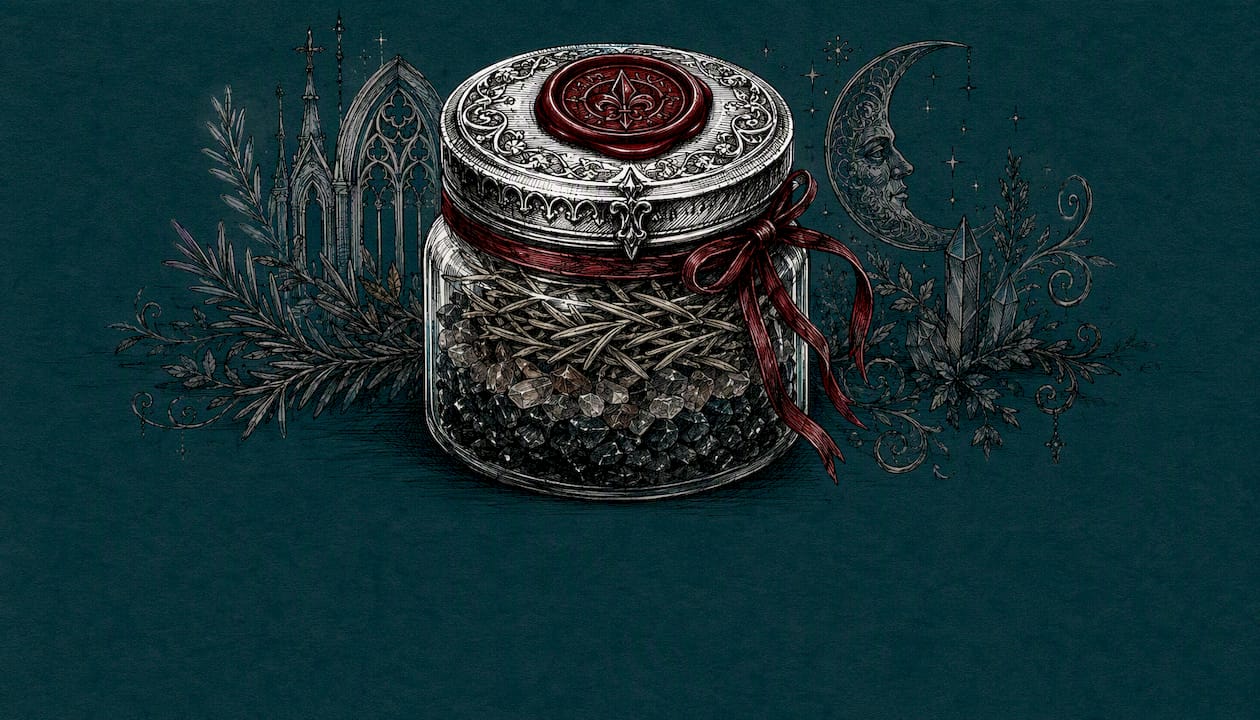
Materials: Black tourmaline chips, smoky quartz chips, dried rosemary, a small jar with a lid.
Layer the herbs and stone chips in the jar, stating your protection intention with each layer. Seal the jar and place it near your front door or carry it in a bag. Recharge monthly by holding the sealed jar and restating the intention.
3. A sleep and support ritual
Materials: Amethyst tumble, selenite wand.
Before bed, sweep the selenite wand over your body from head to feet to clear the day’s accumulated energy. Place the amethyst under your pillow or on your nightstand. State a brief intention for restful sleep or dream clarity. No candles, no elaborate setup.
Everyday use formats
- Carry: Tumbled stones in a pocket or pouch for all-day intention reinforcement.
- Altar placement: Stones arranged by elemental quarter or intention cluster on a working altar.
- Bath infusion: Water-safe stones (rose quartz, clear quartz, amethyst) placed in bathwater for a ritual soak. Confirm water-safety before any stone touches water.
- Sleep placement: Amethyst or selenite near the bed for dream work or energetic clearing overnight.
- Chakra laying: Stones placed directly on the body at corresponding energy centers during meditation or rest.
- Crystal wands: Pointed stones used to direct energy in a specific direction during spellwork or aura work.
For altar setup ideas that integrate crystals with other witchy tools, the witchcraft decor guide at Goth covers spatial arrangement and aesthetic curation in practical detail.
What are the historical roots and cultural contexts for using crystals in ritual?
The use of stones in ritual is not a modern invention, though the specific correspondence systems most practitioners use today are largely a product of the 20th century.
Key historical evidence:
- Kentish crystals: Archaeological finds from Anglo-Saxon England, sometimes called the Kentish spheres, have been interpreted as healing or divinatory objects. Some were silvered on the inside, suggesting use as reflective scrying tools. Scholars disagree sharply about whether these objects reflect a continuous ritual tradition or whether projecting contemporary Neopagan meanings onto pre-modern finds is anachronistic, as the Mystic Crystal Revelations scholarly paper documents in detail.
- Medieval lapidaries: Texts like the Lapidaire tradition recorded stone properties for medicinal and magical purposes throughout the Middle Ages. Chaucer referenced stone-based cures, and Caxton printed lapidary material in early English print runs. These texts are the direct ancestors of modern correspondence charts.
- Crystal gazing and scrying: The practice of using reflective or translucent stones for divination has roots stretching back well before the medieval period in Europe. The term “crystal” historically covered polished glass, beryl, and quartz interchangeably, as Wikipedia’s crystal gazing entry notes.
- Lithomancy: The divinatory practice of reading stones, known as lithomancy, appears across multiple cultures with varying methods, often overlapping with scrying and folk divination traditions, per Wikipedia’s lithomancy entry.
Modern Neopagan practice diverges from these older traditions in one important way: it systematizes correspondences into teachable charts (amethyst = psychic clarity, citrine = abundance) that have no direct equivalent in medieval lapidaries, which were more concerned with physical cures than with elemental or chakra-based energy work. That is not a flaw; it is an honest acknowledgment that contemporary crystal witchcraft is a living, evolving practice rather than a recovered ancient one.
For context on how ritual objects and their provenance are valued in collecting communities, the witchcraft art collecting guide at Goth offers useful framing.
How should you care for crystals and buy them ethically and safely?
Safety cautions
A handful of stones require specific handling awareness:
- Selenite and halite dissolve in water. Never soak them, and keep them away from humid storage.
- Malachite contains copper and produces toxic dust when cut or polished. Avoid making water elixirs with raw malachite; tumbled, polished malachite is generally safe to handle.
- Pyrite can oxidize and release sulfur compounds in prolonged water contact. Keep it dry.
- Soft stones (Mohs 1–4, including selenite, talc, and fluorite) scratch easily and should be stored separately from harder minerals.
Ethical buying checklist for U.S. buyers
The crystal market has significant supply-chain opacity. These steps reduce the risk of buying mislabeled, synthetically treated, or unethically sourced stones:
- Ask the vendor for mine or region of origin. Reputable small dealers can usually name the country and often the specific mine.
- Prefer vendors who specialize in crystals over general gift shops or mass-market platforms selling bulk lots without provenance.
- Be skeptical of unusually cheap prices on rare minerals. A genuine, high-quality moldavite or larimar at a fraction of the market rate is almost certainly treated, synthetic, or misidentified.
- Consider secondhand stones from estate sales or other practitioners. A stone’s history does not diminish its usefulness, and secondhand buying reduces demand for new extraction.
- For crystal jewelry, the occult jewelry collecting guide at Goth covers care and provenance questions specific to wearable pieces.
Storage tips
Keep amethyst, rose quartz, and citrine away from windowsills where direct sunlight hits daily. Use soft cloth pouches for soft minerals. A selenite plate on a shelf provides passive clearing for stones stored nearby without any additional effort.
How do practitioners today integrate crystals into a modern witchy practice?
The practitioners who seem most grounded in their crystal work share a few habits that are worth naming plainly.
They keep small, curated kits rather than large collections. Six stones used consistently outperform forty stones arranged decoratively on a shelf. The selection tends to reflect actual working intentions: a protection stone, an amplifier, a stone for the practitioner’s dominant working area (love, abundance, clarity), and selenite for maintenance.
Ethical sourcing has become a genuine concern in contemporary practice, not just a marketing talking point. Many practitioners in the United States now ask about mine origin before purchasing, prefer small independent vendors over mass-market platforms, and acknowledge that the crystal supply chain has real environmental and labor costs. This aligns with a broader cultural-respect principle that appears in contemporary witchcraft communities: borrowing practices from other traditions requires acknowledgment, and purchasing crystals extracted under exploitative conditions contradicts the care-based ethics most practitioners articulate.
The integration of crystals with other tools, herbs on an altar, candles for elemental correspondence, moon cycle timing, tends to produce more focused ritual work than crystals used in isolation. The moon cycle is the most common timing framework: new moon for setting intentions and programming stones, full moon for charging and releasing.
One principle worth stating directly: most experienced practitioners do not send magic toward other people without consent, including protective or loving intentions. A crystal grid built for someone else’s benefit is generally considered appropriate only when that person has asked for it.
Where can you find curated crystals and witchcraft supplies in the United States?
Finding quality crystals with real provenance is harder than it looks. Most mass-market platforms carry bulk lots with no mine information, inconsistent labeling, and prices that reflect volume over quality.

Goth is a curated marketplace connecting independent vendors and artisans who specialize in witchcraft supplies, occult tools, dark decor, and alternative aesthetics. Rather than sourcing from a single warehouse, the platform brings together small creators and specialist sellers, which means you can ask the vendor directly about stone origin and handling. Goth operates on a commission-based model, so the sellers you find there are independent makers and dealers, not a faceless reseller.
Before purchasing any crystal through the marketplace, check the individual vendor’s provenance notes and care instructions. For wearable crystal pieces, the occult jewelry guide at Goth covers what to look for in crystal-set pieces. Browse the full witchcraft supplies selection at Goth to find stones, tools, and altar pieces from vetted independent sellers.
Sources
- Mystic Crystal Revelations: Crystals in Ritual Practice and Folk Belief from the Iron Age to the Age of Aquarius
- Crystal Witch: Complete Gem Magic Guide for Beginners
- Crystals for Witches: Types, Uses and Care | Grimoire
- Crystal rituals - Yoga Journal
- Top 10 Crystals For Witches - Real Life Witchery
FAQ
What is the role of crystals in witchcraft?
Crystals serve as physical anchors and amplifiers for intention in witchcraft. Practitioners use them to focus attention on a goal, absorb unwanted energy, symbolize a desired outcome, or support divination and meditation. They are tools that concentrate intent, not independent sources of magical power.
What kind of witches use crystals?
Crystal witches and gem witches center their entire practice on minerals, but Wiccan practitioners, eclectic witches, hedge witches, and most solitary practitioners also incorporate crystals regularly. The depth of use varies: some practitioners build elaborate grids, while others carry a single stone for daily grounding.
Does the Bible say crystals are witchcraft?
Some Christian interpretations cite passages in Deuteronomy and Acts that prohibit divination and sorcery as applying to crystal use, particularly scrying or divination with stones. Others distinguish between decorative or geological interest and ritual intent. This is a matter of personal theological interpretation, not a single biblical ruling, and views vary widely across denominations.
How do crystals “work” in a magical practice?
Practitioners describe crystals as working through vibrational correspondence, sympathetic magic, or as intention anchors. Current mineralogical science does not support metaphysical energy claims, but structured ritual use of a meaningful object demonstrably sharpens focus and improves perceived outcomes, as the Yoga Journal crystal rituals guide notes.
Which crystals are best for beginners?
Clear quartz, amethyst, rose quartz, black tourmaline, citrine, and selenite form the most recommended beginner kit. Clear quartz is the most versatile because it amplifies any intention and substitutes for stones you do not yet own. All six are widely available in the United States at accessible price points.
How do I cleanse a crystal for the first time?
Pass it through smoke (rosemary or cedar work well), rest it on a selenite plate overnight, or hold it under cool running water for 30–60 seconds if the stone is water-safe. Avoid water with selenite, halite, pyrite, or any stone rated below Mohs 5. Follow the cleanse with a brief intention-setting to program the stone for your specific working.
Are any crystals toxic or unsafe to handle?
Raw malachite produces toxic copper dust when cut; avoid making water elixirs with it and wash hands after handling rough pieces. Selenite and halite dissolve in water. Pyrite oxidizes in prolonged water contact. Most tumbled, polished stones are safe to handle, but confirm the specific mineral before making any crystal-infused water or elixir.
What is the historical origin of using crystals in ritual?
Archaeological finds like the Kentish spheres from Anglo-Saxon England suggest ritual stone use stretching back over a millennium, though scholars debate whether these reflect divinatory or healing practice. Medieval lapidaries recorded stone-based cures and magical properties, and crystal gazing for divination has documented roots across European and other cultures. Modern correspondence-based systems are largely a 20th-century synthesis rather than a direct continuation of any single ancient tradition.