

Occult Jewelry Collecting Guide: Choose, Care, and Wear
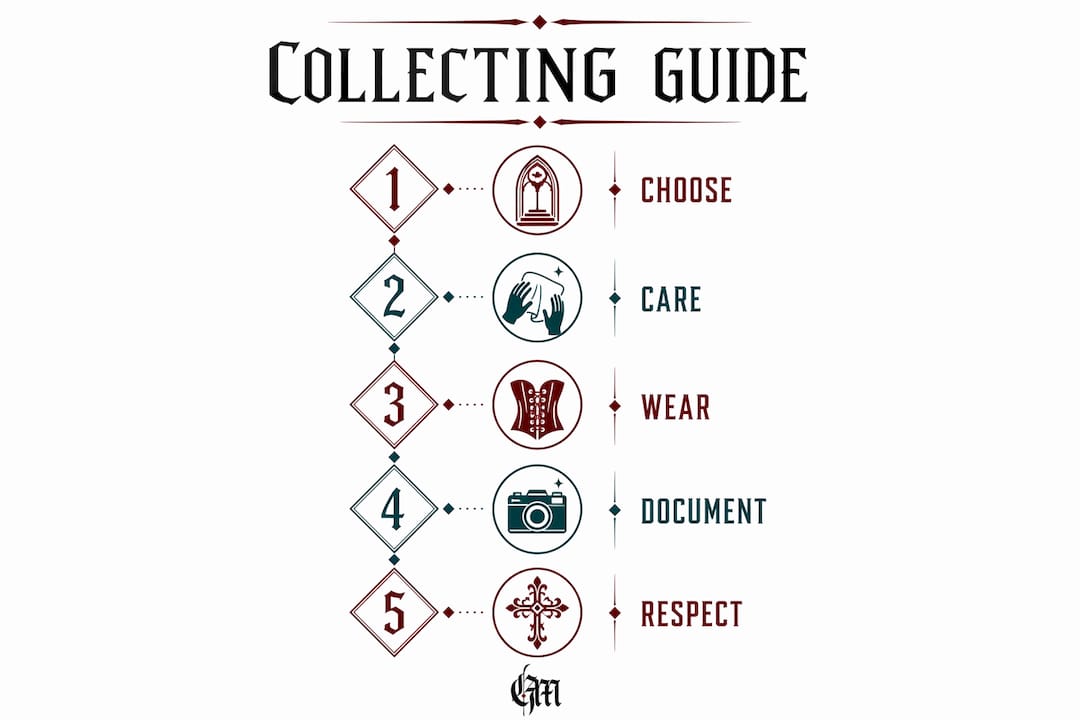
Start with one symbol that genuinely resonates, and wear it for a significant period before buying anything else. That single discipline separates a meaningful collection from a drawer full of impulse purchases. Before you go further, three things need to be checked on every piece: what the symbol means in its original tradition, what the piece is actually made of, and who made it.
Here is the quick-start sequence:
- Pick one resonant symbol. A pentacle, a moon phase, a rune, an Ankh — choose the one that pulls at you, not the one trending on social media. Research its tradition before you buy.
- Check material and durability. Sterling silver stamped 925 outlasts plated brass by years. Know what you are holding before you commit.
- Verify maker and provenance. Handmade artisan pieces, clear hallmarks, or vendor transparency (seller history, process photos) are the markers that matter. Goth.Market lists independent artisans with product-level symbol and material notes. For gemstone basics, the Gemological Institute of America is the standard reference. For provenance on older pieces, museum catalogs and academic sources are your best anchors.
Table of Contents
- What do common occult symbols actually mean for collectors?
- How history and cultural context shape what you should collect
- What metals and gemstones work best for occult jewelry?
- How do you authenticate occult jewelry and spot fakes?
- How do you build a meaningful occult jewelry collection?
- How to clean and energetically cleanse your occult jewelry
- How should you store, display, and document your collection?
- When should you wear a piece versus keeping it for ritual or display?
- How to score a piece using the three-layer spiritual weight model
- How to use symbols respectfully and avoid cultural offense
- How to integrate occult jewelry into everyday fashion and ceremonial use
- Key Takeaways
- The slow collection is the right collection
- Where to find curated occult pieces that come with real context
- Useful sources for deeper research
What do common occult symbols actually mean for collectors?
Occult jewelry types span a wide range of traditions, and the same visual motif can carry completely different ritual weight depending on its origin. The table below gives you a fast reference.
| Symbol | Traditional Meaning | Collector Note |
|---|---|---|
| Pentacle | Protection, the five elements in Wiccan practice | Appears in silver and pewter most often; confirm whether the point faces up (Wiccan) or down (different tradition) |
| Triple Moon | Maiden, Mother, Crone; lunar cycles in goddess traditions | Common in modern pagan and Wiccan jewelry; look for hand-engraved detail vs. stamped mass production |
| Runes (Elder Futhark) | Norse divination and protective inscriptions | Each rune has a specific meaning; a single rune pendant carries more intentional weight than a decorative runic border |
| Eye of Horus | Protection and royal power in ancient Egyptian tradition | Frequently reproduced; authentic artisan versions show hand-finishing on the inner detail |
| Ankh | Life and immortality in Egyptian symbolism | Widely appropriated; seek pieces from makers who cite Egyptian cultural context |
| Scarab | Rebirth and solar protection in Egyptian tradition | Faience and lapis originals are museum pieces; modern versions in silver or resin are collectible reproductions |
| Sator Square | Latin palindrome used as a folk protective charm in medieval Europe | Rare in jewelry; hand-engraved versions on silver or bronze are the most collectible form |
| Animal Familiars (raven, cat, bat) | Spiritual companions and liminal guides across multiple traditions | Ravens, cats, and bats appear across fashion and ritual use; look for sculptural detail as a quality marker |
Less common but worth knowing:
- Hecate’s Wheel (Strophalos): A Greek symbol of the triple goddess and crossroads magic; rare in mass production, more common in artisan silver.
- Triquetra: Celtic knotwork representing threefold unity; widely used in both pagan and Christian contexts, so origin matters.
- Hamsa: A protective hand symbol shared across Jewish, Islamic, and North African traditions; cultural sensitivity is especially relevant here.
- Ouroboros: The serpent eating its tail, representing cyclical time and infinity; appears across Greek, Egyptian, and alchemical traditions.
Pro Tip: The same visual can mean something entirely different depending on tradition. A crescent moon in Wiccan practice signals the goddess; in Islamic art it carries a different sacred weight entirely. Research the origin of a symbol before assigning it personal intention, and never assume a motif is universal.
How history and cultural context shape what you should collect
Protective and symbolic jewelry predates written history. Egyptian amulets in faience and gold date to at least 3000 BCE, worn to invoke divine protection. Mesopotamian cylinder seals carried protective inscriptions. Medieval European folk amulets used the sator square, iron nails, and knotted cord to ward off harm. These were not decorative objects — they were functional ritual tools.
The modern revival of occult jewelry accelerated through the mid-20th century with the growth of Wicca and ceremonial magic traditions, then shifted again after 2010 when the category moved from ultra-alternative niche to mainstream-recognized market. That mainstreaming is exactly why provenance now matters more than it ever did. When any symbol can be mass-produced overnight, the collector’s edge is knowing where a piece came from and who made it.
Do / Don’t checklist for ethical collecting:
- Do research the cultural origin of a symbol before wearing it publicly.
- Do seek out artisan makers who cite their cultural influences and sources.
- Do use museum catalogs and academic references (the Smithsonian’s National Museum of Natural History is a solid starting point for material context) to verify provenance on older pieces.
- Don’t buy sacred objects stripped of their cultural context — a ceremonial piece sold without any attribution is a red flag, not a bargain.
- Don’t treat symbols from living religious traditions as purely decorative without understanding what they mean to practitioners.
- Don’t assume that because something is widely sold, it is appropriate to wear.
Provenance increases both ritual and monetary value. A piece with documented maker history, cultural attribution, and material certification is worth more in every sense than an identical-looking piece with no paper trail.
What metals and gemstones work best for occult jewelry?
Metals and finishes
- Sterling silver (925): The most common choice in artisan occult jewelry. Durable, takes fine detail well, and hallmarked 925 for easy verification. Tarnishes with exposure to air and sulfur; clean with a soft cloth and mild silver polish.
- Fine gold (18k–24k): Rare in occult jewelry but appears in high-end artisan work. Resists tarnish; softer at higher karats, so 18k is more practical for wearable pieces.
- Gold-plated base metal: Affordable but the plating wears through with regular contact. Avoid abrasive cleaners. Not a long-term investment piece.
- Brass: Common in folk and artisan jewelry. Develops a warm patina over time. Can cause skin reactions in nickel-sensitive wearers; check alloy composition.
- Pewter and white metal alloys: Widely used in mass-market occult jewelry. Soft, prone to scratching, and rarely hallmarked. Fine for display; less ideal for daily wear.
Gemstones: metaphysical attributions and care
- Moonstone: Associated with intuition and lunar cycles. Relatively soft (Mohs 6–6.5); avoid ultrasonic cleaners and sharp impacts. Clean with a damp soft cloth.
- Labradorite: Linked to transformation and psychic protection. Similar hardness to moonstone; the iridescent flash (labradorescence) can be dulled by harsh chemicals.
- Amethyst: Traditionally associated with clarity and spiritual protection. Harder (Mohs 7); fades with prolonged sun exposure. Safe for mild soap and water.
- Black tourmaline: One of the most cited protective stones. Durable (Mohs 7–7.5); clean with warm soapy water. Avoid sudden temperature changes.
- Turquoise: Porous and sensitive. Do not submerge in water or expose to oils and chemicals. Wipe with a dry cloth only. Stabilized turquoise is more durable but less valuable than natural.
- Rose quartz: Linked to love and emotional healing. Mohs 7; generally durable but can fade in direct sunlight over time.
Pro Tip: When choosing between a genuine stone and a simulated or plated alternative, ask how often you will wear the piece. For daily wear, genuine stones in secure settings outlast simulated versions and hold their metaphysical attribution in practitioner traditions. For display or occasional ritual use, a well-crafted reproduction is a reasonable choice.
How do you authenticate occult jewelry and spot fakes?
Authenticity comes down to physical evidence. Here is what to look for and what to avoid.
Signs of authentic and quality pieces:
- Hallmarks stamped into the metal: 925 for sterling silver, karat marks (750 for 18k gold) for gold pieces. These should be crisp and consistent, not blurry or applied as a sticker.
- Maker signatures or studio marks, especially on artisan pieces. A signed piece has a traceable origin.
- Soldering quality: clean, smooth joins with no visible gaps or excess solder blobs.
- Hand-tool marks: slight irregularities in texture, stone setting, and engraving that indicate human work rather than machine stamping.
- Patina consistent with claimed age: genuine aged silver develops a dark oxidation in recessed areas that is difficult to fake convincingly.
- Provenance documentation: seller history, process photos, receipts, or references to catalog or museum records.
Red flags:
- Identical “antique” textures across many pieces from the same vendor — machine-applied aging is a common mass-production technique.
- Missing or inconsistent hallmarks, or hallmarks in unusual positions.
- Glued stones in poor-quality settings, especially on pieces sold as vintage or handmade.
- Vague vendor histories with no maker attribution, no process images, and no documentation.
Documenting provenance is your responsibility as a collector. Ask sellers for their sourcing history, request additional photos of maker marks, and keep your own records. Experienced collectors and curators consistently recommend photographing pieces with scale references and maintaining a simple catalog of acquisition details.
How do you build a meaningful occult jewelry collection?
The collector’s differentiator has shifted from rarity to authenticated artisan provenance and quality materials. Choose a collecting strategy early and stick with it long enough to develop real knowledge.
Three starter themes (pick one to begin):
- Symbol-led: Focus on one motif across multiple makers and materials. A collector who owns ten interpretations of the pentacle across different traditions and centuries builds genuine expertise fast.
- Material-led: Collect within a specific material combination, such as sterling silver with moonstone. This approach makes authentication easier and creates visual coherence.
- Maker-led: Follow a specific artisan or studio. This is the fastest path to provenance certainty and often leads to direct relationships with makers.
Budget guidance:
- Entry-level handcrafted pieces from independent artisans: roughly $25–$80 for simple pendants and rings in silver or brass.
- Mid-range artisan work with genuine stones and documented maker history: $80–$300 is a realistic range.
- Vintage and antique pieces with provenance documentation: $150 and up, with significant variation based on age, material, and cultural origin.
Set a yearly acquisition plan rather than buying on impulse. Wear one resonant piece for a full lunar month before adding another — this patience-based approach reveals genuine resonance and prevents accumulation for its own sake.
Market types:
- Artisan marketplaces (handmade): Best for provenance, maker contact, and unique pieces. Higher price per item, but the documentation is built in.
- Vintage shops and auctions: Best for older pieces with historical context. Requires more authentication work on your end.
- Mainstream mass-market: Trend-driven and low-cost, but provenance is minimal. Useful for testing a symbol’s resonance before investing in a quality piece.
How to clean and energetically cleanse your occult jewelry
Physical cleaning quick reference
| Material | Safe Cleaning Method | What to Avoid |
|---|---|---|
| Sterling silver | Soft cloth, mild silver polish, or warm soapy water | Salt, bleach, ultrasonic cleaners for set stones |
| Fine gold | Warm soapy water, soft brush | Chlorine, abrasive cleaners |
| Gold-plated metals | Dry soft cloth only | Water immersion, abrasive cleaners, polishing compounds |
| Porous stones (turquoise, opal, malachite) | Dry cloth wipe only | Water immersion, oils, chemicals of any kind |
| Hard crystals (quartz, amethyst, tourmaline) | Mild soap and water, soft brush | Prolonged sun exposure (fading), ultrasonic for included stones |
| Glued settings (vintage or costume) | Barely damp cloth, air dry immediately | Any immersion; professional cleaning recommended |
Energetic cleansing methods
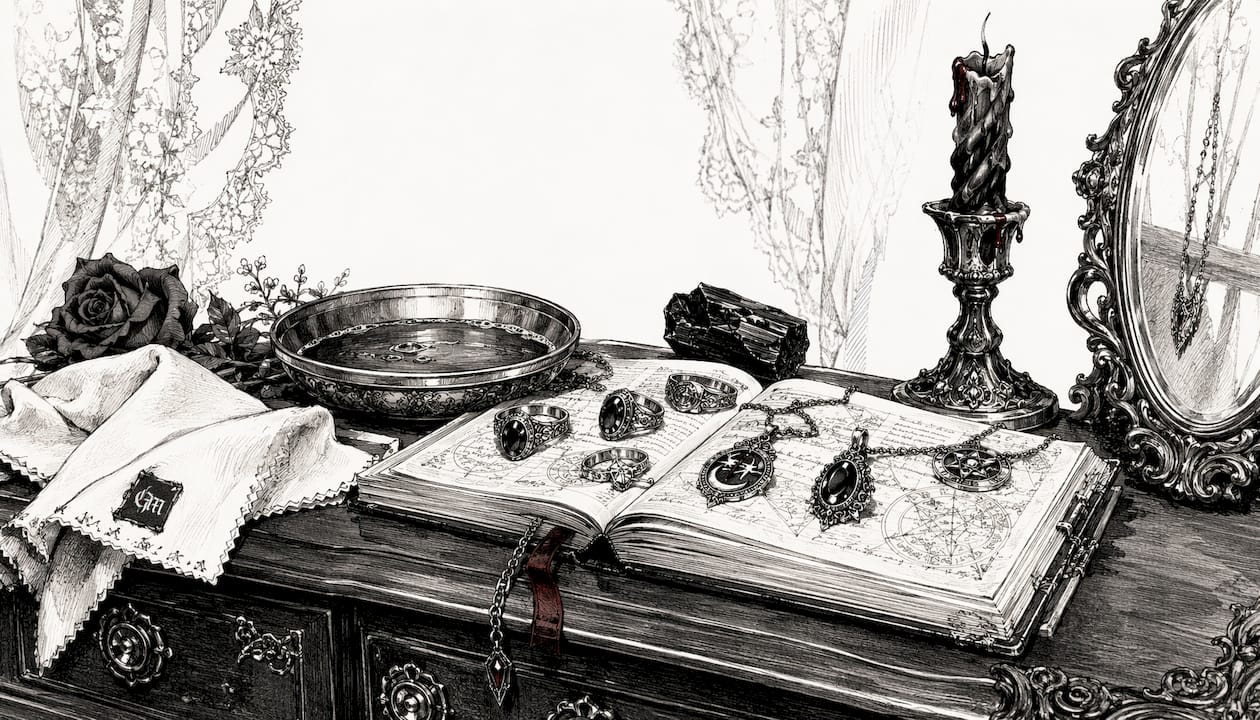
Moonlight and selenite charging are the most widely recommended gentle options because they carry no risk of physical damage. Leave pieces on a windowsill during a full moon, or place them on a selenite slab overnight.
Sound cleansing (singing bowls, bells) works for most materials and is safe for fragile inlays and porous stones. Smoke cleansing (sage, palo santo) is effective but use caution: avoid exposing pieces with fragile inlays, delicate patina, or porous stones to direct smoke for extended periods.
Safety notes:
- Never submerge turquoise, opal, malachite, or any porous stone in saltwater or any liquid.
- Avoid abrasive cleaners on plated items — the plating is thin and will not survive it.
- When in doubt about a vintage or antique piece, take it to a professional jeweler before attempting any cleaning at home.
How should you store, display, and document your collection?
Storage do’s and don’ts:
- Store pieces individually in soft pouches or compartmentalized boxes to prevent scratching.
- Use anti-tarnish strips in silver storage areas; replace them every few months.
- Keep color-sensitive stones (amethyst, rose quartz, turquoise) away from direct sunlight and UV light.
- Store organic materials (bone, wood, shell) in a climate-controlled space away from humidity extremes.
- Never pile pieces together loose — even a brief tangle can damage delicate settings.
For display, balance security with ritual access. High-value or fragile pieces belong in a locked display case with UV-filtering glass. Keep a rotating subset of wearable pieces accessible for daily or ritual use — a small tray or altar space works well for this.
Pro Tip: Photograph every piece from multiple angles against a neutral background, with a ruler or coin for scale. Record the acquisition date, vendor name, price paid, and any certificates or maker notes in a simple spreadsheet. This catalog serves double duty: provenance documentation for resale or insurance, and a personal record of your collection’s growth.
Experienced collectors build their catalogs over years of sustained research and visual engagement with their materials. Starting the habit early costs almost nothing and pays off significantly.
When should you wear a piece versus keeping it for ritual or display?
The decision comes down to three factors: durability, monetary or provenance value, and intention.
Wear it daily if: the piece is made of durable materials (sterling silver, hard stones), carries low monetary risk, and aligns with an intention you want present throughout your day. A black tourmaline pendant in a secure bezel setting is a natural everyday talisman.
Rotate for ritual use if: the piece has significant provenance value, is fragile (thin wire wrapping, glued stones, porous materials), or has been consecrated for a specific purpose. Wearing a ritual piece to the gym is not just a durability problem — it dilutes the intention.
Reserve for display if: the piece is museum-quality, antique, or too fragile for any regular handling. These pieces still serve a purpose as focal points in a collection or altar space.
Practical wear tips: pair delicate settings with low-impact activities only. Rotate pieces to distribute wear. Keep one durable, meaningful anchor piece as your everyday item — something that grounds the collection in daily life without risking your most valuable acquisitions. Intentional layering works best when pieces share complementary intentions; pairing protective black tourmaline with intuition-enhancing moonstone is a classic combination that practitioners recommend over mixing pieces with opposing symbolic aims.
How to score a piece using the three-layer spiritual weight model
A piece’s full value as a collectible comes from three layers working together. Evaluate each one before buying.
- Layer 1: Historical and cultural provenance. Does the piece have a traceable maker, cultural attribution, or documented age? Score: Low (no documentation), Medium (maker known, no cultural research), High (full provenance, cultural context confirmed).
- Layer 2: Material and metaphysical attributes. Is the piece made of genuine materials with recognized metaphysical attributions? Score: Low (plated base metal, simulated stones), Medium (sterling silver or brass, natural stones), High (fine metal, certified natural stones, traditional craft methods).
- Layer 3: Personal intention and resonance. Does the symbol and material connect with something real in your current practice or intention? Score: Low (bought for trend), Medium (aesthetically appealing, some symbolic connection), High (deeply researched, personally meaningful, worn with consistent intention).
Worked example: A hand-engraved sterling silver pentacle pendant from an independent artisan with a maker’s mark and a brief cultural note in the product listing. Layer 1: Medium (maker known, limited cultural depth). Layer 2: High (925 silver, hand-engraved). Layer 3: High (symbol researched, personally resonant). Total: Medium-High. A strong acquisition candidate, with provenance research as the one gap to address before purchase.
When a piece scores high on material quality but low on provenance, that is a signal to dig deeper before buying rather than a reason to walk away. The three-layer model guides acquisition priorities rather than delivering a simple pass/fail verdict.
How to use symbols respectfully and avoid cultural offense
Not every symbol is available to every wearer without context. Some carry active sacred meaning in living traditions, and wearing them without understanding that context can cause real harm to communities who hold them sacred.
The practical standard is straightforward: research before you wear. If a symbol belongs to a living religious or cultural tradition, understand what it means to practitioners before adopting it as personal jewelry. The Hamsa, the Om, and Indigenous protective symbols all fall into this category. Wearing them as fashion accessories without that grounding is the definition of appropriation.
When you buy from artisan makers who cite their cultural influences, you are also supporting the communities those traditions come from. That is the cleanest version of ethical collecting: provenance that traces back to people who have a genuine relationship with the symbol’s tradition.
For symbols with ancient or diffuse origins (the pentacle, the Ankh, the ouroboros), the ethical bar is lower but still present. Know what you are wearing, know where it comes from, and be prepared to explain it if someone asks. That level of literacy is what separates a collector from someone who just bought something that looked cool.
How to integrate occult jewelry into everyday fashion and ceremonial use
The line between daily wear and ceremonial use is mostly about intention and durability, not aesthetics. Most occult jewelry works in both contexts with a little planning.
For everyday fashion, anchor the look with one strong piece rather than layering everything at once. A sterling silver rune pendant or a labradorite ring reads as sophisticated and intentional without requiring explanation. Pair it with neutral or dark clothing to let the piece speak. Gothic and alternative styling naturally accommodates bold symbolic pieces, but even in a conventional office environment, a small pentacle on a fine chain is rarely out of place.
For ceremonial use, the approach flips. The piece is the focal point, not the outfit. Choose items that carry the highest personal resonance and ritual intention, and reserve them specifically for that context. Keeping a piece off your body between rituals maintains a clear energetic boundary between its ceremonial function and daily life.
The occult jewelry meaning deepens through consistent, intentional use rather than through accumulation. A single piece worn with genuine understanding carries more weight than a full collection worn without it. That principle applies whether you are dressing for a Tuesday at work or a full moon ritual.
Key Takeaways
A meaningful occult jewelry collection is built on three non-negotiable foundations: symbol literacy, material integrity, and ethical provenance.
| Point | Details |
|---|---|
| Start with one symbol | Wear a single resonant piece for one lunar month before expanding your collection. |
| Verify materials | Look for 925 hallmarks on silver and confirm genuine stones before buying. |
| Document provenance | Record vendor, date, price, and maker notes for every acquisition from day one. |
| Clean safely by material | Never submerge porous stones; use dry cloth for plated metals and professional help for antique settings. |
| Goth.Market for curated pieces | Browse independent artisan listings with symbol and material notes included on product pages. |
The slow collection is the right collection
The most common mistake new collectors make is speed. They find a symbol they love, buy five versions of it in a week, and then wonder why none of them feel meaningful. The answer is almost always that the research came after the purchase instead of before it.
What actually works is the opposite approach: one piece, worn long enough to know whether it genuinely resonates, then a deliberate expansion guided by the three-layer model. Provenance, material, personal intention. In that order. The pieces that end up mattering most are almost never the ones bought on impulse.
The ethical dimension is not separate from the collecting practice. Crediting artisans, understanding cultural origins, and refusing to strip sacred objects of their context are not optional courtesies. They are the foundation of a collection worth having. Support makers who do the cultural work, ask questions before you buy, and treat the symbols you wear as the living traditions they come from.
Where to find curated occult pieces that come with real context
Most mass-market platforms sell occult-adjacent jewelry with no maker information, no material verification, and no cultural context. That is the gap Goth fills.
Goth.Market connects collectors with independent artisans who specialize in dark, alternative, and occult aesthetics. Product listings include symbol notes, material details, and direct seller contact so you can ask provenance questions before you buy. If you want additional photos of a maker’s process or a certificate of material authenticity, the platform makes that conversation straightforward. Browse the curated occult jewelry collections and contact sellers directly for provenance details. For a broader look at where to shop, the top occult jewelry shops guide covers the US market in detail.
Useful sources for deeper research
- Smithsonian National Museum of Natural History (naturalhistory.si.edu): Gem and mineral reference for material identification and context.
- Gemological Institute of America (GIA) (gia.edu): The standard reference for gemstone grading, care, and authenticity.
- World History Encyclopedia (worldhistory.org): Academic-level historical context on esoteric traditions and their material culture.
- Orientations Magazine / Barbara Levy Kipper interview (orientations.com.hk): Collector methodology, documentation practices, and the value of sustained visual and cultural research.
- Montague’s Jewelers gemstone care guide (montaguesjewelers.com): Practical cleaning and durability notes by stone type.
- Goth.Market blog (goth.market/blogs/news): Symbol history, gothic styling guides, and collector resources specific to the occult and alternative jewelry space.