

How to Price Handmade Gothic Fashion: Strategies for Creators
TL;DR:
- Proper pricing requires understanding all direct and indirect costs plus adding value through craft and exclusivity.
- Successful pricing blends cost-plus, market research, and value-based methods, updated regularly based on data.
- Overcoming pricing fears and emphasizing story and uniqueness helps Gothic creators attract loyal, high-paying customers.
Pricing handmade gothic fashion is genuinely hard. You pour hours into sourcing velvet, hand-stitching lace trim, and perfecting silhouettes that mass-market brands will never touch. Then you stare at a blank price field and freeze. Set it too low and you undersell your craft. Set it too high without a clear rationale and buyers scroll past. Unlike generic retail, gothic fashion lives in a niche where buyers expect uniqueness, story, and soul. This guide breaks down exactly how to calculate your costs, choose a pricing method, justify a premium, and refine your numbers over time so your work finally gets the recognition and revenue it deserves.
Table of Contents
- Understand your true costs and value
- Choose your pricing method: Cost-plus, value-based, or market-driven
- Add premium for exclusivity, ethics, and craftsmanship
- Check competitors and test your prices
- What most gothic creators get wrong about pricing
- Explore and grow your gothic brand
- Frequently asked questions
Key Takeaways
| Point | Details |
|---|---|
| Know your costs | Carefully calculate all material, labor, and value-based extras to find your baseline price. |
| Blend pricing methods | Combine cost-plus, market research, and value-based insights for balanced, effective pricing. |
| Justify premiums | Highlight exclusivity, ethics, and craftsmanship—for higher prices customers willingly pay. |
| Research and test | Continually check market benchmarks and experiment with price points to refine your pricing. |
Understand your true costs and value
Before you touch any pricing formula, you need a crystal-clear picture of what it actually costs you to make a single piece. Many creators only count materials and forget everything else. That’s the fastest route to burning out and breaking even.
Start by listing every direct cost per item: fabric, thread, closures, lining, trims, dyes, labels, and packaging. Then add your indirect costs like shipping supplies, platform fees, and tool wear. After that, calculate your labor. Decide on a fair hourly wage for yourself. A good baseline is at least $15 to $20 per hour for skilled handwork. If a corset takes six hours to build, that’s up to $120 in labor alone before a single yard of fabric enters the equation.
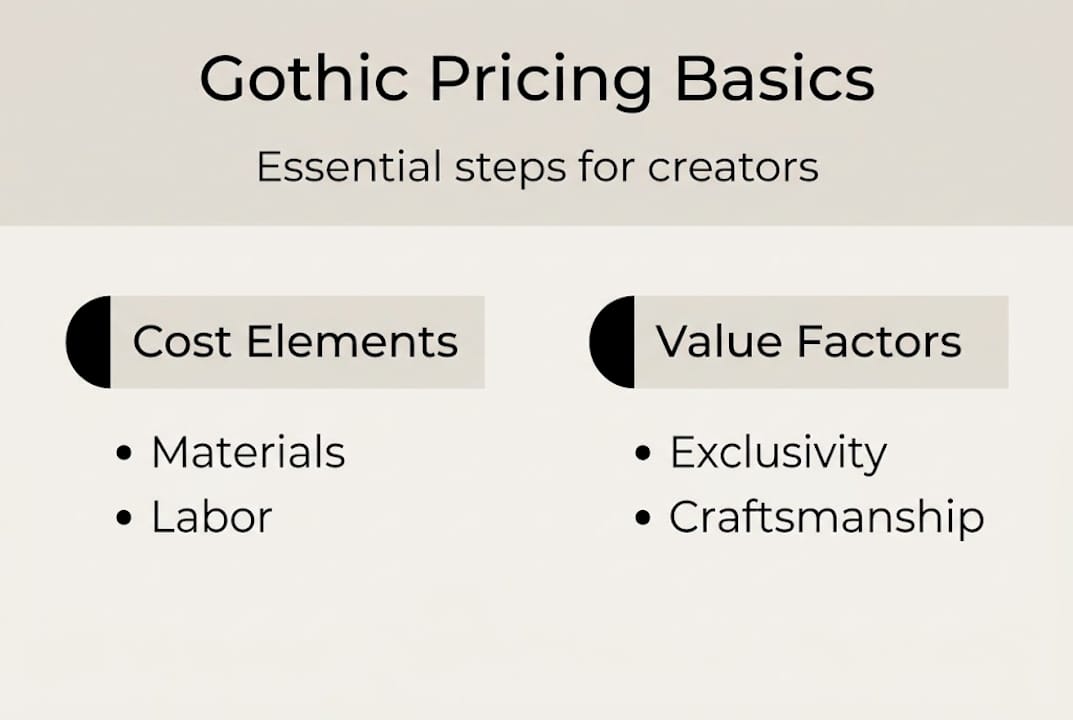
Once you have your baseline, apply a simple cost-plus formula: (Materials + Labor) × Markup. A markup of 2x to 2.5x is common for handmade fashion to cover overhead and generate profit. Cost-plus, value-based, and market-based pricing all form the backbone of fashion pricing, but cost-plus is where every calculation starts.
Pro Tip: Build a cost spreadsheet for every product you make. Track every material purchase with the exact quantity used per item. Update it each time prices shift. This saves you from guessing and makes scaling much easier.
Beyond raw costs, you add value through craft. Gothic buyers specifically seek out handmade item quality they cannot find anywhere else. That uniqueness is real money. Consider what pushes your price above baseline:
- Hand-dyeing or custom colorwork that creates one-of-a-kind results
- Intricate embroidery or beading that takes precision and hours
- Limited-edition releases that create scarcity and collector appeal
- Ethical sourcing of ethical materials and craftsmanship that align with buyer values
- Original pattern design rather than purchased or copied templates
- Custom sizing or bespoke fit options
| Cost element | Example | How to track |
|---|---|---|
| Materials | $18 velvet, $4 thread | Per-unit log |
| Labor | 5 hrs × $18/hr = $90 | Time tracker app |
| Packaging | $2 tissue, $1 tag | Monthly total / units |
| Platform fees | 5% of sale price | Calculate after markup |
Every cost element you identify now protects your margin later.
Choose your pricing method: Cost-plus, value-based, or market-driven
Once you’ve got your costs and values lined up, it’s time to decide how to set your prices. There’s no single right answer, but understanding your options helps you make a confident, informed choice.
| Method | Definition | Best for | Gothic example |
|---|---|---|---|
| Cost-plus | Add fixed markup to total cost | New creators, simple items | Stockings: cost $8, sell at $20 |
| Value-based | Price based on what buyers perceive the item is worth | Signature pieces, strong brand story | Custom corset perceived at $350 |
| Market-driven | Price based on competitor benchmarks | Competitive niches, scaling up | Black lace dress: match similar at $140 |
Most successful gothic brands blend all three. Hybrid approaches combining cost-plus and market research are commonly the most effective for handmade fashion. Use cost-plus as your floor so you never lose money. Use market research as your reality check. Use value-based logic to justify going above both.
Choosing which method to lean on depends on where you are in your brand journey. If you’re just starting out, cost-plus protects you from losses. As you build a following and a recognizable aesthetic, you can shift toward value-based pricing because buyers will pay more for your work specifically. Browse types of gothic fashion to see how sub-styles carry different pricing expectations, and check the guide to gothic dark fashion for a broader view of the market landscape.
Here’s how to test and pick the right fit for your products:
- Calculate your cost-plus price as the baseline minimum.
- Research three to five competitors selling similar gothic items at similar quality.
- Identify the average price range for your category.
- Ask yourself honestly: does my story, craft, or brand justify pricing above average?
- Set your price, list the item, and track conversion rate for 30 days.
- Adjust up or down by 10% increments based on what the data tells you.
Pro Tip: Revisit your prices every quarter. Your material costs change, your audience grows, and your story deepens. A price that fit six months ago may be underselling you today. Pricing is a living decision, not a one-time setup.
Lean into fashion product pricing strategies as a reference point when you need to recalibrate.
Add premium for exclusivity, ethics, and craftsmanship
After picking your pricing method, look for opportunities to add justified premiums based on your story and values. This is where gothic fashion genuinely outperforms mass-market retail in the eyes of your ideal customer.
Gothic buyers are not bargain hunters by nature. They’re seekers. They want pieces that mean something, tell a story, and carry an energy that fast fashion simply cannot replicate. That emotional connection is a real pricing lever. Limited editions, ethical sourcing, and scarcity boost buyer willingness to pay, and eco-conscious shoppers pay up to 15% more for responsibly made goods.
“Scarcity and meaning drive customer desire, especially in the gothic niche. When a buyer knows only ten pieces exist, that exclusivity becomes part of what they’re purchasing.”
Handmade jewelry can be priced at 2 to 3x cost without losing buyers when the story is clearly communicated. The same principle applies to clothing, accessories, and decor. Your job is to make the value visible before the buyer hesitates.
Here are storytelling and branding angles that genuinely add value in this niche:
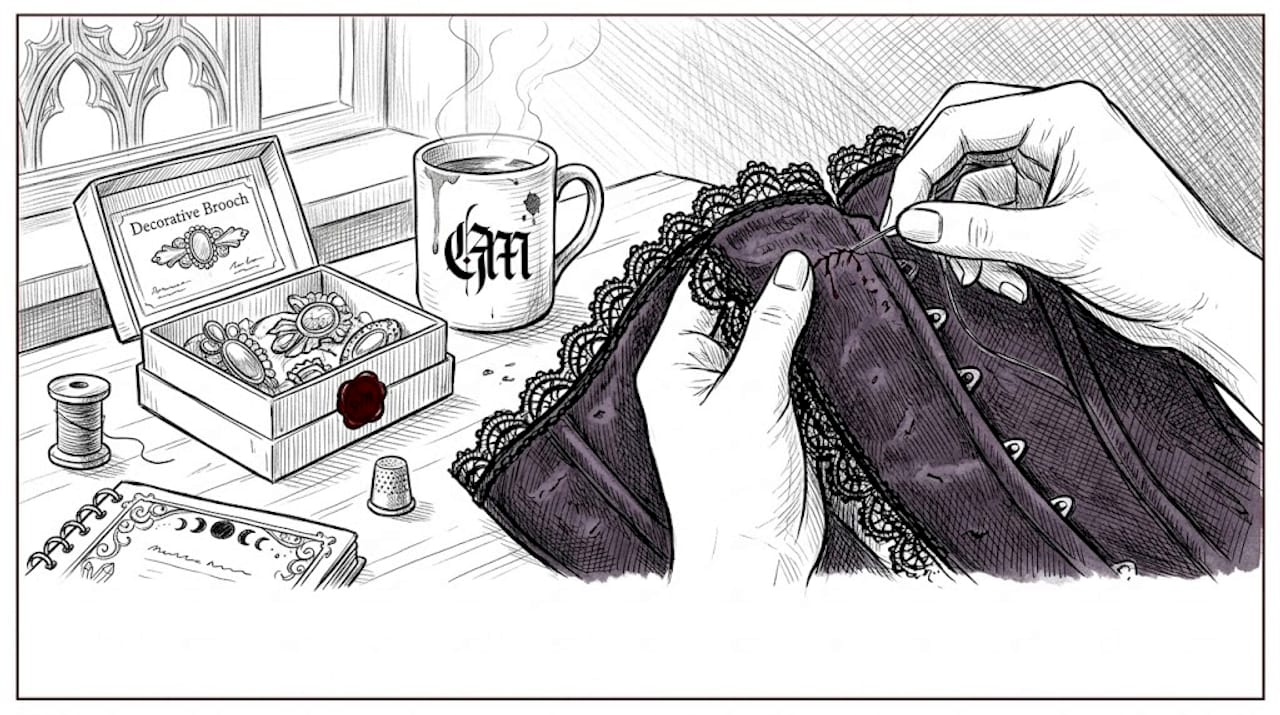
- Production story: Share your process on product pages. Photos of your workspace, hands at work, dye baths, and raw materials make craft real.
- Material sourcing narrative: Where did that velvet come from? Ethical sourcing is a genuine differentiator.
- Limited run announcements: “Only 8 made” creates urgency without manipulation when it’s true.
- Personal design philosophy: Why do you create what you create? Buyers connect with makers who have a clear point of view.
- Community recognition: Mentions, features, or collaborations signal credibility.
The niche gothic market is growing, and buyers in this space are actively looking for makers they can follow and support long-term. Premium pricing, when backed by real story and quality, builds that relationship rather than breaking it.
Check competitors and test your prices
Setting a price is never one-and-done. Here’s how to research the market and refine your approach so your numbers stay competitive and accurate.
Start with real benchmark data. Search Etsy, Instagram shops, and alternative marketplaces for gothic items in your specific category and quality tier. Look at what sells, not just what’s listed. Sold listings are gold because they prove actual buyer behavior. Boutique scarves run $110 to $140 and entry jewelry sells at $14 to $22, with 50 to 60% margins typical across handmade fashion.
| Category | Low range | High range | Notes |
|---|---|---|---|
| Entry gothic jewelry | $14 | $22 | Simple, minimal materials |
| Statement necklace | $45 | $90 | Intricate, limited pieces |
| Boutique scarves | $110 | $140 | Handcrafted, premium fabric |
| Custom gothic corset | $180 | $400+ | Bespoke, time-intensive |
Keep an eye on modern goth fashion trends to understand where the market is moving, track aesthetics in goth fashion to see which sub-styles command the highest interest, and use the gothic styling guide to frame your own positioning.
Once you have benchmarks, run controlled pricing experiments:
- List two similar items at different price points and track which converts better over 30 days.
- Test a 10% price increase on your bestseller. If sales hold steady, the increase is justified.
- Offer a limited-edition drop at a premium price and measure response.
- Collect direct feedback through post-purchase surveys asking buyers about value perception.
- Use fashion market research methods to formalize your testing process as you scale.
Pro Tip: Review your pricing every quarter and always track limited-edition drop performance separately. Drops teach you exactly where your ceiling is, and each one gives you better data than any spreadsheet estimate.
What most gothic creators get wrong about pricing
Here’s the uncomfortable truth most creators never hear: the fear of pricing too high causes far more damage than pricing too high ever would.
New gothic designers consistently set prices at or near cost out of insecurity, not out of strategy. They worry buyers will think they’re greedy or overconfident. But in a niche where buyers specifically seek out rare, meaningful work, a too-low price actually signals low quality. It attracts the wrong audience. Bargain hunters don’t leave five-star reviews about your hand-stitching. Loyal fans who feel they found something special do.
Cost-plus alone ensures survival but undervalues craft. Relying entirely on it means you’re pricing labor as if it’s interchangeable with factory output. It isn’t. The hybrid approach, where cost-plus sets your floor, market research confirms your range, and your brand story lifts your ceiling, is what sets thriving gothic brands apart from creators who burn out after a year.
Ignoring audience research is the second big mistake. Buyers in the gothic fashion world have specific expectations and are genuinely willing to pay more when you meet them. Don’t guess what they value. Ask, observe, and test.
Explore and grow your gothic brand
Ready to put these strategies to work? Seeing what’s already selling gives you the clearest real-world pricing data available, and Goth.Market is exactly the right place to start.
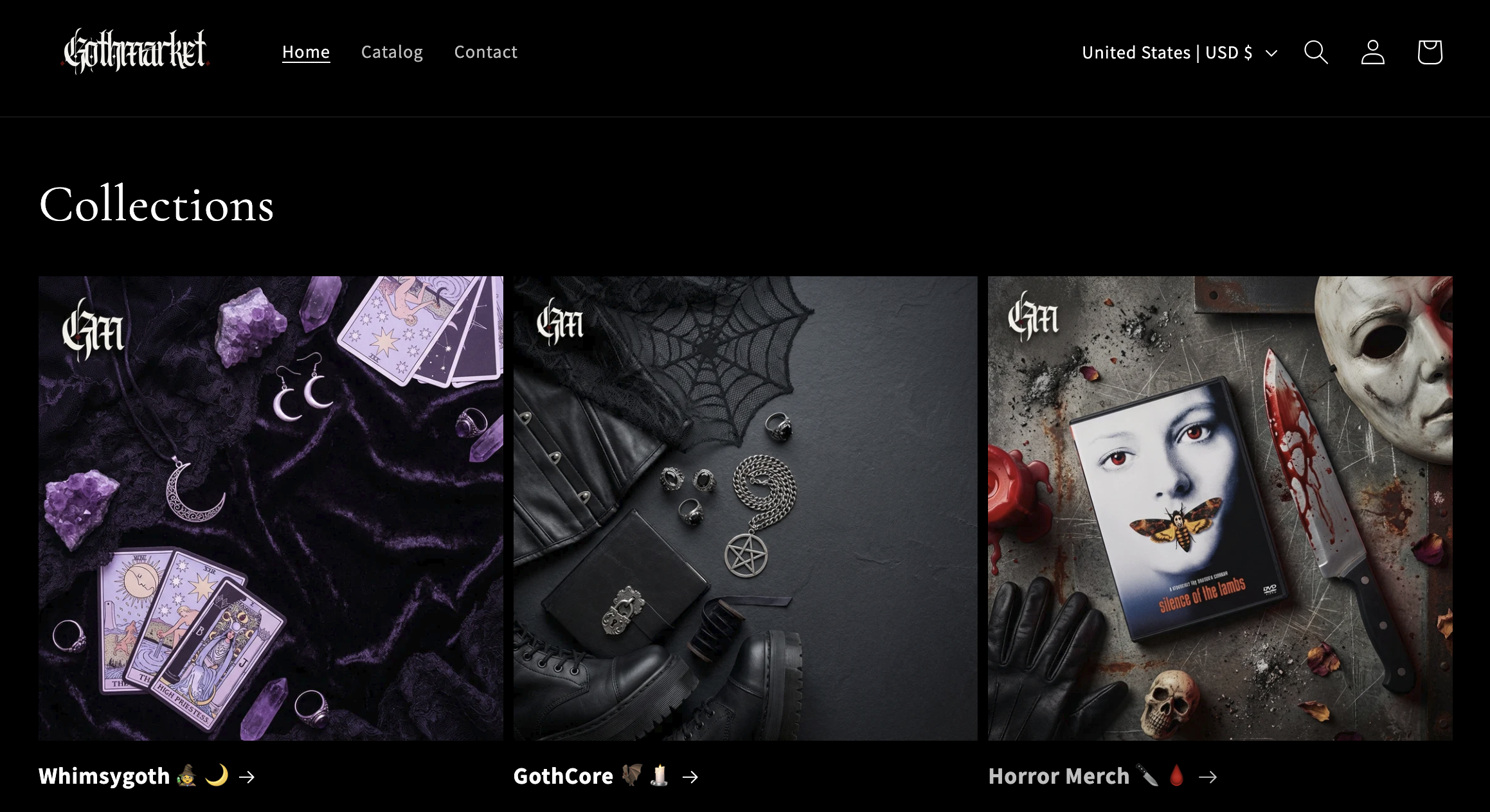
Browse the gothic jewelry collection to benchmark statement pieces and understand what buyers in this space actually spend. Explore the Whimsygoth collection for inspiration on how niche sub-styles are priced and presented. When you’re ready to reach buyers who genuinely value handmade, dark, and alternative work, list your creations in a community built for exactly this audience. Your craft deserves a marketplace that understands it.
Frequently asked questions
What margin should I aim for when pricing handmade gothic clothing?
50 to 60% margins are the standard benchmark for handmade fashion. Push higher if your brand story, scarcity, or niche reputation supports the premium.
How do I add value for higher gothic fashion prices?
Focus on exclusivity, craftsmanship, and ethical sourcing in your product descriptions and social presence. Limited-edition runs and visible process storytelling are the most effective tools.
What’s the risk of setting my prices too low?
Cost-plus undervalues craft and attracts buyers who prioritize price over quality. You end up working more, earning less, and missing the loyal fans who would pay fairly for your work.
How can I test if my new gothic fashion prices are right?
Make small adjustments, track conversion and feedback, and compare with similar brands. Price elasticity testing in fashion shows that even modest price shifts reveal your true optimal range quickly.