

What Is Mystical Symbolism in Gothic and Occult Design?
Mystical symbolism is the visual language of pentagrams, moons, skulls, sigils, and tarot imagery that gothic, occult, and witchy creators use to signal meaning, identity, protection, or ritual intent. You’ll find it stamped into a pendant, embroidered on a hem, or painted across a wall hanging, and in every case the symbol is doing work beyond decoration. Apparel, jewelry, home decor, and ritual supplies all lean on this shorthand because a well-chosen symbol communicates faster than a paragraph of copy ever could, whether that’s Wiccan protection, Victorian mourning, or a personal sigil with no history behind it at all. Picking the right one matters. The wrong symbol can misfire with your audience, muddy your intent, or land on someone’s sacred tradition without you meaning it to.
Key Takeaways
Mystical symbolism works when the symbol’s traditional meaning, its modern use, and the buyer’s expectations all line up in the same direction.
| Point | Details |
|---|---|
| Match symbol to intent | Choose a motif based on what the piece is for, ritual, aesthetic, or both, before choosing how it looks. |
| Simplify for small scale | Strip detailed symbols like the ouroboros down to clean outlines below 20 to 30 millimeters. |
| Add context in product copy | One sentence explaining a symbol’s origin, like the pentacle’s Wiccan roots, prevents most buyer confusion. |
| Check for closed-practice symbols | Avoid reproducing initiation-only or sacred motifs as fashion without community input. |
| Buy or commission from curated makers | Goth.Market connects shoppers with independent creators who build symbolic pieces with accurate materials and context. |
Table of Contents
- What Are the Most Common Mystical Symbols and What Do They Mean?
- How Did Mystical Symbols Change Meaning Over Time?
- How Do You Choose the Right Symbol for a Product or Ritual Piece?
- When Does Using Mystical Symbols Cross Into Appropriation?
- What Materials and Finishes Work Best for Occult Jewelry and Decor?
- Where Can You Ethically Buy or Commission Occult and Gothic Pieces?
- How Do You Design or Customize a Sigil Ethically?
- Why Trust Goth.Market on Mystical Symbolism?
- Where Can You Shop Curated Gothic and Occult Pieces?
- Sources
- FAQ
What Are the Most Common Mystical Symbols and What Do They Mean?
Every symbol in this world carries at least two meanings: what it meant to the tradition that made it, and what it means now to the person wearing it. Knowing both keeps your product copy honest and your designs sharper.
- Pentagram/pentacle. A five-pointed star, often circled, representing earth, air, fire, water, and spirit in Wiccan practice. It functions as a protective amulet and a badge of religious identity for many practitioners, and pentacle necklaces have carried that ritual weight since at least the 1980s. On jewelry, it reads best as a clean, symmetrical pendant of a size that maintains clear definition; if too small, the points blur together.
- Triple moon. Waxing, full, and waning crescents side by side, standing in for maiden, mother, and crone. It’s one of the most requested motifs for earrings and small charms because the shape stays legible even at tiny scale.
- Ankh. The ancient Egyptian symbol of life, now widely adopted in goth and occult fashion as a statement of vitality and eternity. Works well as a larger pendant or back-patch where its crossbar and loop have room to breathe.
- Skull / memento mori. A reminder of mortality with roots in medieval death iconography, now a staple across gothic jewelry from signet rings to hairpins. People sometimes assume it’s morbid rather than reflective; a line of product copy about “remember you will die, so live” reframes it fast.
- Ouroboros. A serpent eating its own tail, symbolizing cycles, renewal, and infinity. Detailed scales get lost below a 20 millimeter diameter, so simplify the linework for rings.
- Sigils. Custom-drawn glyphs built from a condensed intention, unique to the person who made them. No fixed “meaning” exists outside the maker’s own design, which is exactly the point.
- Runes. Letters from historic Germanic alphabets like the Elder Futhark, each carrying a divinatory or elemental association. Best used singly or in short, deliberate sequences rather than as generic decoration.
- Eye of Horus / Eye of Providence. Egyptian protection symbol and the “all-seeing eye” respectively, both frequently confused for each other. Clarify which one you’re selling; customers do notice the mix-up.
- Alchemical symbols. Glyphs for the elements, planets, and processes like calcination or dissolution, popular in minimalist jewelry lines. Their geometric simplicity holds up beautifully at tiny scale.
- Tarot motifs. Major Arcana imagery, especially The Moon, The Tower, and Death, shows up constantly on apparel and decor because each card arrives with a built-in narrative.
Pro Tip: For pendants under 20 millimeters, strip a symbol down to its outer silhouette and one or two interior lines. Detail that reads clearly on a screen mockup often disappears once cast in metal.
Wiccan tradition treats the pentacle as a symbol of elemental balance and protection, not menace. That single distinction resolves most of the confusion shoppers bring to occult jewelry.
How Did Mystical Symbols Change Meaning Over Time?
Symbols don’t stay put. They travel between traditions, get rebranded by outsiders, and eventually get reclaimed by the communities that valued them first.
- Medieval Europe: Memento mori imagery (skulls, hourglasses, wilting flowers) appeared on tombs and rings as a religious meditation on mortality, not as rebellion.
- Victorian era: Mourning jewelry turned death symbolism into wearable sentiment, using jet, hairwork, and mourning rings that later became a direct visual ancestor of modern gothic accessories.
- 20th-century occult revival: Wicca and modern paganism formalized the pentacle as a protective, elemental symbol, tracing its lineage through medieval and Victorian death iconography into subcultural reinterpretation.
- The Satanic Panic: Media coverage in the 1980s conflated the pentagram with satanism, and that misreading still surfaces in customer questions decades later, according to Fashioning Faith’s history of the pentagram necklace.
- Modern reclamation: Goth and witch communities now wear these symbols openly, and gothic fashion treats occult motifs as a normal design element rather than a taboo one.
Sociological work on gothic identity describes this as a deliberate visual grammar: materials, historical references, and motifs act as signifiers that outsiders read one way and insiders read another, according to a semiotic analysis of gothic identity markers. That gap between insider and outsider meaning is exactly why a single line of context in your listing goes further than you’d expect.
Pro Tip: Add one sentence of context to product descriptions for religiously loaded symbols. “A pentacle, worn in Wiccan tradition for protection and balance” heads off more customer service messages than any FAQ page.
The pentagram was never inherently satanic. It became associated with that fear through media panic, not through the symbol’s own history.
How Do You Choose the Right Symbol for a Product or Ritual Piece?
Start with function before aesthetics. A ritual object and a fashion accessory can use the same symbol but need entirely different design decisions.
- Identify the buyer. A practicing Wiccan buying a pentacle for ritual use needs accuracy and correct orientation. A goth fashion shopper buying the same shape wants it to look good with black denim.
- Decide the object’s job. Is this devotional, decorative, or both? A altar piece tolerates more literal iconography than a t-shirt graphic.
- Match scale to detail. Complex symbols (ouroboros, detailed tarot art) need at least 30 millimeters of surface to stay legible; simplify or drop them below that.
- Check material compatibility. Fine engraving holds up in cast silver or pewter but disappears in soft fabric print at small sizes.
- Set the price point around the labor. Hand-engraved sigils cost more than stamped or printed versions, and buyers generally understand why once you explain it.
Before production, ask yourself:
- Who is the actual buyer, and what does the symbol mean to them specifically?
- Does this piece need explanatory copy, or is the symbol self-evident to your audience?
- Is this a devotional object someone will use in ritual, or a purely aesthetic accessory?
Red flags worth catching early:
- Symbols with sacred or closed-practice status that outsiders shouldn’t reproduce for sale.
- Intricate linework that turns to mush below 15 millimeters.
- Look-alike glyphs (Eye of Horus vs. Eye of Providence) that get mislabeled and generate refund requests.
When Does Using Mystical Symbols Cross Into Appropriation?
Borrowing an aesthetic and exploiting a closed practice are two different things, and the line sits at consent and context. Aesthetic borrowing draws on widely shared visual traditions, pentagrams, tarot, alchemical glyphs, that have long circulated across religious and secular use. Exploitative appropriation takes a sacred or closed symbol, strips its meaning, and sells it purely for shock value or profit without acknowledgment.
A short dos-and-don’ts list keeps this manageable for independent creators:
- Do research a symbol’s origin before mass-producing it, especially anything tied to a specific living religious or Indigenous tradition.
- Do credit the tradition a motif comes from in your product copy when it’s relevant.
- Don’t reproduce initiation-only or closed-practice symbols as fashion items if practitioner communities have asked outsiders not to.
- Don’t flatten a symbol’s meaning into pure aesthetic without at least a line of context.
- Do consult practitioners or community sources when you’re unsure; a five-minute forum search often surfaces the answer.
One practical example: a maker selling a pendant styled after a guardian figure found that adding a short line about the motif’s protective origin, similar to how guardian lion imagery carries protective symbolism in Chinese decorative art, cut confused customer messages significantly. Context sells better than silence.
Pro Tip: If a symbol requires a paragraph of explanation to avoid causing offense, that’s a signal to either add the explanation to your listing or reconsider the design.
What Materials and Finishes Work Best for Occult Jewelry and Decor?
Material choice carries its own symbolism in this space, not just an aesthetic one.
- Silver and oxidized silver. The default metal for occult jewelry, associated with lunar and ritual symbolism; oxidized finishes and antique patina read as intentionally aged rather than tarnished.
- Pewter. A budget-friendly alternative to silver that still takes fine detail well in cast pendants.
- Blackened steel. Durable and modern, popular for rings and heavier statement pieces that need to survive daily wear.
- Jet and onyx. Deep black stones with a Victorian mourning-jewelry pedigree, still standard for gothic accessory lines.
- Velvet, lace, and printed cotton. The textile side of the aesthetic, where dark antiquated textures borrowed from Victorian and Elizabethan sources carry as much symbolic weight as the metal pieces do.
For production, engrave or cast sigils rather than stamping them if the design has fine interior lines; stamping tends to flatten detail that engraving preserves. Screen printing handles high-detail apparel graphics better than heat transfer, which cracks and fades faster over repeated washes. For decor, hanging crystals and prisms carry their own symbolic associations with light and protective energy, and display and care guidance for hanging crystals applies directly if you’re pairing them with altar pieces or window displays.
Care instructions worth passing along to buyers: store silver pieces in an airtight bag to slow tarnish, polish oxidized pieces only in the raised areas to preserve contrast, and keep printed textiles inside-out and cold-washed to protect fine detail.
Pro Tip: List the finish, not just the metal, in your product title. “Oxidized silver pentacle” tells a shopper more in three words than “silver pentacle” does.
Where Can You Ethically Buy or Commission Occult and Gothic Pieces?
Curated marketplaces solve a problem generic retail sites can’t: they surface independent makers who actually understand the symbolism they’re selling. Goth works well for this because listings come from creators specializing in dark, alternative, and witchy aesthetics rather than mass-market importers guessing at what “looks gothic.”
Beyond marketplaces, look at local craft fairs, specialist occult retailers, and maker social accounts where you can see work-in-progress photos before committing to a purchase.
If you’re commissioning a custom piece:
- Ask for material samples or photos of prior work in that material.
- Request references or a portfolio link before paying a deposit.
- Agree on turnaround time in writing, especially for hand-engraved work.
- Get explicit written permission if you’re asking the maker to customize a symbol tied to a closed practice.
To verify a maker’s authenticity, check for hallmark stamps on precious metal claims, ask for unedited photos rather than stock images, and read the maker’s bio for specifics about their process rather than vague marketing language.
How Do You Design or Customize a Sigil Ethically?
Building an original sigil is one of the more accessible ways to create truly personal mystical symbolism, and it follows a fairly standard process.
- Write your intention as a single sentence. “I attract steady creative work” works better than something vague.
- Strip repeated letters. Cross out duplicates until you have a short unique set of characters left.
- Arrange the remaining letters into an abstract glyph. Overlap, rotate, and merge the shapes until the original letters are no longer legible as text.
- Stylize for your medium. A sigil bound for a tattoo needs cleaner lines than one destined for an embroidered patch.
- Test at production scale. Print or cast a proof before committing to a full run; details that look fine on a screen often collapse at 15 millimeters.
If you’re designing sigils commercially for clients, put the terms in writing before you start: who owns the final file, whether the client can resell products bearing it, and whether you retain rights to show it in your own portfolio. Never trace or lightly modify another artist’s published sigil or copyrighted occult artwork and sell it as original work; if you’re drawing from a documented historical symbol set, credit the tradition in your listing copy.
A sigil only means what its creator intended. That’s what separates it from inherited symbols like the pentagram, and it’s exactly why the drafting process matters more than the final shape.
Why Trust Goth.Market on Mystical Symbolism?
I’m Rey, and I write and edit the educational content on Goth.Market, covering how occult, gothic, and witchy symbolism actually functions in fashion and decor rather than how outsiders assume it does. That work means tracking sources like Fashioning Faith’s research on Wiccan jewelry practice and sociological studies of gothic identity markers, then translating that into practical guidance for makers and shoppers.
Goth.Market itself operates as a curated marketplace built around independent creators working in gothic, occult, and witchy aesthetics, with educational resources like our guide to occult jewelry meaning and gothic styles and our breakdown of why gothic accessories matter for identity and expression sitting alongside the product catalog. If you’re a maker with questions about listing a commissioned piece, or a shopper trying to verify what a specific symbol means before buying, reach out through the marketplace’s seller contact tools; that’s exactly what they’re there for.
Where Can You Shop Curated Gothic and Occult Pieces?
If you’d rather browse finished work than start from a blank sketch, Goth.Market curates listings from independent creators specializing in exactly this kind of symbolic design, so you’re seeing pieces made by people who understand what a pentacle or sigil is actually doing on the object.
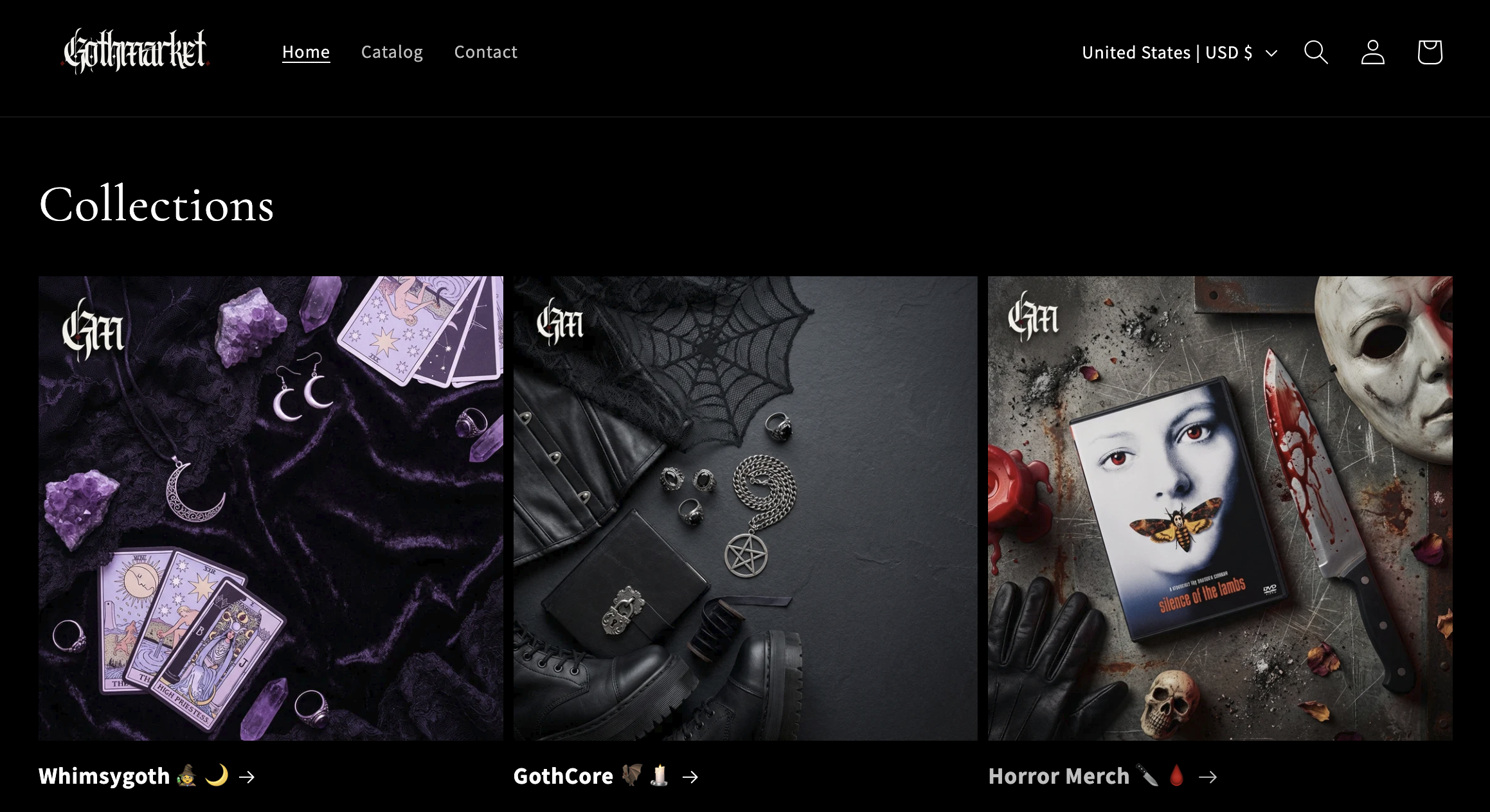
Use the material and symbol tags in the catalog filters to narrow results fast. Searching “oxidized silver” plus “triple moon,” for instance, gets you closer to a specific look than browsing the full jewelry category blind. Maker bios on each listing page tell you who made the piece and often explain their process, which helps you commission with confidence rather than guessing. If you want a piece built to your own sigil or intention, most sellers on the platform take custom orders directly through their shop page. Start browsing the Goth to see current listings from independent creators working in this space right now.
Sources
- 1980s Pentagram/Pentacle Necklace - Fashioning Faith
- The semiotics of a subculture: a sociological analysis of gothic identity markers
- Gothic Jewelry History: From Medieval Mourning Rings to Modern Dark…
- Goth Aesthetic: Complete Subculture & Style Guide (2026)
FAQ
What is mystical symbolism in gothic and occult design?
It’s the use of visual motifs, pentagrams, moons, skulls, sigils, tarot cards, to convey meaning, identity, protection, or ritual function in fashion, jewelry, decor, and ritual supplies. Each symbol carries both a traditional meaning and a modern styling use, and knowing both helps you choose or design pieces with intent.
Is the pentagram a satanic symbol?
No. In Wiccan tradition, the pentagram, usually circled as a pentacle, represents the five elements and functions as a protective symbol, not a satanic one. The satanic association traces back to media coverage during the 1980s Satanic Panic, not to the symbol’s actual origin.
What’s the difference between a pentagram and a pentacle?
A pentagram is the five-pointed star itself; a pentacle is that star enclosed in a circle. In practice, jewelry sellers often use the terms interchangeably, but Wiccan practitioners typically reserve “pentacle” for the circled ritual version.
How do I know if a symbol is culturally sensitive to use?
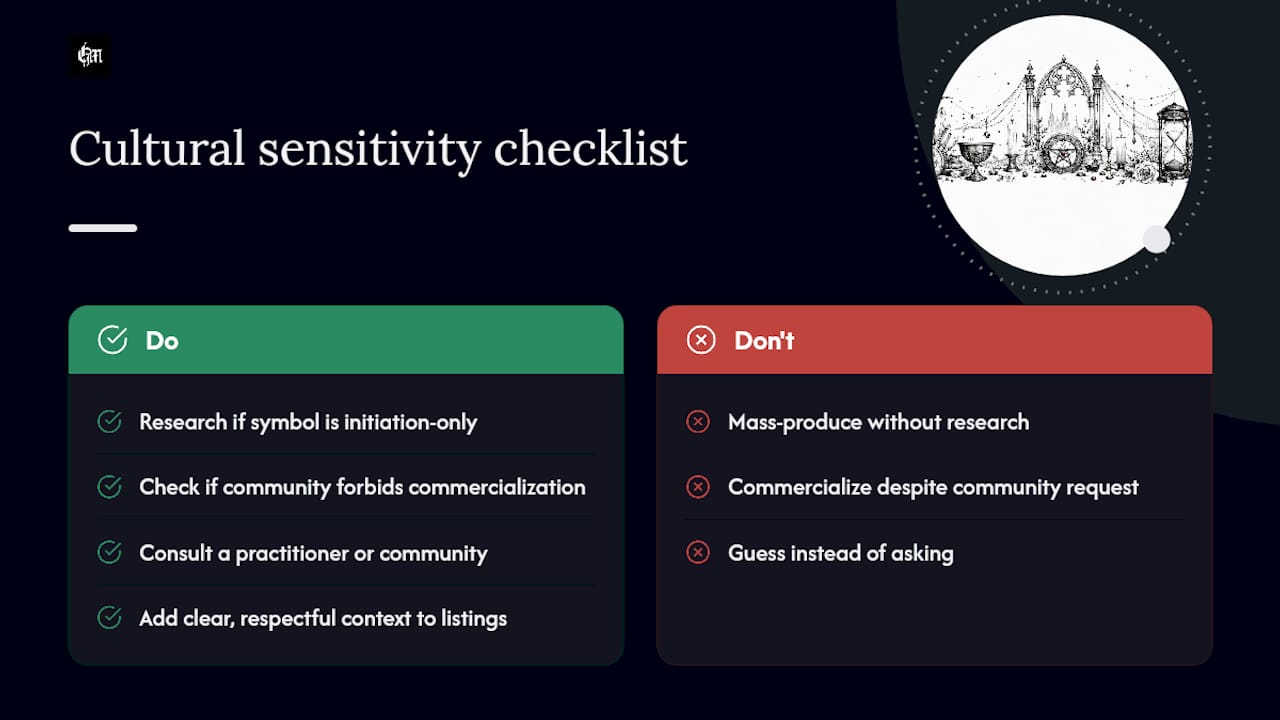
Research whether the symbol belongs to a closed or initiation-only practice before mass-producing it, and check whether the community associated with it has publicly asked outsiders not to commercialize it. When in doubt, consult a practitioner or add clear, respectful context to your listing rather than guessing.
What metal is best for occult and gothic jewelry?
Silver and oxidized silver are the most common choices, prized for their lunar and ritual associations and their compatibility with dark, antiqued finishes. Pewter and blackened steel are common budget or heavy-duty alternatives that still hold fine detail well.
How small can a detailed symbol like the ouroboros go before it loses clarity?
Below roughly 20 millimeters, fine interior details like scales tend to blur into a single shape. Simplify the linework to its outer silhouette for anything smaller than that, whether it’s cast in metal or printed on fabric.
Where can I buy authentic occult or gothic jewelry from real makers?
Curated marketplaces like Goth connect shoppers directly with independent creators, which makes it easier to verify materials, read maker bios, and commission custom work. Craft fairs and specialist occult retailers are also solid options if you want to see work in person first.
How do I create my own sigil without copying someone else’s design?
Write your intention as a single sentence, strip out repeated letters, then arrange the remaining letters into an abstract glyph until the original text is no longer legible. Never trace or lightly modify a published sigil or another artist’s copyrighted occult artwork and sell it as your own.