

Examples of Mystical Motifs for Art and Design in 2026
TL;DR:
- Mystical motifs are symbolic elements that convey spiritual, cosmic, or esoteric ideas across cultures. They include botanical, geometric, and celestial symbols that carry layered meanings rooted in tradition. When used thoughtfully, these motifs create rich, layered designs that connect viewers to ancient knowledge and spiritual truths.
Mystical motifs are recurring symbolic design elements that visually express spiritual, cosmic, or esoteric ideas. Across centuries of art and architecture, these symbols have carried layered meanings far beyond decoration. The best examples of mystical motifs fall into three core categories: botanical, geometric, and celestial. Each category draws from deep cultural traditions, including Ottoman floral symbolism, Hindu sacred geometry, and ancient sky worship. Understanding these categories gives you a precise vocabulary for building art, jewelry, fashion, and decor that resonates on a genuinely symbolic level.
1. What are the most recognized examples of mystical motifs?
Mystical motifs are best understood as condensed forms of knowledge that artists across history used to express abstract spiritual truths in a visual language anyone could feel. They are not random decorative patterns. Each one carries a specific meaning rooted in a cultural or spiritual tradition, and that meaning travels with the symbol across centuries and mediums.
The three primary categories are botanical motifs (roses, tulips, pomegranates), geometric motifs (hexagrams, triangles, circles), and celestial motifs (moon phases, stars, owls). Within each category, individual symbols carry distinct meanings. A rose is not interchangeable with a pomegranate, and a triangle pointing upward means something different from one pointing down. Knowing the difference is what separates meaningful mystical design from generic pattern work.
These motifs appear in architecture, textile, jewelry, manuscript illustration, mosaic, and contemporary digital art. Their staying power comes from their ability to bridge metaphysical thought with material culture, giving viewers a way to engage with existential questions through a visual experience.
2. Botanical motifs as mystical symbols in art
Botanical motifs are among the oldest and most widely used mystical theme examples in recorded art history. Their power comes from the natural world’s built-in symbolism: growth, death, renewal, and abundance.
The most significant botanical motifs include:
- Rose. The rose symbolizes mystical love and the Prophet Muhammad in Ottoman and Islamic art traditions. It appears throughout Hagia Sophia’s decorative program and in Sufi poetry as a metaphor for divine beauty.
- Tulip. The tulip’s vertical form visually resembles the Arabic word for “Allah,” making it a sacred symbol in Ottoman architecture and tilework. It appears in thousands of Iznik ceramic designs.
- Carnation. Carnations represent divine beauty and were used extensively in Byzantine and Ottoman mosaics as a sign of spiritual grace.
- Pomegranate. The pomegranate symbolizes fertility, immortality, and abundance across Greek, Jewish, and Islamic traditions. Its many seeds made it a natural metaphor for spiritual fullness.
- Vine. Vine motifs carry associations with life force, spiritual nourishment, and the sacred in both Christian and pre-Christian art.
These symbols appear in architecture, embroidery, jewelry, and contemporary gothic and witchy design. A pomegranate pendant carries the same symbolic weight as a pomegranate carved into a Byzantine capital. The medium changes; the meaning does not.
Pro Tip: When using botanical motifs in your own work, layer two or three symbols with complementary meanings. A rose paired with a pomegranate, for example, combines divine love with abundance, creating a richer symbolic statement than either symbol alone.
3. Geometric motifs and their spiritual symbolism
Geometric mystical symbols in art function differently from botanical ones. Where botanical motifs draw meaning from nature, geometric motifs encode abstract spiritual concepts directly into mathematical form.
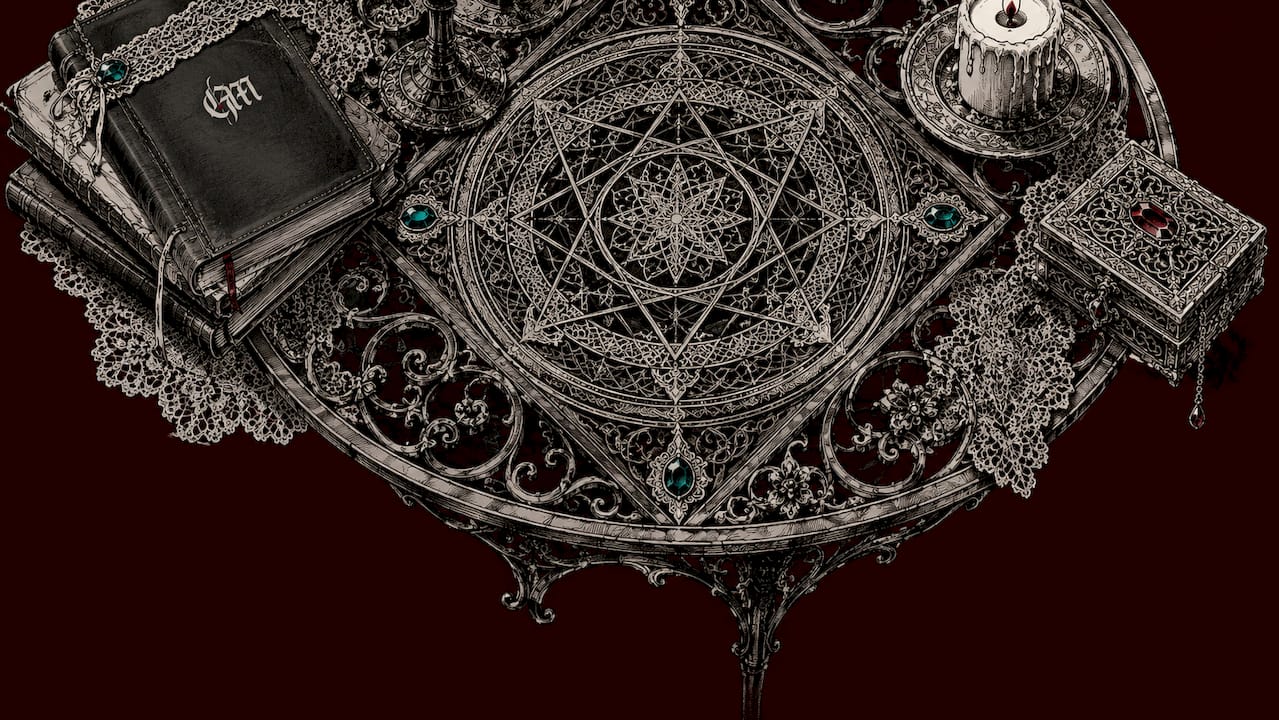
The hexagram, known in Hindu tradition as the Shatkona and in Jewish tradition as the Star of David, is the most powerful example. It consists of two interlaced triangles representing the union of masculine and feminine energies, the meeting of the earthly and the divine. In Hindu practice, it functions as a Yantra, an instrument of meditation and spiritual protection. Its placement in a composition is not arbitrary. Centering a hexagram in a design activates its protective and meditative properties.
Key geometric motifs and their meanings include:
- Upward triangle. Points toward the sky and represents fire, masculine energy, and spiritual ascent.
- Downward triangle. Points toward the earth and represents water, feminine energy, and receptivity.
- Circle. Represents eternity and unity, appearing in mandalas, halos, and sacred architecture worldwide.
- Hexagram. Combines both triangles to represent cosmic balance and the union of opposites.
- Yantra compositions. Geometric arrangements used as meditative focal points, where the geometry itself channels spiritual energy.
Geometric motifs serve functional roles as Yantras, not merely decorative patterns. Their placement and compositional balance are what retain their symbolic power. A hexagram placed off-center or used as filler loses its meaning entirely.
Pro Tip: Place a hexagram or mandala at the true visual center of your composition. Treat it as a focal point, not a background element. This preserves its function as a meditative anchor and prevents the symbol from reading as decoration.
For a deeper look at how these symbols appear in gothic and witchy product design, the guide to witchy motifs in design at Goth covers hexagrams, floral symbols, and their applications in jewelry and accessories.
4. Celestial and cosmic motifs in mystical aesthetics
Celestial motifs form the sky register of mystical design. They evoke ancient, sacred moods by connecting the viewer to cycles larger than human life: lunar phases, stellar patterns, and the boundary between day and night.
The “Mystic Forest” aesthetic is one of the clearest modern examples of celestial motifs in action. It uses a four-color palette of deep teal, dark purple, near-black, and aged gold to simulate a moonlit forest atmosphere. Celestial elements like moon phases, owls, and stars are integral to this aesthetic. The moon phases represent cycles of transformation and renewal. Owls function as transition figures, creatures that move between the visible world and the hidden one.
| Celestial motif | Symbolic meaning | Best register |
|---|---|---|
| Moon phases | Cycles, transformation, time | Sky |
| Stars and constellations | Guidance, fate, cosmic order | Sky |
| Owl | Transition, wisdom, the unseen | Transition |
| Moth | Attraction to light, spiritual seeking | Transition |
| Filtered light rays | Grace, the divine breaking through | Transition |
The Mystic Forest aesthetic differs from the Enchanted Forest aesthetic in tone. Enchanted Forest leans toward warmth, fairy-tale imagery, and bright greens. Mystic Forest uses cooler, darker tones and emphasizes mystery over wonder. Dark Forest aesthetics go further still, removing celestial warmth entirely in favor of shadow and dread. Knowing which register you are working in prevents tonal confusion in your designs.
Celestial motifs work well in art journaling, scrapbooking, textile design, and gothic fashion. A moon phase sequence printed across a garment carries the same symbolic weight as one carved into a temple frieze.
5. How mystical motifs work together in design
The most effective mystical designs do not rely on a single motif. They balance three registers to create a layered, atmospheric experience that feels genuinely sacred rather than decorative.
The three registers are:
- Earth register. Botanical textures like bark, moss, leaves, and roots. These ground the composition and connect it to the physical world.
- Sky register. Celestial bodies, moon phases, stars, and light qualities. These lift the composition toward the cosmic and the infinite.
- Transition register. Creatures and phenomena that move between earth and sky, such as owls, moths, and filtered light. These create authentic mystical depth by linking the two registers.
Equal weighting across all three registers produces a design that feels complete. A composition heavy on celestial motifs without botanical grounding feels cold and abstract. One heavy on botanical motifs without celestial elements feels earthbound and literal. The transition register is what most designers overlook, and its absence is what makes many mystical designs feel flat.
Color strategy matters as much as motif selection. Professional mystical designs favor muted, deep hues like deep teal and near-black paired with aged gold. Oversaturated purples and cool whites destroy the moonlit atmosphere that makes mystical art feel sacred. The goal is to simulate natural light conditions, not to signal “mystical” through obvious color choices.
Pro Tip: Before finalizing any mystical design, audit it against the three registers. If one register is missing, add one element from it. A single moth or a single root texture can rebalance an entire composition.
For historical context on how these symbols developed across occult traditions, the article on occult symbolism and history at Goth provides a thorough foundation.
Key Takeaways
Mystical motifs draw their power from specific cultural traditions, and their effectiveness in design depends on understanding symbolic meaning, register balance, and color strategy.
| Point | Details |
|---|---|
| Three core categories | Botanical, geometric, and celestial motifs each carry distinct symbolic meanings rooted in cultural traditions. |
| Geometric motifs function, not just decorate | Hexagrams and Yantras serve as meditative focal points; placement and balance determine their symbolic power. |
| Three design registers | Balance earth, sky, and transition elements to create layered, authentic mystical compositions. |
| Color strategy is critical | Use muted deep hues like teal, near-black, and aged gold rather than oversaturated tones to preserve sacred atmosphere. |
| Botanical motifs carry layered meaning | Roses, tulips, and pomegranates each carry distinct spiritual meanings that compound when combined thoughtfully. |
Why mystical motifs still matter in creative work
Mystical symbols are not nostalgia. They are civilizational memory, carrying philosophical and spiritual knowledge that no other visual language encodes as efficiently. When I look at a hexagram in a piece of jewelry or a pomegranate in a textile, I see centuries of accumulated meaning compressed into a single form. That compression is what makes these symbols so powerful in creative work.
The mistake most designers make is treating mystical motifs as mood signals rather than meaning systems. A crescent moon slapped onto a black background signals “witchy” to a casual viewer. But a crescent moon positioned in the transition register, paired with a moth and a root texture, in a muted teal and aged gold palette, creates an experience. That is the difference between atmosphere over symbol display, which is exactly what the Symbolist painters understood and most contemporary designers forget.
My honest advice is to learn one motif deeply before you use it. Read about the rose in Sufi poetry. Understand why the hexagram is centered, not scattered. Know what the owl is transitioning between. That knowledge shows up in the work, even when viewers cannot articulate why a piece feels more resonant than another. The best mystical art does not explain itself. It creates a feeling that the viewer recognizes as true.
— Rey
Goth’s curated collection of mystical motif designs
Goth brings together independent creators whose work is built around genuine symbolic knowledge, not trend-chasing. The marketplace carries artwork, jewelry, and fashion featuring botanical, geometric, and celestial motifs with real cultural roots.
Whether you are looking for a hexagram pendant that functions as a Yantra, a garment with Ottoman-inspired floral symbolism, or dark decor built around the Mystic Forest aesthetic, Goth’s collection connects you with creators who understand what these symbols mean. You can also find pieces featuring mystical motif-inspired jewelry that draw on the rose, hexagram, and tulip traditions discussed here. Browse the full range of mystical art and design at Goth and find pieces that carry the meaning you are looking for.
FAQ
What are the most common types of mystical motifs?
The most common types of mystical motifs are botanical (rose, tulip, pomegranate), geometric (hexagram, triangle, circle), and celestial (moon phases, stars, owls). Each type draws from specific cultural and spiritual traditions that define its symbolic meaning.
How do mystical motifs differ from decorative patterns?
Mystical motifs carry specific symbolic meanings rooted in cultural or spiritual traditions, while decorative patterns are primarily aesthetic. A hexagram functions as a Yantra for meditation and protection; a generic geometric pattern does not.
How do I use mystical motifs in my own art or design?
Balance motifs across the three design registers: earth (botanical textures), sky (celestial bodies), and transition (owls, moths, filtered light). Use a muted palette of deep teal, near-black, and aged gold to preserve the sacred atmosphere these symbols require.
What is the significance of botanical motifs in mystical art?
Botanical motifs like the rose, tulip, and pomegranate carry distinct spiritual meanings drawn from Ottoman, Islamic, and Byzantine traditions. The rose represents divine love, the tulip references the name of God, and the pomegranate symbolizes immortality and abundance.
Where do mystical motifs appear in literature?
Mystical motifs in literature function as symbols of sacred memory and philosophical reflection, with examples including Kazakh literary symbols of sky and rivers that convey existential and spiritual meaning across cultural boundaries.