

What Is Mystical Artwork? Themes, Symbols, and Styles
TL;DR:
- Mystical artwork uses symbolic imagery and visionary aesthetics to evoke transcendent, spiritual, and unconscious experiences. It employs deliberate visual markers like darkness, complexity, and luminosity, along with layered symbolism and sacred geometry to induce awe and inner exploration. Artists create these works through meditative practices and repetition, drawing inspiration from diverse traditions, impacting viewers emotionally and spiritually beyond mere decoration.
Mystical artwork is defined as a form of creative expression that uses symbolic imagery, visionary aesthetics, and spiritual motifs to connect viewers with experiences beyond ordinary perception. Unlike decorative art, it does not aim to represent the physical world accurately. Instead, it points toward something felt rather than seen: the transcendent, the sacred, the unknowable. Artists like Alex Grey, William Blake, and Hilma af Klint built entire careers around this pursuit, and ancient traditions from Egyptian iconography to Tibetan thangka painting demonstrate that the impulse to visualize the invisible is as old as human consciousness itself. Mystical artwork, also referred to as visionary art in contemporary art criticism, operates at the intersection of spirituality, psychology, and aesthetics.
What is mystical artwork, and what defines it?
Mystical artwork transcends physical reality, depicting insights drawn from altered states of consciousness, spiritual visions, and inner experience rather than external observation. This distinction separates it from representational or even abstract art that remains anchored to the visible world. The goal is not beauty for its own sake. The goal is contact with something larger.
Three primary visual markers reliably signal a mystical work. Mysterious darkness, dazzling complexity, and overwhelming luminosity such as gold leaf or an internal glow each trigger what art historians call the “numinous” response: a sense of awe that bypasses rational thought. These are not stylistic accidents. They are deliberate tools for inducing a specific psychological and emotional state in the viewer.
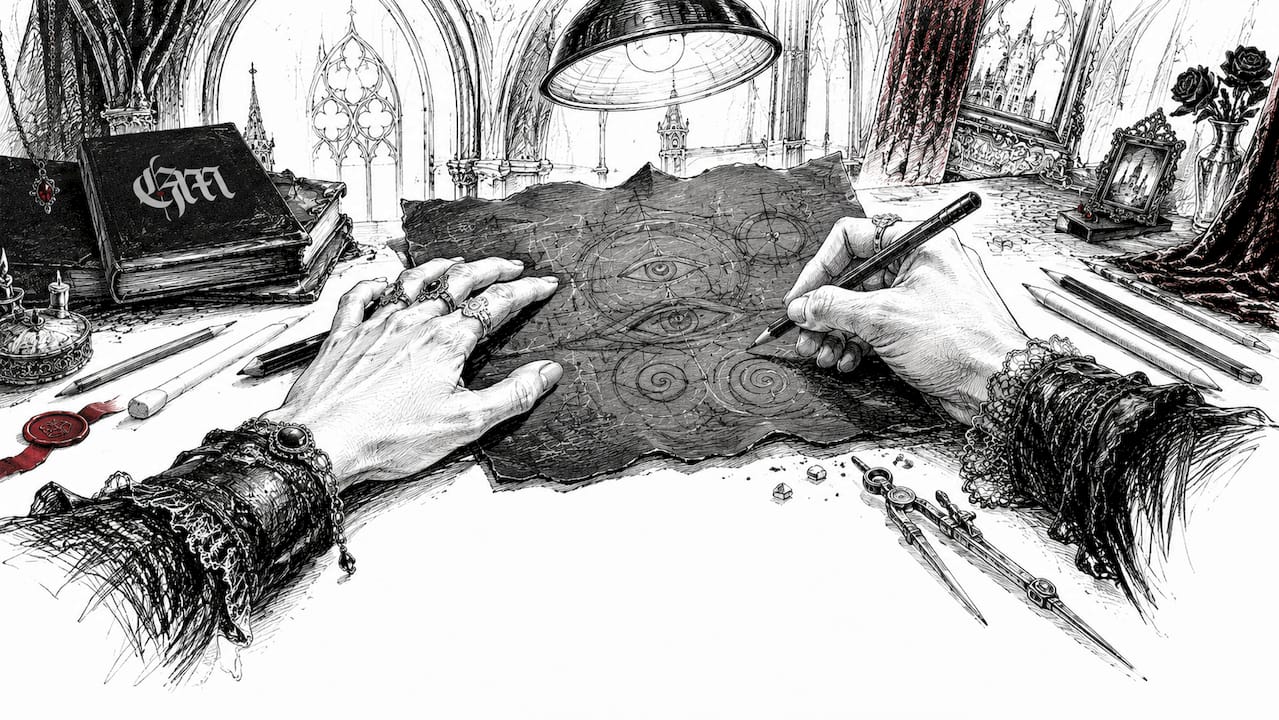
The definition of mystical art also encompasses its relationship to symbolism. Symbols like the eye, the spiral, and the moon function as a non-verbal language that invites ongoing discovery rather than fixed meaning. A spiral does not mean one thing. It means something different to a viewer meditating on it in 2026 than it did to a Neolithic cave painter, and both interpretations are valid. This open-ended quality is not a weakness of the form. It is the form’s defining strength.
What are the features and symbols of mystical artwork?
The visual vocabulary of mystical art is consistent enough to recognize across cultures and centuries, yet flexible enough to absorb new influences. Understanding these features helps you engage with the work rather than simply observe it.
Core visual features include:
- Geometric and mandala-like patterns: Repetitive, symmetrical forms that draw the eye inward and create a meditative rhythm. Sacred geometry appears in Islamic art, Hindu yantra diagrams, and the work of contemporary visionary artists.
- Celestial and cosmic imagery: Moons, stars, suns, and galaxies appear frequently, signaling the scale of what mystical art addresses: existence itself.
- Layered symbolism: Multiple symbols occupy the same composition, each carrying its own meaning while contributing to a unified emotional atmosphere.
- Figures in states of transcendence: Meditating figures, deities, and beings with closed or partially closed eyes signal inward focus rather than outward engagement.
- Color as emotional signal: Deep indigos, luminous golds, and rich crimsons are not chosen for realism. They are chosen for their psychological weight.
Art compositions in this tradition are often arranged with esoteric geometric alignments that are felt rather than decoded, providing a sense of unseen order beneath the surface. You do not need to understand sacred geometry intellectually to feel its effect. That is precisely the point.
Pro Tip: When viewing mystical art, resist the urge to identify every symbol immediately. Spend two minutes with a single piece before reaching for your phone. The meaning that surfaces in silence is usually more personal and more accurate than any art history explanation.
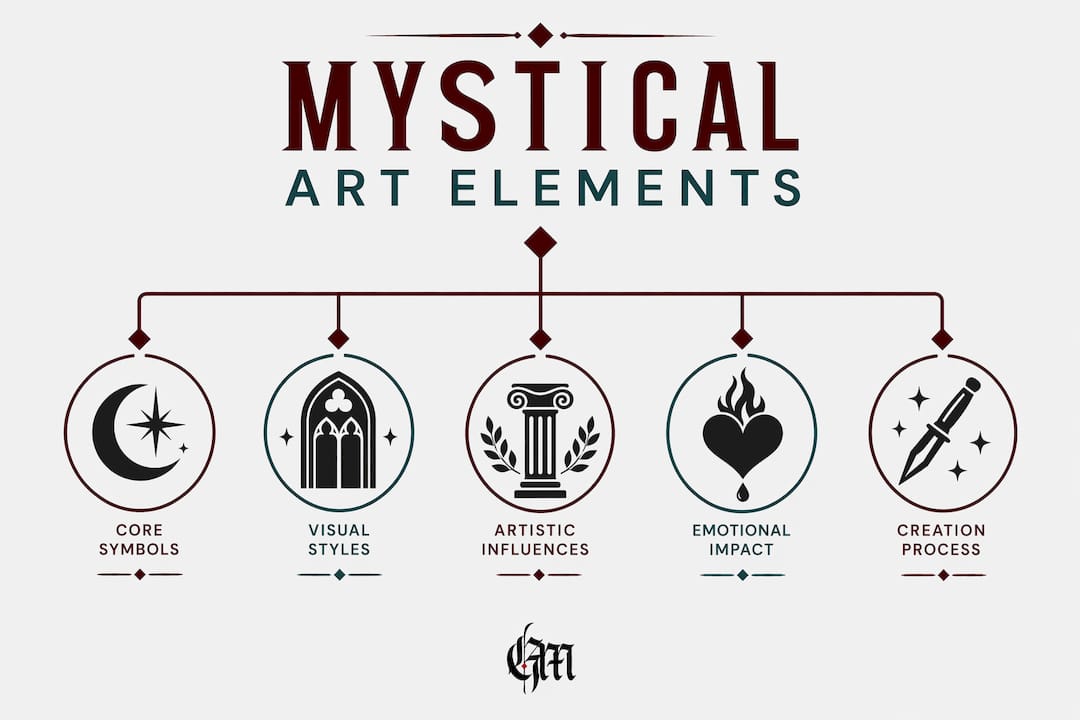
For a deeper look at how these symbols translate into wearable and decorative forms, Goth’s guide to gothic art symbolism breaks down the most common motifs and their historical roots.
How do artists create mystical artwork?
The creative process behind mystical art differs fundamentally from conventional studio practice. Most artists in this tradition do not begin with a sketch of what they want to depict. They begin with a state of mind.
- Entering an altered or meditative state: Artists often rely on intuition over observation, channeling spiritual energy rather than planning compositions intellectually. Meditation, breathwork, or extended periods of silence precede the act of mark-making.
- Using repetition as a spiritual tool: Repetition and geometric patterns replace narrative with meditative duration, encouraging both artist and viewer to slow down. Filling a canvas with thousands of tiny repeated marks is itself a ritual act.
- Creating a condition, not a subject: Mystical artists focus on producing a meditative viewer state rather than representing a recognizable subject. The artwork is a vehicle, not a destination.
- Employing symbolic motifs deliberately: The partially closed eyes motif explicitly shifts viewer focus inward, representing withdrawal from external to internal perception. Artists choose this motif because it communicates a psychological direction without words.
- Embracing process as ritual: The Mystics: A Blessed Rage for Order exhibition at BRIC Arts Media featured artists whose meticulous, repetitive practices represent secular mysticism. The act of creation itself becomes the spiritual practice, independent of any religious framework.
Pro Tip: If you want to try creating mystical art, start with a single symbol that resonates with you personally. Draw it repeatedly for 20 minutes without stopping to evaluate the result. The repetition itself will shift your mental state in ways that inform the work.
Which artistic styles and influences shape mystical art?
Mystical artwork does not belong to a single movement. It draws from multiple traditions simultaneously, which is part of what makes it so difficult to categorize and so rich to explore.
| Style or Tradition | Key Characteristics | Notable Artists |
|---|---|---|
| Surrealism | Dream logic, unconscious imagery, irrational juxtapositions | Salvador Dalí, Max Ernst |
| Symbolism | Allegorical figures, emotional atmosphere, rejection of realism | Gustave Moreau, Odilon Redon |
| Visionary Art | Altered states, cosmic imagery, spiritual visions rendered literally | Alex Grey, Android Jones |
| Abstract Art | Form and color as spiritual language, non-representational | Hilma af Klint, Wassily Kandinsky |
| Ancient Religious Iconography | Sacred geometry, deity figures, ritualistic composition | Egyptian, Byzantine, Tibetan traditions |
Surrealism, Symbolism, and visionary art movements all feed into what we now recognize as mystical artwork, but the tradition predates all of them by millennia. Hilma af Klint, working in Stockholm in the early 20th century, produced abstract paintings she believed were channeled from spiritual entities, decades before abstract art became a recognized movement. William Blake engraved visions he described as literal encounters with angels. These are not metaphors. These artists believed they were documenting real experiences from beyond ordinary consciousness.
Abstract art and installation art explore mystical principles through form, color, and immersive environments that foster spiritual contemplation. James Turrell’s light installations, for example, strip away all representational content and leave the viewer alone with pure perceptual experience. That is mystical art operating at its most minimal and most powerful.
The cross-cultural reach of mystical art is significant. Islamic geometric art, Celtic knotwork, Aztec cosmological diagrams, and Hindu mandalas all share the same underlying impulse: to make the invisible visible through pattern and symbol. Exploring occult-inspired design reveals how these ancient visual languages continue to shape contemporary aesthetics.
What is the cultural and emotional significance of mystical artwork?
Mystical art exists because humans have always needed a visual language for experiences that words cannot hold. It is a response to the oldest existential questions: What is consciousness? What lies beyond death? What connects us to each other and to the cosmos?
“Mystical art transcends escapism and invites existential inquiry, emphasizing symbolic depth and emotional resonance over literal interpretation.” — The Allure of Mystical Art
This distinction matters. Mystical art is not fantasy art, though the two are often confused. Fantasy art creates alternate worlds for entertainment. Mystical art points toward dimensions of this world that ordinary perception misses. The emotional experience it produces is closer to what you feel standing inside a cathedral or watching a solar eclipse than what you feel watching a film.
Viewers engage in emotional resonance with mystical art, where the artwork acts as a mirror for the subconscious rather than a logic puzzle. This means the significance of a piece is partly created by the viewer. Two people standing before the same Alex Grey painting will have genuinely different experiences, and both are correct. The art is designed to activate something personal.
The cultural significance of mystical artwork also includes its role in secular spirituality. Many people who do not follow organized religion still experience a hunger for transcendence, wonder, and connection to something larger than daily life. Mystical art serves that hunger directly, without requiring doctrinal commitment. A secular mode of mysticism in art focuses on creative process, detail, and ritualistic repetition as spiritual expression regardless of belief system.
What draws people to mystical art specifically:
- It creates contemplative space in a world saturated with information and noise.
- It validates inner experience, including dreams, intuitions, and states of awe, as real and worth exploring.
- It connects individual experience to universal human questions across cultures and centuries.
- It offers a visual vocabulary for experiences that resist verbal description.
Key takeaways
Mystical artwork is a symbolic, spiritually oriented art form that uses visual language to evoke transcendent experience, drawing on intuition, repetition, and cross-cultural iconography rather than literal representation.
| Point | Details |
|---|---|
| Core definition | Mystical art depicts spiritual and visionary experience through symbol and pattern, not physical reality. |
| Three visual markers | Mysterious darkness, dazzling complexity, and overwhelming luminosity reliably signal mystical intent. |
| Creative process | Artists enter meditative states and use repetition as ritual, creating conditions rather than subjects. |
| Key influences | Surrealism, Symbolism, visionary art, and ancient religious iconography all shape the tradition. |
| Emotional function | Mystical art mirrors the subconscious and invites existential inquiry rather than passive observation. |
Why I think most people approach mystical art the wrong way
Most people walk up to a mystical artwork and immediately try to decode it. They want to know what the eye means, what the spiral represents, what the artist intended. That intellectual reflex is understandable, but it is exactly the wrong entry point.
I have spent years around art that operates in this register, and the works that stay with me longest are the ones I stopped trying to understand. There is a painting by Hilma af Klint, part of her The Paintings for the Temple series, that I sat with for nearly 20 minutes in silence. I could not tell you what it means. I can tell you it changed the quality of my thinking for the rest of that day.
Artists urge viewers to trust intuition when engaging with mystical art, bypassing logical analysis for emotional and spiritual connection. That is not mystical advice. It is practical advice about how this category of art actually functions. The meaning is not hidden in the symbols waiting to be extracted. The meaning is generated in the encounter between the image and your specific inner life at that specific moment.
If you live with mystical art in your home, rather than only encountering it in galleries, that encounter becomes a daily practice. A piece of gothic wall art with genuine symbolic weight does something different to a room than a decorative print. It holds a kind of attention. That is worth paying for.
— Rey
Bring mystical artwork into your space with Goth
If this article has sparked a genuine interest in owning mystical artwork, Goth curates exactly the kind of pieces worth living with. The marketplace connects independent creators working in gothic, occult, and visionary traditions with collectors who want something more than mass-produced decoration.
From symbolic dark decor to occult-inspired prints and homeware, Goth.Market offers a curated selection built around the aesthetics this article explores. Whether you are drawn to celestial imagery, sacred geometry, or the darker symbolic traditions of gothic art, the platform makes it straightforward to find pieces that resonate. For those interested in how mystical symbolism translates into interior spaces, Goth’s guide to occult homeware is a practical next step. Independent creators also sell contemporary art prints through partner studios featured on the platform.
FAQ
What is the difference between mystical art and religious art?
Religious art depicts specific theological figures and narratives within a defined doctrinal framework. Mystical art explores transcendent and spiritual experience without requiring adherence to a specific belief system, making it accessible to secular audiences as well.
What symbols appear most often in mystical artwork?
The eye, spiral, moon, sun, and sacred geometric forms appear across virtually every mystical art tradition. These symbols function as a non-verbal language inviting personal interpretation rather than carrying a single fixed meaning.
Can someone with no spiritual beliefs appreciate mystical artwork?
Yes. Mystical art operates through emotional resonance and perceptual experience rather than doctrinal belief. Many viewers respond to its contemplative qualities, visual complexity, and sense of wonder without any spiritual framework.
How is visionary art related to mystical artwork?
Visionary art is the contemporary art world’s term for work that depicts insights from altered states of consciousness and spiritual visions. It is the most direct modern expression of what mystical artwork has always done, making the two terms largely interchangeable in current usage.
What makes mystical art different from abstract art?
Abstract art removes representational content to explore form, color, and composition as ends in themselves. Mystical art uses abstraction as a means toward a specific end: evoking spiritual experience, inner vision, or transcendent awareness in the viewer.