

Esoteric Symbolism: Meaning, History, and How to Read It
Esoteric symbolism is the use of visual signs, geometric forms, and figures to convey hidden or inner truths accessible only to an initiated or attentive observer. According to the Encyclopaedia Britannica, the word “esoteric” traces to the Greek esōterikós, meaning “from within,” which captures exactly what these symbols do: they point inward, toward layers of meaning that ordinary observation misses. The Pythagorean Tetractys, Carl Gustav Jung’s archetypal images, and the cross-cultural studies of Ananda K. Coomaraswamy all demonstrate that this symbolic language spans alchemy, Kabbalah, Hermeticism, Jungian psychology, fine art, and contemporary alternative fashion.
Key Takeaways
Esoteric symbolism is a precise, multilayered language encoding metaphysical correspondences across alchemy, Kabbalah, Hermeticism, and Jungian psychology, readable only with tradition-specific context.
| Point | Details |
|---|---|
| Definition and origin | “Esoteric” derives from Greek esōterikós (“from within”); these symbols convey hidden truths beyond literal language. |
| Symbols as structured language | In alchemy and Kabbalah, symbols function as a “calculus” mapping physical, metaphysical, and divine levels simultaneously. |
| Practitioner context matters | Schwaller de Lubicz argued a symbol’s power depends on the user’s inner readiness, not intellectual recognition alone. |
| Interpretation requires tradition | Coomaraswamy showed symbolism is objective and cross-cultural; meaning is verifiable against a tradition’s internal logic, not purely personal. |
| Contemporary use is widespread | Esoteric motifs appear in fine art, goth fashion, occult jewelry, film, and ritual practice, with varying degrees of contextual fidelity. |
Table of Contents
- What are the origins and historical background of esoteric symbolism?
- What exactly does “esoteric symbolism” mean in practice?
- How is esoteric symbolism different from exoteric symbolism?
- Which traditions and systems use esoteric symbols?
- How do esoteric symbols actually work — what mechanisms transmit meaning?
- What are the common esoteric symbols and their layered meanings?
- How can I approach and interpret esoteric symbols responsibly?
- How are esoteric symbols used in contemporary culture and practice?
- What ethical cautions and cultural issues should readers be aware of?
- What do psychology and philosophy say about esoteric symbolism?
- What are the most common misconceptions and criticisms of esoteric symbolism?
- Which primary texts and reliable resources should I consult to learn more?
- Why most people misread esoteric symbols, and what to do instead
- Sources
- FAQ
What are the origins and historical background of esoteric symbolism?
The roots run deep and wide. A compressed timeline shows how the tradition built on itself across millennia:
- Ancient Egypt (3000 BCE onward): Hieroglyphic and funerary symbolism encoded cosmological truths about death, resurrection, and divine order. The ankh, the djed pillar, and the eye of Horus each carried layered theological meanings beyond their pictographic surfaces.
- Pythagorean school (6th century BCE): The Tetractys, a triangular arrangement of ten points in four rows (1+2+3+4), encoded the harmony of the cosmos, the structure of music, and the four elements simultaneously. It was both a mathematical diagram and a sacred oath.
- Classical mystery schools (5th–3rd century BCE): Eleusinian, Orphic, and Mithraic rites used symbolic objects and ritual gestures to transmit experiential knowledge that could not be spoken plainly.
- Medieval alchemy and Kabbalah (10th–15th century CE): Alchemical emblems mapped the transformation of matter onto the transformation of the soul. The Kabbalistic Tree of Life organized divine emanations into a diagram that functioned as a map of reality.
- Renaissance occultism (15th–16th century): Heinrich Cornelius Agrippa’s Occult Philosophy (1531) systematized planetary magic squares and elemental correspondences. Albrecht Dürer embedded a 4×4 magic square in his 1514 engraving Melencolia I, with rows, columns, and diagonals all summing to 34.
- 19th–20th century theosophy and depth psychology: H. P. Blavatsky’s Theosophical Society revived and synthesized global symbolic traditions. Carl Jung reframed esoteric archetypes as psychological realities, arguing that the collective unconscious generates the same symbolic forms across unconnected cultures.
Magic squares themselves appeared in China as the Lo Shu square, a 3×3 grid with rows, columns, and diagonals having equal sums. The fact that the same mathematical structure surfaced independently in China, India, and Renaissance Europe points to something the tradition always claimed: certain symbolic forms encode universal structural truths.
What exactly does “esoteric symbolism” mean in practice?
A symbol used esoterically is not a label or a logo. It is a multilayered instrument. Learn Religions describes how, in systems like alchemy and Kabbalah, symbols function as a structured “calculus” that maps physical, metaphysical, and divine levels of reality onto a single visual form.
The difference between symbolic reference and symbolic function is worth spelling out:
- Reference: A cross refers to Christianity. A crescent refers to Islam. The symbol points at something external.
- Function: An esoteric symbol does something. The Tetractys, for instance, operates simultaneously as a cosmological diagram (the four elements), a musical theory (the ratios 1:2:3:4 generate the octave, fifth, and fourth), and a meditative object. Contemplating it is meant to align the practitioner’s mind with cosmic structure, not merely remind them of it.
- Correspondence: Esoteric symbols work through analogy. The sun corresponds to gold, to the heart, to the number 6 in certain Kabbalistic schemes, and to the archetypal hero. A single solar symbol activates the whole web.
- Initiation: Some symbols only become fully legible after instruction. The outer form is visible to anyone; the inner meaning requires a teacher, a text, or a practice.
Coomaraswamy put it plainly: symbolism is an objective, quasi-mathematical language, not a private invention. Symbols retain intelligibility across cultures even when used decoratively, because they encode structural relationships that exist independently of any one tradition.
How is esoteric symbolism different from exoteric symbolism?
The distinction is about audience and depth, not about secrecy for its own sake.
- Audience: Exoteric symbols address the general public. Esoteric symbols address initiated students or attentive practitioners who have the context to read their deeper layers.
- Purpose: Exoteric use is instructional, commemorative, or decorative. Esoteric use is transformative, ritual, or initiatory.
- Interpretive access: Exoteric reading is literal or broadly moral. Esoteric reading is anagogic (leading the mind upward) and analogical, moving through multiple levels of meaning.
- Example: A parable in scripture has an outer moral lesson anyone can grasp and an inner structural meaning that maps onto cosmological or psychological realities. The outer reading is exoteric; the inner reading is esoteric.
Theosophical writers like H. P. Blavatsky framed this dual function explicitly: symbols both preserve sacred knowledge and conceal it from those not prepared to receive it. That is not elitism for its own sake. It is a practical recognition that certain practices require preparation to be used safely and accurately.
One common misunderstanding: not all hidden meanings are intentionally secretive. Many symbols became obscure simply because the cultural context that made them readable was lost. A medieval alchemical emblem is not hiding from you; it is speaking a language that requires a dictionary.
Which traditions and systems use esoteric symbols?
The major systems each developed their own symbolic vocabulary, though they borrowed from each other constantly:
- Alchemy: Symbols for metals, planets, and processes (calcination, dissolution, coagulation) mapped material operations onto spiritual transformation. The ouroboros, the squared circle, and the pelican are central alchemical images.
- Kabbalah: The Tree of Life organizes ten sefirot (divine attributes) and twenty-two paths corresponding to Hebrew letters. Every symbol in the system interlocks with every other.
- Hermeticism: Rooted in the Corpus Hermeticum and the principle “as above, so below,” Hermetic symbolism maps cosmic structure onto human consciousness and vice versa.
- Neo-Platonism: Plotinus and later Proclus used geometric and numerical symbols to represent the emanation of reality from the One.
- Sufism: Islamic mystical poetry and visual art encode spiritual states through symbolic imagery: the wine, the beloved, the tavern are not literal but point to stages of union with the divine.
- Theosophy: H. P. Blavatsky synthesized Hindu, Buddhist, Kabbalistic, and Hermetic symbols into a unified framework, influencing artists from Hilma af Klint to Wassily Kandinsky.
- Jungian psychology: Carl Jung identified archetypes (the Shadow, the Anima, the Self) as the psychological substrate of esoteric symbols, arguing they arise from the collective unconscious rather than from cultural invention alone.
- Ceremonial magic: Heinrich Cornelius Agrippa and later figures like the Golden Dawn systematized planetary sigils, elemental weapons, and ritual diagrams as operational tools.
- Indigenous mystery traditions: Navajo sand paintings, Andean quipu, and West African adinkra symbols each encode cosmological and ethical knowledge in visual form.
Cross-cultural borrowing is the rule, not the exception. The pentagram traveled from Pythagorean mathematics to medieval Christian apotropaic use to Renaissance magic to contemporary Wicca, accumulating layers at each stop.
How do esoteric symbols actually work — what mechanisms transmit meaning?
Several distinct mechanisms are at play, often simultaneously:
- Correspondence/analogical mapping: A symbol connects a visible form to an invisible reality through structural analogy. Gold corresponds to the sun not arbitrarily but because both share qualities (radiance, incorruptibility, centrality) that the tradition treats as objectively related.
- Archetypal resonance: Jung argued that certain symbols activate pre-existing psychological structures. The mandala, for instance, appears spontaneously in the dreams of people with no knowledge of Tibetan Buddhism, which Jung read as evidence of a shared psychic substrate.
- Numerical and geometric encoding: The Tetractys encodes the ratios of musical harmony in its spatial arrangement. Agrippa’s planetary magic squares embed number sequences used in ritual invocation. The geometry is not decorative; it is the mechanism.
- Ritual and performative activation: A symbol drawn in a ritual context, with specific intent and preparation, functions differently from the same symbol printed on a T-shirt. The traditional doctrine of symbol describes symbols as anagogic nodes: they lead the mind upward when the conditions are right.
- Oral and initiatory context: Primary texts and visual sources (alchemical emblems, Kabbalistic diagrams) were historically learned through apprenticeship and commentary, not independent study.
Schwaller de Lubicz pushed this further. He argued that a symbol’s power depends on the practitioner’s “being-able,” an inner readiness that intellectual recognition alone cannot substitute. You can read every book about the Tree of Life and still not use it in the sense he means.
Pro Tip: Before working with a symbol ritually or artistically, ask whether you are bringing the context the symbol requires. The same form can be decoration, communication, or transformation depending entirely on what you bring to it.
What are the common esoteric symbols and their layered meanings?
Each of these symbols carries at least three levels: a surface form, a metaphysical correspondence, and a tradition-specific usage.
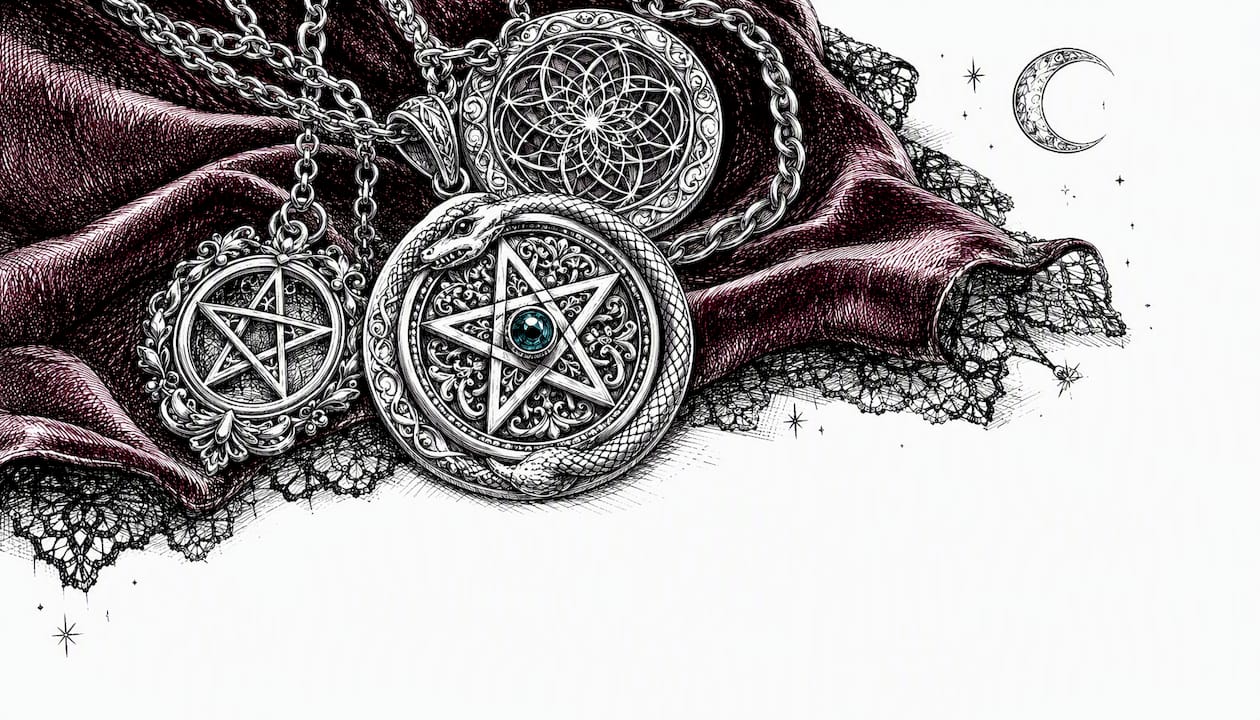
- Pentagram: Five-pointed star. Surface: a geometric figure. Metaphysical: the five elements (earth, water, fire, air, ether) in Pythagorean and Hermetic systems. Cultural note: inverted in some ceremonial magic traditions to indicate a different elemental hierarchy, not inherently “evil.”
- Ouroboros: Serpent eating its own tail. Surface: a circular animal. Metaphysical: the eternal cycle of creation and dissolution, the unity of opposites. Appears in Egyptian funerary texts, Greek Gnostic manuscripts, and alchemical treatises as a symbol of the prima materia.
- Ankh: Egyptian looped cross. Surface: a hieroglyphic sign for “life.” Metaphysical: the union of male and female principles, immortality, the key to hidden knowledge. Widely adopted in contemporary goth and occult jewelry for its layered resonance.
- Tetractys: Ten points in a triangle (rows of 1, 2, 3, 4). Surface: a numerical diagram. Metaphysical: the harmony of the cosmos, the four elements, the ratios of musical consonance. The Pythagoreans swore their oaths by it.
- Tree of Life (Kabbalah): Ten sefirot connected by twenty-two paths. Surface: a diagram. Metaphysical: the structure of divine emanation, a map of consciousness, and a framework for ritual work. Each path corresponds to a Hebrew letter, a tarot card, and a planetary or elemental force.
- Mandala: Circular geometric diagram. Surface: decorative pattern. Metaphysical: a map of the cosmos and the psyche, used in Tibetan Buddhist and Hindu ritual as a meditation support. Jung documented its spontaneous appearance in patients’ drawings as evidence of the Self archetype.
- Magic squares: Numerical grids where rows, columns, and diagonals sum to the same number. Surface: a mathematical curiosity. Metaphysical: each square corresponds to a planet (Saturn = 3×3, Jupiter = 4×4, Mars = 5×5). Dürer’s Melencolia I (1514) features the Jupiter square, with the date 1514 encoded in the bottom row.
- Squared circle: A circle inscribed in a square or vice versa. Surface: geometric construction. Metaphysical: the reconciliation of heaven (circle) and earth (square), the goal of the Great Work in alchemy.
- Sigils: Condensed symbolic forms derived from names, intentions, or planetary seals. Surface: abstract mark. Metaphysical: a compressed intention or invocation. Used in ceremonial magic and increasingly in contemporary goth fashion and jewelry design as personal emblems.
For historical visual reference, the Ripley alchemical scroll (1624, after George Ripley, held at Princeton University Library) is one of the most complete surviving examples of layered alchemical imagery, available through Wikimedia Commons.
How can I approach and interpret esoteric symbols responsibly?
Interpretation without context produces confident nonsense. Here is a practical method:
- Establish the context first. Where did you encounter the symbol? A medieval manuscript, a contemporary tattoo, and a ritual diagram require different interpretive frames.
- Identify the tradition. Is this Kabbalistic, alchemical, Hermetic, Buddhist? Each system has its own internal logic, and a symbol means something specific within that logic.
- Check primary sources. For Hermetic symbols, the Corpus Hermeticum and Agrippa’s Occult Philosophy are the baseline. For Kabbalistic symbols, the Zohar and Scholem’s scholarly commentary. For Jungian archetypes, Jung’s Collected Works, especially volumes 9 and 12.
- Note layered meanings. A symbol rarely means one thing. Map the surface form, the metaphysical correspondence, and the tradition-specific usage separately before synthesizing.
- Test correspondences. Does the symbol’s meaning cohere with other symbols in the same system? Esoteric systems are internally consistent; if your reading contradicts the system’s own logic, revisit it.
- Seek qualified guidance when necessary. For living traditions (Kabbalah, Tibetan Buddhism, Yoruba Ifá), consulting a practitioner or scholar is not optional when you intend to use a symbol ritually.
A responsible interpretation checklist:
- Verify the symbol’s tradition of origin before assigning meaning.
- Distinguish between historical use and contemporary popular use.
- Acknowledge when a symbol belongs to a living community with its own interpretive authority.
- Avoid flattening a multivalent symbol to a single “meaning” for convenience.
- Credit sources when publishing interpretations.
Pro Tip: A quick reverse-image search plus a cross-reference against a scholarly database (JSTOR, the Warburg Institute’s image archive) takes ten minutes and can save you from confidently misreading a symbol that means the opposite of what you think.
How are esoteric symbols used in contemporary culture and practice?
The symbols did not stay in manuscripts. They migrated into every corner of visual culture:
- Fine art: The esoteric art movement, from Hilma af Klint’s geometric canvases (painted 1906–1915 and explicitly based on Theosophical and Rosicrucian symbolism) to contemporary artists, uses these forms to create works that function on multiple levels simultaneously. Modern artists deliberately reuse esoteric motifs to embed layered meanings that reward attentive viewers.
- Gothic and alternative fashion: The ankh, pentagram, ouroboros, and sigils appear on clothing, jewelry, and accessories as both aesthetic choices and personal symbolic statements. The symbolism in goth fashion is rarely arbitrary; many wearers choose specific symbols for their traditional meanings, not just their visual impact.
- Occult jewelry: Rings, pendants, and talismans bearing Kabbalistic, alchemical, and Hermetic symbols are among the most direct contemporary applications. Platforms like Goth curate independent artisans whose work draws explicitly on these traditions, connecting buyers with pieces that carry genuine symbolic depth rather than mass-produced approximations.
- Film and literature: From Umberto Eco’s Foucault’s Pendulum to Alejandro Jodorowsky’s films, esoteric symbolism structures narrative at the level of plot and image. Dan Brown’s novels, whatever their scholarly limitations, introduced millions of readers to the surface vocabulary of Hermetic and Masonic symbolism.
- Contemporary ritual groups: Wicca, Thelema, the Golden Dawn revival, and various neo-shamanic practices use esoteric symbols as operational tools in ceremony, not as decoration.
- Branding and visual culture: Corporate logos, album covers, and architectural ornament frequently borrow esoteric forms, sometimes deliberately (Led Zeppelin’s Zoso symbols, designed by Jimmy Page, a practicing occultist) and sometimes by cultural osmosis.
What ethical cautions and cultural issues should readers be aware of?
Using esoteric symbols without understanding their context creates real problems, for the user and for the communities whose traditions they come from:
- Cultural appropriation: Symbols from living traditions (Navajo sand painting motifs, Tibetan vajra, Yoruba vévé) belong to communities that maintain their meaning through ongoing practice. Wearing them as fashion without acknowledgment reduces a living system to a trend.
- Reducing traditions to aesthetics: When a symbol is stripped of its functional context and used purely decoratively, it loses the layered meaning that made it significant. The symbol becomes a costume.
- False “secret” claims: Much of what circulates online as “hidden” or “forbidden” symbolism is either well-documented in public scholarship or simply invented. Treat dramatic secrecy claims skeptically.
- Commercialized trivialization: Mass-produced “occult” merchandise often combines symbols from incompatible traditions in ways that would be incoherent to any practitioner. Buying from independent artisans who understand the traditions they work with is a meaningful distinction.
- Safety with ritual practices: Some ceremonial practices involve altered states, group dynamics, or psychological intensity. Approaching them without preparation or guidance carries real risk.
When a symbol belongs to a living tradition, consulting a practitioner or scholar before using it publicly is the minimum standard of respect.
What do psychology and philosophy say about esoteric symbolism?
Jung’s contribution was to reframe the question entirely. Rather than asking whether esoteric symbols encode objective metaphysical truths, he asked why the same symbolic forms appear across unconnected cultures and in the spontaneous imagery of modern patients. His answer: archetypes, structural patterns in the collective unconscious that generate consistent symbolic forms because they reflect consistent features of human psychological experience. The mandala, the hero’s journey, the shadow figure, the divine marriage all appear in Tibetan tantra, Greek mystery religion, and the dreams of twentieth-century Europeans who had never studied either.
Coomaraswamy pushed back against purely psychological readings. For him, symbolism is not a projection of the psyche onto the world; it is a recognition of structural correspondences that exist in reality. The sun genuinely shares properties with gold, with the heart, with the principle of illumination. The symbol does not create the relationship; it names it. This is closer to Platonic philosophy than to Jungian psychology, and the distinction matters for interpretation: if symbols are psychological projections, their meaning is ultimately personal; if they are objective correspondences, their meaning is verifiable against the tradition’s own internal logic.
Philosophically, the debate maps onto the older question of universals. Nominalists treat symbols as conventional signs with no inherent meaning. Realists (in the medieval sense) treat them as participating in the realities they represent. Most esoteric traditions are implicitly realist, which is why they insist on precision: using the wrong symbol for a purpose is not merely aesthetically wrong, it is functionally wrong.
What are the most common misconceptions and criticisms of esoteric symbolism?
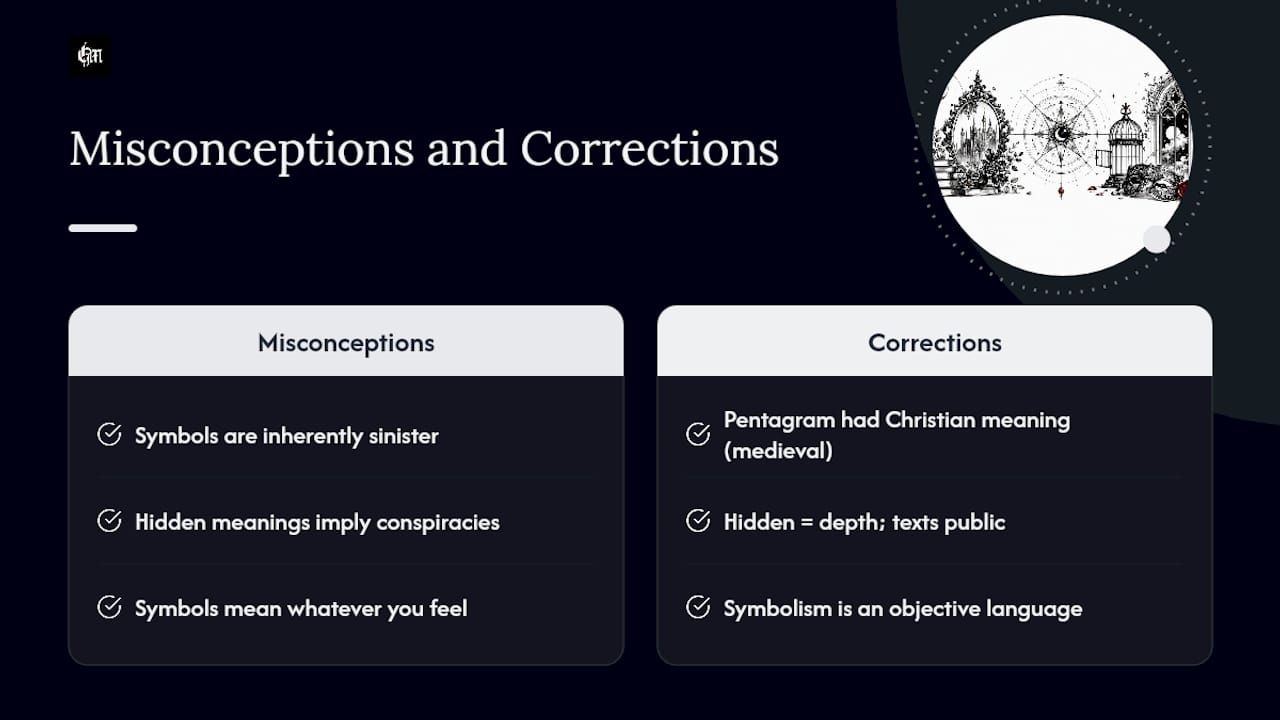
Misconception 1: Esoteric symbols are inherently sinister. The pentagram, the all-seeing eye, and the inverted cross all have long histories in mainstream religious and philosophical contexts before their association with transgressive subcultures. The pentagram was a Christian symbol representing the wounds of Christ in medieval Europe.
Misconception 2: Every hidden meaning is a conspiracy. The “hidden” in esoteric symbolism refers to depth of meaning, not to a secret agenda. Most esoteric texts are publicly available; the knowledge is hidden only in the sense that it requires preparation to understand.
Misconception 3: Symbols mean whatever you feel they mean. This is the most common error in popular culture. Coomaraswamy’s corrective is direct: symbolism is an objective language, not a Rorschach test. Feeling that the ouroboros “means” infinity is not wrong, but it is incomplete and potentially misleading if you then use it in a context where its alchemical meaning (the unity of opposites in the prima materia) is what the tradition actually intends.
Criticism 1: Unfalsifiability. Critics from analytic philosophy and cognitive science argue that esoteric symbol systems are unfalsifiable: any interpretation can be made to fit any symbol by adjusting the correspondence web. This is a genuine methodological problem, and serious practitioners acknowledge it by insisting on internal consistency within a tradition rather than free-form interpretation.
Criticism 2: Elitism and gatekeeping. The initiatory structure of esoteric traditions has historically excluded women, non-Western practitioners, and the economically disadvantaged. Contemporary scholars and practitioners increasingly address this by publishing primary texts, making scholarly commentary accessible, and questioning which exclusions were functional and which were merely social.
Criticism 3: Commercialization dilutes meaning. When mass-market products use sacred symbols as decoration, the symbols lose the contextual density that made them functional. This is a real loss, though it does not invalidate the symbols themselves.
Which primary texts and reliable resources should I consult to learn more?
For readers who want to go deeper, here is a prioritized list organized by purpose:
- Historical grounding: The Corpus Hermeticum (Brian Copenhaver’s translation, Cambridge University Press) and Agrippa’s Three Books of Occult Philosophy (Llewellyn edition) are the foundational Western texts. Gershom Scholem’s Major Trends in Jewish Mysticism is the standard scholarly entry point for Kabbalah.
- Philosophical framework: Coomaraswamy’s The Transformation of Nature in Art and Figures of Speech or Figures of Thought develop his argument for symbolism as objective language. René Guénon’s The Symbolism of the Cross applies the same framework to a single symbol with unusual rigor.
- Psychological perspective: Jung’s Collected Works, Volume 9 (The Archetypes and the Collective Unconscious) and Volume 12 (Psychology and Alchemy) are the essential texts. Marie-Louise von Franz’s Alchemy: An Introduction to the Symbolism and the Psychology is more accessible.
- Visual reference: The Warburg Institute’s online image archive and Wikimedia Commons both hold high-quality reproductions of historical symbolic art. The Ripley alchemical scroll at Princeton is a landmark example.
- Contemporary applied context: For readers interested in how these symbols translate into wearable art and design, Goth’s blog covers occult jewelry meanings and styles and occult-inspired design with attention to the historical traditions behind the forms.
- Online scholarly access: JSTOR and the Internet Archive hold digitized versions of many primary texts. The Cambridge Dictionary’s entry on “esoteric” is a useful quick reference for the word’s common versus scholarly usage.
Why most people misread esoteric symbols, and what to do instead
The standard advice on esoteric symbolism tends to fall into one of two traps. Either it treats every symbol as a doorway to infinite personal meaning (the “it means what it means to you” school), or it presents a flat catalog of symbols with one-line definitions that strip out everything interesting. Both approaches miss the point.
What the research in this article actually supports is a third position: esoteric symbols are precise instruments with verifiable internal logic, and they reward the same kind of careful, contextual reading you would give a technical text in an unfamiliar field. The Tetractys is not a spiritual inkblot. It encodes specific mathematical relationships that the Pythagorean tradition used for specific purposes. Getting those relationships right is not pedantry; it is the difference between using a tool correctly and using it as a paperweight.
The conventional advice also underestimates how much context matters for contemporary use. Wearing an ankh or a pentagram is not inherently appropriative or disrespectful, but it is worth knowing what you are wearing and why. The goth and alternative communities have long engaged with these symbols more thoughtfully than mainstream culture gives them credit for, often drawing on genuine historical knowledge rather than surface aesthetics.
What to prioritize: start with one tradition, go to its primary texts, and learn the internal logic before branching out. Breadth without depth produces the kind of symbol soup that fills social media feeds and means nothing to anyone who actually knows the systems. One tradition understood well is worth more than a dozen half-remembered correspondences.
Sources
The sources below ground the claims in this article and point toward deeper study:
- Encyclopaedia Britannica — Esotericism
- Learn Religions — Occult symbols (overview)
- artnet News — 5 occult symbols decoded
- Theosophy — The Universal Mystery Language (HT Edge)
FAQ
What does esoteric symbolism mean?
Esoteric symbolism refers to the use of visual signs, geometric forms, and figures to convey hidden or inner truths accessible to an initiated or attentive observer. The word “esoteric” comes from the Greek esōterikós, meaning “from within,” and distinguishes this symbolic mode from exoteric (publicly accessible) communication. These symbols appear across alchemy, Kabbalah, Hermeticism, Jungian psychology, and contemporary alternative art and fashion.
How is esoteric symbolism different from regular symbolism?
Regular (exoteric) symbolism communicates a single, publicly accessible meaning, like a red light meaning “stop.” Esoteric symbolism operates on multiple levels simultaneously: a surface form, a metaphysical correspondence, and a tradition-specific function. The same symbol can mean different things at different levels of interpretation, and its full meaning is typically accessible only to those with the relevant training or context.
What are some well-known examples of esoteric symbols?
The Pythagorean Tetractys, the Kabbalistic Tree of Life, the alchemical ouroboros, the pentagram, the ankh, the mandala, planetary magic squares, and the squared circle are among the most widely documented. Each carries layered meanings: the Tetractys, for instance, encodes musical ratios, the four elements, and cosmic harmony in a single triangular diagram of ten points.
Who are the key scholars associated with esoteric symbolism?
Ananda K. Coomaraswamy argued that symbolism is an objective, cross-cultural language rather than a private invention. Carl Gustav Jung identified esoteric archetypes as psychological realities arising from the collective unconscious. Heinrich Cornelius Agrippa systematized Western occult symbolism in the 16th century. H. P. Blavatsky synthesized global symbolic traditions through the Theosophical Society in the 19th century.
Can esoteric symbols be used in art and fashion without deep knowledge?
They can be used aesthetically, but without contextual knowledge the layered meaning is lost and the result is surface decoration rather than genuine symbolic communication. Experts like Coomaraswamy warn that intelligibility depends on restoring at least some of the original context. For living traditions, using symbols without acknowledgment of their source raises ethical concerns about cultural appropriation.
How do I start interpreting esoteric symbols accurately?
Begin by identifying the tradition the symbol comes from, then consult primary sources for that tradition (the Corpus Hermeticum for Hermetic symbols, the Zohar for Kabbalistic ones, Jung’s Collected Works for archetypal imagery). Note the symbol’s layered meanings separately before synthesizing, and test your reading against the tradition’s internal logic. For symbols from living communities, consulting a practitioner or scholar is the most reliable path to accurate interpretation.