

The Role of Sigils in Goth Wear: A Style Guide
TL;DR:
- Sigils are symbolic glyphs rooted in magical tradition that now serve as personal statements in goth fashion. They encode occult meaning and subcultural identity, transforming clothing into visual expressions of philosophy and intention.
Sigils are symbolic glyphs rooted in magical tradition, and the role of sigils in goth wear is to embed personal intention, occult meaning, and subcultural identity directly into clothing and accessories. Originally used in grimoires to represent spirits or seal magical intentions, these symbols crossed into gothic fashion through Victorian mysticism, occult revivals, and modern movements like chaos magic. Today, a sigil on a goth garment is never just decoration. It is a statement of philosophy, a mark of belonging, and sometimes a private ritual made visible. Goth has built an entire curated world around this kind of layered symbolism.
How have sigils historically influenced goth fashion?
Sigils trace their roots to Western magical tradition, where they functioned as the true names of spirits, granting the practitioner control over occult entities. Grimoires like The Lesser Key of Solomon cataloged hundreds of these glyphs, each tied to a specific demon or angelic force. That association with hidden power made sigils irresistible to subcultures built around mystery and the forbidden.
Victorian mourning culture and the occult revival of the 19th century gave gothic aesthetics their first major infusion of symbolic depth. Victorian mourning dress and its preoccupation with death, memory, and the afterlife translated directly into goth’s embrace of dark, introspective themes. Occult societies like the Hermetic Order of the Golden Dawn popularized sigil use among educated elites, and those symbols eventually filtered into art, jewelry, and clothing.
The transition from ritual tool to fashion statement happened gradually. Key historical shifts include:
- Grimoire seals became decorative motifs on rings, pendants, and belt buckles.
- Alchemical symbols for elements like fire, water, and mercury appeared on printed fabrics.
- Demonic and angelic sigils from medieval manuscripts inspired embroidered patches and screen prints.
- Hermetic glyphs moved from secret society rituals into publicly worn jewelry and accessories.
Each step stripped away some of the original ritual context while preserving the visual weight and mystery. That tension between sacred origin and secular display is exactly what gives gothic symbolism its edge.
What sigils and gothic symbols are most common in goth clothing?
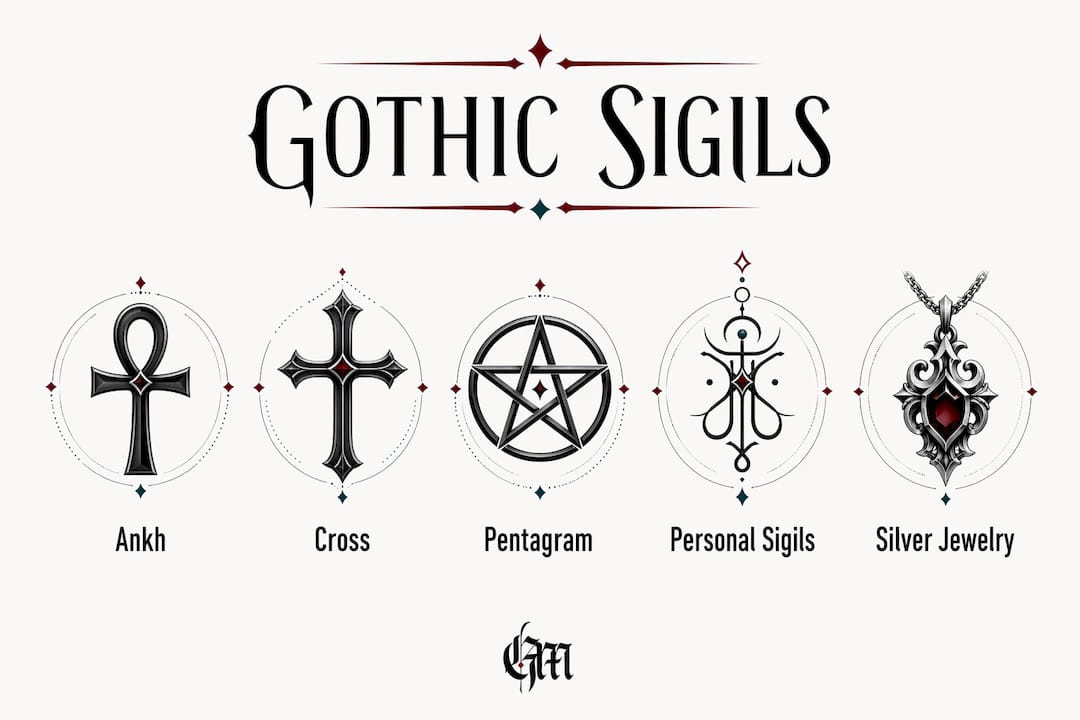
Gothic fashion relies on a core vocabulary of symbols, and crosses, ankhs, and pentagrams communicate values like mortality, rebellion, and eternal life through jewelry and clothing. These are the symbols most readers recognize, but the full range runs much deeper.
The core symbol set
The ankh is an ancient Egyptian hieroglyph meaning life. Goth and vampire fashion adopted it to evoke immortality and mystical power, and it appears constantly on necklaces, earrings, and printed tees. The pentagram carries dual meaning: a five-pointed star pointing up signals protection and the five elements, while an inverted version signals defiance of conventional morality. The chaos star, an eight-pointed symbol from chaos magic, represents infinite possibility and the rejection of fixed belief systems.
Traditional religious symbols and occult sigils function differently in goth wear. A cross references Christian iconography but is often inverted or stylized to signal rebellion. A sigil from a grimoire carries no religious baggage at all. It is a pure glyph, and its meaning is either historical or entirely personal.
| Symbol | Origin | Common meaning in goth wear |
|---|---|---|
| Ankh | Ancient Egypt | Eternal life, vampire mysticism |
| Pentagram | Western occultism | Protection, elemental balance, defiance |
| Inverted cross | Christian iconography | Rebellion, anti-establishment stance |
| Chaos star | Chaos magic | Infinite possibility, personal freedom |
| Grimoire sigil | Medieval occult texts | Spirit contact, hidden power, ritual identity |
| Personal sigil | Chaos magic practice | Individual intention, private philosophy |
Pro Tip: Place a personal sigil in a spot only you can see, like the inside of a collar or the lining of a jacket. The private placement mirrors the original magical practice of concealing sigils from outside eyes.
Silver jewelry with sigil designs sits at the center of goth accessory culture because silver carries its own symbolic weight. Its traditional association with the moon and protection aligns perfectly with occult themes, making it the default metal for sigil rings, pendants, and cuffs.
How have chaos magic and cybersigilism reshaped goth aesthetics?
Chaos magic changed the entire logic of sigil creation. Rather than copying symbols from old grimoires, chaos magic practitioners condense a personal statement of intent into an abstract glyph designed to bypass the conscious mind and embed desire directly into the subconscious. The symbol does not need to reference any tradition. It only needs to mean something to its creator.
That shift from inherited symbol to personal creation had a direct impact on goth fashion. Wearers stopped relying solely on established glyphs and started commissioning or designing their own. A custom sigil on a jacket back or a ring face carries a meaning only the wearer fully understands. That privacy is part of the appeal.
Cybersigilism pushed this further by combining traditional occult motifs with digital and posthuman aesthetics. Artists working in fine-line, blackwork, and gray shading produce abstract designs that look simultaneously ancient and algorithmic. The style emerged from Berlin’s club scene and spread globally through music and social media. Billie Eilish and Gen Z brought it into mainstream visibility, making abstract sigil aesthetics a recognized marker of personal and mystical identity.
The influence on goth wear shows up in several ways:
- Biomechanical prints on shirts and leggings blend organic forms with circuit-like sigil patterns.
- Abstract tattoo-inspired graphics appear on hoodies, corsets, and jackets.
- Custom digital sigils are printed on demand, making one-of-a-kind garments accessible.
- Layered glyph designs combine multiple sigil traditions into single, complex compositions.
Cybersigilism represents a generational shift where sigils transcend traditional occult meanings to become expressions of anxiety, ambition, and philosophical identity woven into digital culture and biomechanical design. For goth wearers, that means a sigil on a garment can carry the weight of an entire personal worldview.
Pro Tip: When sourcing cybersigilism-inspired pieces, look for artists who specialize in blackwork or fine-line illustration. The detail work in these styles translates better to fabric printing than bold, flat designs.
How do goth enthusiasts practically integrate sigils into their wear?
Sigils work across every category of goth dress, from statement jewelry to subtle printed details. The key is intentionality. A sigil chosen for purely aesthetic reasons still carries visual meaning to observers familiar with the tradition.
-
Start with jewelry. Rings, pendants, and cuffs are the most direct way to wear a sigil. Occult jewelry lets you carry a symbol close to the body, which mirrors the original magical practice of wearing seals for protection or intention.
-
Use clothing prints strategically. A sigil printed large across a back panel makes a public statement. The same glyph printed small on a chest pocket reads as a private mark. Choose placement based on how much you want the symbol to communicate outward versus inward.
-
Mix traditional and personal sigils. Pairing an ankh necklace with a custom chaos magic sigil ring creates a conversation between historical tradition and personal intention. That layering is exactly how gothic accessories express identity and subcultural belonging simultaneously.
-
Consider tattoos as permanent sigil wear. A tattooed sigil is the most committed form of symbolic dress. It removes the garment entirely and makes the body the canvas. Many goth wearers treat tattoos and clothing as a unified aesthetic system.
-
Extend into accessories. Bags, belts, and boots with embossed or printed sigils complete a look without overwhelming it. A single sigil on a belt buckle anchors an entire outfit in symbolic meaning.
Grant Morrison described modern branding as hypersigils that propagate desires and identities subliminally across culture. Goth wearers who design their own sigils are doing exactly that on a personal scale. They are creating their own visual language and wearing it publicly.
Key Takeaways
Sigils in goth wear function as personal and occult symbols that communicate identity, philosophy, and subcultural belonging through clothing and accessories.
| Point | Details |
|---|---|
| Sigils carry historical weight | Originating in grimoires like The Lesser Key of Solomon, sigils entered goth fashion through Victorian occult revivals. |
| Core symbols have fixed meanings | Ankhs, pentagrams, and chaos stars each communicate specific values like eternal life, protection, or personal freedom. |
| Chaos magic enabled personal sigils | Wearers now create custom glyphs encoding private intentions, moving beyond inherited occult symbols. |
| Cybersigilism modernized the aesthetic | Abstract, digital-age sigil designs now appear on goth garments as expressions of posthuman identity. |
| Placement carries meaning | Where a sigil sits on a garment, public or private, changes how it communicates to the wearer and the world. |
Why sigils in goth fashion matter more than most people realize
Most fashion commentary treats sigils as decoration. That reading misses the point entirely. What I have observed across years of watching goth culture is that sigils function as the most honest form of self-disclosure available in fashion. You cannot fake a sigil the way you can fake a brand logo. Either you chose it for a reason or you did not.
The shift toward personal sigils driven by chaos magic is the most significant development in gothic symbolism in decades. It moved the practice from referencing someone else’s tradition to authoring your own. That is a meaningful distinction. A person wearing a grimoire seal is quoting history. A person wearing a sigil they designed from a personal statement of intent is writing their own.
Cybersigilism complicates this further in ways I find genuinely interesting. It takes the abstract, personal quality of chaos magic sigils and runs it through a digital aesthetic filter. The result looks ancient and futuristic at the same time. That tension is very goth. The subculture has always been about holding contradictions together without resolving them.
My honest view is that sigils are the most intellectually serious element of goth fashion. They require the wearer to know something, decide something, and commit to it visually. That is rare in any subculture.
— Rey
Goth and the art of wearing your symbols
Goth curates gothic fashion, occult jewelry, and dark accessories from independent creators who understand exactly what symbolic weight means in this subculture. Every piece on the platform is chosen because it carries genuine aesthetic and cultural meaning, not because it fits a mass-market trend.
If you are building a wardrobe around sigil-inspired designs, Goth connects you with artists working in the traditions covered here, from grimoire-based occult jewelry to cybersigilism-influenced prints. The gothic accessories collection is a strong starting point for understanding how symbols translate into wearable form. For those ready to go deeper, the full marketplace at Goth brings together clothing, jewelry, and art that treat symbolism as the point, not an afterthought.
FAQ
What is a sigil in goth fashion?
A sigil is a symbolic glyph originally used in magical practice to represent spirits or intentions. In goth fashion, sigils function as wearable symbols that express personal philosophy, occult identity, and subcultural belonging.
What is the difference between a sigil and a gothic symbol?
Gothic symbols like the ankh or pentagram come from established religious or occult traditions with fixed meanings. A sigil, especially in chaos magic practice, is often a custom glyph created by the wearer to encode a personal intention.
What does the ankh mean in goth wear?
The ankh is an ancient Egyptian symbol for life, adopted by goth and vampire fashion to represent eternal life and mystical power. It appears frequently on necklaces, rings, and printed clothing.
What is cybersigilism and how does it connect to goth style?
Cybersigilism combines traditional occult sigil aesthetics with digital and biomechanical design, producing abstract glyphs that reflect posthuman identity. The style spread from Berlin’s club scene into goth and cyber-goth wardrobes through music, tattoo culture, and social media.
How do I choose a sigil for my goth wardrobe?
Choose a sigil based on the meaning you want to carry. Traditional grimoire sigils reference historical occult power, while a custom chaos magic sigil encodes a personal intention only you fully understand. Both work in goth wear, and combining them creates layered symbolic depth.