

Dark Folk Art: What It Is, How to Identify It
TL;DR:
- Dark folk art combines traditional folk craft with themes rooted in occult symbolism, folk horror, and the uncanny to explore psychological depth without shock. It features handmade textures, muted earthy palettes, and coherent symbolic language derived from mythic and ritual sources. Collectors should look for signs of personal meaning, authentic handwork, and artwork that reflects a confrontational or introspective intent.
Dark folk art combines the visual language of traditional folk craft with intentional thematic darkness, drawing on occult symbolism, folk horror, and the uncanny in nature to create work that is psychologically exploratory rather than shock-driven.
tl;dr: Dark folk art typically includes woodcut-style prints, rustic textiles with occult or seasonal motifs, folk-horror-influenced paintings, and handmade objects referencing boundary spirits or ancestral ritual. It usually does not include mainstream horror illustration whose sole purpose is to frighten or disgust. The rest of this article covers visual markers, thematic sources, materials, named artists, symbol interpretation, and where to find or buy pieces in the United States.
Table of Contents
- What is dark folk art, and how do you recognize it?
- Visual characteristics that define the dark folk aesthetic
- Themes and mythological influences behind dark folk art
- How dark folk art differs from traditional folk art and horror art
- Materials and techniques used in dark folk art
- Artists and places to see dark folk art examples
- How to interpret common symbols in dark folk art
- Where to find and buy dark folk art in the United States
- Key Takeaways
- Why dark folk art deserves more serious attention than it gets
- Browse curated dark folk art on Goth’s marketplace
- Useful sources and further reading
What is dark folk art, and how do you recognize it?
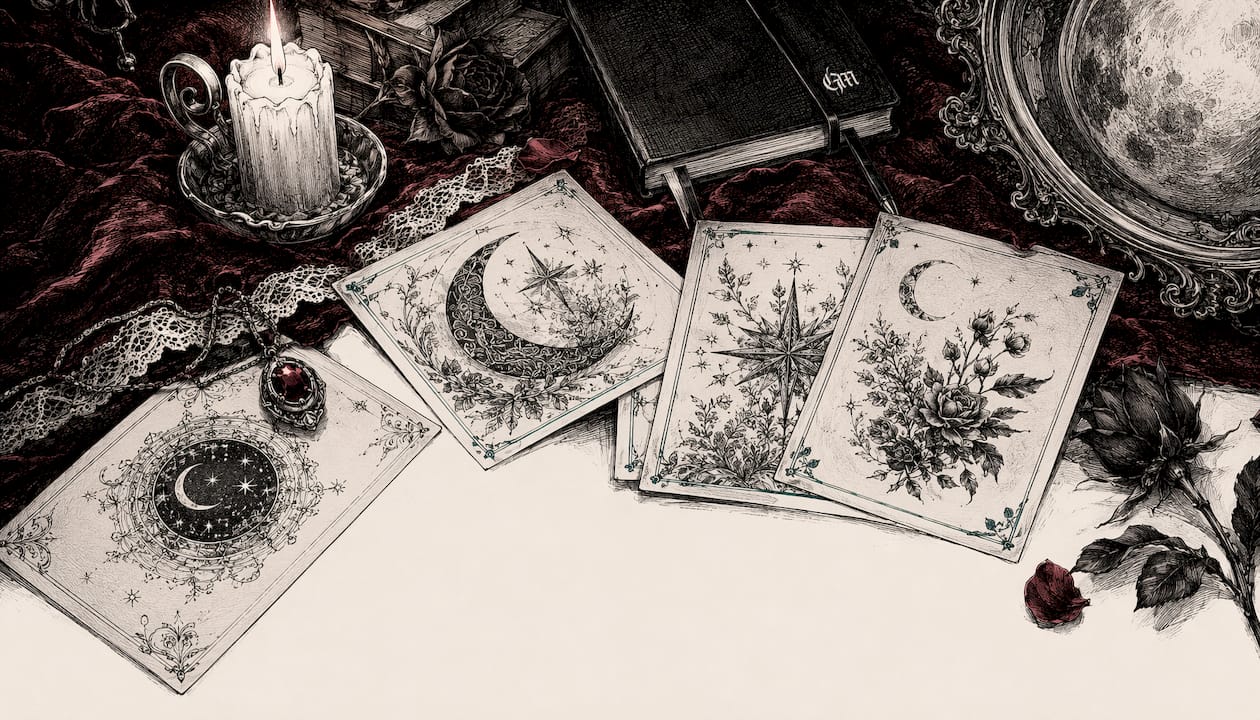
Dark folk art blends the atmospheric iconography of dark art with the visual languages of traditional folk craft: woodblock prints, rustic textiles, and stylized forest imagery. The result sits at an intersection that neither pure folk craft nor pure horror art occupies on its own.
The category is not a fixed historical movement. Most contemporary makers working in this mode are self-taught artists who borrow folk forms and aesthetics rather than inheriting them through strict community transmission. That distinction matters when you are trying to classify a piece, and the article addresses it directly in the comparison section below.
Visual characteristics that define the dark folk aesthetic
The handmade quality is the first thing to look for. Dark folk art tends to carry visible evidence of its making: linocut ridges, uneven brushwork, textile weave showing through paint, or the slight imprecision of a hand-carved stamp. That texture is not a flaw; it is load-bearing.
Core visual markers:
- Muted or limited palettes: blacks, deep earth tones, ochre, forest green, and bone white dominate. Saturated primaries are rare.
- Simplified, flattened forms: figures and animals read as symbols rather than portraits, closer to a woodcut silhouette than a realistic rendering.
- Repeated folklore motifs: woodland animals, bare trees, moons, skulls, hands, and seasonal or solstice imagery recur across makers and regions.
- Atmospheric composition: frieze-like layouts, figure-in-landscape arrangements, and strong bilateral symmetry are common structural choices.
- Occult and ritual objects: pentacles, bones, herbs, candles, and boundary markers appear as recurring props rather than incidental details.
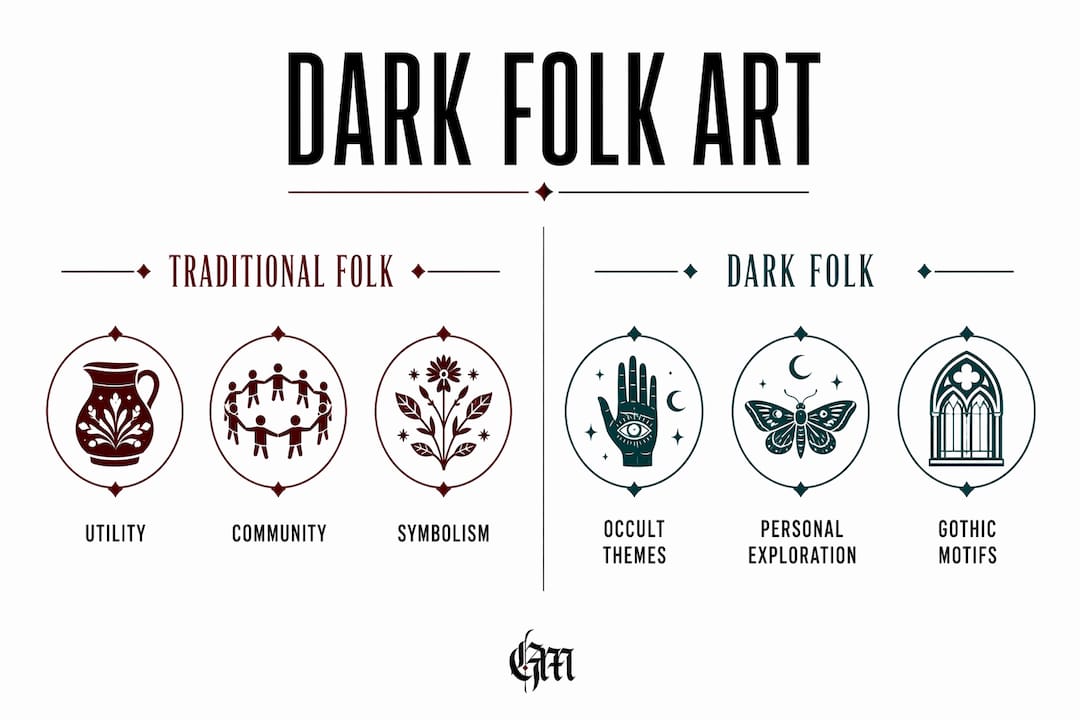
The American Folk Art Museum frames folk art around four themes: utility, community, individuality, and symbolism. Dark folk art keeps the symbolism and individuality while often discarding the utilitarian root entirely.
Pro Tip: The clearest sign a piece is working in the dark folk idiom rather than just gothic decoration is that the motifs form a coherent internal language. A crow, a threshold, and a bare-branched tree in the same composition are not decorative accidents; they are a sentence. Gothic decoration tends to layer symbols for atmosphere. Dark folk art tends to use them to say something specific.
Themes and mythological influences behind dark folk art
Folk horror is the dominant narrative frame. The concept, popularized through British film and fiction, centers on rural uncanny landscapes where nature is not a backdrop but an active, often threatening force. Folk-horror researchers describe this as “the skull beneath the skin of the countryside,” and many dark folk artists work directly from that image.
Common mythic and folkloric sources:
- Boundary spirits and liminal figures (the stranger at the crossroads, the figure at the threshold)
- Solstice and seasonal rituals, particularly those tied to harvest, death, and rebirth
- Witchcraft traditions, both historical and contemporary folk practice
- Ancestral traces: grave markers, memorial objects, and objects of mourning
- Prophetic animals and omens drawn from regional folklore
Intent separates dark folk art from horror decoration. Dark art as a movement focuses on psychological exploration, the Jungian Shadow, and existential themes. The imagery is a vehicle for that inquiry, not the point in itself. A piece with a skull in it is not automatically dark folk art; a piece that uses a skull to ask something about mortality, memory, or community loss probably is.
The “dark” label is also sometimes self-applied as a subcultural signal. Dark border Morris dance teams, for example, adopt gothic attire and seasonal ritual framing as a deliberate break from bright traditional aesthetics. That same logic operates in visual dark folk art: the darkness is a chosen register, not an inherited one.
How folklore shapes dark art is worth understanding before you start collecting, because it changes what you look for in a piece.
How dark folk art differs from traditional folk art and horror art
The three categories overlap but are not interchangeable. Here is a side-by-side comparison using qualitative categories:
| Category | Origin | Intent | Technique | Visual signs |
|---|---|---|---|---|
| Traditional folk art | Community transmission, utilitarian roots | Functional, celebratory, communal | Craft-trained within community | Bright palettes, regional motifs, practical objects |
| Dark folk art | Self-taught or community-adjacent; borrows folk forms | Psychological exploration, uncanny, existential | Handmade, folk-derived (linocut, textile, rustic paint) | Muted palette, occult/seasonal motifs, atmospheric composition |
| Dark/horror art | Individual studio practice or commercial illustration | Shock, fear, visceral reaction | Academic or digital, often high-realism | Graphic violence, explicit monsters, high contrast |
Folk art is typically visual art created within a community and passed on informally, often with practical utility. Dark folk art borrows that visual grammar but usually operates outside strict community transmission. As Artforum’s analysis of folk art notes, the boundary between “folk” and “self-taught” or “naïve” art is genuinely contested, and many celebrated folk works spring from personal vision rather than group tradition.
Quick classification checklist — five questions:
- Does the maker reference folk motifs or community tradition deliberately, rather than incidentally?
- Is the intent exploratory or psychological rather than purely shock-driven?
- Does the work show evidence of handmade execution (tool marks, textile texture, linocut ridges)?
- Does the palette lean muted and earthy rather than saturated or graphic?
- Do the symbols form a coherent internal language rather than a decorative accumulation?
Three or more “yes” answers put a piece firmly in dark folk territory. A piece that scores “yes” only on question 1 is probably traditional folk art. A piece that scores “yes” only on shock intent is horror illustration.
Materials and techniques used in dark folk art
The medium is part of the message. Each technique contributes something specific to the aesthetic, and knowing what to look for helps you distinguish handmade originals from mass reproductions.
- Linocut and woodblock printing: stark contrasts, slightly uneven ink distribution, and visible plate texture. The relief process naturally simplifies forms into the bold silhouettes that define the style.
- Hand-stitched textiles: embroidery, weaving, and appliqué create tactile age. Stitch variation and thread irregularity are signs of handwork; machine embroidery tends to be too uniform.
- Rustic or primitive painting: flat color fields, minimal shading, and visible brushwork on raw or lightly primed surfaces. Encaustic (wax-based) painting appears occasionally for its aged, layered quality.
- Mixed media and assemblage: found objects, natural materials (bones, dried plants, feathers), and paper collage combined with painted or printed surfaces.
- Photography with darkroom or digital manipulation: grain, vignetting, double exposure, and hand-applied texture overlays that preserve a handmade feel even in a photographic medium.
Contemporary makers often use hybrid techniques: a linocut aesthetic achieved digitally, or a digital print finished with hand-applied wax or stitching. The folk feel is maintained through texture and restraint, not necessarily through entirely analog process.
Pro Tip: To spot a handmade print versus a digital reproduction of one, look at the ink edges under magnification or in raking light. A genuine linocut shows slight ink squeeze at the edges of marks and occasional plate texture in the unprinted areas. A digital reproduction of the same image will have perfectly uniform dot patterns throughout.
Artists and places to see dark folk art examples
Paul Watson is one of the most-cited practitioners in the contemporary dark folk idiom. His work combines folk-horror imagery with woodcut-style illustration, using muted palettes and woodland motifs to create pieces that feel rooted in British rural tradition while remaining entirely personal. His portfolio is accessible through his artist website and has been featured in specialist blogs covering the intersection of folk horror and visual art.
Other names and places worth looking up:
- Rima Staines: British painter and illustrator whose work draws on Eastern European folk tradition, seasonal ritual, and hand-lettered text. Her blog, Into the Hermitage, documents process and influences.
- Samuel Arber: printmaker working in linocut with strong folk-horror references; his work appears in small-press publications and independent gallery shows in the UK and US.
- The American Folk Art Museum (New York City): holds permanent and rotating collections that include self-taught and outsider works with dark or uncanny themes alongside traditional pieces.
- Noirci Studio: a contemporary art marketplace featuring spiritual wellness wall art that intersects folk motifs with darker spiritual themes, offering a useful reference point for how the aesthetic translates into collectible wall art.
For image research, look for close-up texture shots that show tool marks and ink distribution, motif grids that map recurring symbols across a maker’s body of work, and artist portraits alongside their studio materials. These images tell you more about authenticity than a finished product shot alone.
How to interpret common symbols in dark folk art
Symbols in dark folk art carry ranges of meaning, not fixed definitions. Context, maker statement, and regional tradition all shift interpretation. Treat the following as starting points, not conclusions.
- Crow or raven: ancestral messenger, omen, threshold guardian. In some regional traditions, a crow at a window signals death; in others, it signals wisdom or prophecy.
- Fox: boundary figure, trickster, liminal traveler between worlds. Often appears at the edge of a composition, neither fully in nor out.
- Hare: associated with the moon, fertility cycles, and witchcraft in British and Northern European folk traditions. A running hare often signals transition or pursuit.
- Bare tree: death, dormancy, and the possibility of return. The tree without leaves is a seasonal marker as much as a symbol of mortality.
- Threshold or doorway: the boundary between known and unknown, living and dead, community and wilderness.
- Skull or bones: mortality and memory, not necessarily horror. In folk traditions, bones are often protective or ancestral rather than threatening.
- Pentacle or five-pointed star: protection, elemental balance, and occult practice. Meaning varies significantly by orientation and cultural context.
The occult symbolism that appears in wearable craft follows the same interpretive logic: motif plus context plus maker intent equals meaning. A skull on a mass-produced T-shirt and a skull carved into a hand-painted memorial panel are not saying the same thing.
Avoid universalizing. A crow means something specific in Appalachian folk tradition that it does not mean in Scandinavian tradition. When a maker’s statement is available, read it before assigning meaning.
Where to find and buy dark folk art in the United States
Reliable places to look:
- Museum folk art departments: the American Folk Art Museum in New York City and the Smithsonian American Art Museum both hold collections that include self-taught and outsider works with dark or uncanny themes.
- Regional folk festivals and craft fairs: events like the Outsider Art Fair (New York) and regional folk festivals in Appalachia, the Pacific Northwest, and New England regularly feature makers working in dark folk modes.
- Curated online marketplaces: platforms that specialize in independent makers and require seller verification offer better provenance transparency than general resale sites. Goth’s marketplace is one option for dark folk-style decor and art from independent creators.
- Artist collectives and small-press publishers: zine fairs, small-press book fairs, and printmaking collectives often feature dark folk work at accessible price points.
- Niche galleries: galleries specializing in outsider art, folk horror, or alternative aesthetics occasionally mount dedicated shows.
Marketplace vetting checklist:
- Does the listing include a maker statement or artist notes?
- Are there close-up photographs showing tool marks, stitch variation, or print texture?
- Is the edition size stated for prints (signed and numbered is preferable)?
- Does the seller have a consistent motif language across their body of work?
- What is the return policy if the piece arrives damaged?
For first-time collectors: start with small prints or textile pieces at lower price points to develop your eye before committing to larger works. Community shows and zine fairs are genuinely good places to find unique pieces and talk directly with makers. Understanding why collecting dark art matters can also help you clarify what you are actually looking for before you spend money.
Key Takeaways
Dark folk art is defined by the combination of folk craft’s visual grammar and psychologically exploratory dark themes, and that combination is what separates it from both traditional folk craft and shock-focused horror art.
| Point | Details |
|---|---|
| Core definition | Dark folk art merges folk craft visual language with occult, folk-horror, and uncanny themes for psychological depth, not shock. |
| Key visual markers | Look for muted palettes, simplified forms, handmade texture, and motifs that form a coherent symbolic language. |
| Intent is the differentiator | A piece with dark imagery is not automatically dark folk art; psychological or existential intent is what places it in the category. |
| Collecting tip | Prioritize works with a maker statement, visible handwork evidence, and consistent motif language across the artist’s body of work. |
| Where to start | Goth’s curated marketplace connects buyers with independent creators selling verified dark folk-style art, prints, and decor. |
Why dark folk art deserves more serious attention than it gets
The category gets dismissed in two directions simultaneously. Fine art critics tend to treat it as hobbyist gothic decoration. Horror fans sometimes find it too restrained. Both miss the point.
What makes dark folk art genuinely interesting is the tension it holds between the communal and the personal. Traditional folk art derives authority from community transmission: the pattern means something because everyone in the village agreed it meant something. Dark folk art borrows that visual authority while operating from entirely individual vision. The maker is saying: these symbols carry weight, and I am going to use that weight to say something true about fear, loss, or the uncanny in the world. That is a more sophisticated move than it looks.
The folk-horror frame is also underappreciated as a critical lens. When a dark folk artist places a figure at a threshold in a bare winter landscape, they are not decorating a wall. They are working in a tradition that runs from ancient apotropaic marks on barn doors through to contemporary folk-horror cinema. The piece is in conversation with all of that, whether the maker consciously intends it or not.
Collectors who understand this tend to make better choices. They look for coherence rather than accumulation, and they ask what a piece is actually saying rather than whether it matches the sofa. That shift in attention is what separates a collection from a mood board.
Browse curated dark folk art on Goth’s marketplace
Goth’s marketplace is built specifically for independent creators working in dark, alternative, and occult-influenced aesthetics, which means the dark folk art you find there comes with context that general resale platforms rarely provide.
Independent sellers on Goth list prints, hand-stitched textiles, artisan-made decor, and mixed-media pieces alongside maker statements and process notes. That documentation is exactly what the vetting checklist above asks for, and it is built into how the platform works. Browse the dark art and decor collection to see current listings from verified independent creators. If you are new to collecting, start with a small signed print, read the maker’s statement, and use the motif guide in this article to start building your interpretive eye.
Useful sources and further reading
These are the most relevant sources used in this article, selected for authority and depth:
- What Is Dark Art? — Ash Darq: Michael Cunliffe’s artist-written definition of dark art as psychological exploration rather than shock; the clearest available statement of intent-based framing.
- The Dark Folk Arts of Paul Watson — Grey Dog Tales: Artist feature and interview that shows the stylistic convergence of folk-horror imagery and folk craft technique in a contemporary practitioner’s work.
- Problems in Folk Art — Artforum: Scholarly analysis of why “folk art” is a contested category; essential reading for anyone who wants to classify work carefully.
- Folk Art Revealed — American Folk Art Museum: Museum framework for the four themes of folk art (utility, community, individuality, symbolism); useful for anchoring any analysis of traditional versus contemporary folk modes.
- Folk Art — Wikipedia: Reliable overview of the technical definition of folk art and its distinction from academic and outsider art traditions.
- The History and Development of Dark Border Morris — Morris Federation: Documents how “dark” functions as a self-applied subcultural signal in folk practice, with implications for how the label operates in visual art.
- Noirci Studio: Contemporary art marketplace with works at the intersection of folk motifs and darker spiritual themes; a practical reference for how the aesthetic translates into collectible contemporary art.