

Alternative Accessories: Identify and Style Your Alt Look
Alternative accessories are wearable objects chosen to signal non-mainstream, subcultural identity — the chains, chokers, and spiked cuffs that mark someone as part of goth, punk, grunge, emo, steampunk, or industrial culture rather than the mainstream. According to Merriam-Webster, an accessory is an object that adds beauty, convenience, or effectiveness to something else — but in alternative fashion, that secondary role becomes the primary statement.
A few pieces you’ll recognize immediately:
- Chokers (velvet, leather, or spiked metal)
- Chain wallets and wallet chains worn visibly
- Studded or pyramid-stud belts
- Occult or sigil pendants on oxidized silver chains
- Fishnet gloves or arm sleeves
- Safety-pin jewelry and patched denim cuffs
- Layered rings with skull, serpent, or celestial motifs
One styling tip that works every time: swap your standard belt for a wide studded one on a plain black tee and jeans, and the whole outfit reads alternative without changing anything else.
Pro Tip: Small worn items — rings, necklaces, chokers — deliver the highest identity signal per square inch of your outfit. Start there before adding larger statement pieces.
Key Takeaways
Alternative accessories are identity-signaling pieces chosen for subcultural meaning, not mainstream trend appeal — authenticity of sourcing and motif matters as much as the object itself.
| Point | Details |
|---|---|
| Definition | Alternative accessories signal subcultural identity through motifs, materials, and provenance. |
| Recognition signals | Look for occult motifs, heavy-gauge metal, oxidized finishes, and artisan or vintage provenance. |
| Substyle shorthand | Each substyle (goth, punk, grunge, emo, steampunk, industrial) has a distinct accessory vocabulary. |
| Styling rule | One focal piece plus two texture or metal accents converts a basic outfit without looking like a costume. |
| Goth | Goth offers curated alternative accessories from independent creators with maker bios and authentic subcultural sourcing. |
Table of Contents
- What actually makes an accessory ‘alternative’ rather than just edgy?
- What are the staple accessories for each major alt substyle?
- How do you use accessories to make a basic outfit look alternative?
- How can you customize or DIY accessories to make them feel authentic?
- Where can you reliably buy alternative accessories in the United States?
- Why do alternative accessories matter more than most people realize?
- Goth.Market: a curated source for gothic and alternative accessories
- Sources
- FAQ
What actually makes an accessory ‘alternative’ rather than just edgy?
The difference between an alternative accessory and a mainstream piece with edge is intent and provenance. Alternative fashion is defined more by subcultural attitude than by extravagance — a grunge utility chain wallet is as alternative as a gothic ornate silver pendant, because both communicate membership in a community that rejects mainstream aesthetics.
The markers that make something genuinely alt:
- Motifs: occult symbols, pentagrams, skulls, anarchist imagery, Victorian mourning motifs, gears and clockwork, macabre or horror iconography
- Materials: heavy-gauge chain, oxidized or blackened metal, genuine leather, lace, velvet, raw denim, industrial hardware
- Construction: handmade, distressed, repurposed, or visibly modified — not factory-smooth
- Finish: matte, oxidized, patinated, or deliberately worn rather than polished and pristine
- Provenance: sourced from independent artisans, curated niche marketplaces, vintage stores, or made by the wearer
Authenticity signals matter to the community. Visible wear on a vintage pendant, a maker’s stamp on a hand-forged ring, or a patch sewn (not ironed) onto a cuff all read as genuine. Mass-market knockoffs tend to have uniform, machine-perfect finishes, lightweight metal that feels hollow, and motifs that are decorative rather than meaningful.
Pro Tip: Flip the piece over. A real artisan piece usually has a maker’s mark, rough solder points, or intentional asymmetry. A factory knockoff is perfectly symmetrical and feather-light.
What are the staple accessories for each major alt substyle?
Each substyle uses a distinct accessory vocabulary. Alternative fashion covers a wide spectrum, and the six substyles below — goth, punk, grunge, emo/scene, steampunk, and industrial — each have recognizable signature pieces that readers can identify or shop for. Visual examples across eras and regions are cataloged at Wikimedia Commons.
| Feature | Goth | Punk | Grunge | Emo/Scene | Steampunk | Industrial |
|---|---|---|---|---|---|---|
| Signature motifs | Occult, Victorian mourning, bats, crosses | Anarchy, skulls, tartan, safety pins | Utility, flannel, anti-fashion | Stars, hearts, band logos, neon | Gears, clocks, Victorian sci-fi | Rivets, chains, military, hazard |
| Common materials | Oxidized silver, lace, velvet, jet | Leather, studs, metal, PVC | Denim, flannel, rubber, hemp | Plastic, enamel, cotton, acrylic | Brass, copper, leather, glass | Black metal, rubber, industrial hardware |
| Typical finish | Dark, ornate, heavy | Raw, aggressive, DIY | Worn, utilitarian, distressed | Colorful, glossy, layered | Antique brass, polished copper | Matte black, brushed steel |
| Archetypal items | Lace choker, silver pentagram pendant | Studded belt, safety-pin earring | Chain wallet, rubber bracelet | Star hair clip, enamel pin | Pocket watch, goggles | Rivet cuff, chain harness |
Goth
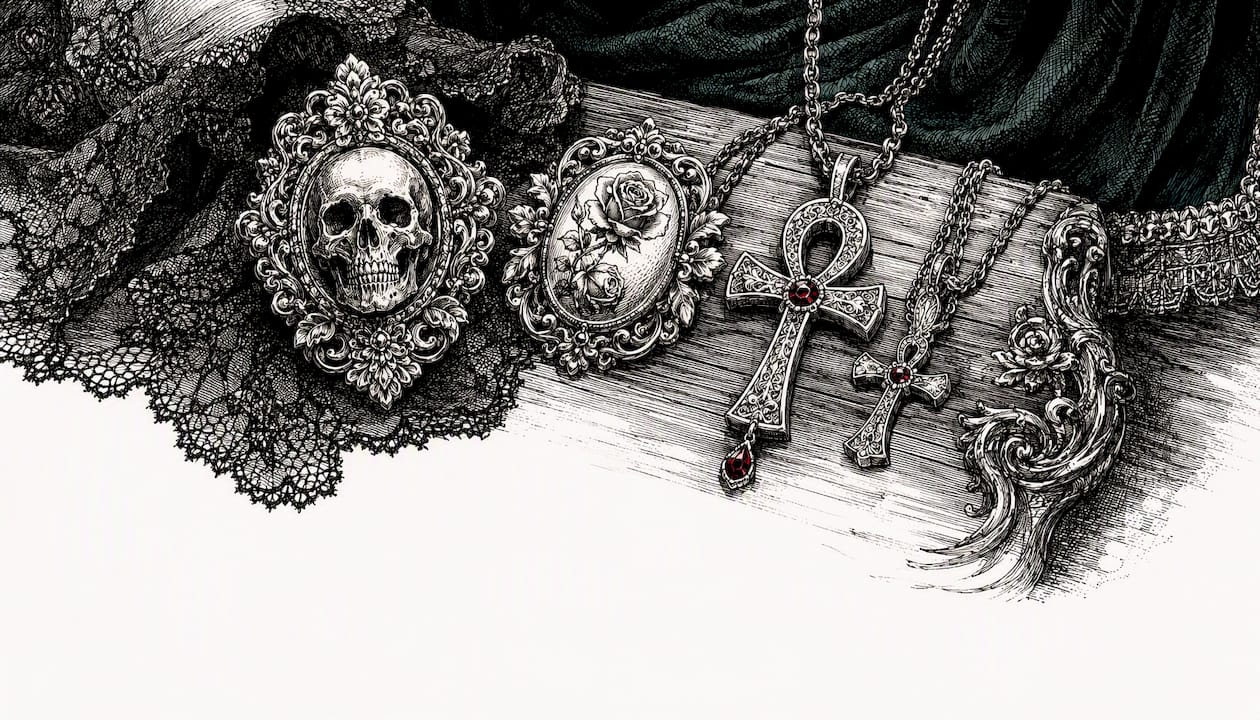
Ornate Victorian-era metalwork is the direct ancestor of modern gothic accessories. Staples include lace or velvet chokers, silver or pewter cross pendants, cameo brooches, layered ring sets with skull or crescent motifs, jet-black bead necklaces, and ornate hair combs. Pieces tend to be heavy, dark, and detailed. Browse gothic accessory staples for 2026 for current examples.
Punk
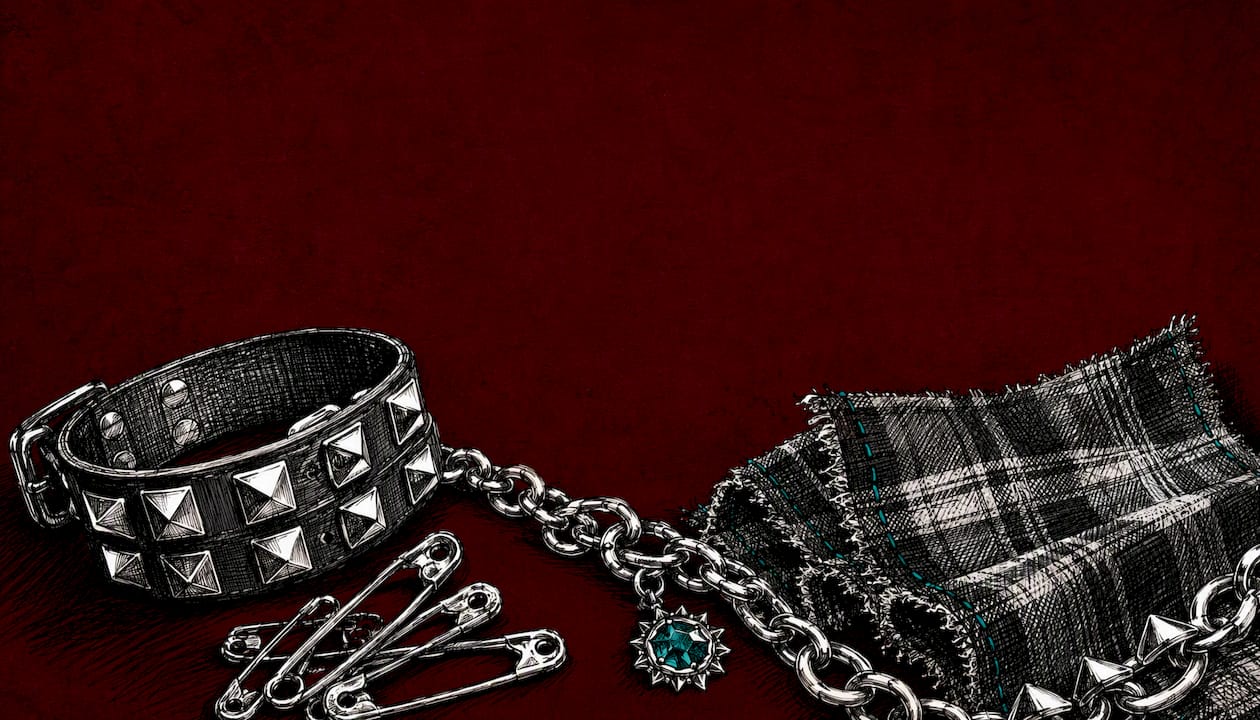
Punk accessories weaponize everyday objects. Studded leather belts, safety-pin earrings, spiked wristbands, chain necklaces, and band-patch denim cuffs are the core vocabulary. Tartan — historically a power pattern with deep cultural associations — appears on scarves, bags, and bondage straps, repurposed as an anti-establishment signal.
Grunge
Grunge is deliberately anti-accessory, which is itself a statement. Rubber or hemp bracelets, chain wallets worn hanging from belt loops, simple stud earrings, and knit beanies are the staples. Nothing is precious; everything looks like it could survive a mosh pit.
Emo/Scene
Emo and scene accessories lean into color and layering. Star-shaped hair clips, enamel pins covering every lapel, rubber wristbands stacked to the elbow, chunky plastic rings, and band-logo pendants are typical. Scene adds neon accents and oversized bows.
Steampunk
Steampunk accessories are the most prop-like of the substyles. Pocket watches on brass chains, aviator goggles with tinted lenses, leather fingerless gloves with buckle details, compass pendants, and gear-motif rings are the staples. Copper and brass dominate; the finish is always antique.
Industrial
Industrial accessories are stripped-down and functional-looking. Rivet-studded leather cuffs, heavy chain harnesses worn over clothing, military-surplus dog tags, and matte-black metal rings are the core pieces. The aesthetic references factory hardware more than jewelry.
How do you use accessories to make a basic outfit look alternative?
The fastest method: one focal accessory (a statement choker or pendant) plus two texture or metal accents (rings, a chain belt, a studded cuff) shifts a plain outfit into alt territory without looking like a costume. Alt-accessory styling guides consistently highlight chunky chain necklaces, velvet chokers, studded cuffs, layered rings, and fishnet accessories as the highest-impact converters.
-
Casual tee and jeans: Add a wide studded belt, a layered ring set on both hands, and a chain wallet clipped to the belt loop. The tee and jeans stay exactly the same; the accessories do all the work.
-
Work-appropriate basics: A dark blazer or structured shirt reads professional until you add a small occult pendant on a fine chain and two stacked silver rings. Subtle enough for most offices, unmistakable to anyone who knows the motifs.
-
Summer outfit: A plain sundress or shorts-and-tank combo becomes alt with fishnet arm sleeves, a leather or velvet choker, and a single chunky ring. The contrast between the light garment and the heavy accessory is the point.
-
Layered fall/winter look: Stack a chain necklace over a turtleneck, add a studded cuff over your sleeve, and clip a brooch or enamel pin to your coat lapel. Three accessories, three different textures, one coherent look. For more layered styling ideas, gothic outfit styling guides break down proportion and motif repetition in detail.
Pro Tip: Mix motifs from only one substyle per outfit. Combining a steampunk pocket watch with punk safety pins and goth lace reads as costume, not style. Pick a lane and accent from there.
How can you customize or DIY accessories to make them feel authentic?
Simple DIY alterations — adding studs, distressing edges, attaching chains, or converting vintage finds — are the fastest way to make accessories feel genuinely yours rather than off-the-shelf. The community values maker provenance, so document your process and tag your pieces.
-
Add studs to a plain belt: Lay the belt flat. Use a leather punch or awl to make evenly spaced holes along the center. Press pyramid or cone studs through each hole and fold the prongs flat on the back with needle-nose pliers. Safety note: wear eye protection when working with metal prongs; sharp edges can snap.
-
Convert a vintage pendant to a choker: Remove the pendant from its original chain using jewelry pliers. Thread it onto a 14–16 inch length of velvet ribbon or black leather cord. Finish with a lobster-claw clasp and jump rings at each end. Safety note: use flat-nose pliers, not your fingers, to open jump rings — they can pinch hard.
-
Make a patched denim cuff: Cut a strip from an old denim jacket sleeve, roughly 3 inches wide. Sew or iron-on (then hand-stitch the edges for durability) band patches, occult symbols, or custom embroidery. Add a snap or velcro closure at the back.
-
Distress leather wallet edges: Rub the edges of a plain leather wallet with medium-grit sandpaper in short strokes. Follow with a small amount of dark shoe polish rubbed in and wiped off — it settles into the scratches and creates a worn, aged look. Safety note: work in a ventilated area if using solvent-based polish.
Materials you’ll use across these projects:
- Leather punch or awl
- Needle-nose and flat-nose jewelry pliers
- Pyramid or cone studs (available at craft stores)
- Jump rings and lobster-claw clasps
- Velvet ribbon or leather cord
- Sandpaper (medium and fine grit)
- Dark shoe polish or leather dye
Label finished pieces with a small tag noting the maker and date. Keep a photo of the process. Both details increase the piece’s perceived authenticity and its value if you ever sell or trade it.
Where can you reliably buy alternative accessories in the United States?
Prioritize independent artisans, curated niche marketplaces, and vintage or thrift sources for pieces that read as genuinely alternative. Each channel has real trade-offs.
Shopping checklist before you buy:
- Check for a maker’s mark, signature, or bio — artisan pieces almost always have one
- Test metal weight: authentic heavy-gauge pieces feel substantial; hollow factory pieces feel light
- Read seller reviews specifically for material quality, not just shipping speed
- Confirm the return or exchange policy before purchasing handmade items (many artisans do not accept returns on custom work)
- For vintage pieces, ask about provenance — where the seller sourced it and approximate era
- Inspect photos for finish consistency: real oxidized or patinated metal shows variation; factory “aged” finishes are uniform
Where to look:
- Independent artisans at craft fairs, local markets, and niche online platforms: highest authenticity, often one-of-a-kind, supports the subculture’s creative economy directly
- Curated alternative marketplaces (like Goth): pre-vetted sellers, consistent quality signals, and community-driven curation
- Vintage and thrift stores: Goodwill, estate sales, and local consignment shops regularly surface genuine Victorian and 1980s–1990s alt pieces at low prices — patience required
- Specialty boutiques: brick-and-mortar alt boutiques in most major US cities carry curated selections; staff usually know the provenance of their stock
Basic care tips by material:
- Metal: Store in a dry, sealed bag to slow tarnish. Polish with a soft cloth; avoid water on oxidized finishes, which will strip the patina.
- Leather: Condition every few months with a leather balm. Keep away from prolonged sun exposure, which dries and cracks it.
- Lace and velvet: Hand-wash cold or spot-clean only. Store flat, not folded, to prevent permanent creasing.
For a broader look at what’s trending in the scene right now, alternative subculture trends in 2026 covers which pieces are gaining traction and why. The intersection of alt aesthetics with streetwear is also worth watching — streetwear’s cultural growth has pushed several alt motifs (chains, hardware, oversized rings) into broader circulation, which cuts both ways for authenticity.
Why do alternative accessories matter more than most people realize?
Accessories communicate subcultural values faster than clothing does. A shirt requires context; a pentagram pendant or a safety-pin earring is a complete sentence. That speed is why long-time community members treat accessory choices seriously — they function as identity markers and community signals in a way that a black t-shirt alone never quite does.
What gets underestimated is the cumulative effect of small, intentional choices. Most people new to alternative fashion try to buy a complete look at once, which is exactly what produces the “costume” read. The people who wear it most convincingly built their accessory collections slowly — one vintage find, one artisan piece, one DIY project at a time. Each piece has a story, and that history shows in how it’s worn.
The historical depth here is real. Gothic accessories draw directly from Victorian mourning jewelry and ornate metalwork, punk repurposed working-class and military hardware, and grunge rejected ornamentation as a political act. Wearing these pieces without knowing that context isn’t wrong, but knowing it changes how you choose and combine them.
Start with one piece that genuinely resonates. Source it intentionally — from an artisan, a vintage shop, or your own hands. Document it. Then add the next one. That process, repeated, is what builds a wardrobe that reads as authentic rather than assembled.
Goth.Market: a curated source for gothic and alternative accessories
If you want pieces with real provenance and maker accountability, Goth connects you directly with independent creators specializing in gothic, occult, and dark alternative aesthetics — no mass-market filler, no algorithm-driven trend chasing.
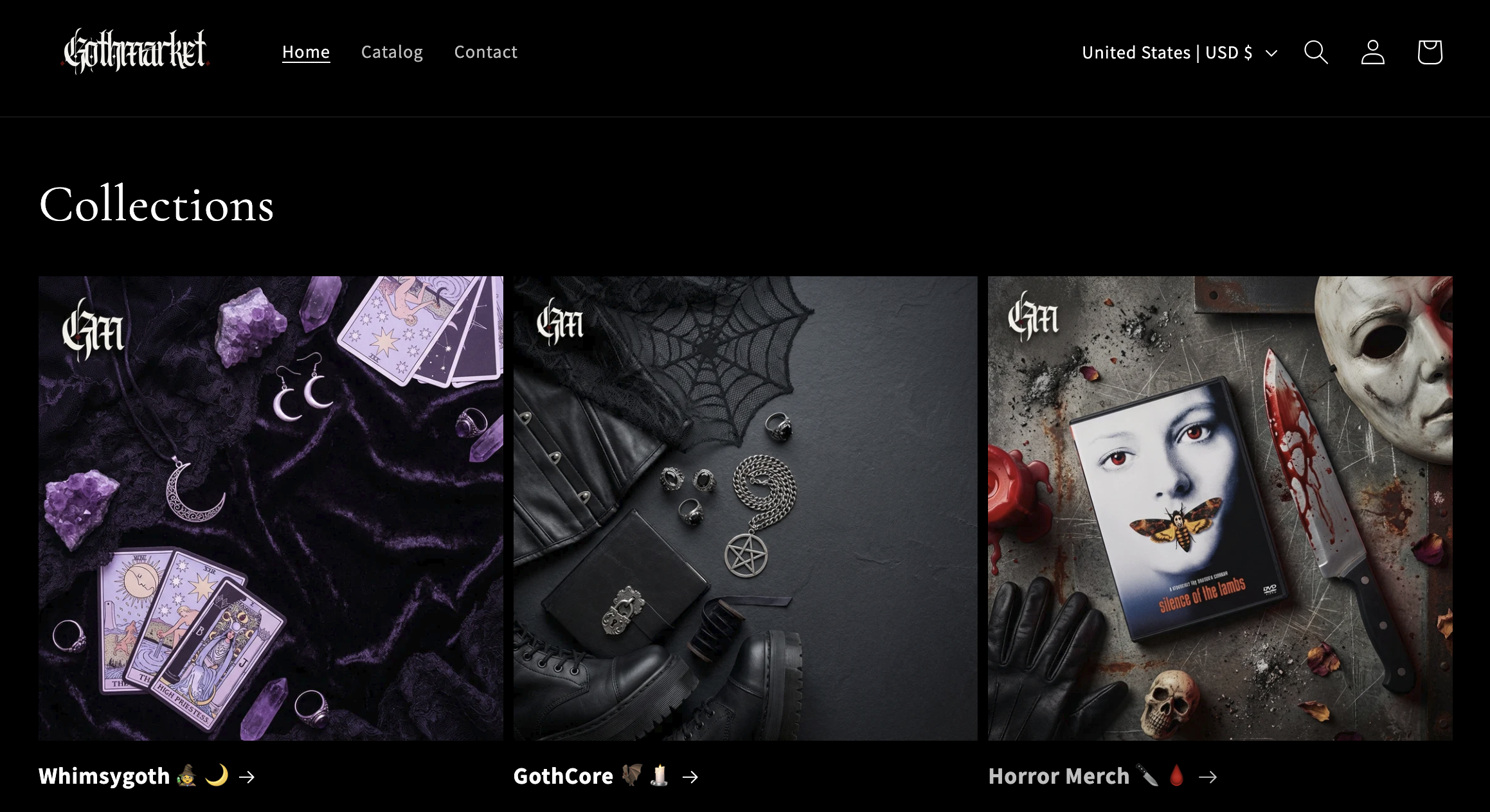
Three things that set it apart from general marketplaces: every seller is vetted for alignment with the subculture’s aesthetic standards, product listings include maker bios so you know exactly who made what you’re buying, and the curation skews toward pieces with genuine subcultural depth rather than surface-level edge. You’ll find unique gothic accessory ideas across jewelry, wearables, and dark decor — all from creators who are part of the community they’re making for. Browse the marketplace and find the piece that starts your collection.
Sources
- Alternative fashion - Wikipedia
- ACCESSORIES Definition & Meaning - Merriam-Webster
- Victorian jewelry design overview - Victorian Web
- Tartan — power pattern - The Arts Society
- Category:Alternative fashion - Wikimedia Commons
FAQ
What are alternative accessories, exactly?
Alternative accessories are personal adornments chosen to signal membership in a non-mainstream subculture — goth, punk, grunge, emo, steampunk, or industrial — rather than to follow commercial fashion trends. They typically use unconventional materials (chains, oxidized metal, leather, lace), carry subcultural motifs (occult symbols, skulls, anarchist imagery), and are sourced from artisans, vintage stores, or made by the wearer. The alternative fashion community defines them by attitude and intent as much as by appearance.
What exactly is alternative style?
Alternative style is a broad category of fashion that deliberately rejects mainstream commercial aesthetics in favor of subcultural identity. It encompasses substyles including goth (dark, Victorian-influenced), punk (anti-establishment, DIY), grunge (utility-first, anti-fashion), emo/scene (emotional, layered, colorful), steampunk (Victorian sci-fi), and industrial (military hardware, factory aesthetic). What unites them is the use of clothing and accessories to communicate community belonging and personal values rather than trend participation.
Which accessories have the highest impact for building an alt look?
Small worn items deliver the most identity signal per size. Chokers, layered rings, chain necklaces, and studded cuffs are consistently cited as the highest-impact converters for turning a basic outfit into an alternative one. A single focal piece — a velvet choker, an occult pendant, a wide studded belt — can shift the entire read of an outfit without changing any clothing.
Can you be alternative and still shop at mainstream stores?
Yes, with caveats. Mainstream stores occasionally carry pieces with alt-adjacent motifs — chain belts, simple stud earrings, plain leather cuffs — that can function as alt accessories when combined intentionally. The community distinction is that mass-market pieces lack provenance and maker accountability, which matters to long-time community members. A practical approach: use mainstream basics as the base layer and source your accessories from artisans, vintage shops, or curated marketplaces like Goth where maker identity is part of the product.
How do I avoid looking like I’m wearing a costume?
Stick to one substyle’s motif vocabulary per outfit and limit statement pieces to one or two. Mixing goth lace with steampunk goggles and punk safety pins simultaneously reads as costume because no single subcultural identity is being expressed. Build outfits around a focal accessory, then add two supporting accents in the same material or motif family. Worn-in, vintage, or DIY pieces also help — they carry history that factory-new pieces don’t.
What materials should I look for when buying authentic alt accessories?
Heavy-gauge chain, genuine leather, oxidized or blackened metal, velvet, lace, brass, copper, and industrial hardware are the materials most associated with authentic alternative accessories. Avoid lightweight hollow metal, plastic that mimics metal, and machine-perfect finishes on pieces marketed as “handmade.” A real artisan piece usually has slight asymmetry, visible solder points, or a maker’s mark on the back.
How do I care for alternative accessories to make them last?
Store metal pieces in a sealed dry bag to slow tarnish, and avoid water on oxidized finishes — moisture strips the patina that gives them their look. Condition leather every few months with a leather balm and keep it out of direct sun. Lace and velvet should be hand-washed cold or spot-cleaned and stored flat. For pieces with mixed materials (leather and metal, for example), treat each material separately rather than using a single product on the whole piece.
Where is the best place to find alternative accessories in the United States?
Independent artisans at craft fairs and niche online platforms, curated alternative marketplaces, and vintage or thrift stores are the three most reliable sources for authentic pieces. Curated marketplaces like Goth pre-vet sellers for subcultural alignment and include maker bios, which removes much of the guesswork around provenance. Vintage and thrift stores — Goodwill, estate sales, local consignment shops — regularly surface genuine 1980s and 1990s alt pieces at low prices, though finding them takes patience.