

What Are Horror Motifs? A Guide for Genre Enthusiasts
TL;DR:
- Horror motifs are recurring concrete elements that reinforce a story’s central themes through deliberate repetition. They differ from symbols, which may appear once, and from tropes, which are genre-wide conventions; motifs provide specific texture within a narrative. These motifs build atmosphere and emotional impact by creating sustained psychological tension, often reflecting cultural fears and evolving with social context.
Horror motifs are recurring concrete elements, such as ghosts, labyrinths, doppelgangers, or body horror, that appear repeatedly throughout a narrative to reinforce its central themes and build emotional atmosphere. Unlike a symbol, which may appear once to carry meaning, a motif earns its power through repetition. Understanding what are horror motifs, and how they differ from tropes and symbols, transforms the way you read Shirley Jackson, watch Ari Aster, or interpret the Gothic tradition from Ann Radcliffe to Stephen King.
What are horror motifs, and how do they work?
A horror motif is a specific recurring element that reinforces the story’s core theme through deliberate repetition. Themes are abstract, the fear of death, the collapse of identity, the unknowability of the universe. Motifs are the concrete, observable patterns that keep delivering that theme to the reader’s nervous system. Remove a motif and the theme survives. Remove enough motifs and the emotional texture collapses entirely.
The academic term most commonly used alongside “motif” in literary criticism is narrative device or recurring image, but within horror studies, “motif” is the precise and accepted vocabulary. Horror scholars, from Noël Carroll in The Philosophy of Horror to the Gothic literature guides maintained by the University of Maryland Libraries, use motif to describe the building blocks that give the genre its distinctive psychological weight.
Motifs also operate below conscious awareness. Readers and viewers often feel a story’s dread accumulating without being able to name why. That is the motif doing its work, creating rhythm and resonance beneath the surface of the plot.
How do horror motifs differ from symbols and tropes?
This distinction matters more than most genre discussions acknowledge. The three terms are frequently collapsed into each other, and that confusion produces shallow analysis.
| Concept | Definition | Example in horror |
|---|---|---|
| Motif | Recurring concrete element reinforcing theme | The labyrinth appearing throughout a haunted house narrative |
| Symbol | A single image or object carrying layered meaning | A cracked mirror representing fractured identity in one scene |
| Trope | A broad genre convention or scenario | The final girl surviving a slasher film |
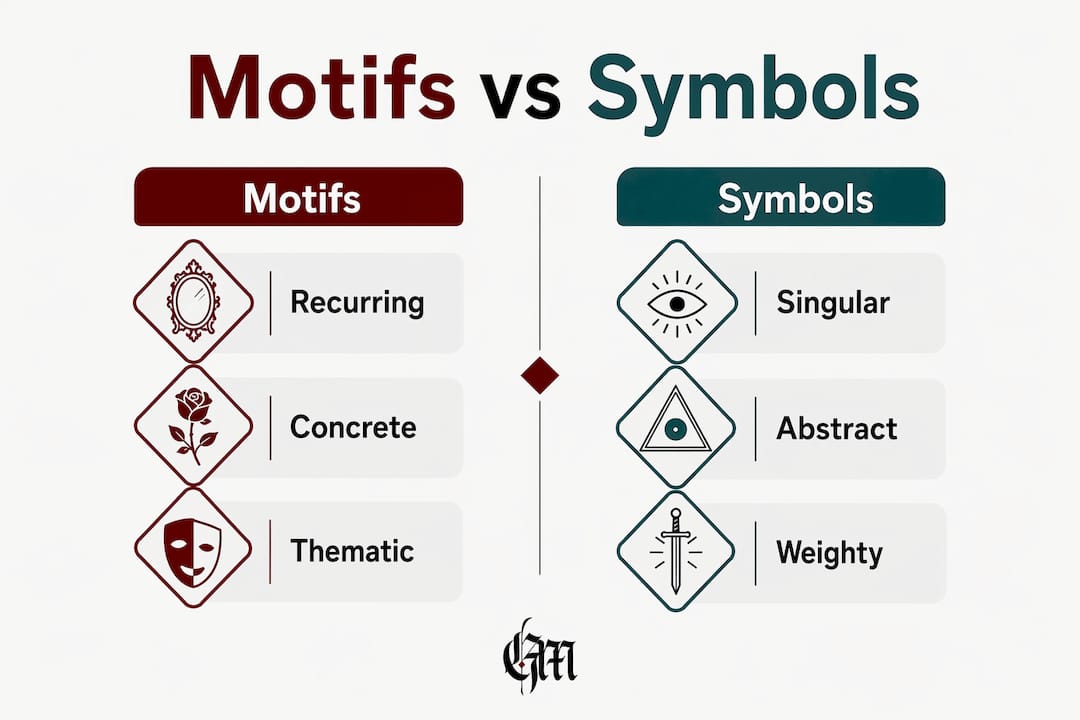
A symbol may appear once and carry enormous weight. A motif must repeat to qualify. As writing expert Alan Watt explains, a single instance is a symbol, while a motif provides recurring texture that amplifies the theme across the full narrative arc. The distinction is structural, not interpretive.
Tropes operate at an even higher level of abstraction. Gothic fiction’s atmospheric dread over visceral fear is a trope-level convention. The specific labyrinthine corridors that recur in a particular Gothic novel are the motif. Tropes describe what a genre does broadly; motifs describe what a specific story does repeatedly.
Pro Tip: When analyzing a horror text, list every concrete image or scenario that appears more than twice. If it connects to the story’s central fear, you have identified a motif. If it appears once with heavy symbolic weight, it is a symbol. If it describes a genre-wide pattern, it is a trope.
What are the most common horror motifs and their meanings?
The most frequently used horror motifs across centuries of literature and film include ghosts, monsters, body horror, cosmic horror, the discovered manuscript, the doppelganger, the labyrinth, the madwoman in the attic, and atmospheric pathetic fallacy. Each carries a specific thematic freight.
- Ghosts represent unresolved trauma, the past refusing to release the present. Henry James’s The Turn of the Screw and Mike Flanagan’s The Haunting of Hill House both use spectral figures not as jump scares but as embodied grief.
- The doppelganger expresses the horror of fractured selfhood. Jordan Peele’s Us and Dostoevsky’s novella The Double both deploy the motif to interrogate identity, class, and suppressed desire.
- Body horror externalizes internal psychological collapse. David Cronenberg’s films, from Videodrome to The Fly, treat the disintegrating body as a map of psychic disintegration.
- Cosmic horror, codified by H.P. Lovecraft, uses motifs of vast indifferent entities and incomprehensible geometry to produce epistemological terror, the fear that human understanding is fundamentally inadequate.
- The labyrinth recurs in Gothic fiction as a physical expression of psychological entrapment. Shirley Jackson’s Hill House is architecturally wrong in ways that mirror the protagonist’s mental deterioration.
- The madwoman in the attic, analyzed famously by Sandra Gilbert and Susan Gubar, evolved from a confinement trope into a motif expressing internal trauma and social repression, shifting thematic weight as feminist criticism reframed its meaning.
“Horror motifs are not decorative. They are rhetorical. Each recurrence tightens the argument the story is making about what human beings most fundamentally fear.”
Visual horror extends these motifs into non-verbal territory. Horror poster imagery such as enormous hands reaching toward small figures, or doors opening onto darkness, functions as psychological shorthand, communicating vulnerability and loss of agency without a single word of dialogue. These visual motifs tap into ancestral fears and become clichéd only when deployed without a unique narrative twist.
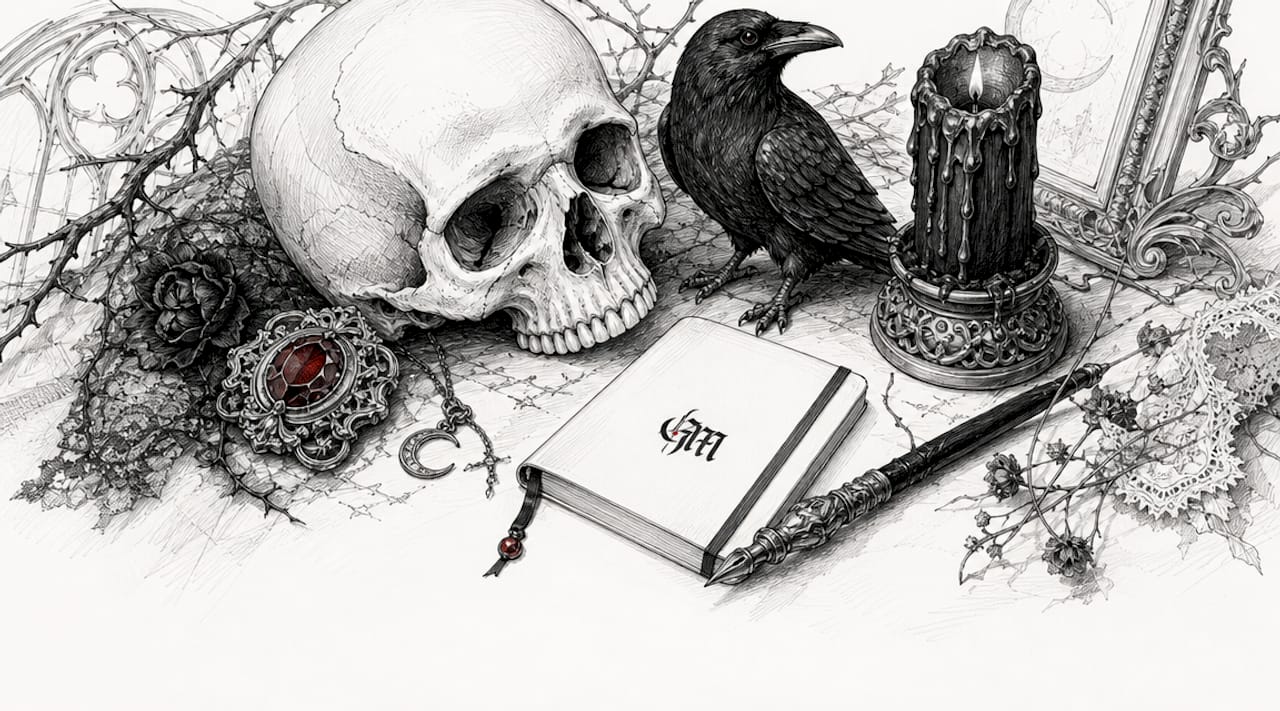
The symbolism embedded in gothic art follows the same logic, with skulls, ravens, decaying architecture, and thorned roses appearing repeatedly across centuries of visual culture because they carry accumulated thematic meaning that audiences recognize instinctively.
How do horror motifs build atmosphere and emotional impact?
Horror motifs function as the genre’s primary rhetoric, bridging the familiar and the unknown to produce what scholars call epistemological horror. This is the specific dread that arises when a character, and by extension the reader, confronts the limits of what can be known or understood. The motif does not explain the threat. It accumulates it.
The mechanism works in four stages:
- Introduction. The motif appears early, often innocuously. A recurring sound, a repeated visual detail, a phrase that surfaces in dialogue.
- Repetition. Each subsequent appearance carries the emotional charge of the previous one, building associative dread without requiring explicit exposition.
- Escalation. The motif intensifies in frequency or context as the narrative approaches its crisis point, creating rhythm the reader feels before they consciously register it.
- Resolution or rupture. The motif either resolves thematically, confirming the story’s argument about fear, or ruptures, denying the reader the comfort of closure.
This structure distinguishes atmospheric dread from visceral horror. Visceral horror, a sudden monster reveal or a graphic injury, produces an immediate spike of fear. Atmospheric dread, built through motif repetition, produces sustained psychological tension. The most effective horror writing, from Poe’s The Tell-Tale Heart to Kathe Koja’s The Cipher, integrates motifs into story structure rather than deploying them as isolated set pieces.
Motifs also dismantle the reader’s sense of security by making the familiar threatening. The domestic space, the family home, the trusted companion, the reliable body, becomes the site of horror precisely because it was previously safe. This contrast between the homely and the threatening is the engine that makes horror motifs emotionally devastating rather than merely startling.
How to identify and apply horror motifs in literature and film
Identifying motifs requires attention to repetition and placement, not just content. A single dark corridor is atmosphere. A dark corridor that appears at every moment of psychological crisis, described in the same terms, is a motif.
When reading or watching horror, track these signals:
- Repeated concrete images. The same object, location, or physical sensation appearing across multiple scenes.
- Recurring language. A phrase, description, or sound that returns with variations.
- Structural placement. Motifs often appear at narrative turning points, signaling thematic significance through position as much as content.
- Emotional consistency. Each recurrence produces a similar emotional response, confirming the motif’s thematic function.
For writers, the most important principle is that motifs should emerge organically during drafting and be deliberately shaped during revision. Forcing a motif into a first draft produces exactly the inauthenticity readers detect. Write the story first. Then identify which concrete elements recurred naturally, and amplify those that align with your central theme.
Pro Tip: During revision, search your manuscript for the three images or scenarios you wrote most instinctively. Those are your natural motifs. Strengthen their recurrence and thematic connection before adding anything new.
The horror aesthetics of fashion and visual art follow the same principle. Gothic subculture’s most enduring visual vocabulary, skulls, thorns, decaying grandeur, mirrors, and shadow, works because these elements function as motifs across centuries of horror storytelling. They carry accumulated meaning that communicates instantly to anyone fluent in the genre.
Key takeaways
Horror motifs are the concrete, repeated elements that give the genre its psychological depth and emotional staying power, distinct from symbols and tropes in both structure and function.
| Point | Details |
|---|---|
| Motifs require repetition | A single image is a symbol; a motif must recur to build thematic resonance. |
| Motifs differ from tropes | Tropes are genre-wide conventions; motifs are specific recurring elements within a single narrative. |
| Common motifs carry thematic weight | Ghosts, doppelgangers, labyrinths, and body horror each express specific psychological fears. |
| Motifs build atmospheric dread | Repetition creates sustained tension that visceral horror alone cannot achieve. |
| Organic development matters | Effective motifs emerge from drafting and are refined in revision, not forced from the start. |
Why motifs are the part of horror most readers overlook
Rey here. After years of reading and writing about horror, the observation I keep returning to is this: most readers experience motifs without ever naming them. They feel the dread accumulate. They notice something is wrong before the plot confirms it. They finish a story and describe it as “atmospheric” without being able to say why. That unnamed feeling is almost always a motif doing its work.
The misconception I encounter most often is that motifs are an academic overlay, something critics impose on texts after the fact. The opposite is true. The best horror writers, Jackson, King, Ligotti, Koja, Barker, think in motifs from the start. The recurring image is not a coincidence they later rationalized. It is the story’s nervous system.
What I find genuinely exciting about studying motifs is how they reveal the cultural anxieties of their moment. The madwoman in the attic meant something specific in Victorian Gothic and something entirely different after second-wave feminist criticism reframed it. Cosmic horror motifs that Lovecraft used to express xenophobia are now being reclaimed by writers like Victor LaValle and N.K. Jemisin to interrogate exactly that history. Motifs are not static. They absorb the fears of whoever is using them.
If you want to deepen your appreciation of horror, stop asking “what happens?” and start asking “what keeps appearing?” The answer to that second question is where the real meaning lives.
— Rey
Bring horror motifs into your everyday aesthetic
The motifs that define horror literature and film, skulls, ravens, decaying grandeur, cosmic geometry, the uncanny double, have always lived beyond the page and screen. At Goth, these recurring symbols of darkness and psychological depth translate directly into fashion, decor, and art that carries genuine thematic weight. Independent creators on Goth.Market draw on the same Gothic and horror traditions explored in this article to produce pieces that speak the visual language of the genre fluently. Whether you are furnishing a space that reflects your love of atmospheric dread or building a wardrobe that references the genre’s most enduring imagery, the goth home decor and fashion collections at Goth connect literary motifs to objects you can actually live with.
FAQ
What is the simplest definition of a horror motif?
A horror motif is a concrete element, such as an image, phrase, or scenario, that recurs throughout a horror narrative to reinforce its central theme. Unlike a symbol, which may appear once, a motif must repeat to build emotional and thematic significance.
How do I tell a motif apart from a trope?
A trope is a broad genre convention shared across many works, such as the haunted house or the final girl. A motif is a specific recurring element within a single narrative, chosen deliberately to reinforce that story’s particular themes.
What are some classic examples of horror motifs in literature?
Classic horror motifs in literature include the doppelganger in Dostoevsky’s The Double, the labyrinthine architecture in Shirley Jackson’s The Haunting of Hill House, and the discovered manuscript device used across Gothic fiction from Horace Walpole to Bram Stoker’s Dracula.
Can a motif appear in visual media as well as written horror?
Yes. Visual horror motifs, such as enormous hands, open doors leading to darkness, and fragmented mirrors, function as psychological shorthand in film posters and cinematography, communicating fear and vulnerability without dialogue.
Why do horror motifs lose their power over time?
Motifs become clichéd when deployed without a unique narrative twist or thematic purpose. Motifs historically reflect specific social and psychological anxieties, and when those anxieties shift culturally, the motif must evolve or be recontextualized to retain its emotional force.