

The Role of Crosses in Goth Jewelry: Meaning and Style
TL;DR:
- Crosses have long symbolized mortality, history, and personal identity in gothic jewelry. They have evolved from medieval funerary symbols and Victorian mourning traditions to modern expressions of rebellion and individualism.
Crosses are the defining motif of gothic jewelry, functioning simultaneously as spiritual symbols, historical artifacts, and personal identity markers. The role of crosses in goth jewelry extends far beyond religious iconography. These symbols carry centuries of meaning rooted in medieval funerary practice, Victorian mourning culture, and punk rebellion. Gothic jewelry collections in 2026 prominently feature variations including Celtic, Teutonic, and Maltese crosses, each carrying distinct visual weight and symbolic nuance. Understanding why crosses dominate gothic jewelry requires tracing their path from cathedral stonework to silver pendants worn as personal declarations.
What is the role of crosses in goth jewelry?
The cross entered gothic aesthetics through two parallel channels: religious architecture and funerary tradition. Medieval Gothic cathedrals used cross forms structurally and decoratively, embedding the symbol into the visual grammar of an entire era. That architectural language translated directly into jewelry worn by people who identified with the weight and drama of that period.
Victorian mourning culture deepened the cross’s presence in personal adornment. When Queen Victoria entered extended mourning after Prince Albert’s death in 1861, black jewelry became socially expected among the British upper class. Jet, a fossilized wood mined in Whitby, England, became the material of choice for mourning crosses and pendants. This practice spread across social classes and established a direct link between cross motifs and the aesthetics of grief, memory, and mortality.
Gothic subculture, which emerged from post-punk music scenes in the late 1970s and early 1980s, absorbed these historical threads deliberately. Bands like Bauhaus and Siouxsie and the Banshees styled themselves with crosses and Victorian funerary references as a form of cultural provocation. The cross became a way to signal awareness of death, history, and the limits of mainstream comfort. Gothic motifs like crosses evolved from medieval memento mori and Victorian mourning into a modern celebration of mortality and individual identity.
Key historical moments in cross symbolism
- Medieval memento mori: Crosses appeared on funerary objects to remind the living of death’s certainty, a practice called memento mori, Latin for “remember you will die.”
- Victorian mourning jewelry: Jet and black enamel crosses became standard accessories for the bereaved, codifying the cross as a symbol of loss and remembrance.
- Gothic cathedral architecture: The cruciform floor plan and stone cross carvings of Gothic cathedrals gave the subculture its name and visual reference points.
- Punk and post-punk adoption: Early goth musicians wore crosses as anti-establishment statements, reframing religious symbols as tools of cultural critique.
- Subculture formalization: By the mid-1980s, the cross had become a recognized marker of gothic identity, appearing in jewelry, clothing, and stage design.
What styles and variations of crosses appear in goth jewelry?
Gothic jewelry does not treat all crosses as equal. Each variation carries a distinct history and communicates a different set of values to those who know how to read them.
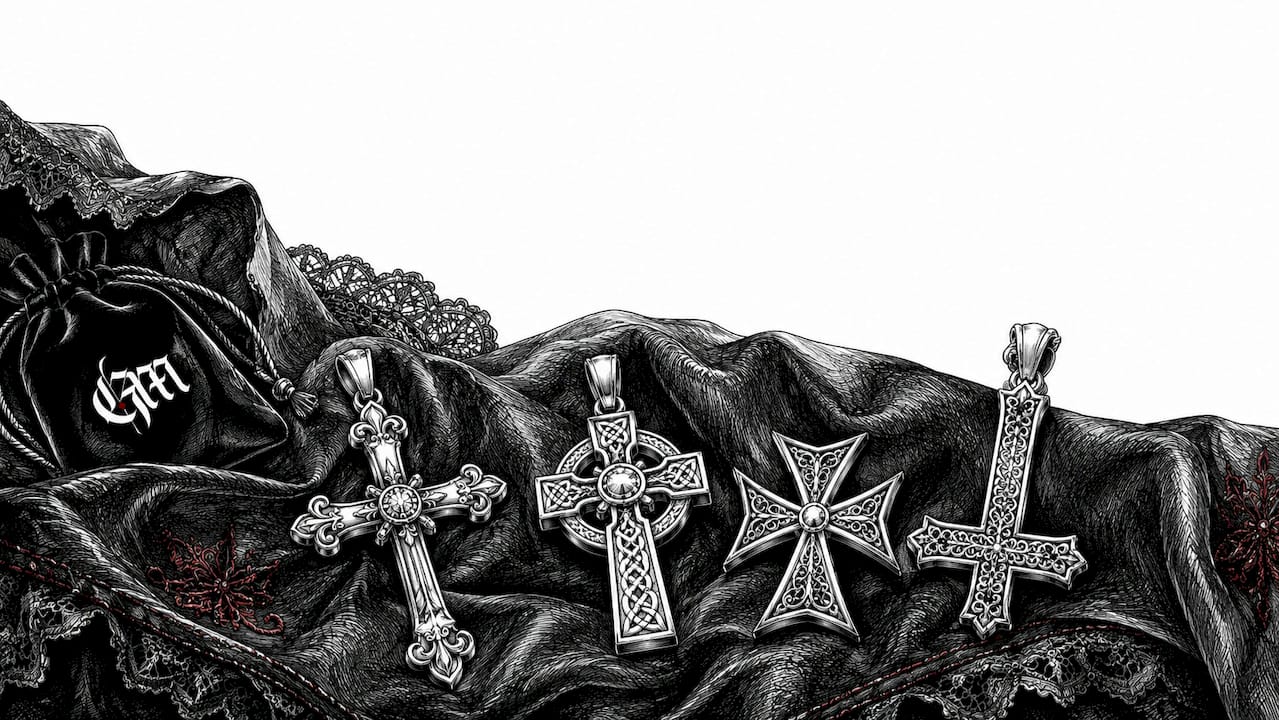
The Latin cross is the most recognized form, a vertical bar intersected by a shorter horizontal bar in the upper third. Its religious heritage is undeniable, but gothic wearers often choose it for its stark geometry rather than its Christian associations. In gothic jewelry, the Latin cross appears in oversized pendants, layered necklaces, and ring designs, frequently rendered in oxidized silver or blackened metal.
The Celtic cross adds a protective ring at the intersection of the bars, often decorated with knotwork patterns. This design originates in early medieval Ireland and Scotland, where it merged Christian symbolism with pre-Christian solar and protective motifs. Gothic wearers prize the Celtic cross for its visual complexity and its connection to ancient, pre-institutional spirituality.
The Teutonic cross and Maltese cross bring a more angular, heraldic quality to gothic jewelry. The Teutonic cross, associated with medieval German military orders, features flared arms that create a bold, graphic silhouette. The Maltese cross, with its eight points, carries associations with the Knights Hospitaller and medieval chivalric culture. Both designs translate well into statement rings, brooches, and large pendants.
The inverted cross carries the most charged symbolism in gothic aesthetics. The inverted cross originates from St. Peter’s crucifixion. Peter reportedly asked to be crucified upside down, considering himself unworthy to die in the same manner as Christ. That act of humility became the symbol’s original meaning. Gothic and punk culture adopted the inverted cross as a provocation, exploiting the discomfort it causes in mainstream audiences while those within the subculture often appreciate its layered, dual symbolism.
Materials define the emotional register of cross jewelry as much as the shape does. Materials like onyx, jet, hematite, and black tourmaline are chosen to evoke 19th-century mourning traditions. These dark stones absorb light rather than reflecting it, creating a visual weight that matches the symbolic gravity of the cross motif. Silver, particularly oxidized or antiqued silver, provides the most common metal setting because its cool tone contrasts sharply with dark stones and pale skin.
Pro Tip: When layering cross necklaces, mix chain lengths by at least 3–4 inches between each piece. This prevents tangling and lets each cross read as a distinct statement rather than a visual cluster.
How do crosses symbolize concepts beyond religion in goth culture?
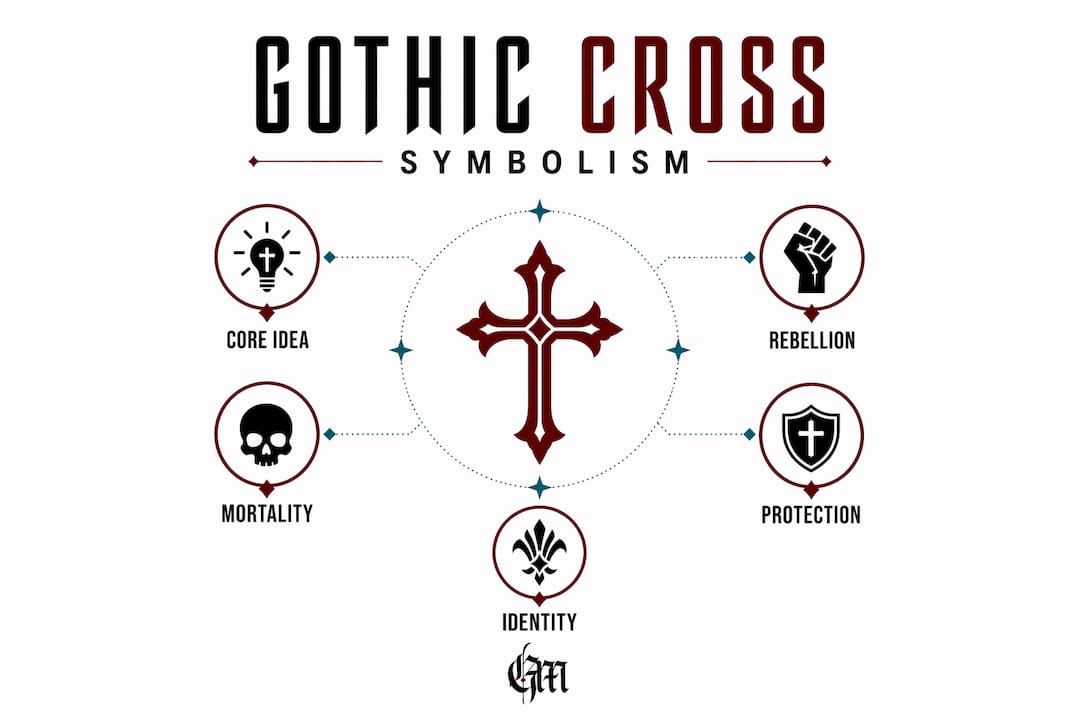
Gothic wearers use crosses to communicate ideas that organized religion never intended. Gothic jewelry acts as a personal language, allowing wearers to interpret crosses based on individual meanings like mourning, protection, or aesthetic defiance. This shift from institutional to personal meaning is the defining characteristic of how crosses function in gothic subculture.
The themes crosses carry within gothic culture include:
- Mortality awareness: Crosses signal that the wearer acknowledges death as a constant presence rather than a taboo subject. This connects directly to the medieval memento mori tradition.
- Rebellion and provocation: Inverted crosses and stylized designs challenge mainstream comfort zones, functioning as deliberate statements of cultural difference.
- Protection: Celtic and Maltese cross forms carry historical associations with warding off harm, a meaning gothic wearers often retain and personalize.
- Mourning and remembrance: Victorian funerary aesthetics inform how many gothic wearers use crosses to honor loss, whether personal grief or a broader meditation on impermanence.
- Identity declaration: Wearing a cross in a gothic context signals membership in a subculture that values depth, history, and the willingness to engage with uncomfortable truths.
Gothic subculture jewelry is the most historically grounded alternative style, linking wearers visually to 19th-century funerary customs where the natural and supernatural were treated as overlapping domains. That historical grounding gives gothic cross jewelry a seriousness that purely aesthetic fashion accessories rarely achieve. The cross becomes a way of carrying history on your body.
How are crosses incorporated into modern goth fashion trends?
Contemporary gothic jewelry design treats crosses as structural elements within a larger visual system. Crosses provide vertical lines that harmonize with other motifs like skulls and serpents, enhancing layered gothic styling. That vertical geometry creates visual rhythm when multiple pieces are worn together, which is why cross necklaces remain central to the layered look that defines traditional goth fashion.
Modern gothic jewelry incorporates crosses across every jewelry category:
- Necklaces: Long chain pendants featuring oversized Latin or Celtic crosses anchor the layered necklace stacks that define traditional goth styling. Chokers with small cross charms add a Victorian reference at the collarbone.
- Earrings: Drop earrings featuring Maltese or Teutonic crosses create movement and visual drama. Stud versions of the inverted cross appear frequently in ear-stacking arrangements.
- Rings: Signet-style rings engraved with cross motifs and cocktail rings set with dark stones and cross centerpieces appear across both traditional and contemporary gothic collections.
- Brooches: Victorian-inspired cross brooches, often featuring jet or black enamel, reference mourning dress directly and work as statement pieces on lapels or collars.
Victorian and funerary influences heavily inform gothic jewelry, reflected in the choice of dark stones and antique styling. Contemporary designers working in the gothic space balance this historical weight with modern minimalism. A single oxidized silver cross on a fine chain reads as contemporary goth, while a layered arrangement of three different cross styles in varying lengths signals traditional gothic maximalism.
Silver cross necklaces define the aesthetic for goth enthusiasts alongside chokers and layered rings. The consistency of this combination across decades confirms that the cross is not a trend within gothic fashion. It is the foundation.
Pro Tip: Oxidized silver develops a natural patina over time. Store cross jewelry in an airtight pouch to slow oxidation, or embrace the darkening as part of the piece’s character. Both approaches are valid within gothic aesthetics.
You can find a wide range of pieces that combine these design principles in the Vintage Silver Tone Punk Goth Jewelry Set, which pairs cross motifs with dark gemstones and vintage styling across multiple jewelry forms.
Key Takeaways
Crosses in gothic jewelry function as personal symbols of mortality, rebellion, and identity, rooted in medieval and Victorian traditions that the subculture deliberately reclaims and reinterprets.
| Point | Details |
|---|---|
| Historical depth | Cross motifs in goth jewelry trace directly to medieval memento mori and Victorian mourning customs. |
| Symbolic range | Crosses communicate mortality, protection, rebellion, and personal identity depending on the wearer’s intent. |
| Style variations | Celtic, Teutonic, Maltese, and inverted crosses each carry distinct histories and visual qualities. |
| Material choices | Onyx, jet, hematite, and oxidized silver reinforce the mourning and funerary aesthetic of cross jewelry. |
| Personal language | Modern gothic wearers interpret crosses individually, replacing institutional meaning with personal resonance. |
Why the cross in goth jewelry is more than a fashion statement
People outside the subculture often assume gothic cross jewelry is either religious or anti-religious. Both assumptions miss the point entirely. What I find most compelling about cross symbolism in gothic culture is how deliberately it refuses that binary.
The inverted cross is a perfect example. Most people see it as a rejection of Christianity. But its actual origin, St. Peter’s request to be crucified differently out of humility, is itself a deeply spiritual act. Gothic wearers who know that history wear the symbol with full awareness of its complexity. That layered knowledge is the whole point. You can explore more of this symbolic depth in Goth’s guide to occult jewelry symbolism.
The cross also connects gothic wearers to something most modern fashion cannot offer: genuine historical continuity. When you wear a jet cross pendant in the style of Victorian mourning jewelry, you are participating in a visual tradition that stretches back over 150 years. That is not nostalgia. That is a deliberate choice to carry history as part of your identity.
What I encourage gothic jewelry wearers to do is resist the pressure to explain their symbols to outsiders. The cross in gothic culture works precisely because it holds multiple meanings simultaneously. Let it do that work. The significance of crosses in goth culture is most powerful when the wearer understands it fully and lets others wonder.
— Rey
Gothic cross jewelry worth wearing
Goth curates gothic jewelry that takes cross symbolism seriously, from Celtic knotwork pendants to oxidized silver Maltese cross rings set with dark stones.
The collections at Goth.Market bring together independent creators who understand the historical and symbolic weight behind every cross motif. Whether you want a single statement piece or a full layered arrangement, the catalog covers traditional goth maximalism and contemporary minimal gothic styles. Each piece connects to the funerary and medieval traditions that make gothic jewelry the most historically grounded form of alternative fashion available today.
FAQ
What does a cross symbolize in goth jewelry?
A cross in gothic jewelry symbolizes mortality, remembrance, protection, or personal defiance, depending on the wearer’s intent. Gothic wearers treat crosses as personal symbols rather than fixed religious icons.
What is the difference between a Celtic cross and a Latin cross in goth style?
The Celtic cross adds a protective ring at the intersection and often features knotwork, connecting it to pre-Christian symbolism. The Latin cross uses a simpler form and carries a more direct religious heritage, though both appear widely in gothic collections.
Why do goths wear inverted crosses?
The inverted cross originates from St. Peter’s crucifixion and historically represents humility rather than anti-Christian sentiment. Gothic and punk culture adopted it as a provocation, exploiting its charged appearance while many wearers appreciate its layered dual meaning.
What materials are most common in gothic cross jewelry?
Onyx, jet, hematite, and black tourmaline are the most common stones, chosen to evoke Victorian mourning traditions. Oxidized or antiqued silver is the dominant metal because its cool, dark tone complements both the stones and the gothic aesthetic.
How do you style cross jewelry in a gothic outfit?
Layer cross necklaces at different lengths, mixing chain weights and cross styles for visual depth. Combine pendant crosses with cross earrings and ring motifs to build a cohesive gothic look without every piece competing for attention.