

Oddities Collecting Ethics: A Buyer and Maker's Code
Ethical oddities collecting means prioritizing clear provenance and maker transparency above all else, a practice well supported by communities like the Only Queer Crew marketplace. That single rule protects independent artists from copycats, keeps buyers from funding exploitative sourcing, and keeps curated marketplaces trustworthy. This article covers oddities collecting ethics for gothic and occult decor, replicas, and handmade curiosities, not biological specimens like taxidermy or bone work, which fall under a different set of legal and ethical questions.
Before you buy or list anything, do three things:
- Ask for maker or origin photos, not stock images.
- Check the material list against the price. If they don’t match, ask why.
- Request any provenance notes: receipts, restoration history, or a maker’s own account of the piece.
Key Takeaways
Ethical oddities collecting depends on provenance documentation, maker transparency, and respect for closed cultural practices ahead of aesthetics or price.
| Point | Details |
|---|---|
| Provenance comes first | Request maker photos, receipts, or restoration notes before buying any curio. |
| Originality matters | Avoid direct copies of independent designs; check pricing against material cost. |
| Closed practices need restraint | Skip commercializing lineage-based traditions; support tradition holders instead. |
| Fair pricing reflects labor | Materials, hours worked, fees, and a living wage should all show up in the price. |
| Goth.Market builds in transparency | The platform’s provenance fields let makers document sourcing directly on listings. |
Table of Contents
- What Does Ethical Oddities Collecting Look Like in Practice?
- How Do Buyers and Sellers Verify Provenance?
- How Should Collectors Handle Culturally Sensitive Items?
- Are the Materials in a Curio Ethically Sourced?
- What Makes a Price Fair for Handmade or Vintage Curios?
- How Can You Spot a Copy or Mass-Produced Knockoff?
- What Checklist Should Buyers and Sellers Use?
- Who’s Behind This Guidance on Collecting Ethics?
- What’s the Real Standard Collectors Should Hold Themselves To?
- How Does Goth.Market Support These Practices?
- Sources
- FAQ
What Does Ethical Oddities Collecting Look Like in Practice?
Three habits separate a responsible collector from someone who’s just accumulating stuff. None of them are complicated, but all of them require you to slow down before you click “buy” or hit “publish” on a listing.
- Respect originality. Don’t buy or resell direct copies of an independent designer’s work. If two sellers offer the “same” hand-poured resin skull at noticeably different prices, one of them may have copied the design. Courts and legal scholars have long wrestled with when copying crosses the line from inspiration into infringement, and the alternative-goods market is no exception.
- Disclose everything. Materials, maker name, and place of origin belong in every listing, full stop. A “vintage-style” reliquary box needs to say whether it’s actually vintage or a modern reproduction.
- Default to restraint with closed practices. If an item references a cultural or lineage-based tradition you don’t belong to, treat that as a signal to pause, not a design opportunity.
Pro Tip: Before listing an item that borrows from a spiritual or cultural tradition, spend fifteen minutes researching whether that practice is open or closed. That small step avoids most disputes before they start.
How Do Buyers and Sellers Verify Provenance?
Provenance sounds like a museum word, but for a curated marketplace it just means proof that an item is what the listing claims. Acceptable evidence varies by item type, but some documentation always helps: maker photos taken mid-process, original receipts, a note about restoration work, or a signed card from the artist.
Buyers should ask direct questions and expect direct answers. “Who made this?” “Is this the original piece or a cast from it?” “What’s the wood or metal, specifically?” A seller who answers with vague marketing language (“mystical energy infused”) instead of material facts is worth a second look.
Sellers should build a habit around a simple checklist:
- Close-up, multi-angle photos showing texture and construction.
- A clear material tag (brass, resin, reclaimed oak, whatever it actually is).
- Approximate date and region of origin, if known.
- Any repair or restoration history, even minor.
Listings with this level of detail tend to draw fewer disputes, because buyers already have the answers before they ask the question.
How Should Collectors Handle Culturally Sensitive Items?
Some objects carry weight beyond their materials. Ritual tools, items tied to closed spiritual lineages, or artifacts connected to a specific heritage group require a different level of caution than a mass-produced gargoyle statue.
Start by asking whether the practice behind the item is open or closed. Open practices, like general astrology symbolism, are widely shared and don’t require special permission to reference. Closed practices, tied to specific initiations or heritage, are a different matter. According to guidance on cultural appropriation in spiritual practice, items and rituals tied to lineage or initiation shouldn’t be commercialized by people outside that tradition.
If you’re unsure which category an item falls into:
- Don’t purchase or resell it. Redirect your money toward the tradition’s actual keepers instead.
- If you already own something questionable, consider donating proceeds from resale to a relevant community organization rather than profiting from it yourself.
- For open practices, credit your sources, pay tradition holders when you can, and avoid turning sacred language into decorative copy.
A quick gut check: if a listing’s language treats a closed ritual object as a purely aesthetic accessory, that’s usually the clearest sign something’s been commodified that shouldn’t have been. The same guidance on cultural appropriation puts it simply: when in doubt, prioritize relationship with tradition holders over convenience for yourself.
Are the Materials in a Curio Ethically Sourced?
Social-media-driven demand for occult and gothic aesthetics has pushed some materials, like white sage and certain crystals, toward overharvesting and exploitative sourcing. That dynamic, sometimes called occult capitalism, rewards speed and volume over care for where materials actually come from.
Watch for these red flags:
- No sourcing information at all, especially for mined stones or metalwork.
- A price so low it couldn’t plausibly cover ethical labor or material costs.
- Vague claims like “ethically sourced” with zero specifics behind them.
Better alternatives exist and they’re not hard to find: recycled metals, reclaimed vintage hardware, locally sourced substitutes for popular but overharvested plants, and pieces built to be repaired rather than replaced.
Pro Tip: List repairability and care instructions directly in your product description. Buyers increasingly treat “this can be fixed, not just discarded” as a sign the maker actually cares about the object’s lifespan.
What Makes a Price Fair for Handmade or Vintage Curios?
A fair price for a handmade curio reflects four things: materials, labor hours, marketplace fees, and a living-wage allowance for the maker’s time. Skip any of those and the price stops reflecting reality.
- Materials first. Add up actual cost, not wholesale guesswork.
- Labor next. Even a rough hourly rate multiplied by build time reveals whether a price is realistic.
- Fees and margin. Marketplace commission and packaging costs belong in the number too.
- Living-wage check. If the math results in a wage below what the maker could earn elsewhere, the price needs to go up, not down.
Buyers can gauge fairness by asking for a rough cost breakdown. A maker who can explain “$40 in materials, six hours of work” builds more trust than one who just shrugs. This same logic explains why goth community norms tend to favor durable, maker-made goods over disposable fast fashion alternatives that undercut independent creators on price while delivering far less craftsmanship.
How Can You Spot a Copy or Mass-Produced Knockoff?
Price is one signal, but it’s not the only one. A “deal that’s too good” on a hand-carved item almost always means it wasn’t actually hand-carved.
Visual tells include identical aging patterns across “different” antique pieces, mirrored tooling marks that suggest a mold rather than a hand tool, and edge finishing that looks machine-uniform instead of slightly irregular. Listing tells matter just as much: stock photography instead of the actual item, origin descriptions that stay suspiciously vague, or the same exact piece showing up across several unrelated seller accounts.
If something feels off:
- Ask directly for provenance documentation.
- Request a photo of the maker’s mark or signature, taken specifically for you.
- Report the listing to marketplace moderators if the seller can’t or won’t answer.
What Checklist Should Buyers and Sellers Use?
Sellers can build trust fast with a short, repeatable listing format:
- Full material list, no vague terms.
- Maker biography or a link to their profile.
- Provenance photos showing the piece mid-creation or in original context.
- Condition and repair notes, even small ones.
- Cultural attribution, clearly stated, if the piece draws on any tradition.
Buyers should message sellers with their own short list: request provenance photos, ask about unique maker marks, and confirm the return policy and shipping insurance before paying. For pricing your own handmade gothic pieces, a documented process also justifies a stronger price point.
Good recordkeeping pays off at resale, too. Date-stamped photos and saved receipts turn a vague “trust me” into an actual paper trail the next buyer can verify.
| Point | Details |
|---|---|
| Ask before you buy | Request provenance photos and material specifics before any purchase. |
| Disclose before you list | State materials, maker, and origin clearly in every listing description. |
| Respect closed practices | Skip items tied to closed cultural traditions; support keepers instead. |
| Price reflects labor | Fair prices account for materials, hours worked, and a living wage. |
Who’s Behind This Guidance on Collecting Ethics?
This guide comes from Rey, a contributor at Goth.Market who covers occult jewelry sourcing and dark art collecting practices for the platform’s curated marketplace resources. Goth.Market itself operates as a curation-first platform, meaning provenance and maker verification aren’t afterthoughts, they’re built into how the site works.
- Listings emphasize maker transparency over anonymous mass-market sourcing.
- The platform prioritizes independent creators over drop-shipped goods.
- Practical guides on selling art in gothic marketplaces reflect the same provenance standards outlined here.
What’s the Real Standard Collectors Should Hold Themselves To?
Most advice on collecting ethics stops at “don’t buy stolen stuff,” which is true but nearly useless. The harder, more useful standard is asking whether your purchase makes an independent maker’s business more viable or less. Every dollar spent on an unattributed knockoff is a dollar an actual artist doesn’t see, and that math adds up across a whole subculture built on people making things by hand.
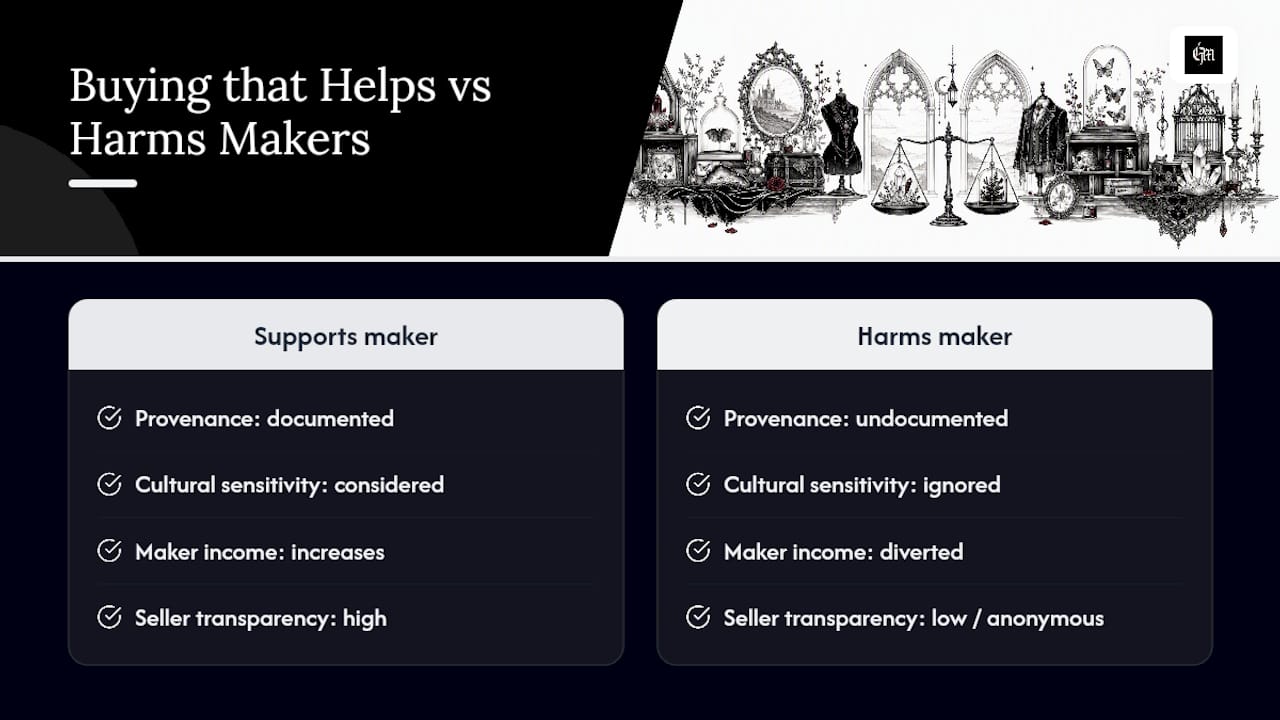
The conventional wisdom also underrates how much cultural sensitivity gets treated as an afterthought rather than a first filter. Buyers scroll past questions of closed practices because the item just looks cool. That’s backwards. The question of whether you’re allowed to own something should come before the question of whether you want it.
What should you prioritize first, practically? Provenance documentation. Not because it’s the flashiest concern, but because it’s the one that resolves almost every other ethical question by extension. A seller who can document materials, origin, and process has usually already thought through the cultural and labor questions too. A seller who can’t document anything usually hasn’t.
— Rey
How Does Goth.Market Support These Practices?
Goth.Market is built around the same standards this guide lays out: curation over mass production, and maker transparency over anonymous listings. The platform gives independent creators space to document their process, meaning buyers aren’t guessing about where a piece came from.
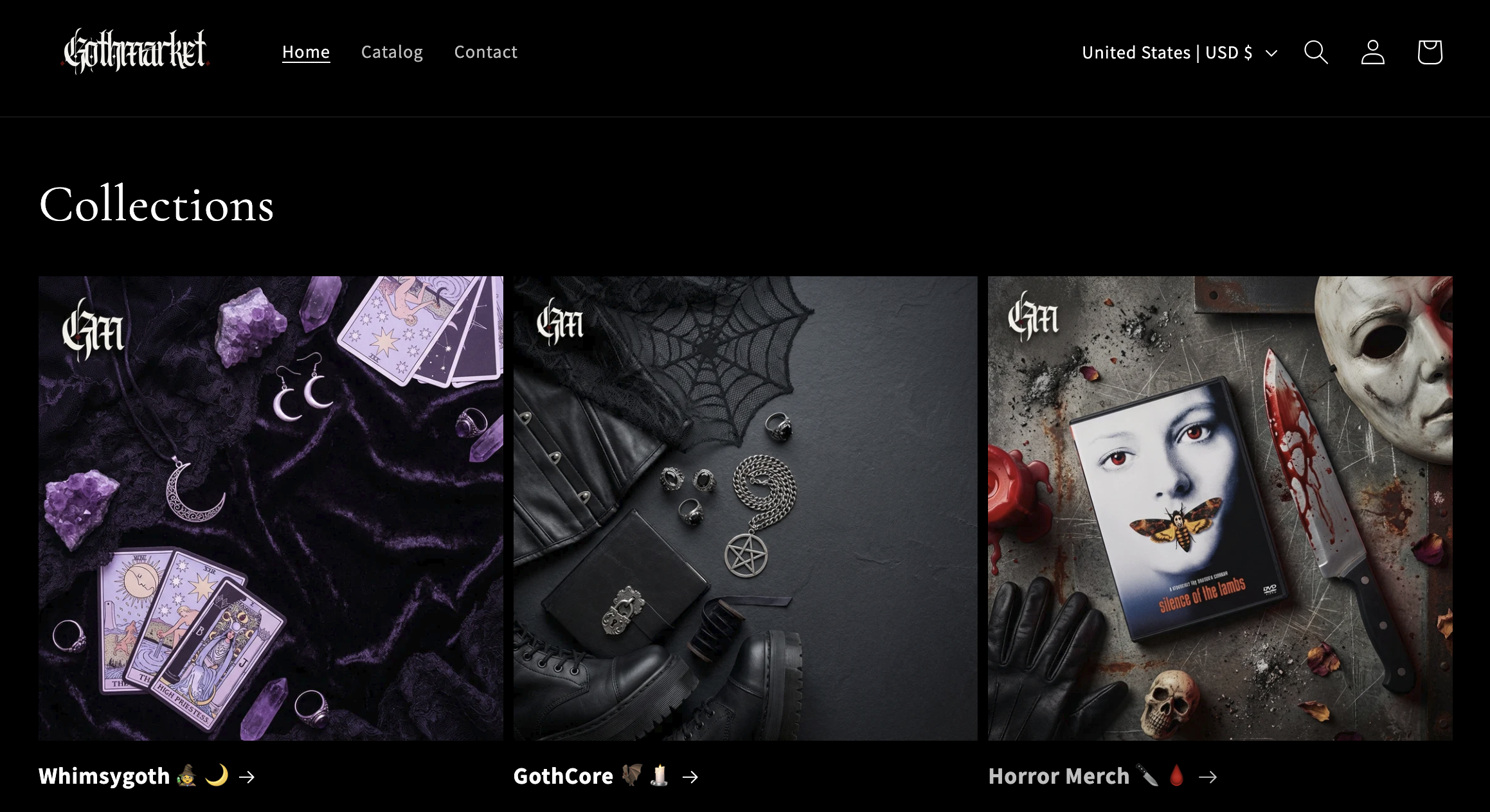
Sellers get provenance fields built into their listing tools, so material sourcing, maker background, and repair notes live directly on the product page instead of buried in a message thread. Buyers browsing the marketplace can filter for listings that show this level of detail, which makes it easier to support makers who are actually doing the work honestly. If you’re a maker ready to list transparently, or a shopper who wants curios with real provenance behind them, Goth to start browsing or set up a seller profile today.
Sources
Don’t purchase or resell it. Redirect support toward the tradition’s actual keepers, and if you already own the item, consider donating any resale proceeds to a relevant community organization.
- When is copying wrong? — University of Washington Law Digital Commons
- Appreciation or Appropriation? How to Know Before You Practice — Ayana Madrone (Substack)
- The Pitfalls of Occult Capitalism — Wayfinder Tarot
- Goth fast fashion, and why it isn’t always a good thing — Gothic Charm School
FAQ
What is the main rule for ethical oddities collecting?
Prioritize provenance and transparency above everything else. If a seller can document materials, origin, and maker identity, most other ethical questions resolve themselves.
Does oddities collecting ethics cover bones or taxidermy?
No, this guide covers curated gothic and occult decor, replicas, and handmade curios, not biological specimens like taxidermy or bone collecting, which involve separate legal and ethical frameworks.
How can I tell if an item is a copy of an independent maker’s design?
Look for identical pieces sold at very different prices, stock photography instead of maker-specific images, and vague or missing origin details. A genuinely original piece usually comes with documentation the seller can produce on request.
How do I know if a price is fair for a handmade curio?
A fair price accounts for materials, labor hours, marketplace fees, and a living wage for the maker’s time. Ask the seller for a rough cost breakdown if the number seems unclear.
What documentation should sellers include in a listing?
Include a full material list, maker background, close-up provenance photos, condition or repair notes, and cultural attribution if the piece draws on any tradition.
Why does Goth.Market focus on provenance and maker transparency?
Goth.Market is a curation-first marketplace, so provenance fields and maker verification are built directly into how listings work, rather than added as an afterthought.
What are red flags that a listing might be mass-produced?
Watch for identical aging across “different” pieces, mirrored tooling marks, machine-uniform edges, stock photos, and the same item appearing across multiple unrelated seller accounts.