

How to Create Dark Decor That Feels Moody, Not Oppressive
TL;DR:
- Dark decor relies on a warm, layered lighting scheme, textured surfaces, and a bold focal anchor. Achieving intimacy involves warm bulbs, contrasting textures, and large green plants, avoiding flatness. Proper sequencing and authentic gothic pieces complete the mood while renters should focus on swaps like lighting and textiles.
Dark decor works when you build it from a formula of warm, deep color palette, layered warm lighting bulbs, varied textures, living greenery, and a clear focal anchor. Get those elements right and the room reads as intentional and intimate. Miss any one of them and it reads as a cave.
TL;DR: Start here today
- Swap every bulb to a warm 2700K–3000K equivalent
- Add one dark anchor piece: a velvet sofa, a painted feature wall, or a large dark rug
- Place 2–3 large leafy plants near your brightest window
- Layer at least 3–4 light sources at different heights
- Test paint swatches in situ for 3–5 days before committing
Table of Contents
- How do you choose the right dark color palette?
- What does a layered lighting plan look like in a dark room?
- How do you mix textures so a dark room feels rich, not flat?
- How do plants and focal points keep a dark room from feeling static?
- What are the best renter-friendly swaps for dark decor?
- A step-by-step paint-sample checklist before you commit
- Where should you source curated gothic and dark decor?
- Key Takeaways
- Dark decor is about intimacy, not just darkness
- Where to shop for gothic and dark decor that actually fits the aesthetic
- Sources and further reading
How do you choose the right dark color palette?
Pick warm-undertoned deep colors and decide early whether you want a full-room drench or a single dark anchor. Forest green, warm charcoal, midnight navy, and oxblood all work. Cold blue-blacks and gray-blues do not, at least not without careful warm-light compensation.
The single most overlooked factor is Light Reflectance Value. LRV measures how much light a color bounces back: a low LRV (below 20) absorbs more light and deepens the enveloping effect. Room orientation matters just as much. North-facing rooms shift colors cooler and grayer, so a warm charcoal can read almost blue-black by afternoon. South-facing rooms warm everything up, giving you more latitude with cooler darks.
Color drenching — painting walls, trim, and ceiling the same deep hue — creates a cocooning, seamless envelope that can paradoxically make a small room feel larger. A feature wall or painted dado rail is the lower-commitment entry point. Powder rooms and dining rooms are ideal for a full drench because they are used in short, deliberate sessions. Bedrooms work well too. Living rooms benefit from a feature wall first.
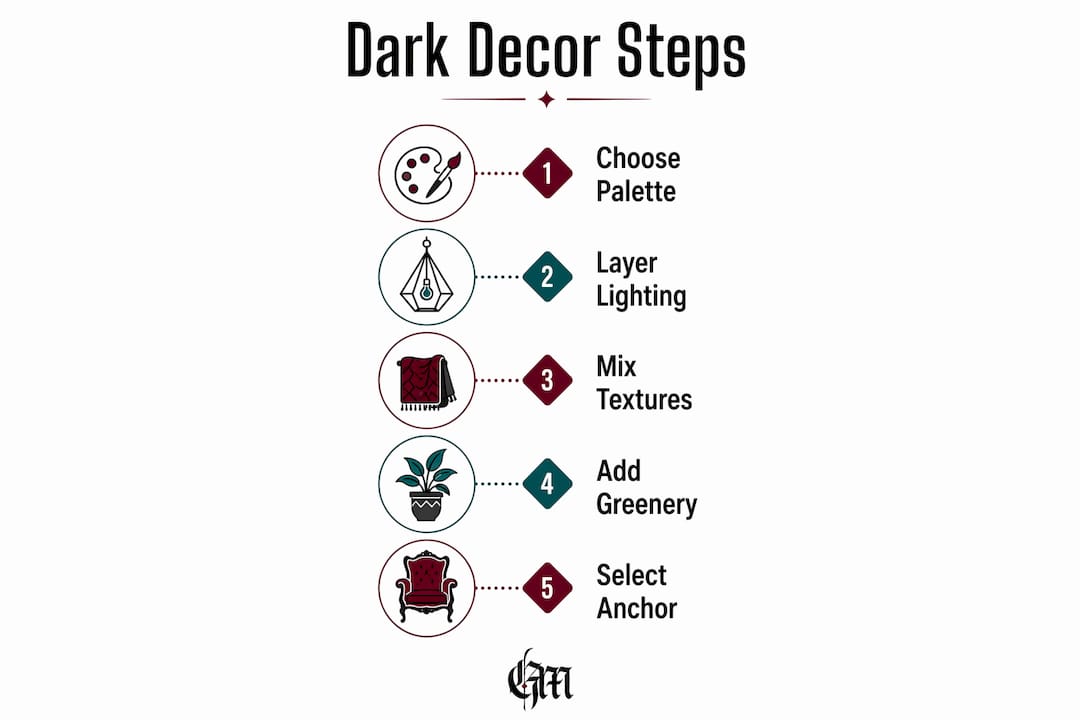
Pro Tip: If you are new to dark decor, start with one anchor piece rather than a full paint commitment. A velvet sofa in forest green or a single painted wall in oxblood gives you the mood without the irreversibility.
What does a layered lighting plan look like in a dark room?
Layered warm lighting is what separates a glowing, moody room from a flat one. Use multiple distinct sources and keep every bulb in a warm color temperature range. Avoid cool-white bulbs that make dark walls read institutional, not intimate.
Build the plan in this order:
- Ambient layer: a ceiling fixture or recessed lights on a dimmer; this is your baseline, not your primary mood source
- Mid-level layer: table lamps and floor lamps near seating, at roughly face height when seated
- Accent layer: wall sconces, picture lights over art, and candle groupings for the lowest, warmest glow
- Reflective layer: mirrors opposite windows or near accent lamps to circulate warmth through the room
Vintage filament-style bulbs and extra-warm amber LEDs are worth the slight premium here. A two-light ceiling mount in a dark or aged-brass finish keeps the fixture from fighting the palette. Put as much as possible on dimmers — the ability to drop the ambient layer to 20% while the table lamps carry the room is what makes dark spaces feel alive at night.
How do you mix textures so a dark room feels rich, not flat?
The rule is simple: always pair absorptive surfaces with reflective ones. Matte paint and velvet absorb light and add depth. Brass, glass, and high-gloss trim reflect it and add definition. A room built entirely from matte surfaces reads two-dimensional no matter how good the color is.
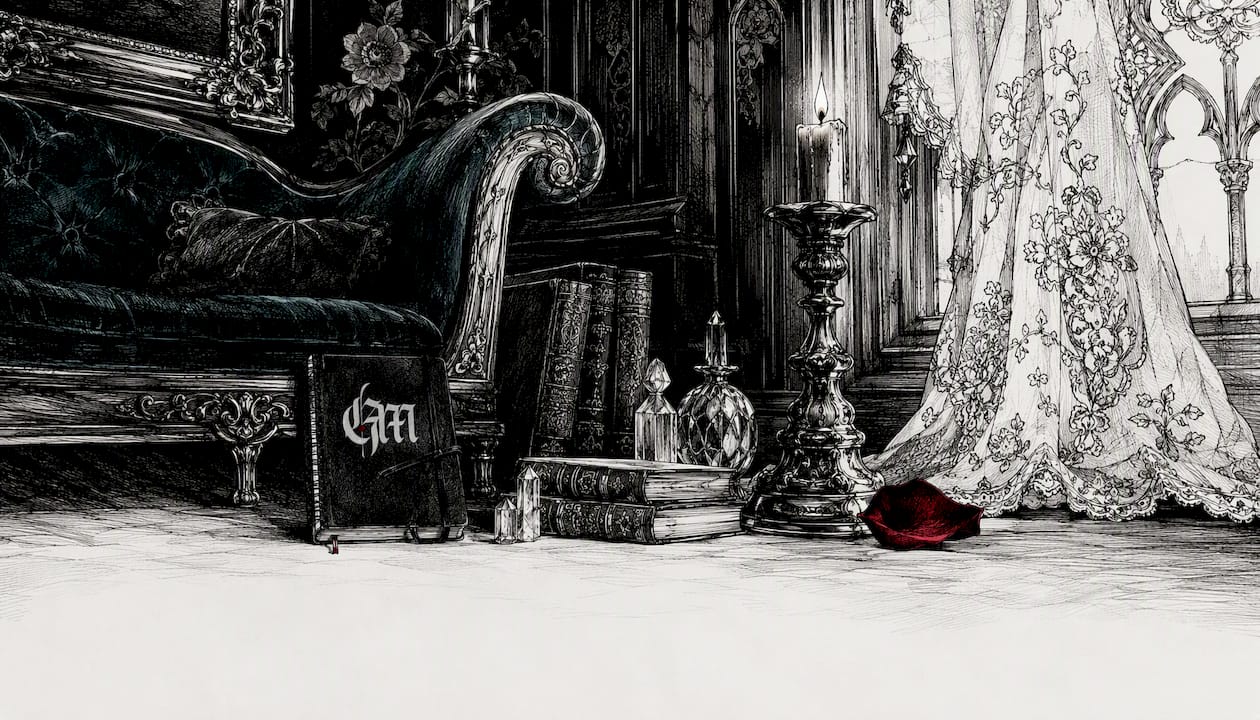
The finishes trick is one of the most underused moves in dark decorating: paint walls in matte or eggshell, then paint the trim in semi-gloss or high-gloss in the exact same hue. The color reads as one, but the sheen difference makes the architecture visible. It costs nothing extra.
Surface pairings that work reliably: a velvet sofa with a brass floor lamp, matte walls with a lacquered cabinet, leather seating with a chunky wool rug. For flooring, dark wood or stone anchors the palette at ground level. Layer rugs on top — a large-scale pattern in charcoal or deep jewel tones grounds the furniture arrangement and adds the tactile weight the room needs. Warm metals like brass and bronze act as light-catchers, adding small bright points without lightening the overall scheme.
How do plants and focal points keep a dark room from feeling static?
At least 2–3 large leafy plants are non-negotiable. Large plants like fiddle leaf figs, monsteras, and birds of paradise do structural work in dark rooms: they break up the geometry, add a vertical element furniture cannot provide, and introduce deep green that reads as neutral against both dark walls and pale accents. Group them near your brightest window, use plant stands to vary heights, and keep them out of corners where they will disappear.
Every dark room needs one strong focal anchor:
- A large piece of gothic or occult wall art in a dark frame
- A statement velvet headboard in a bedroom
- A dark bookcase styled with curated objects, candles, and trailing plants
- A fireplace surround in dark stone or painted brick
Light the focal point directly with a picture light or a directed floor lamp. That single lit anchor is what gives the eye somewhere to land and prevents the room from reading as undifferentiated darkness.
For styling touches that register as gothic or occult: brass mirrors with ornate frames, candle groupings in varying heights, curated books with dark spines, and textured trays holding occult accessories. Scent completes the atmosphere — gothic wall art and candles or incense (black amber, oud, or palo santo) work together to make the space feel fully inhabited rather than just decorated.
What are the best renter-friendly swaps for dark decor?
You can achieve a convincing dark mood without touching a single wall. The highest-impact swaps are bulbs and curtains: warm bulbs cost almost nothing and change the entire character of a room in ten minutes; heavy velvet or blackout curtains add weight, texture, and darkness simultaneously.
Other swaps to try immediately:
- Peel-and-stick wallpaper in a dark botanical or geometric pattern on one wall
- Large tapestries or textile hangings as a renter-safe feature wall
- Dark velvet or linen throw pillows and a chunky knit blanket over existing furniture
- A large dark rug as the room’s anchor
- Dark slipcovers over a light sofa
Spend money on lighting and one good anchor piece. Thrift or buy secondhand for textiles, ceramics, and decorative objects — patina and age read better in a gothic aesthetic than anything new and mass-produced. One caution for renters: test peel-and-stick adhesive on a small hidden patch before committing, and use felt pads or a tray under heavy plant pots to protect floors.
A step-by-step paint-sample checklist before you commit
Test paint in situ for several days before ordering gallons. Colors shift dramatically with room orientation and time of day — a swatch that looks perfect at noon in a south-facing room can read almost black by 6 PM.
- Pick candidate colors with warm undertones and low Light Reflectance Value (LRV) suitable for dark interiors.
- Apply paint swatches of sufficient size on at least two different walls in the room
- Observe the swatches across multiple times of day and lighting conditions
- Test the swatches with your final warm lighting plan in place, including lamps and dimmers
- Decide between full-room painting or a feature wall based on your observations
| Item | DIY estimate | Pro estimate | Timeline |
|---|---|---|---|
| Sample cans (3) + brushes | — | N/A | 1 day |
| Single feature wall paint | — | — | 1–2 days |
| Full-room color drench | — | — | 2–5 days |
Red flags to stop and rethink: the color reads cool or flat under your bulbs; a single cool overhead bulb is still in the room; every surface is the same sheen; the room feels claustrophobic after the drench test.
Pro Tip: Run the full lighting plan — lamps on, dimmers low, candles lit — before you judge a swatch. A color that looks wrong under a single overhead bulb often transforms completely under layered warm light.
Where should you source curated gothic and dark decor?
Specialist curation beats mass-market every time for this aesthetic. Generic home stores carry dark-adjacent pieces; they rarely carry pieces with the material quality, finish, or occult specificity that makes a gothic room feel authentic rather than themed.
Before buying anything, check: material quality and finish photos, seller reviews, return policy, and listed dimensions. Scale is the most common mistake — a piece that looks dramatic in a product photo can disappear against a dark wall if it is undersized. Favor warm metals (brass, bronze, aged gold) and pieces with tactile finishes over anything chrome or plastic.
Goth.Market curates independent creators and artisans selling gothic decor, occult accessories, dark wall art, velvet seating, brass accents, and candles. It is the most direct route to pieces that match the guide’s recommendations without sorting through mass-market noise. The gothic home decor checklist on the site is a useful companion for building a room from scratch.
Key Takeaways
Dark decor succeeds when warm-undertoned color, layered 2700K–3000K lighting, mixed textures, living greenery, and one clear focal anchor work together as a system.
| Point | Details |
|---|---|
| Warm bulbs first | Swap every bulb to 2700K–3000K before judging any paint color or decor choice. |
| Test paint for 3–5 days | Observe swatches across morning, afternoon, and evening light before committing to a full drench. |
| Mix absorptive and reflective | Pair matte walls and velvet with brass, glass, or high-gloss trim to prevent a flat, two-dimensional look. |
| Plants do structural work | Place 2–3 large leafy plants near your brightest window to break geometry and add life. |
| Shop Goth.Market for authentic pieces | Goth curates independent gothic and occult decor makers, cutting through mass-market noise. |
Dark decor is about intimacy, not just darkness
The conventional advice on moody interiors focuses almost entirely on color. Pick the right dark paint, the guides say, and the room will follow. That framing misses the point. Color is the container. What fills it — light, texture, living things, objects with history — is what makes a dark room feel inhabited rather than staged.
The rooms that work best are the ones where darkness is a byproduct of warmth, not the goal itself. A room lit with four warm sources at different heights, furnished with velvet and brass and a few large plants, will feel intimate and alive even if the walls are a relatively modest charcoal. The same room painted the deepest oxblood available, lit with a single overhead cool bulb, will feel like a waiting room.
The practical lesson: sequence matters. Warm bulbs first, always. Then the anchor piece. Then the layers. Committing to a full-room drench before you have the lighting plan in place is the single most common mistake, and it is also the most expensive to undo. Start with one good lamp and one dark piece. The room will tell you what it needs next.
For readers who want to go deeper on style subtypes within the gothic aesthetic, the gothic decor style guide at Goth covers Victorian, modern minimal, and occult-focused approaches in detail.
Where to shop for gothic and dark decor that actually fits the aesthetic
Goth.Market is the curated alternative to scrolling through generic home stores hoping something dark enough shows up. Every seller on the platform specializes in gothic, occult, and alternative aesthetics, which means the pieces already speak the same visual language as this guide.

Search these categories directly: dark wall art, velvet seating, brass and aged-metal accents, occult candles, and witchy home accessories. When you find a piece you like, check the listed dimensions against your wall or floor plan, read the seller’s return policy, and look at finish photos in natural light. Pieces with warm metal hardware or aged patina will integrate most naturally with a layered warm-light scheme.
Browse the full dark decor collection at Goth.Market and start with one piece that anchors the room.
Sources and further reading
The lighting specifications (2700K–3000K), LRV guidance, and paint-testing advice in this guide draw from published interior design resources and professional decorating guidance. The texture and material strategies reference design case studies including the Noir Matiere high-rise interior project documented by Quiet Minimal.
- Dark and Moody Interior Design: Cozy, Not Depressing — Living Large In A Small House: layered lighting, mirror placement, and finish strategies
- How to Create a Dark Living Room — Sherwin-Williams: LRV guidance and color selection for dark rooms
- How To Achieve the Moody Aesthetic — Pretty Wild World: 10-step sequencing and renter-friendly swaps
- Moody Home Decor Style Guide — Minimize My Mess: budget swaps and beginner approaches
- How to decorate with dark colours — House & Garden: paint-sample testing and room orientation advice
- Dark Moody Interior Design Ideas Guide — MeltFlexAI: plant placement and texture pairing strategies
- Noir Matiere: A Dark High-Rise Interior — Quiet Minimal: material contrast and plant-as-architecture case study
- Goth.Market — curated marketplace for gothic, occult, and dark decor from independent creators