

Gothic Printmaking Explained: Techniques and History
TL;DR:
- Gothic printmaking involved early European techniques like woodcut and engraving that spread images widely. Its symbolic and emotional style continues to influence modern gothic art, fashion, and decor. The craft’s physical challenges shaped its distinctive visual language and enduring cultural significance.
Gothic printmaking is defined as the early European practice of producing prints through woodcut and engraving techniques, developed primarily between 1400 and 1500. This period produced the first widely distributed visual art in Western history, making it one of the most consequential shifts in how images reached audiences. For artists, students, and enthusiasts drawn to dark aesthetics, understanding gothic printmaking means understanding the roots of an entire visual tradition. The raw intensity, symbolic density, and handcrafted permanence of these prints still echo through modern gothic and alternative art today.
What is gothic printmaking and how did its techniques develop?
Gothic printmaking refers to two core methods: relief woodcut printing and intaglio engraving, both originating in early 15th-century Europe. These were not decorative hobbies. They were the first technologies for reproducing images at scale, and the gothic aesthetic they carried shaped centuries of visual culture.
Woodcut: the relief method
Woodcut printing dominated the early 1400s. An artist carved an image into a flat block of wood, leaving raised lines that held ink. The block was then pressed onto paper or fabric to transfer the image. Early gothic woodcuts used simple, bold outlines with heavy areas of flat color. The results were stark and direct, which suited the religious and devotional content that most prints depicted.
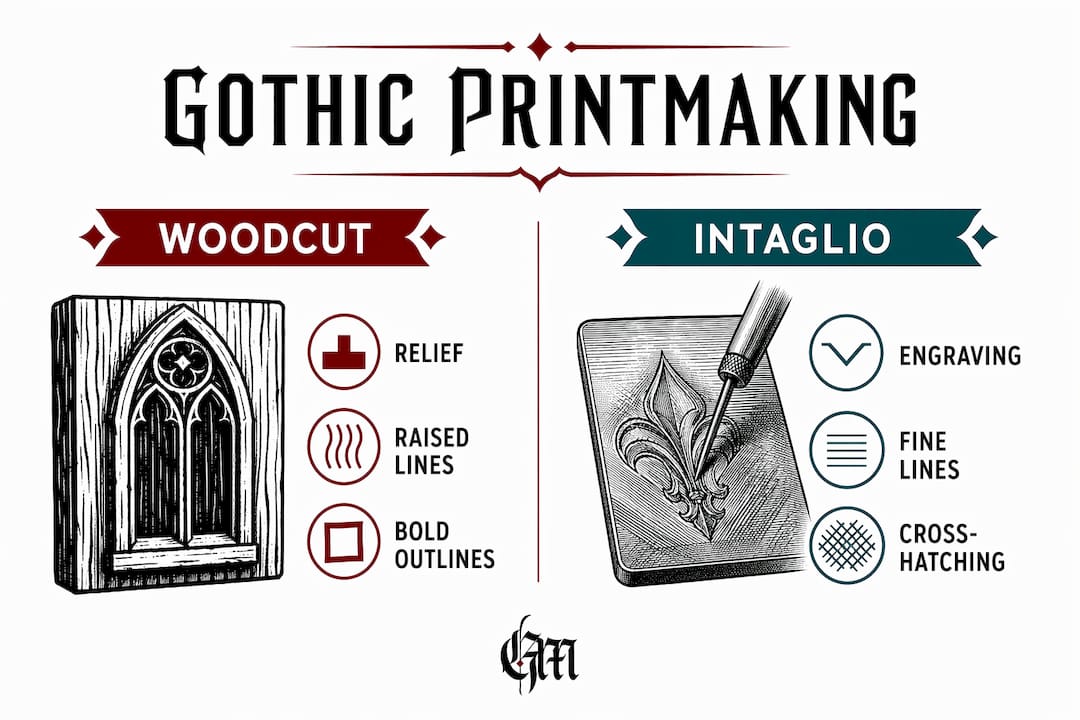
The process required planning the entire composition in reverse before cutting a single line. One wrong cut ruined the block. This constraint forced gothic printmakers to think with unusual clarity about line and form, which is part of why early gothic prints carry such visual authority.
Intaglio engraving: precision from the goldsmith’s bench
Intaglio engraving developed in the late 1430s, growing directly out of goldsmith traditions. Instead of carving raised lines, engravers cut grooves into a copper plate with a tool called a burin. Ink was pressed into those grooves, the surface was wiped clean, and damp paper was pressed hard against the plate to pull the ink out. The result was a finer, more detailed image than woodcut could produce.
The transition from goldsmith to printmaker was natural. Both crafts demanded control over metal and an eye for intricate pattern. Gothic engravers brought that same decorative sensibility to their prints, which is why early engravings often feel dense with ornamental detail.
- Choose your matrix. Woodcut uses a wood block; engraving uses a copper plate. Each demands different tools and a different physical approach.
- Cut or carve the image. Woodcut removes material around the lines. Engraving cuts the lines themselves into the metal.
- Apply ink. Woodcut inks the raised surface. Engraving fills the recessed grooves.
- Transfer to paper. Both methods press paper against the inked matrix, but engraving requires far greater pressure to pull ink from the grooves.
- Assess and refine. Early gothic printmakers pulled test prints and re-cut lines to correct errors or sharpen detail.
Pro Tip: If you are learning engraving for the first time, practice burin cuts on a scrap copper plate before committing to a composition. Confident, continuous strokes produce clean lines. Hesitant strokes leave ragged edges that are nearly impossible to fix.
The transition from woodcut to engraving between 1425 and 1460 marked a shift toward thinner lines, cross-hatching for tonal depth, and far greater compositional complexity. That shift defined the mature gothic print style.
How did gothic printmaking style evolve and influence artistic expression?
Gothic woodcut style moved through two distinct phases. The first phase, roughly the early 1400s, produced prints with heavy outlines, flat color, and minimal shading. The second phase, emerging through the mid-1400s, introduced cross-hatching, finer line work, and layered tonal gradients. This second phase is where gothic printmaking reached its full visual power.
The stylistic evolution was not purely technical. It reflected a changing cultural moment. Gothic printmakers worked within a tradition that valued symbolic richness over naturalistic representation. Every motif carried meaning: the skull signaled mortality, the cathedral arch pointed toward the divine, the serpent carried moral weight. Gothic art symbolism was not decorative. It was a language, and printmaking was the medium that spread it to mass audiences for the first time.
Key stylistic traits of gothic prints include:
- Intricate line work. Gothic engravers used dense networks of parallel and crossed lines to build shadow and volume.
- Symbolic motifs. Religious figures, architectural elements like pointed arches and tracery, and memento mori imagery appear consistently across gothic prints.
- Hierarchical composition. Important figures were scaled larger than secondary ones, regardless of spatial logic.
- Emotional intensity. Faces in gothic prints often carry exaggerated expressions of grief, devotion, or awe.
- Compositional density. Gothic engravers, trained as goldsmiths, tended to fill every available space with detail, sometimes to the point of visual overload.
Lucas van Leyden stands as the most significant figure bridging gothic and Renaissance printmaking. Working in the early 16th century, he combined the symbolic density of gothic engraving with the humanist ideals of the Renaissance, producing prints that feel psychologically complex in a way earlier gothic work rarely achieved.
“Gothic printmaking’s greatest achievement was not technical precision but emotional directness. These prints were designed to be felt before they were understood, and that quality has never gone out of fashion.”
The risk of compositional overloading was real. Gothic engravers, inheriting the goldsmith’s instinct to fill space, sometimes produced prints where the eye has nowhere to rest. This is not a flaw by modern standards. It is a characteristic. Understanding it separates artists who study gothic prints from those who merely admire them.
What practical challenges did gothic printmakers face?
Gothic printmaking was physically demanding in ways that modern printmaking is not. The tools were simple, the materials were limited, and the margin for error was narrow.
Copper engraving plates lasted approximately 60 prints before wear degraded the fine lines. That is a small production run by any standard. Artists had to re-cut worn lines to extend a plate’s life, which risked altering the original composition. The constraint shaped how gothic printmakers thought about editions and distribution.
Common practical challenges included:
- Burin control. The engraving burin required confident, consistent hand pressure to produce clean lines. Hesitation produced ragged, uneven strokes that were visible in the final print.
- Pressure consistency. Before screw presses existed, printmakers applied pressure manually by rubbing or hammering. Uneven pressure ruined cross-hatching details and produced inconsistent tonal values.
- Plate wear. Fine lines wore down faster than bold ones, meaning the most delicate parts of a composition degraded first.
- Ink viscosity. Gothic printmakers had to mix inks to the right consistency for each method. Too thin, and the ink spread beyond the lines. Too thick, and it failed to transfer cleanly.
Pro Tip: When studying gothic prints, look at the edges of fine lines under magnification. Clean, confident edges indicate a master engraver. Ragged or doubled lines reveal hesitation or a worn plate, and both tell you something real about the conditions under which the print was made.
| Challenge | Cause | Effect on print |
|---|---|---|
| Plate wear | Repeated printing pressure | Fine lines fade; detail is lost |
| Burin hesitation | Lack of hand confidence | Ragged, inconsistent line edges |
| Uneven press pressure | Manual application before screw presses | Patchy tonal values and incomplete ink transfer |
| Ink inconsistency | No standardized formulas | Bleeding or faint lines depending on paper absorbency |
Material constraints did not limit gothic printmakers. They shaped the aesthetic. The bold outlines of early woodcuts exist partly because fine lines were harder to cut cleanly in wood. The density of gothic engravings reflects the goldsmith’s trained instinct to work at close range with small tools. Every technical limitation left a visible mark on the style.
Why does gothic printmaking matter to alternative art culture today?
Gothic printmaking carries a raw visual language that modern gothic and alternative aesthetics have never fully abandoned. The directness, the emotional intensity, and the symbolic density of 15th-century prints translate directly into contemporary dark art, decor, and fashion.
The influence on modern gothic wall art is concrete and traceable. Pointed arch motifs, skull imagery, dense cross-hatching, and religious iconography appear across gothic-inspired posters, prints, and textiles produced today. These are not random borrowings. They are a continuous visual tradition that gothic printmaking established.
For collectors and enthusiasts, the appeal is authenticity. Gothic prints carry the marks of their making: the texture of hand-pressed paper, the slight variation in line weight, the evidence of a human hand working under physical constraint. That quality is exactly what mass-produced imagery cannot replicate.
The influence extends into:
- Gothic wall art. Engraving-style line work appears in contemporary prints sold through independent artists and alternative marketplaces.
- Alternative fashion graphics. Cross-hatching and woodcut-style bold outlines appear on band merchandise, clothing, and accessories within the gothic and emo subcultures.
- Occult and witchcraft imagery. Symbolic motifs from gothic printmaking, including celestial diagrams, anatomical figures, and religious iconography, feed directly into modern occult visual culture.
- Collector interest. Enthusiasts building gothic art collections increasingly seek prints that reference or replicate historical gothic techniques.
Gothic printmaking also matters educationally. Students who study these techniques learn to think about image-making in terms of constraint, intention, and physical process. That discipline produces better artists, regardless of the medium they ultimately work in.
Key Takeaways
Gothic printmaking is the foundation of Western visual culture, and its techniques, motifs, and emotional directness remain the defining source code for modern gothic and alternative aesthetics.
| Point | Details |
|---|---|
| Two core techniques | Woodcut relief printing and intaglio engraving define gothic printmaking’s technical identity. |
| Stylistic evolution | Gothic prints shifted from bold outlines in the early 1400s to complex cross-hatching by the mid-1400s. |
| Material constraints shaped style | Copper plate wear, burin demands, and manual press pressure all left visible marks on the gothic aesthetic. |
| Lucas van Leyden’s legacy | He merged gothic symbolic density with Renaissance humanism, producing the most psychologically complex prints of the era. |
| Modern relevance | Gothic printmaking motifs and techniques directly inform contemporary gothic wall art, alternative fashion, and occult visual culture. |
Why gothic printmaking deserves more serious attention
Most people who love gothic aesthetics have absorbed gothic printmaking’s influence without knowing it. The cross-hatched shadows on a band’s album art, the woodcut-style skull on a piece of dark decor, the dense architectural detail in a gothic poster: all of it traces back to workshops in 15th-century Europe where craftsmen were solving very practical problems with very limited tools.
What strikes me most about gothic printmaking is how honest it is. There is no digital undo. There is no layer mask. Every cut into a wood block or copper plate is a committed decision, and the print carries the record of every one of those decisions. That kind of accountability produces a different quality of image than anything made with the option to erase.
For students, studying gothic printmaking is one of the fastest ways to develop visual discipline. When you cannot fix a mistake, you stop making careless ones. The burin teaches patience. The wood block teaches planning. Both teach you to see your composition as a whole before you touch the material.
The revival of interest in gothic printmaking within alternative art communities is not nostalgia. It is a recognition that the visual language these early printmakers built is still the most direct way to communicate the themes that gothic culture cares about: mortality, devotion, beauty in darkness, and the weight of history. That language has not been improved upon. It has only been borrowed.
— Rey
Gothic art and prints at Goth
Gothic printmaking’s legacy lives in the art that surrounds you. Goth is the marketplace where that legacy stays alive through independent creators who work in the tradition of dark, symbolic, and handcrafted visual art.
At Goth, you will find gothic-inspired prints, wall art, and decor that draw directly from the visual vocabulary of historical gothic printmaking. From woodcut-style illustrations to engraving-influenced line art, the platform connects artists who understand this tradition with collectors and enthusiasts who want to live inside it. Independent creators on Goth bring authenticity that mass-market art simply does not offer. If gothic printmaking’s history has sharpened your eye for what makes dark art powerful, Goth is where you put that knowledge to work.
FAQ
What is gothic printmaking in simple terms?
Gothic printmaking is the practice of producing prints through woodcut and engraving techniques in 15th-century Europe. It is the earliest form of mass image reproduction in Western art history.
What are the two main gothic print techniques?
The two primary techniques are woodcut relief printing, which dominated the early 1400s, and intaglio engraving, which developed from goldsmith traditions in the late 1430s.
Who are the most important gothic printmakers?
Master E.S. is one of the earliest identified engravers in the gothic tradition. Lucas van Leyden is the most significant figure bridging gothic engraving with Renaissance printmaking in the early 16th century.
How did gothic printmaking influence modern gothic art?
Gothic printmaking established the core visual motifs of the gothic tradition, including skull imagery, architectural elements, and dense symbolic line work, all of which appear directly in contemporary gothic wall art, alternative fashion, and occult visual culture.
Why did copper engraving plates wear out so quickly?
Copper plates lasted approximately 60 prints before fine lines degraded from repeated printing pressure. Artists re-cut worn lines to extend plate life, which sometimes altered the original composition.
Recommended
- Why Choose Gothic Style: Self-Expression and Aesthetic Impact – GothMarket
- Role of Art in Gothic Style – Inspiring Modern Dark Aesthetics – GothMarket
- What Does Gothic Aesthetic Mean? 12th Century Origins Explained – GothMarket
- How to start a gothic art collection: tips for new collectors – GothMarket