

What Is a Witch Bottle? History, Ingredients, and Modern Uses
A witch bottle is a protective, and historically curative, vessel built to trap or reverse harmful magic aimed at its maker. The practice traces back to 17th-century England, with textual accounts running from roughly 1660 to 1705 and about 100 physical bottles recovered by archaeologists since. A typical bottle held some combination of the following:
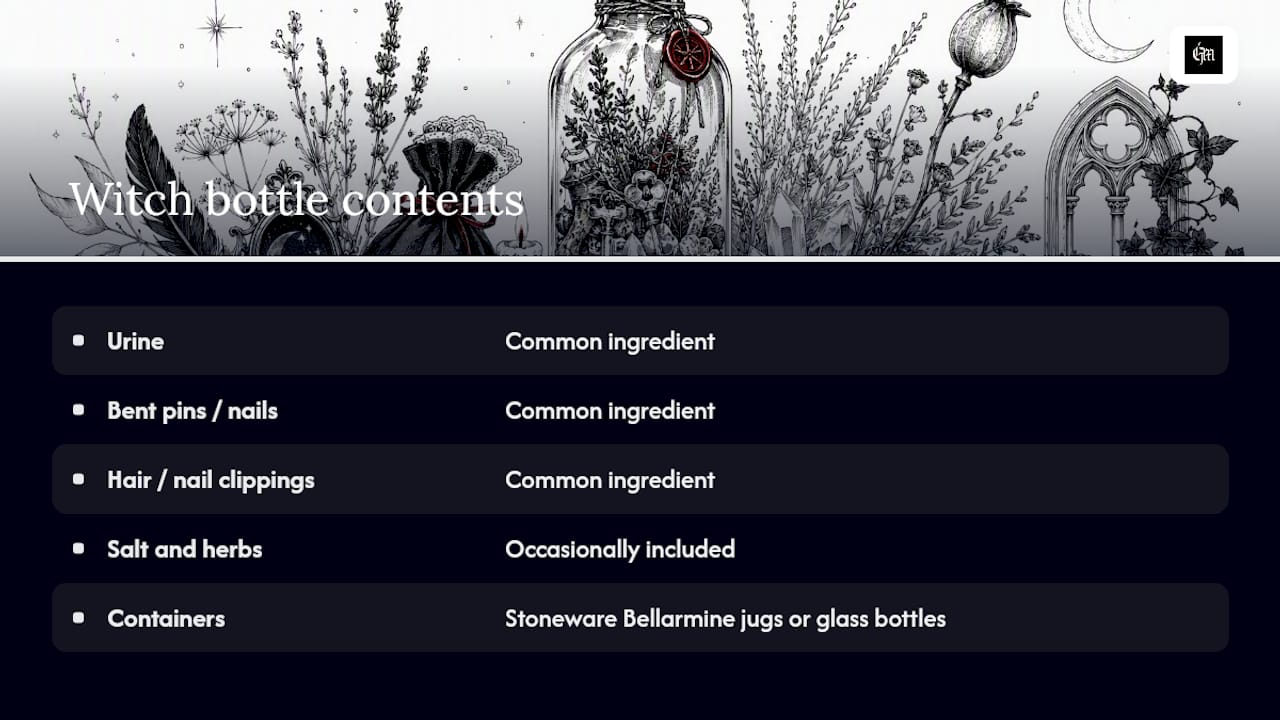
- Urine, believed to carry a sympathetic link to the afflicted person
- Bent pins, nails, or thorns meant to injure the attacking witch
- Hair or nail clippings from the person being protected
- Salt, wine, or herbs added for purification or potency
That’s the short version. The longer story involves boiling pots, buried hearths, and a nineteenth-century historian who named the whole practice after the fact.
Key Takeaways
Witch bottles began as 17th-century curative remedies against suspected bewitchment, not decorative charms, and modern versions should trade unsafe historic ingredients for herbs, salt, and clear intention.
| Point | Details |
|---|---|
| Curative origin | Primary sources from roughly 1660 to 1705 frame the bottle as a remedy for diagnosed bewitchment, not a general shield. |
| Common contents | Urine, bent pins, hair, salt, and wine appear across most documented historical examples. |
| Archaeological scale | About 100 bottles have been catalogued in England, with fewer than a dozen confirmed U.S. finds. |
| Safety over authenticity | Skip bodily fluids and boiled sealed containers; substitute herbs, salt, and stated intention instead. |
| Sourcing matters | Goth.Market’s curated marketplace connects practitioners with makers who disclose material origin and craft. |
Table of Contents
- What ingredients and containers were historically used in witch bottles?
- What are the origins and original purpose of witch bottles according to primary sources?
- How were witch bottles prepared, hidden, and sometimes destroyed historically?
- What do archaeological finds tell us about where witch bottles were used and what they contained?
- How are witch bottles adapted or reimagined today, and what ethical/safety cautions should practitioners follow?
- How can Goth.Market help you source ethically curated materials and learn crafting techniques?
- What other folk practices share the same protective logic as witch bottles?
- How did communities and courts view witch bottles at the time?
- What has making and studying these objects taught me about ritual craft?
- Where to find responsibly curated jars and supplies for your own protection jar
- Sources
- FAQ
What ingredients and containers were historically used in witch bottles?
Period sources describe a fairly consistent kit. Urine shows up in nearly every documented account, often paired with iron objects like pins, nails, or bent needles meant to wound whatever force was causing harm. Hair and nail clippings from the afflicted person created a physical link between the victim and the counter-curse, while salt appeared as a purifying agent and wine or vinegar sometimes served as a preservative or symbolic substitute for blood.
- Urine — the central ingredient in most recorded “urinary experiments”
- Pins and nails — sharp objects meant to torment the attacking witch
- Hair or nail clippings — established the sympathetic connection to the victim
- Salt — added for purification in many regional variants
- Wine or herbs — occasional additions noted in later, less standardized recipes
Containers mattered too. Early bottles were often German stoneware jugs known as Bartmann or Bellarmine jugs, prized for their thick walls and tight seals. Glass bottles became more common later. Roughly 100 extant witch bottles have been catalogued from England, with far fewer confirmed finds elsewhere, and contents vary enough between sites that no single “correct” formula ever existed.
What are the origins and original purpose of witch bottles according to primary sources?
The evidence for witch bottles comes almost entirely from a narrow window of English writing, and it tells a more medical story than most modern retellings suggest. Historians working from ballads, treatises, and court records have identified roughly 13 primary accounts describing the practice between about 1660 and 1705, a period when belief in bewitchment as a diagnosable affliction still ran deep in English folk medicine.
The strongest scholarly reinterpretation treats these bottles not as generic protective charms but as targeted cures for a specific, already-identified curse. Someone believed to be bewitched, often suffering symptoms a doctor couldn’t explain, would undergo what period writers called a “urinary experiment.”
The bottle wasn’t a preventative shield hung by the door. It was closer to a prescribed remedy, assembled after a diagnosis of bewitchment, meant to reverse an affliction already underway.
That distinction matters for anyone reading older sources literally. The term “witch bottle” itself is a 19th-century label retrofitted onto a 17th-century medical and magical practice that contemporaries would have described in the language of physick and countercharm, not witchcraft supply. Urine itself carried established uses in period healing well beyond the bottle, which is part of why it turns up so consistently in the record.
How were witch bottles prepared, hidden, and sometimes destroyed historically?
The process followed a fairly consistent sequence across the surviving accounts, though the exact steps shifted by region and by the specific ailment being treated.
- Collect urine from the afflicted person, sometimes alongside hair or nail clippings
- Add bent pins, nails, or thorns to the bottle
- Seal the container tightly, often with wax or a cork
- Either bury it at a threshold or hearth, or boil and burn it as part of the remedy
Some accounts describe throwing the sealed bottle into a fire so it would explode, a dramatic act meant to symbolically destroy the source of the curse. Others describe simply burying it near a doorway, chimney, or riverbank, where it would sit undisturbed for generations. Boiling and burning both appear in the historical record as legitimate variations on the remedy, not deviations from it.
Pro Tip: Don’t replicate the historical recipe literally. Bodily fluids and boiled sealed glass are genuine safety hazards, and pressurized containers can shatter. Modern versions swap in herbs, salt, and intention.
What do archaeological finds tell us about where witch bottles were used and what they contained?
Physical evidence backs up the textual record, with some surprises attached. Museum and press analyses, including testing reported by National Geographic, have confirmed urine traces in bottles once assumed to hold wine, along with pins, teeth, coins, and hair. Lab analysis has repeatedly overturned informal identifications based on smell or taste, which is why researchers now insist on chemical testing before publishing conclusions about contents.
- About 100 witch bottles have been documented in the archaeological record, concentrated heavily in East Anglia and southern England
- Fewer than a dozen possible examples have turned up in the United States, making English finds far more common
- Dating relies on stratigraphy, container style (Bellarmine jugs date more precisely than plain glass), and occasional documentary corroboration
How are witch bottles adapted or reimagined today, and what ethical/safety cautions should practitioners follow?
Modern practitioners have largely moved away from literal replication. Instead of urine and buried concealment, contemporary “protection jars” favor visible display, safe substitutes, and clearly stated intention over historical accuracy. The shift isn’t a loss of authenticity so much as a practical update: nobody needs to boil bodily fluids in a sealed bottle to make a protective charm meaningful.
- Skip bodily fluids entirely; substitute rosemary, black salt, or obsidian chips for symbolic protection
- Never disturb or “collect” suspected archaeological witch bottles found during renovation, since they may hold research or heritage value
- Source herbs and jars from sellers who disclose origin and harvesting practices
- Treat intention as the active ingredient, not exact ingredient replication
Pro Tip: If you find an old bottle sealed and hidden in a wall or hearth during a renovation, leave it intact and contact a local historical society before opening it. That artifact may be more valuable unopened.
How can Goth.Market help you source ethically curated materials and learn crafting techniques?
Goth.Market curates artisan jars, ethically sourced herbs, and sealing wax from independent makers who disclose how their materials are gathered, which matters more than most buyers realize when historic ingredient lists lean on unsafe or unsourced items. Look for:
- Hand-thrown stoneware or blown-glass jars built for sealing, not decoration
- Herb blends with stated origin and harvest method
- Sealing wax and cord suited to long-term concealment or display
For step-by-step guidance, see Goth.Market’s guide to making witchy accessories and its beginner’s overview of witchcraft supplies.
What other folk practices share the same protective logic as witch bottles?
Witch bottles belong to a much wider family of concealed protective objects, and separating them from that family helps explain why they took the shape they did. Builders and homeowners across early modern Europe and colonial America tucked shoes into wall cavities, sealed dried cats into chimneys, and scratched apotropaic marks (daisy wheels, interlocking V’s) near doors and windows. Historians documenting these practices note that concealed shoes appear to have marked a kind of spiritual trap similar in logic to the bottle: an object placed where a malevolent force might enter, meant to snare or confuse it.
Horseshoes nailed above doorways, iron scattered across thresholds, and rowan branches tied to barns all draw on the same underlying belief that iron, sharp edges, and specific plants disrupted hostile magic. Witch marks carved into beams served a related but distinct function, working as passive deterrents rather than active traps.
What separates the witch bottle from most of these is its curative framing. A horseshoe or witch mark was largely preventative, placed before trouble arrived. The bottle, by contrast, was often assembled in response to an active affliction, closer to a folk medical intervention than a standing charm. Archaeologists studying concealed objects caution against treating every hidden object the same way, since the material record alone rarely tells you whether something was prophylactic or curative without supporting documentation.
How did communities and courts view witch bottles at the time?
Witch bottles occupied an odd social space. They weren’t performed openly or documented as public ritual. Most accounts describe them as private, often desperate remedies undertaken by a family that believed one of its members had been cursed, usually after conventional medicine had failed to explain an illness. That privacy makes sense given the era’s legal climate: England’s witchcraft statutes remained on the books through much of the 17th century, and accusing a specific neighbor of causing harm through malefic magic carried real legal weight.
The bottle offered a workaround. Rather than formally accusing a suspected witch in court, a family could attempt to reverse the curse quietly and, in some accounts, cause the presumed witch physical pain as the bottle’s contents did their symbolic work. Some period narratives describe the suspected witch appearing at the victim’s door in apparent agony, which the household would interpret as confirmation of both the curse and the cure. Whether these stories reflect actual social confrontations or moralizing embellishment by the pamphleteers who recorded them is hard to say from the surviving texts alone.
Clergy and physicians occupied an ambiguous position, sometimes recommending bottle remedies alongside conventional treatment. That overlap tells you something about how blurry the line was between medicine and magic in ordinary 17th-century households, long before anyone called the object a “witch bottle” at all.
What has making and studying these objects taught me about ritual craft?
Working with reproduction ritual objects for years has taught me one thing the academic sources only hint at: intention did the heavy lifting even in the 17th century. The pins and urine mattered less as literal mechanisms than as focus points for a household in crisis. Modern practitioners who swap in black salt and rosemary aren’t diluting the tradition. They’re doing what every generation of this practice has done: adapting available materials to a belief system that never depended on exact replication in the first place.
Where to find responsibly curated jars and supplies for your own protection jar
If you’re ready to build your own protective jar without touching the historically unsafe ingredients, Goth.Market’s marketplace connects you with independent makers who specialize in exactly this kind of work.

You’ll find hand-sealed stoneware and glass jars sized for concealment or display, ethically harvested herb blends with sourcing notes attached, and sealing wax in shades that suit a genuinely dark aesthetic rather than a costume-shop one. For candle-based ritual work that pairs naturally with a sealed jar, partner maker Stars and Cents offers a sea salt and orchid candle with a real silver coin embedded inside, and craft-focused practitioners building their own jar seals may find Latvian Candles’ silicone molds useful for custom wax work. For a full walkthrough of what to buy and why, read Goth.Market’s guide to trusted witchcraft supplies, then head to the Goth to browse jars and herbs from vetted independent sellers today.
Sources
- What is a ‘witch-bottle’? Assembling the textual evidence from early modern England - PMC
- ‘Witch bottles‘ filled with nails and teeth were once thought to heal the cursed | National Geographic
- Witch bottle — Wikipedia
FAQ
What is the purpose of a witch bottle?
A witch bottle traps or reverses harmful magic directed at its maker, and historical accounts frame it primarily as a cure for an already-identified curse rather than a general protective charm.
How do you prepare a witch bottle historically?
Historical preparation involved collecting urine, hair, or nail clippings, adding bent pins or nails, sealing the container, and either burying it or boiling and burning it as part of the remedy. Modern versions skip the bodily fluids entirely.
Where should a witch bottle be placed?
Historical accounts describe burial near hearths, thresholds, walls, and riverbanks, chosen as points where hostile magic might enter a home. Modern practitioners often keep jars on a shelf near an entryway or bedside for visible, intentional display instead.
What did people put in a witch bottle?
Common contents included urine, bent pins or nails, hair or nail clippings, salt, and occasionally wine or herbs, held in stoneware Bellarmine jugs or glass bottles.
Are witch bottles still used today?
Yes, though modern versions typically substitute herbs, salt, and crystals for historic ingredients like urine, and practitioners emphasize stated intention over exact recipe replication.
How many witch bottles have archaeologists found?
Researchers have catalogued roughly 100 extant witch bottles, concentrated heavily in England, with fewer than a dozen possible examples identified in the United States.
Is it safe to make a witch bottle with urine or other bodily fluids?
No. Bodily fluids in a sealed, potentially boiled container pose real health and safety risks, and modern practitioners widely substitute herbs, salt, or crystals instead.
What’s the difference between a witch bottle and a modern protection jar?
A historical witch bottle was typically a curative response to a specific suspected curse, often concealed and containing bodily fluids and pins. A modern protection jar is usually preventative, displayed openly, and built from safe substitutes like herbs and salt.