

What Is Dark Academia Style: Origins and How to Wear It
TL;DR:
- Dark academia is a cultural aesthetic rooted in classical literature, Gothic architecture, and intellectual pursuits that fosters a romanticized view of elite academic life. Its fashion emphasizes layered, vintage-inspired clothing in deep, earthy tones, accompanied by meaningful accessories like tweed blazers, collared shirts, and leather satchels. The aesthetic aims to evoke a sense of depth and curiosity, but it also carries tensions of elitism and performative intellectualism that require thoughtful engagement.
Dark academia style gets misread as moody vintage fashion. Put on a tweed blazer, carry a worn copy of a classic novel, and you’re done, right? Not quite. What is dark academia style, really? It’s a full cultural aesthetic rooted in literary obsession, Gothic architecture, moral complexity, and a deep longing for intellectual life that feels increasingly rare in the digital age. This article breaks down where it came from, what it actually looks like, why it resonates so powerfully, and how to engage with it in a way that honors its depth rather than flattening it into a costume.
Table of Contents
- Key takeaways
- Where dark academia actually came from
- The core elements of dark academia fashion
- The cultural weight behind the aesthetic
- How dark academia compares to related aesthetics
- How to style dark academia authentically
- My honest take on dark academia’s appeal and its limits
- Complete your dark academia look with Goth
- FAQ
Key takeaways
| Point | Details |
|---|---|
| More than fashion | Dark academia is a literary and cultural subculture, not just a clothing trend. |
| Rooted in literature | Works like The Secret History define the aesthetic’s themes of elitism and moral complexity. |
| Specific wardrobe elements | Tweed, pleated skirts, earthy tones, and layered textures are the core visual vocabulary. |
| Carries cultural critiques | The aesthetic romanticizes elite institutions while also critiquing them, creating real tension. |
| Authenticity matters | Vintage sourcing and thoughtful styling distinguish genuine expression from performative adoption. |
Where dark academia actually came from
Most people encounter dark academia as a Pinterest board or a TikTok outfit. Its real roots go deeper. Dark academia originated on Tumblr around 2015, emerging as an internet aesthetic built around scholarly pursuits, classic literature, and the arts. It grew steadily through the late 2010s, then exploded during the pandemic years when millions of people found themselves cut off from physical spaces and craving something with intellectual weight.
The aesthetic draws heavily from specific literary sources. Donna Tartt’s The Secret History is the defining text, a novel about elite classics students at a Vermont college who commit murder in the name of intellectual transcendence. That premise is not incidental. The aesthetic’s original literary core includes themes of murder, elitism, and moral decay. The “dark” in dark academia is not just about moody filters or rainy libraries. It’s about the shadow side of obsessive intellectualism.
Architecturally, the aesthetic is inseparable from Collegiate Gothic and classical European university buildings. Think Oxford’s stone corridors, candlelit lecture halls, and libraries that feel centuries old. These spaces represent what dark academia culture reaches toward: a world where knowledge has physical, tactile presence.
“Dark academia is an intellectual fantasy that idealizes old universities without the real-world stressors.” — Tumblr’s Vice President, via GQ
That quote captures the central tension perfectly. The aesthetic offers an escape into an idealized version of academic life. No student loan anxiety, no burnout. Just candlelight, philosophy, and centuries of accumulated knowledge. It’s a fantasy, and knowing that is part of understanding why it works.
Key cultural touchstones that shaped the aesthetic:
- The Secret History by Donna Tartt
- Dead Poets Society and The Skulls as film references
- Classical European university architecture
- Romantic era poetry and Greek mythology
- The visual tradition of chiaroscuro painting
The core elements of dark academia fashion
The dark academia aesthetic translates into a very specific visual language. Dark academia wardrobe staples include tailored trousers, pleated skirts, collared shirts, cozy cardigans, chunky loafers, and blazers worn in deliberate, scholarly layers. Nothing is casual. Everything suggests someone who just stepped out of a seminar room.

The color palette does a lot of the heavy lifting. The aesthetic centers on deep, earthy, moody tones, including dark green, brown, black, cream, and sepia. These colors evoke aged paper, old wood, leather-bound books, and the kind of light that comes through stained glass in late autumn. Textures matter enormously: tweed, wool, corduroy, leather, and linen all carry the right weight and warmth.
Building a dark academia wardrobe
Here is a comparison of core wardrobe staples versus items that dilute the look:
| Dark academia staples | What to avoid |
|---|---|
| Tweed blazers and tailored jackets | Athleisure or anything with visible logos |
| Pleated midi skirts | Mini skirts or anything too casual in cut |
| Collared shirts and turtlenecks | Graphic tees or streetwear-influenced tops |
| High-waisted trousers | Distressed or low-rise denim |
| Chunky loafers and leather Oxford shoes | Sneakers or platform sandals |
| Berets, scarves, and wire-frame glasses | Trendy accessories with no historical reference |
Accessories complete the picture. Berets, wool scarves, leather satchels, wire-frame glasses, and vintage watches all signal intellectual intent. So do props like a well-annotated novel or a fountain pen. These details are not superficial. They reinforce the aesthetic’s core claim that learning is beautiful and worth taking seriously.
Pro Tip: Sourcing from thrift stores and vintage markets is the most authentic approach. Fast fashion replicas of dark academia pieces tend to miss the texture and weight that make the look feel genuine. When you build a timeless wardrobe from real vintage finds, the clothing carries a history that fast fashion simply cannot replicate.
The cultural weight behind the aesthetic
Dark academia resonates because it taps into something most people quietly want: a life where intellectual passion is treated as beautiful rather than impractical. The dark academia aesthetic reflects a shared fantasy of elite university life and intellectual obsession, offering romanticized escape from modern academic stress. That appeal is real, and it should not be dismissed.
But the aesthetic carries significant tensions. Here is where dark academia meaning gets complicated:
- Romanticization of elitism. The universities and libraries that define the visual grammar of dark academia are historically exclusive spaces. Treating them as pure fantasy erases who was kept out.
- Commodification of intellect. Dark academia critiques anti-intellectualism but paradoxically commodifies the very institutions it romanticizes. Buying the look is not the same as engaging with the ideas.
- Chiaroscuro as metaphor. The visual motif of light and shadow that runs through dark academia art is not just decorative. It symbolizes the tension between enlightenment and corruption, a theme central to The Secret History and the broader literary canon the aesthetic draws from.
- Performative intellectualism. Carrying a copy of Crime and Punishment for the cover rather than the content is a real pitfall. Dark academia can slip into aesthetic performance disconnected from genuine intellectual engagement.
Dark academia offers an analog escape from digital life, appealing to those seeking tangible connections to history, literature, and art. That impulse is healthy. The danger comes when the escape becomes purely visual and the intellectual substance gets left behind. Understanding the cultural roots of dark fashion helps you engage more honestly with what you’re drawn to and why.
How dark academia compares to related aesthetics
Dark academia does not exist in isolation. It sits within a broader family of aesthetics, each with overlapping fashion elements but meaningfully different cultural references and emotional tones.
| Aesthetic | Color palette | Mood | Core references |
|---|---|---|---|
| Dark academia | Deep greens, browns, black | Brooding, intellectual, mysterious | Classic lit, Gothic universities, moral complexity |
| Light academia | Cream, beige, soft gold | Nostalgic, gentle, aspirational | Ancient Greece, poetry, gentle scholarly life |
| Gothic | Black, deep purple, crimson | Macabre, theatrical, subversive | Horror, Victorian mourning culture, occult |
| Vintage scholarly | Dusty pastels, warm tones | Nostalgic, cozy, bookish | Mid-century libraries, typewriters, tea rooms |
The key difference between dark academia and light academia is mood and moral stakes. Light academia is sunlit and hopeful. Dark academia accepts the shadow. It is interested in what knowledge costs, not just what it offers.
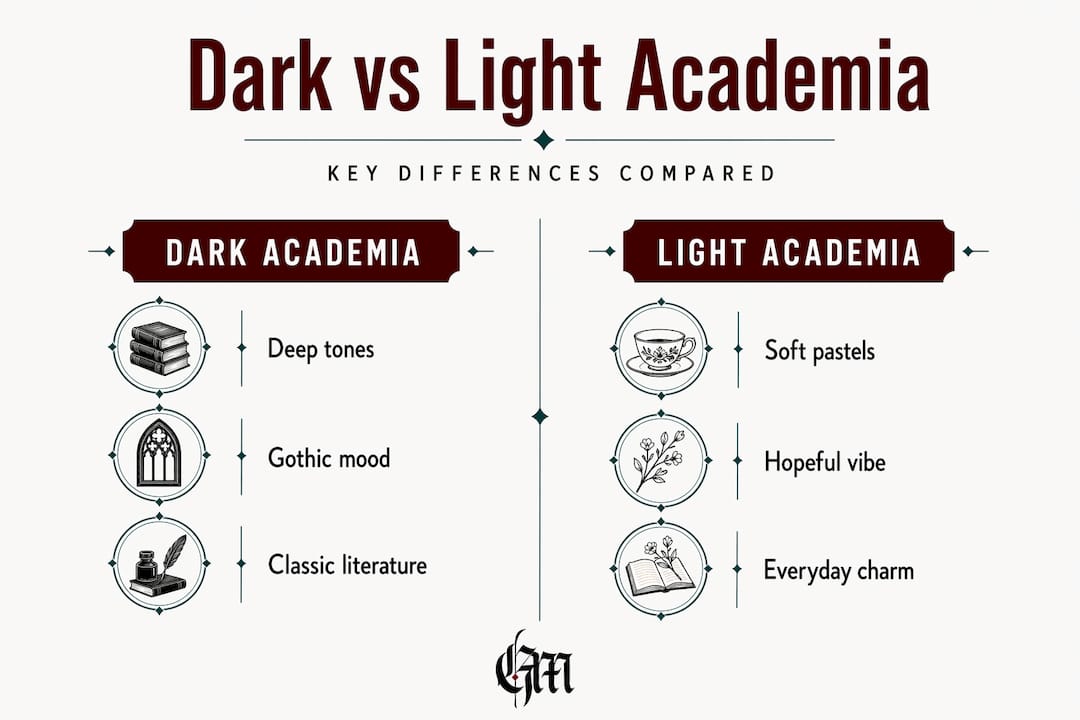
Dark academia overlaps with dark aesthetic culture more broadly, sharing an appreciation for old architecture, muted color palettes, and alternative expressions of beauty. But dark academia’s literary specificity sets it apart. The fashion is inseparable from the books, the art, and the philosophical questions underneath.
How to style dark academia authentically
Getting the dark academia fashion right is about intention, not acquisition. Here is how to approach it without losing the plot:
- Start with a capsule core. Build around two or three quality pieces: a good tweed blazer, one pair of high-waisted trousers, and a collared shirt. Versatile anchors matter more than a large wardrobe.
- Source vintage first. Thrift stores, estate sales, and consignment shops are where the real pieces live. Layering textures and prioritizing vintage items over fast fashion is what separates authentic styling from costume play.
- Layer deliberately. A cardigan over a collared shirt under a blazer, finished with a scarf, creates the kind of textured, considered silhouette the aesthetic demands. Each layer should add something visually.
- Choose accessories that mean something. Wire-frame glasses, a leather satchel, a meaningful ring, a well-worn watch. Check key accessories for dark styles that fit this sensibility without drifting into pure Gothic territory.
- Read the books. This sounds obvious and it is not meant to be prescriptive. But engaging with The Secret History, Romantic poetry, or Greek mythology adds depth to how you wear the aesthetic. The clothes and the ideas were always meant to go together.
Pro Tip: Avoid the trap of over-accessorizing with props. One annotated novel and a fountain pen is atmosphere. A desk covered in Latin textbooks you have never opened is performance. The difference reads clearly to anyone who knows the aesthetic well.
My honest take on dark academia’s appeal and its limits
I have watched dark academia cycle through internet trends twice now. Each time, the initial wave brings genuine curiosity, and then the commodification catches up and something real gets smoothed out. My experience is that the people who get the most from this aesthetic are the ones who let the fashion lead them toward the literature, not away from it.
The romanticization is real and worth examining. I find myself drawn to the visual grammar of old libraries and tweed and candlelight for reasons that are partly about beauty and partly about a longing for intellectual environments that feel weightier than a browser tab. That longing is not foolish. But dark academia simultaneously critiques and commodifies elite academic culture, and I think it’s worth sitting with that tension rather than resolving it too quickly.
What I find genuinely useful is treating dark academia as a starting point rather than a destination. If the aesthetic leads you to read Donna Tartt, to look up the history of Collegiate Gothic architecture, or to think about what intellectualism means in a culture that often devalues it, then the fashion has done something real. If it stops at the outfit, you have only touched the surface of something much more interesting.
Wear it thoughtfully. Let it make you curious. And define the aesthetic on your own terms rather than assembling someone else’s Pinterest board.
— Rey
Complete your dark academia look with Goth
If you are ready to build out your dark academia wardrobe with pieces that actually carry weight, Goth has you covered. The curated collections at Goth.Market prioritize the kind of thoughtful, distinctive styling that dark academia demands, with no mass-market shortcuts.

For jewelry that fits the scholarly and brooding sensibility of the aesthetic, the curated jewelry collection at Goth includes vintage-inspired rings, layered necklaces, and antique-finish pieces that complement tweed and leather without overwhelming them. If you want something with more whimsy and mystery woven in, the whimsygoth collection offers moody accessories that sit perfectly at the crossroads of dark academia and gothic. Goth connects independent creators with people who take their aesthetic seriously. That is exactly the kind of sourcing the dark academia community was built on.
FAQ
What is dark academia style in simple terms?
Dark academia style is a fashion and cultural aesthetic inspired by classic literature, Gothic architecture, and elite university life. It centers on earthy, moody tones, layered scholarly clothing, and a romanticized view of intellectual pursuit.
What books define dark academia culture?
The Secret History by Donna Tartt is the defining text, exploring elitism, moral complexity, and obsessive intellectualism among classics students. Romantic poetry, Greek mythology, and Gothic literature also form the aesthetic’s literary backbone.
How is dark academia different from light academia?
Dark academia uses deep, moody colors and engages with morally complex, shadowy themes rooted in crime and obsession. Light academia leans toward softer palettes and a gentler, more hopeful take on scholarly life without the darker narrative underpinning.
Can dark academia fashion be styled on a budget?
Yes. Thrift stores and vintage markets are actually the most authentic sources for dark academia pieces, since the aesthetic values worn textures and historical weight over newness. A tweed blazer from a consignment shop will always outperform a fast fashion replica.
What is the “dark” in dark academia really about?
The dark in dark academia refers to moral complexity, mystery, and themes like murder and elitism found in its source literature, not just a moody color palette. Social media portrayals often sanitize this, stripping the aesthetic of its real narrative weight.