

What Is Cybergoth Aesthetic? Style, Music, and Culture
TL;DR:
- Cybergoth is a subculture that blends gothic darkness, rave energy, cyberpunk futurism, and industrial music into a unified style. It features neon accents, synthetic hair, and tech-inspired accessories, emphasizing a collision of opposites. Today, the style evolves by mixing signature elements with everyday streetwear for practical, wearable fashion.
The cybergoth aesthetic is defined as a subculture that fuses gothic darkness, rave energy, cyberpunk futurism, and industrial aggression into a single visual and musical identity. It emerged in the late 1990s and reached peak visibility through the 2000s, built on neon synthetic hair, PVC clothing, platform boots, and aggressive electronic music. Unlike many alternative styles that borrow loosely from multiple sources, cybergoth commits fully to the collision of opposites: black and neon, organic and synthetic, decay and technology. If you are curious about what defines cybergoth and how to wear it, this guide covers everything from its roots to how to build a look today.
What is cybergoth aesthetic and where did it come from?
Cybergoth is the product of four distinct subcultures colliding in late 1990s underground scenes. Gothic darkness, rave rebellion, rivethead industrialism, and cyberpunk futurism all fed into its DNA, creating something that felt genuinely new rather than derivative. The result was a style and lifestyle built around warehouse raves, industrial clubs, and a shared fascination with a post-apocalyptic future.
The term “cybergoth” was first used by Games Workshop in a tabletop gaming context, but the aesthetic itself developed independently in music and fashion communities. Clubs in cities like London, Berlin, and Chicago became incubators for the look, where EBM and Electro-Industrial tracks set the tone for both the dancing and the dress code. The music was not background noise. It was the engine that drove every visual choice.
What makes cybergoth distinct from standard goth is its embrace of neon. Traditional gothic fashion stays within a dark palette. Cybergoth deliberately breaks that rule by layering UV-reactive colors over a black base, creating a look that reads as both threatening and electric under club lighting.
Key subcultural roots
- Goth: Dark romanticism, black clothing, and a fascination with mortality
- Rave culture: Neon colors, synthetic materials, and high-energy communal dancing
- Rivethead: Industrial music fandom, military surplus aesthetics, and anti-mainstream attitude
- Cyberpunk: Tech-inspired accessories, dystopian worldview, and DIY modification culture
How to dress cybergoth: fashion and visual elements
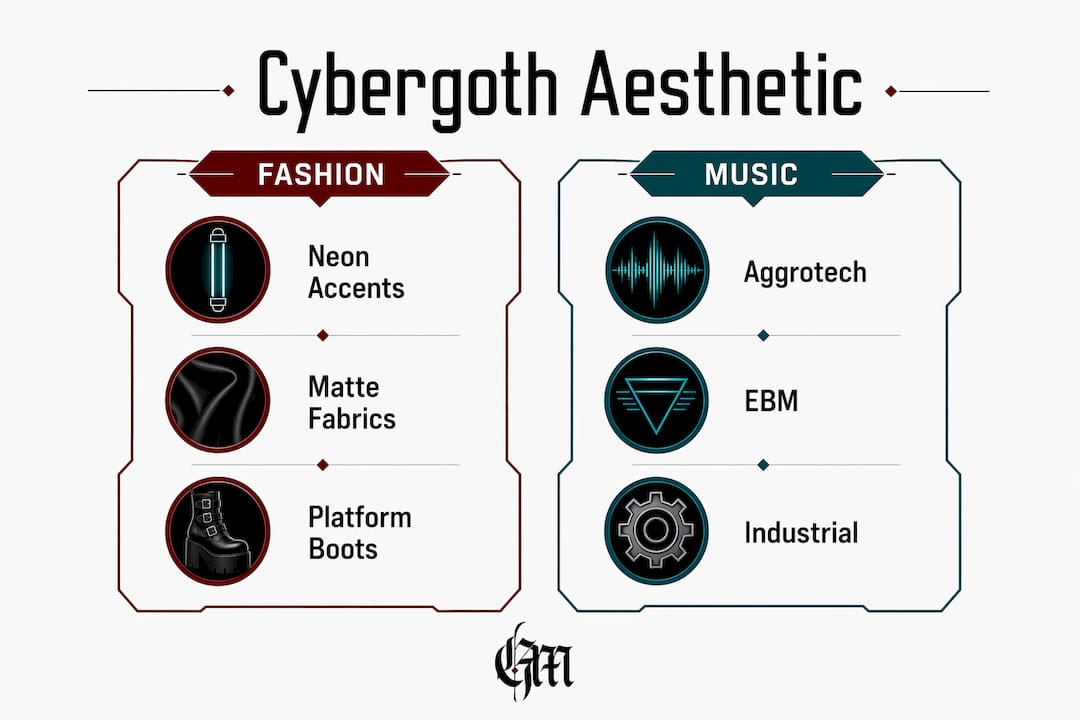
Cybergoth fashion is built on a black foundation with neon accents that glow under UV light. Neon synthetic dreadfalls, platform boots, PVC clothing, gas masks, and goggles are the core building blocks. Every element serves a purpose: the platforms add height and aggression, the gas mask signals dystopian survivalism, and the cyberlox create a silhouette that reads as unmistakably cybergoth from across a dark room.

The aesthetic intentionally clashes organic and synthetic, mixing matte black basics with high-visibility neon accents. That contrast is not accidental. It reflects the subculture’s core tension between darkness and technology, between the human body and the machine.
Essential cybergoth wardrobe pieces
- Synthetic dreadfalls (cyberlox): Neon-colored hair extensions in UV-reactive shades like electric blue, toxic green, and hot pink
- Platform boots: Typically 4 to 6 inches, often in black patent leather or PVC
- PVC and vinyl clothing: Corsets, pants, skirts, and jackets in glossy black or neon
- Gas masks and respirators: Worn as accessories, often modified with LED lights or painted details
- Goggles: Industrial-style eyewear, sometimes with colored lenses or LED strips
- LED and circuit-board accessories: Chokers, cuffs, and belts with tech-inspired motifs
Fabric choice matters more than most beginners realize. Matte black fabrics like fishnet, velvet, and matte PVC create the dark base. Glossy PVC, holographic vinyl, and UV-reactive mesh add the neon contrast. Mixing textures within a single outfit is standard practice, not a mistake.
Pro Tip: Lightweight foam or yarn dreadfalls are far more comfortable for long events and photoshoots than heavy synthetic alternatives. If you plan to wear cyberlox for more than two hours, foam or yarn versions prevent neck strain and stay in place better under movement.
Cybergoth fabric and finish comparison
| Fabric type | Finish | Best use |
|---|---|---|
| Matte PVC | Flat black | Base layers, pants, corsets |
| Glossy vinyl | High shine | Statement pieces, jackets |
| UV-reactive mesh | Neon glow | Layering, sleeves, inserts |
| Holographic fabric | Iridescent | Accents, skirts, panels |
| Fishnet | Textured matte | Underlayers, arm sleeves |
Cybergoth makeup ideas follow the same logic as the clothing. A heavy black base with sharp liner, UV-reactive eyeshadow in neon shades, and graphic face paint or circuit-board designs around the eyes are all standard. The goal is a face that looks inhuman under club lighting.
What music drives cybergoth culture?
Aggrotech, Electronic Body Music (EBM), and Electro-Industrial are the three genres that define cybergoth’s sonic identity. These are not gentle genres. Aggrotech layers distorted vocals over hard industrial beats. EBM drives repetitive, hypnotic rhythms designed for physical movement. Electro-Industrial combines both into something that feels simultaneously mechanical and emotional.
The music directly shapes the dance style. Cybergoth dancing, sometimes called industrial dancing, is high-energy and physically demanding. It involves sharp, angular movements, stomping, and rhythmic arm gestures that mirror the aggression of the music. The subculture’s music bonds the community through intense shared physical experience, which is why live events and club nights remain central to cybergoth culture even decades after its peak.
“Cybergoth is not a costume you put on. It is a frequency you tune into. The music tells your body what to do, and the clothes tell the room who you are.”
Key artists and acts associated with cybergoth music include Combichrist, Suicide Commando, Wumpscut, and Covenant. These acts built the soundtrack for warehouse raves and industrial club nights across Europe and North America through the 2000s.
Cybergoth culture has also moved into digital and virtual spaces, with virtual club events, glitchcore visual aesthetics, and online communities keeping the subculture active. That shift matters because it opened cybergoth to people who never had access to a physical industrial club scene. Platforms like Discord and Twitch now host cybergoth music nights, and TikTok has introduced the visual aesthetic to a new generation.
How has cybergoth style evolved for modern wear?
Modern cybergoth blends signature elements with everyday streetwear, making the aesthetic more wearable outside of club settings. Utility joggers, cargo pants, and oversized hoodies now appear alongside platform boots and cyberlox. The silhouette has softened without losing its identity.
This evolution is not a compromise. It is a natural adaptation. The 2000s version of cybergoth was built for warehouse raves and club nights. The 2026 version needs to function in a world where people also commute, work, and socialize in daylight. Mixing one or two signature cybergoth pieces with practical streetwear is now the dominant approach among people who wear the style regularly.
Here is a practical framework for building a modern cybergoth wardrobe:
- Start with a black base. Black utility joggers, a matte PVC corset, or a black oversized jacket give you a neutral foundation that works with any cybergoth accent piece.
- Add one statement piece. Platform boots, a pair of industrial goggles, or a set of neon cyberlox immediately signals the aesthetic without requiring a full costume.
- Layer with UV-reactive accents. Neon mesh sleeves, a UV-reactive choker, or a holographic belt panel add the neon contrast that defines the look.
- Incorporate tech-inspired accessories. LED cuffs, circuit-board pendants, and modified gas masks push the look into full cybergoth territory for events.
- Customize where possible. DIY modifications, hand-painted details, and self-assembled accessories are deeply valued in cybergoth culture. A store-bought item you modify is more authentic than a complete off-the-shelf outfit.
Pro Tip: Check alternative subculture trends for 2026 before building your wardrobe. The cybergoth aesthetic is shifting toward muted neons and utility-focused silhouettes this year, which means olive and charcoal tones are appearing alongside the classic black and electric blue palette.
The DIY ethic is not optional in cybergoth culture. It is a core value. Buying a complete look off a rack misses the point. The subculture rewards people who modify, build, and personalize their gear. That could mean painting circuit-board patterns onto a gas mask, sewing UV-reactive panels into a jacket, or assembling custom cyberlox from raw materials.
Key Takeaways
The cybergoth aesthetic is defined by the deliberate collision of gothic darkness and neon technology, expressed through fashion, music, and community built on industrial electronic genres.
| Point | Details |
|---|---|
| Core identity | Cybergoth fuses goth, rave, cyberpunk, and industrial influences into one visual and musical subculture. |
| Signature fashion | Platform boots, PVC clothing, neon cyberlox, goggles, and gas masks are the non-negotiable building blocks. |
| Music drives the look | Aggrotech, EBM, and Electro-Industrial shape both the dance style and the visual energy of the subculture. |
| Modern adaptation | Mixing cybergoth staples with streetwear like utility joggers makes the aesthetic practical for daily wear. |
| DIY is central | Personalizing and modifying pieces is a core cultural value, not just a style preference. |
Why cybergoth still hits differently than any other alternative aesthetic
I have spent years watching alternative subcultures cycle in and out of mainstream attention. Most of them soften when they get popular. Cybergoth does the opposite. The more people discover it, the more committed its core community becomes to pushing the visual language further.
What strikes me most about cybergoth is its honesty about duality. It does not pretend that darkness and light are opposites. It wears both at the same time, literally, with black fabric and neon hair under the same UV light. That is not a contradiction. It is a statement about how complex identity actually works.
The subculture also has one of the most physically demanding participation requirements of any alternative scene. Industrial dancing is not casual. It requires stamina, commitment, and a willingness to look intense in public. That barrier filters out passive observers and creates a community of people who are genuinely invested in the culture, not just the costume.
If you are building a dark wardrobe and considering cybergoth as part of it, start with the music. Listen to Combichrist or Suicide Commando before you buy a single piece of clothing. If the music moves you, the fashion will follow naturally. If it does not, you will end up with a costume rather than an identity.
— Rey
Where to find authentic cybergoth fashion and gear
Building a real cybergoth wardrobe means sourcing pieces that are built for the aesthetic, not mass-produced approximations.

Goth is a curated marketplace connecting independent creators with people who take alternative fashion seriously. The platform carries platform boots, synthetic hair, PVC clothing, industrial goggles, and tech-inspired accessories from vendors who understand the subculture. Every piece on Goth is selected for its authenticity to dark and alternative aesthetics, which means you are not sorting through generic Halloween costumes to find something real. Whether you are building your first cybergoth outfit or expanding an existing wardrobe, Goth gives you direct access to independent makers who specialize in exactly this style.
FAQ
What is the cybergoth aesthetic in simple terms?
Cybergoth is a subculture that combines gothic fashion, rave neon, cyberpunk technology, and industrial music into one visual and lifestyle identity. Its signature look pairs black PVC clothing with neon synthetic hair and tech-inspired accessories.
What music do cybergoths listen to?
Aggrotech, EBM, and Electro-Industrial are the primary genres. Artists like Combichrist, Suicide Commando, and Covenant are central to the cybergoth music scene.
How is cybergoth different from traditional goth?
Traditional goth stays within a dark, monochromatic palette. Cybergoth deliberately adds UV-reactive neon colors, synthetic materials, and tech-inspired accessories, creating a futuristic contrast that standard goth avoids.
What are the essential cybergoth fashion pieces?
Synthetic dreadfalls, platform boots, PVC clothing, gas masks, and goggles are the core items. LED accessories and UV-reactive fabrics complete the look.
Can you wear cybergoth style outside of club events?
Modern cybergoth mixes signature pieces like platform boots and cyberlox with streetwear staples like utility joggers, making the aesthetic practical for everyday wear beyond club settings.