

What Is Alternative Lifestyle? A Plain-Language Guide
TL;DR:
- Alternative lifestyles encompass any way of living that departs from mainstream cultural norms, spanning housing, work, relationships, and community practices. These choices are socially constructed and vary greatly depending on local standards, often involving structural changes rather than superficial aesthetics. Benefits include stronger social ties, environmental sustainability, and personal authenticity, while challenges involve social stigma and legal uncertainties requiring careful research and community engagement.
Most people picture a specific type when they hear “what is alternative lifestyle” — maybe a commune dweller, a goth, or someone living off the grid. But that mental image misses most of the picture. Alternative lifestyle is a broad, sociologically recognized term for any way of living that departs from the mainstream norms of a given culture. It covers everything from how you structure your home and work to how you form relationships, build community, and express your identity. This guide breaks down the real meaning, the major types, the genuine benefits, and how to thoughtfully explore one yourself.
Key Takeaways
| Point | Details |
|---|---|
| Definition is culturally relative | What counts as “alternative” depends on local norms, not a universal standard. |
| Many lifestyle domains can change | Housing, work, relationships, and community governance can all shift independently. |
| Real benefits exist beyond aesthetics | Alternative living often increases social cooperation, authenticity, and sustainability. |
| Stigma is a real obstacle | Social and family pressure are the most common challenges people face when changing their lifestyle. |
| Start with research and community | Visiting intentional communities or online groups before committing prevents idealization and regret. |
What is alternative lifestyle, exactly?
The phrase “alternative lifestyle” gets used casually but it has a specific meaning in both everyday and academic contexts. The Cambridge Dictionary defines it as a way of living that is unusual, especially when it deviates from typical home and job arrangements in modern society. That framing is useful because it grounds the concept in something concrete: what most people in a given society actually do.
In sociology, the term goes deeper. Alternative lifestyles are socially constructed and defined relative to what a culture considers normal. A polyamorous household is “alternative” in suburban Ohio but unremarkable in certain historical or cross-cultural contexts. This means the label itself says as much about the society doing the labeling as it does about the person being labeled.
“Alternative lifestyles are not inherently deviant or wrong. They are simply choices that fall outside the statistical and cultural center of a given society at a given time.” — paraphrased from HandWiki’s philosophical summary
The word “alternative” can also be used pejoratively, which is worth naming directly. When someone uses it to dismiss a way of living rather than simply describe it, that reflects cultural bias, not objective reality. Recognizing this distinction keeps your thinking clear.
Alternative culture, the broader umbrella, exists on the fringes of mainstream culture and provides the social context in which many lifestyle choices develop meaning. Subcultures — gothic, punk, pagan, and others — are nested within that umbrella. Understanding the cultural infrastructure helps explain why alternative lifestyles often come with distinct aesthetics, community structures, and value systems rather than existing in isolation.
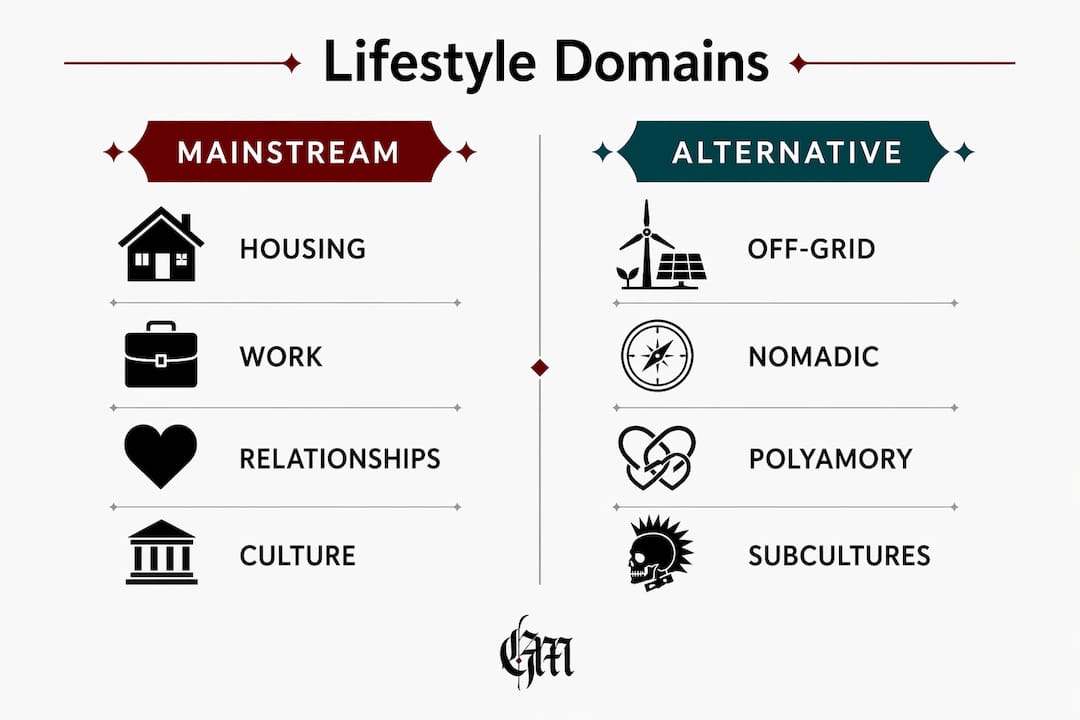
Types of alternative lifestyles across life domains
One of the most common mistakes is treating alternative lifestyle as a single category. Research advises organizing descriptions around the domains of life that change, because different people make different changes and the combinations are nearly infinite.
Housing and where you live
Off-grid living means generating your own power, collecting your own water, and often growing food. It ranges from a rural homestead with solar panels to a fully self-sufficient compound. Tiny house living prioritizes radically reduced square footage and lower costs. Intentional communities like Twin Oaks in Virginia share housing, meals, and resources under collective governance, with democratic decision-making and income-sharing built into daily life. These are structural changes, not just aesthetic ones.
Work and economics
Digital nomads maintain location-independent income and move between cities or countries, often with no fixed address. Freegans reject conventional employment and consumption as much as possible, sourcing food and goods from waste streams. Time-banking communities exchange services by the hour rather than money, creating parallel local economies.
Relationships and family structure
Polyamory involves maintaining multiple romantic relationships with the full knowledge and consent of everyone involved. Some intentional communities practice chosen family structures where emotional and financial interdependence is distributed across a group rather than a nuclear household.
Cultural and spiritual practices
This is where subcultures like gothic, pagan, and neo-tribal communities live. The change here is not always structural but it is deep. Identity, ritual, aesthetic, and worldview all shift.
Here is a comparison across those domains:
| Domain | Mainstream norm | Alternative example |
|---|---|---|
| Housing | Single-family home, mortgage | Intentional community, off-grid homestead |
| Work | 9-to-5 salaried employment | Digital nomad, time-banking, freegan |
| Relationships | Monogamous marriage | Polyamory, chosen family structure |
| Community | Neighborhood with individual households | Communal governance, income-sharing collective |
| Identity and culture | Mainstream fashion, religious majority | Gothic subculture, pagan practice, body modification |
A few things worth noting from this table. First, someone can be entirely mainstream in four domains and radically alternative in one. Second, common examples like off-grid living and nomadic work styles overlap with sustainability movements, meaning “alternative” and “progressive” frequently share ground.
Pro Tip: When researching specific alternative lifestyles, look for first-person accounts from people living them rather than outside commentary. You will get far more accurate information about daily life, finances, and social dynamics.
Benefits and challenges of alternative living
The benefits of alternative living are well documented in research on intentional communities and cooperative living. They include:
- Stronger social ties. Shared resources and collective decision-making create trust-based social structures that many mainstream neighborhoods simply lack.
- Greater authenticity. Living according to your actual values rather than inherited scripts reduces cognitive dissonance and stress over time.
- Environmental impact. Many alternative lifestyles, especially communal and off-grid ones, have significantly lower resource footprints per person than conventional Western households.
- Economic flexibility. Shared housing, shared tools, and community support reduce individual costs in ways that solo households cannot replicate.
The challenges are equally real and worth taking seriously:
- Social stigma. Family disapproval, workplace judgment, and general misunderstanding are the most consistently reported friction points, especially for people in visible subcultures or unconventional relationship structures.
- Legal gray areas. Communal land ownership, non-traditional family structures, and off-grid living can all run into zoning laws, property regulations, or custody complications.
- Economic sustainability. Some alternative economic models work beautifully at the community level but require significant upfront commitment or a transition period with reduced income.
- Idealization risk. People who romanticize alternative communities before joining often experience sharp disappointment. Every community has its own internal conflicts and imperfections.
Trust-based social structures within intentional communities are genuinely powerful, but they take time to build and can fracture under financial or interpersonal pressure. Going in with realistic expectations matters more than enthusiasm.
Pro Tip: Before making any major lifestyle change, spend time in the community or context you are considering. Visit, volunteer, or connect with people online who have been living that way for five or more years. The five-year perspective reveals what a honeymoon phase cannot.
How to adopt an alternative lifestyle thoughtfully
The phrase “how to adopt an alternative lifestyle” tends to produce romanticized content about quitting your job and moving to a farm. The reality is more methodical, and more interesting for it.
-
Clarify which domain you actually want to change. Most people feel a vague pull toward something different. Getting specific — is it your housing, your relationships, your work, your community, your identity expression? — prevents you from making sweeping changes in areas you did not need to change.
-
Research from the inside out. Read memoirs and forums written by people living the lifestyle, not lifestyle journalists covering it from the outside. Understanding community norms from an internal perspective prevents the outsider misinterpretation that is extremely common.
-
Visit before you commit. Most intentional communities welcome visitors and short-term volunteers. Organizations like the Fellowship for Intentional Community maintain directories. Visiting for a week gives you more real information than months of online research.
-
Build a financial runway. Any major lifestyle shift carries transition costs. Three to six months of personal expenses as savings is not excessive when you are leaving conventional employment or housing.
-
Prepare for social friction. Decide in advance how you will explain your choices to family or colleagues. Clear, non-defensive language works better than elaborate justifications. You do not owe anyone a defense, but having one ready reduces stress.
-
Start with community, not isolation. Connecting with others already living the way you want to live reduces both practical and emotional obstacles. Alternative subculture communities are a practical starting point for aesthetic and identity-based shifts.
Recognizing the multidimensionality of alternative lifestyles from the start prevents you from chasing a simplified version that does not match the reality you actually want.
My take: what most people get wrong
I have spent years observing how alternative lifestyles get discussed, dismissed, and misrepresented, and the same mistake comes up constantly. People treat “alternative” as a personality type rather than a structural description.
What I have learned is that someone living in Twin Oaks with democratic governance and income sharing has almost nothing in common with a digital nomad working from Bali, except that both deviate from mainstream norms. Lumping them together because they are “alternative” is the same intellectual error as grouping all mainstream people together because they have jobs and apartments.
The other thing I find consistently underappreciated is how much internal diversity exists within any given alternative community. Gothic subculture alone contains people with radically different politics, values, and living arrangements. The aesthetic can be shared; the lifestyle beneath it rarely is. That is why I think the most useful question is not “is this an alternative lifestyle?” but “which specific norms am I changing, and why?”
My honest advice: treat alternative fashion styles and aesthetics as doors, not destinations. They can introduce you to communities and value systems worth exploring. But the real work of building a life that fits you happens underneath the surface, in the structural choices about how you live, work, and relate.
— Rey
Express your alternative identity with Goth
If your interest in alternative lifestyles starts with self-expression and aesthetics, Goth.Market is built for exactly that. It is a curated marketplace connecting independent creators with people who want clothing, accessories, and decor that actually reflect who they are.
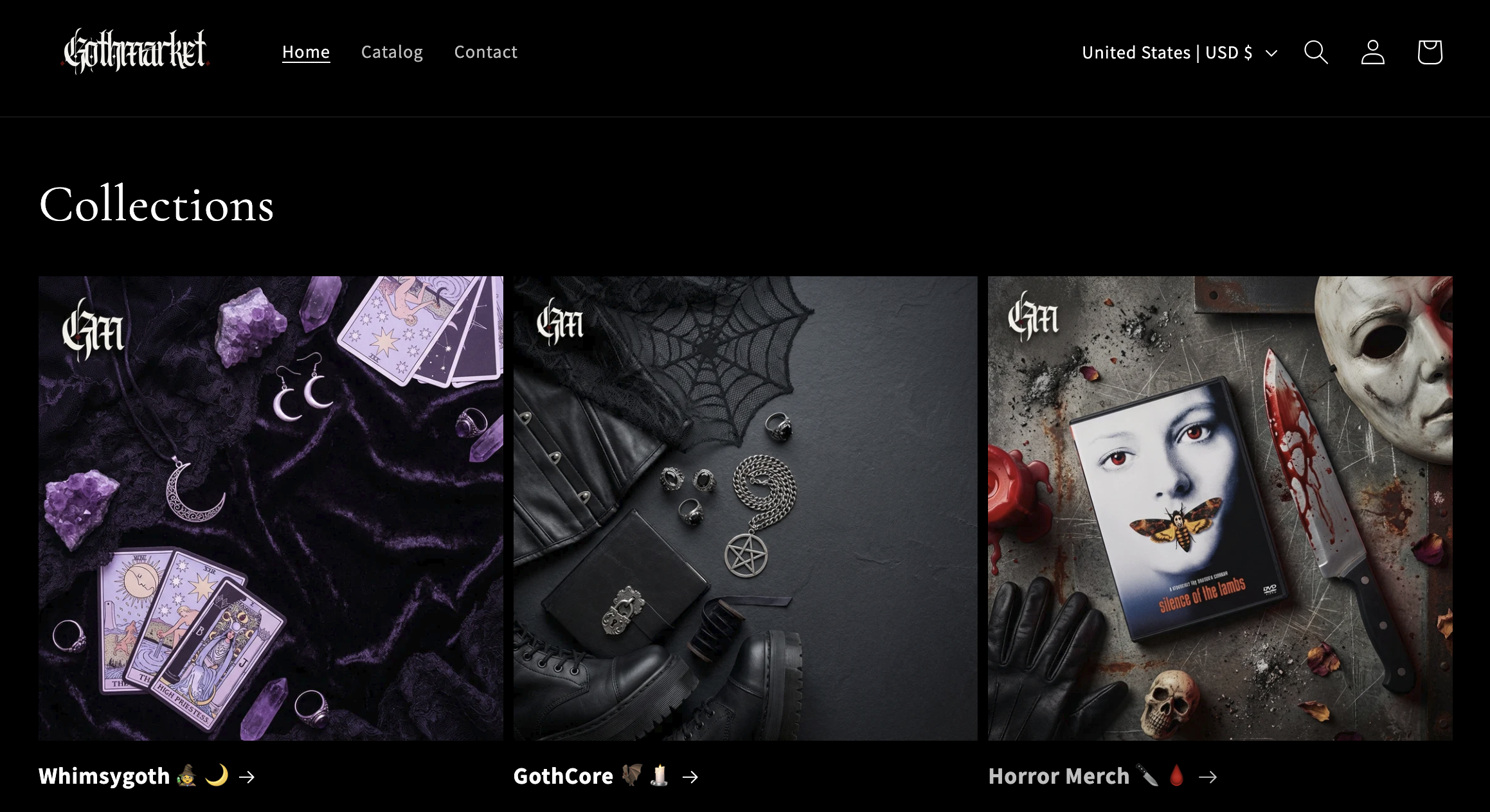
Whether you lean toward gothic, witchy, or whimsical dark aesthetics, the platform carries pieces that mainstream retail simply does not stock. The jewelry collection covers everything from occult sigil rings to celestial pendants, sourced from independent artists. For a softer dark aesthetic, the whimsygoth collection blends mystical and playful elements into a style that feels genuinely personal. Goth exists to support alternative identity expression with pieces that carry real meaning, not mass-market approximations.
FAQ
What defines an alternative lifestyle?
An alternative lifestyle is any way of living that departs from the mainstream norms of a given culture, including how a person structures housing, work, relationships, and community. The Cambridge Dictionary specifically frames it as living in ways that are unusual compared to typical home and job arrangements.
What are the most common types of alternative lifestyles?
Common types include intentional communities, off-grid living, polyamory, digital nomadism, and subculture-based identity practices like gothic or pagan living. These span multiple life domains including housing, work, relationships, and cultural expression.
Is an alternative lifestyle the same as a subculture?
Not exactly. A subculture is a group that shares aesthetic, musical, or cultural practices. An alternative lifestyle refers more broadly to structural changes in how someone lives. Subcultures often support and express alternative lifestyles, but the two concepts are not interchangeable.
What are the real benefits of alternative living?
Research on intentional communities shows benefits including stronger social cooperation, reduced environmental impact, greater authenticity, and lower individual living costs through shared resources. The tradeoffs include social stigma and the effort required to maintain trust-based community structures.
How do I start exploring an alternative lifestyle without making irreversible changes?
Start by identifying which specific life domain feels misaligned with your values, then connect with communities already living that way before making structural changes. Visiting intentional communities, joining online groups, or simply spending time in alternative subculture spaces gives you grounded information before any commitment.