

What Protection Amulets Mean and Why Cultures Still Wear Them
A protection amulet is an object worn or carried because someone believes it wards off harm, illness, or bad luck. Scholars call this function “apotropaic,” from the Greek for turning away evil, and it is the single trait every amulet shares across every culture that has ever made one. What that harm looks like changes by place and era: the evil eye in the Mediterranean, disease demons in Mesopotamia, dangerous river crossings in West Africa, or plain bad fortune in a modern city apartment.
Two objects show how wide that range gets. The hamsa, a palm-shaped charm with an eye at its center, protects against envy and misfortune across Jewish, Islamic, and Christian communities. The nazar, the blue-and-white glass eye bead sold in shops from Istanbul to Athens, does something similar but works through color and gaze rather than shape. Both are thousands of years old in concept, both are still made and worn today, and both illustrate the core idea this article unpacks: the history, the materials, the rituals that “activate” these objects, and how their meaning shifts depending on who’s wearing them.
A few things worth holding onto before diving in:
- Amulets are defensive by design, meant to block something bad rather than attract something good.
- Their power, in most traditions, comes from a mix of material, inscription, and belief, not the object alone.
- The same basic shapes (an eye, a hand, a knot, a horn) recur across unrelated cultures, which tells you something about how humans process fear of the unseen.
Key Takeaways
Protection amulets work as defensive, apotropaic objects whose meaning depends on culture, material, inscription, and the wearer’s own ritual conviction.
| Point | Details |
|---|---|
| Amulet defends, talisman attracts | Use “amulet” for protective pieces and “talisman” for objects meant to draw in luck or success. |
| History runs deep | Evidence of protective objects dates to the Upper Paleolithic, with evil-eye talismans specifically tracing back roughly 5,000 years. |
| Material and inscription matter | Traditional amulets pair specific materials, like lapis or blue glass, with spoken or written activation, unlike mass-produced reproductions. |
| Meaning shifts by faith | The same object, like a red string or protective bead, carries different theological weight in Judaism, Islam, Christianity, Hinduism, and Buddhism. |
| Shop with the symbol’s history in mind | Goth curates artisan-made hamsa, nazar, scarab, and pentagram jewelry with documented symbolic detail rather than generic mass-market pieces. |
Table of Contents
- What Is the Difference Between Amulet, Talisman, and Protection Charm Meaning?
- Where and When Did Protection Amulets Originate?
- What Are the Major Types of Protection Amulets Around the World?
- How Were Protection Amulets Made and Ritually Activated?
- Why Do People Believe Protection Amulets Actually Work?
- How Are Amulets Used in Different Religions and in Modern Life?
- What Should You Know Before Collecting or Buying Protection Amulets?
- Why the Goth Market Team Cares About Getting These Symbols Right
- What Are the Biggest Myths About Protection Amulets?
- How Have Protection Amulets Shaped Art, Literature, and Pop Culture?
- Why These Symbols Still Matter
- Where Can You Find Genuine Protection Jewelry With Real Symbolic Roots?
- Primary Sources and Further Reading
- Sources
- FAQ
What Is the Difference Between Amulet, Talisman, and Protection Charm Meaning?
An amulet defends. A talisman attracts. That distinction sounds simple, but it gets muddied constantly, including by people who sell these objects for a living.
The word “amulet” comes from the Latin amuletum, which the Roman naturalist Pliny the Elder used to describe an object that protects its bearer from trouble, according to Wikipedia’s overview of amulets. That protective, defensive function is the whole point. A hamsa hung by a doorway isn’t trying to bring you money or love. It’s trying to keep the evil eye out.
A talisman works the other direction. Where an amulet blocks, a talisman draws in: wealth, love, victory, favorable outcomes. Think of a lucky coin carried before a job interview, or a carved stone meant to sharpen a hunter’s aim. Both are physical objects invested with intention, but the intention points opposite ways.
“Charm” is the loose, catch-all term. In everyday English, people say “lucky charm” for objects that function as either amulets or talismans, and folklorists themselves don’t always draw a hard line. A four-leaf clover, technically, is closer to a talisman (attracting luck) than an amulet (blocking harm), but almost nobody makes that distinction out loud.
Here’s how the three terms tend to sort out in practice:
- Amulet — a scarab buried with an Egyptian mummy to protect the soul in the afterlife.
- Talisman — a ring inscribed with astrological symbols, worn to draw success in business.
- Charm — a rabbit’s foot on a keychain, doing a bit of both jobs depending on who you ask.
Pro Tip: When you’re shopping for symbolic jewelry, ask the seller what the piece is meant to do, not just what it’s called. “Protection piece” almost always means amulet logic; “abundance piece” almost always means talisman logic, and the material and inscription usually follow that intent.
Where and When Did Protection Amulets Originate?
Humans have been making protective objects for tens of thousands of years, long before anyone wrote down what those objects meant. The practice, per Wikipedia’s history of amulets, dates back to at least the Upper Paleolithic period, when carved bone, tooth, and shell pendants show patterns of wear consistent with being worn on the body rather than simply kept as tools. Archaeologists can’t interview a Paleolithic hunter about intent, but the consistency of certain shapes across sites suggests symbolic use rather than decoration alone.
The clearest, richest evidence comes from ancient Egypt. Egyptian amulets were made by the thousands, in dozens of standardized forms, for both the living and the dead. The scarab beetle amulet is the best known: modeled on the dung beetle, which Egyptians associated with the sun god Khepri rolling the sun across the sky, scarabs were worn by living people for protection and placed directly on or within mummy wrappings to protect the soul’s journey through the afterlife. According to the Art Institute of Chicago’s digital publication on ancient Egyptian art, these objects were frequently inscribed with spells or protective texts, which turned a simple carved stone into something closer to a sealed prayer.
Mesopotamia developed its own parallel tradition. Cylinder seals, clay figurines buried under doorway thresholds, and carved amulets depicting protective demons like Pazuzu were used to guard households against disease-bearing spirits, particularly around childbirth, a moment considered especially vulnerable to supernatural attack.
Greek and Roman cultures carried the practice forward under their own names. The Romans used the term fascinus, a phallic amulet believed to ward off the evil eye and bad luck, worn by children and hung in households and even on chariots. Pliny’s writing on amuletum dates from the first century CE, which gives us the actual etymological root of the modern English word.
A rough timeline helps put the scale of this history in perspective:
- Upper Paleolithic (roughly 40,000 to 10,000 years ago): earliest carved pendants showing signs of wearable, symbolic use.
- Ancient Egypt (from around 3000 BCE): standardized amulet forms including the scarab, the wedjat eye, and the djed pillar, used by the living and buried with the dead.
- Mesopotamia (third to first millennium BCE): protective demons, doorway figurines, and cylinder seals aimed at childbirth and household safety.
- Greece and Rome (first millennium BCE through Late Antiquity): fascinus, eye motifs, and Pliny’s written record of the word amuletum itself.
- Medieval Europe and the Islamic world: continuation and adaptation of older forms, often layered with new religious inscriptions.
What’s striking is not any single date but the fact that this practice never really stopped. Evil-eye talismans specifically date back roughly 5,000 years, which means the blue glass bead sold at a modern souvenir stand traces a nearly unbroken symbolic lineage back to the Bronze Age.
What Are the Major Types of Protection Amulets Around the World?
Once you start looking, a handful of shapes show up again and again across cultures that had little to no historical contact with each other. That repetition is part of what makes the subject genuinely interesting rather than just a catalog of trinkets.
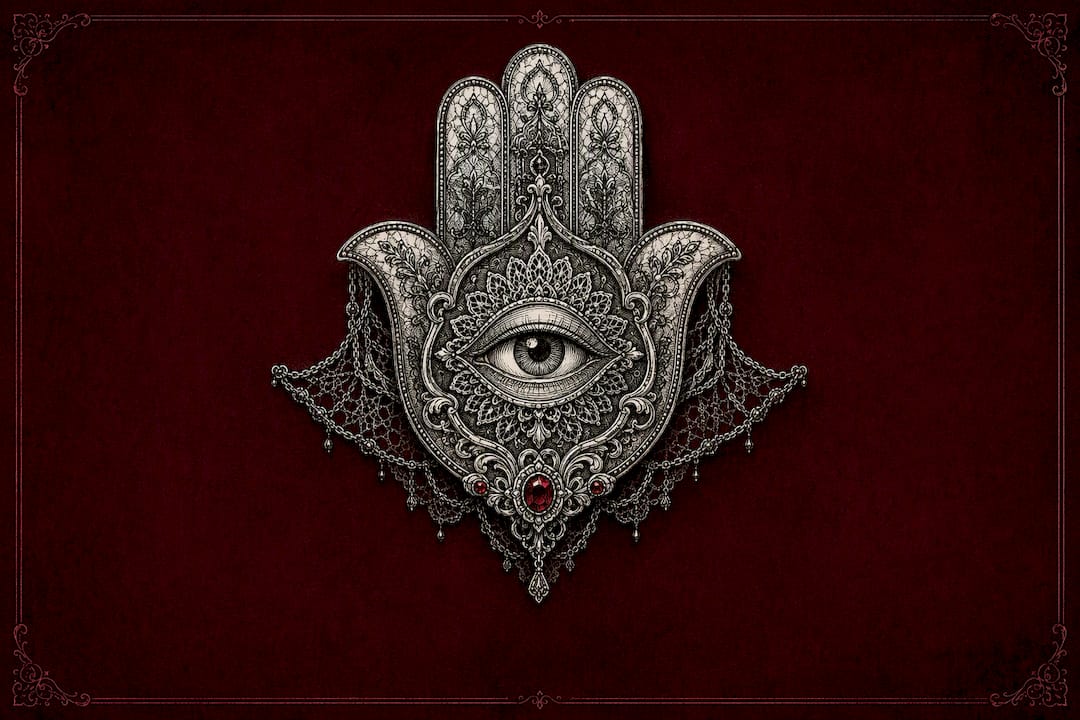
The hamsa is a palm-shaped amulet, usually shown with five fingers and an eye set in the center of the palm. It appears across Jewish, Islamic, and Christian communities in North Africa and the Middle East, each with its own name and slightly different emphasis: Hand of Fatima in Islamic tradition, Hand of Miriam in Jewish tradition. Cultural historians note that the hamsa functions as a genuine example of a symbol crossing faith lines while picking up distinct local meaning in each. Orientation matters too: worn with fingers pointing down, it’s often read as inviting blessings; pointing up, as a more direct block against harm.
Nazar, or evil-eye beads, are the blue, white, and black concentric-circle glass beads found from Turkey through Greece, the Levant, and Central Asia. The color scheme isn’t decorative accident. Blue is rare in nature and was historically associated with protective power, and glass bead production in the second millennium BCE helped standardize the form we recognize today.
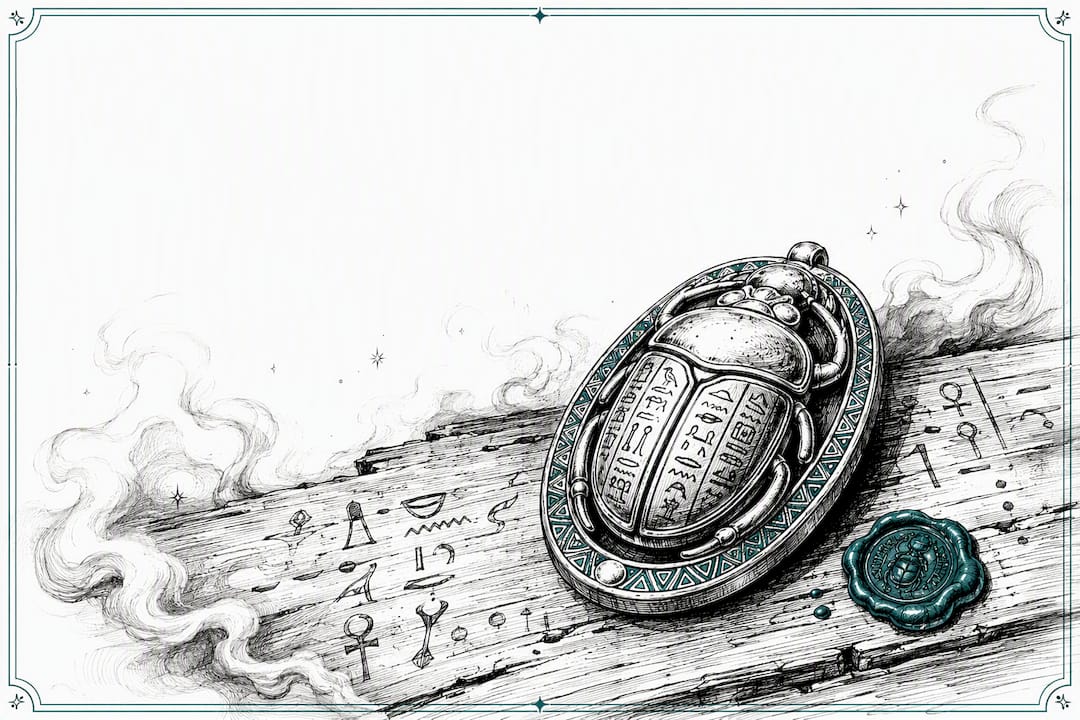
Scarabs carry ancient Egyptian meaning specifically tied to renewal, the sun’s daily cycle, and rebirth after death, which is why they show up constantly in funerary contexts.
Red string bracelets, tied around the left wrist in Kabbalistic practice, are meant to protect the wearer from the evil eye’s negative energy. Similar red-thread customs, unrelated in origin, show up in Chinese folk tradition and in various European practices of tying red thread on a newborn’s wrist or crib.
The cornicello, or cornetto, is the twisted red horn charm common in Southern Italy, worn to guard against the evil eye (malocchio) and, in some folk traditions, against impotence or bad fortune more broadly.
The pentagram, a five-pointed star, has also carried protective meaning historically, particularly in medieval European contexts where it was inscribed on doors and objects as a ward. That’s a separate thread worth understanding on its own terms: a pentagram becomes a pentacle specifically when the star is enclosed in a circle, and in modern occult practice, a pentacle often functions as a consecrated tool or amulet rather than just a symbol. Pentagram jewelry today, particularly a pentagram necklace, draws on that same protective and elemental symbolism, distinct from either the hamsa’s cross-faith history or the nazar’s Mediterranean roots.
How Were Protection Amulets Made and Ritually Activated?
The material of an amulet was rarely arbitrary. Traditional practice paired specific substances with specific protective jobs, and getting that pairing right mattered as much as the shape of the object.
- Lapis lazuli and other deep blue stones were prized in Egyptian amulets, tied to the heavens and to the goddess Isis.
- Metals like silver and gold carried associations with purity and permanence, and were often chosen for amulets meant to last a lifetime or be passed down.
- Glass, especially blue glass, became the standard for evil-eye beads once bead production scaled up in the ancient Mediterranean.
- Bone, shell, and carved stone dominated the earliest known amulets, long before metalworking existed.
- Written texts, folded small and sealed inside a case, form the basis of the tawiz tradition: Qur’anic verses or other sacred writing enclosed and worn on the body, where the words themselves, not just the container, carry the protective force.
Beyond material, activation mattered. Some amulets were crafted at astrologically favorable moments, timed to specific planetary alignments believed to charge the object with power. Others required spoken formulas recited by a specific maker, sometimes tied to a family or religious lineage that gave the amulet its legitimacy. Egyptian scarabs, per the Art Institute of Chicago’s collection notes, were frequently inscribed with protective spells rather than left as plain carved stone, which turned manufacture into something closer to a ritual act than a craft process.
This is also where the line between a consecrated amulet and a decorative reproduction gets drawn. A mass-produced glass pendant from a tourist shop and a hand-inscribed tawiz from a traditional maker can look similar from three feet away, but the tradition treats them as entirely different objects.
Pro Tip: If authenticity matters to you, look for signs of hand-inscription, sealed compartments, or documented artisan origin rather than uniform, machine-cut symmetry. A genuinely made piece rarely looks perfectly identical to a hundred others on the same shelf.
Why Do People Believe Protection Amulets Actually Work?
The evil eye concept gives the clearest window into how amulets function as a social mechanism, not just a private superstition. The belief holds that envious or malicious looks can cause real harm, illness, bad luck, even death, and it shows up independently across cultures with no shared origin: evil-eye beliefs date back roughly 5,000 years and appear from the Mediterranean through South Asia. That kind of independent, repeated invention across unconnected societies suggests the fear it responds to (being singled out, resented, watched) is a genuinely universal human experience, not a cultural quirk.
Psychologically, an amulet does something measurable even if its metaphysics aren’t. Wearing one is a ritual act, and ritual reliably reduces anxiety by giving people a sense of control over outcomes they otherwise can’t influence, similar to the confidence boost some people get from a pre-game routine. Scholars studying material culture describe this as the “efficacy of belief”: the protective function of an amulet often ties more to the wearer’s conviction and ritual practice than to any physical property of the object itself.
There’s also a social dimension. Cultural historians note that the evil eye and protective objects work to manage envy and interpersonal risk within a community, while also functioning, in modern contexts, as identity markers. Wearing a hamsa or a red Kabbalah string can signal:
- Cultural or religious belonging.
- Shared values with a community or family tradition.
- A personal aesthetic that draws on protective symbolism without full religious commitment.
None of that requires the object to have measurable supernatural power to be meaningful.
How Are Amulets Used in Different Religions and in Modern Life?
The three Abrahamic faiths take notably different official stances on amulets, even though practitioners within each have historically used them.
In Islam, the tawiz, a small case containing Qur’anic verses, is common in folk practice across South Asia and the Middle East, though some Islamic scholars debate whether relying on physical objects for protection conflicts with placing trust in God alone. In Christianity, biblical text is generally read as warning against occult objects and divination, yet items like the Saint Christopher medal or the crucifix function amulet-like for many Catholic and Orthodox believers, worn specifically for protection during travel or illness. In Judaism, the mezuzah affixed to a doorpost and the red Kabbalah string both carry protective function, rooted in different textual and mystical traditions. In Hinduism, protective threads (raksha sutra) tied around the wrist and amulets containing sacred ash or images of deities are common, especially for children. In Buddhism, particularly in Thailand and Myanmar, small amulets blessed by monks (phra khrueang) are worn or carried and can command significant respect and even monetary value.
Modern, largely secular use has spread well beyond any single religious framework. People wear amulets as fashion, hang them in cars and homes, gift them to newborns regardless of the family’s specific faith, and collect them as art or historical objects. That last category, spiritual practice without strict religious adherence, is probably the fastest-growing use case today.
A few practical notes on placement carry over from tradition into modern use:
- Doorways and entrances are the most common placement across cultures, since thresholds are traditionally seen as vulnerable points where harm enters.
- Worn on the body, close to the heart or on the wrist, for personal, continuous protection.
- Given to infants, tied to a crib or clothing, reflecting the widespread belief that children are especially vulnerable to the evil eye or misfortune.
- Carried while traveling, echoing the Roman use of fascinus on chariots and the modern use of Saint Christopher medals.
What Should You Know Before Collecting or Buying Protection Amulets?
Collectors and casual buyers face the same basic question: is this piece meaningful, or is it decoration wearing a meaningful shape? Provenance matters more than most buyers realize. A piece with documented origin, whether that’s a named artisan, a specific regional tradition, or verifiable age, holds different weight than something anonymous.
Material tells you a lot too. Museum pieces and traditionally made amulets tend to use natural materials, stone, bone, metal, glass, while mass-market reproductions lean heavily on plastic and uniform casting. According to Britannica’s overview of amulets, genuine traditional pieces typically carry inscriptions or ritual markings that mass-produced versions simply skip, since those details cost time and skill to replicate.
Buying ethically means being honest about the line between appreciation and appropriation, particularly for symbols tied to closed or living religious practices. Favor sellers who credit and compensate the artisans and cultural traditions behind a design; our own guide to occult jewelry symbols and meanings breaks down which motifs carry specific cultural weight.
For care: keep metal and stone pieces away from moisture and harsh chemicals, store fragile glass beads separately so they don’t chip against harder jewelry, and consider a dedicated jewelry safe for anything with real material or sentimental value.
Why the Goth Market Team Cares About Getting These Symbols Right
We source occult and gothic jewelry from independent makers, which means we see how often historic motifs get flattened into meaningless shapes by mass manufacturers. A hamsa stripped of its cross-faith history, a pentagram sold with no context on pentacle versus pentagram distinctions, a nazar bead with no mention of why blue glass mattered in the first place.
Our vendors tend to do the opposite: they lean into the material and symbolic detail rather than sanding it off. If you’re shopping with intention, look for listings that name the tradition a piece draws from, not just its shape.
What Are the Biggest Myths About Protection Amulets?
The most persistent myth is that an amulet’s power lives entirely in the object, independent of the wearer or maker. Most traditions actually treat the object as one part of a larger ritual system involving intention, timing, and sometimes a specific maker’s authority. A scarab without its inscribed spell, in ancient Egyptian practice, was a much weaker thing than one properly prepared.
A second common misconception: that amulets are inherently tied to one religion, usually whichever one a given culture is most familiar with. In reality, the same underlying logic (the hamsa, the evil eye, protective knots) recurs across faiths and even across societies with no historical contact, which argues against any single religious ownership of the concept.
Third, people often assume older automatically means more powerful. Age can indicate craftsmanship and provenance, both of which matter to collectors, but a modern piece made with proper material and intention isn’t inherently “less protective” in any tradition’s own internal logic than an ancient one.
Finally, there’s a flattening myth that all these objects mean the same thing: generic “good luck.” In fact, the amulet versus talisman distinction alone shows two entirely different functions, and within amulets specifically, the target of protection (illness, envy, dangerous travel, childbirth) varies enormously by culture and era.
How Have Protection Amulets Shaped Art, Literature, and Pop Culture?
Amulets show up constantly in storytelling because they’re a compact, visual way to signal stakes: whoever wears or loses the amulet is protected or exposed. Egyptian funerary art, full of scarabs and wedjat eyes painted directly onto sarcophagi and tomb walls, is arguably the earliest large-scale “genre” of amulet-focused visual art, meant to be read by the dead as much as the living.
Literature picked up the theme early and never let go. Folklore across the Mediterranean and Middle East is dense with evil-eye narratives, stories where a single envious glance causes illness or ruin, countered only by the right charm or ritual. That structure, an invisible threat defeated by a specific protective object, became a template modern fiction still leans on, from fantasy novels built around magical talismans to horror films where a cursed object inverts the whole concept.
Fashion and jewelry design have arguably done the most to keep these symbols visible day to day. The hamsa and nazar both moved from strictly religious or folk contexts into mainstream jewelry design over the past few decades, worn now by people with no direct tie to the original traditions, which is exactly the appropriation-versus-appreciation tension worth taking seriously when buying. Pentagram jewelry followed a related but separate path, shifting from a purely occult or Wiccan symbol into broader gothic and alternative fashion, where a pentagram necklace today often reads as much as aesthetic identity as ritual object.
Why These Symbols Still Matter
The evil eye belief predates recorded history by a comfortable margin, and it’s still stamped on glass beads sold at airport gift shops today. That continuity says something: the fear these objects respond to (envy, illness, the unknown) hasn’t gone anywhere, even in a world with antibiotics and security cameras.
What I find most underrated in this topic is how little the “does it actually work” debate matters to the objects’ cultural value. A scarab, a hamsa, a pentagram necklace, all of them carry centuries of craft, belief, and regional meaning whether or not you personally believe in apotropaic power. Treat that history with some respect when you buy or wear one. Learn what the symbol actually meant before it became a fashion accessory, and favor pieces made by people who understand that history rather than ones stripped of it entirely.
If you’re building out a collection, our guide to choosing occult jewelry that resonates is worth a read before you buy your next piece.
Where Can You Find Genuine Protection Jewelry With Real Symbolic Roots?
Most protection jewelry sold online comes from the same handful of overseas factories, stamped out in bulk with no attention to the tradition behind the shape. Goth takes a different route: every hamsa, evil-eye piece, or pentagram design in our marketplace comes from an independent artisan or small vendor who can tell you exactly what the symbol means and how it’s made, not a mass-production line with no story attached.
You can search our curated occult jewelry directly by symbol, hamsa, eye beads, scarab motifs, pentagram and pentacle designs, and see the maker’s own description of the piece’s material and meaning before you buy. If you want the deeper background on symbol meanings first, our breakdown of occult jewelry symbols and forms is a solid starting point, and our collecting guide covers care and provenance in more depth than we could fit here.
Ready to find a piece with real history behind it? Browse curated protection jewelry on Goth Market and filter by symbol to find the piece that matches what you’re actually looking to ward off.
Primary Sources and Further Reading
For readers who want to go deeper than this article, a few sources stand out. Wikipedia’s entry on amulets covers the etymology and archaeological range in detail. The Art Institute of Chicago’s digital publication on Egyptian amulets offers museum-level detail on scarabs and funerary practice. Wikipedia’s entry on the evil eye traces that belief’s spread across regions, and Britannica’s amulet entry gives a concise scholarly overview of material and religious framing.
Sources
- Amulet — Wikipedia
- Ancient Egyptian art: About amulets — Art Institute of Chicago digital publication
FAQ
What powers do protection amulets have?
Traditionally, amulets are believed to ward off specific harms, illness, envy, the evil eye, or dangerous travel, rather than grant general good fortune. Their perceived power comes from a combination of material, inscription, and the ritual conviction of the wearer, not a single universal mechanism.
What does the Bible say about wearing amulets?
Biblical text generally warns against occult objects and divination practices, though interpretations vary widely across Christian traditions. In practice, many Christians wear protective items like Saint Christopher medals or crosses in an amulet-like way, treating them as tokens of faith rather than magical objects.
What are some well-known examples of protection amulets?
The hamsa, the nazar (evil-eye bead), the Egyptian scarab, the red Kabbalah string, and the Italian cornicello are among the most recognized examples across cultures. Each targets a different form of harm, from envy and the evil eye to misfortune during the afterlife journey.
Where should I place or wear my amulet?
Doorways and entrances are the traditional placement, since thresholds are seen across cultures as vulnerable points. Wearing an amulet close to the body, on a necklace or bracelet, is the most common personal-protection approach, and infants are often given amulets tied to their crib or clothing.
What is the difference between a pentagram and a pentacle?
A pentagram is simply the five-pointed star; a pentacle is that same star enclosed in a circle, often used in modern occult practice as a consecrated protective tool rather than just a symbol. Pentagram jewelry, including a pentagram necklace, draws on both forms depending on the design.
Is an amulet the same thing as a talisman?
No. An amulet is defensive, meant to block harm like the evil eye or illness, while a talisman is meant to attract something desired, like wealth or success. The word “charm” is used loosely for both in everyday conversation, but the distinction matters in academic and specialist contexts.