

How to Start a Witchcraft Practice: A Beginner's Path
You can start a witchcraft practice tonight with three skills: grounding, a simple candle ritual, and a journal. No lineage, no expensive tools, and no prior experience required.
Here are three things you can do right now:
- Ground yourself: Sit with both feet flat on the floor, take five slow breaths, and name five things you can see, four you can touch, three you can hear. That is a complete grounding practice.
- Do a 5-minute ritual: Light one candle, write one clear intention in a notebook, sit with it for five minutes, then close by blowing out the flame and saying “it is done.” A candle and a notebook are sufficient for foundational ritual work.
- Choose one learning resource: Pick a single book or reputable site and stay with it for at least two weeks before adding more. The Salem Witch Museum is a reliable starting point for historical context in the U.S.
Ethical grounding matters from day one. The Threefold Law, a widely referenced principle in Wiccan-influenced practice, holds that what you send out returns to you threefold. Whether you adopt it literally or treat it as a metaphor for accountability, it is a useful early compass. Goth.Market is one curated source for starter supplies when you are ready to buy, but the practice itself costs almost nothing to begin.
Key Takeaways
Starting a witchcraft practice requires three things above all: a daily grounding habit, a journal, and the discipline to practice before you shop.
| Point | Details |
|---|---|
| Practice beats gear | A candle and a notebook cover most beginner rituals; buy tools only after 30 days of practice. |
| Ground before every session | The 5–4–3–2–1 sensory exercise stabilizes attention and makes all other work safer and clearer. |
| Journal everything | Your Book of Shadows is the single most important tool; thirty entries reveal patterns no book can teach you. |
| Ethics from day one | Consent, harm-avoidance, and cultural sensitivity are foundational, not advanced topics. |
| Goth.Market for vetted supplies | When you are ready to buy, Goth.Market connects you with independent makers who are transparent about materials and sourcing. |
Table of Contents
- What is witchcraft, and what does a personal practice actually look like?
- What are the main types of witchcraft a beginner can explore?
- What are the core daily practices you should start with?
- What tools and altar items do you actually need to start?
- How do you cast a simple beginner spell or ritual?
- What ethical and safety issues should beginners watch for?
- How long does it take to build a practice, and what does it cost?
- Where can you learn more and find a trustworthy community?
- How do you choose supplies mindfully and avoid the collecting trap?
- What the “practice first” approach actually means in practice
- Where to find curated starter supplies for your practice
- Sources
- FAQ
What is witchcraft, and what does a personal practice actually look like?
Witchcraft is an intentional practice of working with natural energy, symbolism, and ritual to create change. That definition is deliberately broad, because the practice is. It is not a religion by default (though it can be), not a personality type, and not a social-media aesthetic. At its core, it is a set of skills you develop through repetition: awareness, intention, and the ability to work with symbolic action.
A personal practice looks like a daily habit more than a dramatic event. It might be five minutes of grounding in the morning, a short journaling entry after a ritual, or a weekly candle working tied to the lunar cycle. The foundations of a safe practice are grounding, cleansing, protection, a simple working, and recording results. That sequence is repeatable and builds real skill over weeks.
Pro Tip: The social-media version of witchcraft, all crystals and perfectly arranged altars, is décor, not practice. A witchcraft decor guide can help you tell the difference between what looks good and what actually does something. The tools are props; the practice is the point.
Common myths worth clearing up early:
- Witchcraft does not require initiation, a coven, or a specific lineage.
- You do not need to identify as Wiccan to practice witchcraft.
- Expensive tools do not make rituals more effective; clarity of intention does.
- Witchcraft is not the same as Satanism, and it is not inherently dangerous.
What are the main types of witchcraft a beginner can explore?
There is no single correct path. Most beginners land somewhere eclectic before narrowing down, and that is completely legitimate. Here is a quick map of the most common approaches.
Solitary eclectic practice is where most beginners start. You draw from multiple traditions, work alone, and build a practice around what resonates. No teacher required, no lineage, no dues. The risk is information overload; the fix is picking one source at a time.

Wicca is a structured, initiatory religion developed in mid-20th century Britain and popularized by Gerald Gardner and Doreen Valiente. It has a defined theology (the God and Goddess), a liturgical calendar (the Wheel of the Year), and ethical guidelines including the Wiccan Rede (“harm none”). Many beginner books default to Wicca, so you will encounter it whether you choose it or not.
Kitchen magic and green witchery center on herbs, food, and the home as sacred space. If you already cook intentionally or garden, this path often feels the most natural. Correspondences (rosemary for clarity, lavender for calm) are the primary symbolic language.
Folk and herbal traditions are rooted in specific cultural or regional practices: Appalachian folk magic, Hoodoo, Brujería, Strega, and others. These traditions carry cultural weight and often specific lineage. Approach them with respect, research their origins, and be honest about whether you have a connection to the culture in question.
Hedge witchery and ancestral practice focus on liminal states, dreamwork, and communication with ancestors or spirits. This path tends to attract people drawn to mediumship, trance, or working with the dead.
Secular or non-religious magical practice strips out deity and religion entirely, treating magic as a psychological or symbolic technology. If you are skeptical of metaphysical claims but curious about ritual’s effect on the mind, this is a coherent starting point.
Pro Tip: Trial a tradition for two to four weeks before deciding it is yours. Read one primary text, try one practice from it daily, and journal what you notice. You are not committing to a path; you are gathering data.
Overlap between these categories is the norm, not the exception. A practitioner might follow the Wheel of the Year (Wiccan-influenced), work with kitchen herbs (green witch), and honor their ancestors (hedge/folk). Mixed practice is not diluted practice.
What are the core daily practices you should start with?
The most reliable beginner sequence is grounding, cleansing, protection, one simple working, and journaling. Do that in order, five to fifteen minutes a day, and you will have a real practice within a month.
Grounding exercise: step by step
| Step | Action | Sensory cue |
|---|---|---|
| 1 | Sit with feet flat on the floor | Feel the weight of your body settle |
| 2 | Take five slow breaths, counting each exhale | Notice your chest and shoulders drop |
| 3 | Name 5 things you can see | Eyes open or closed |
| 4 | Name 4 things you can physically feel | Floor, chair, air temperature |
| 5 | Name 3 things you can hear | Near, then far |
| 6 | Set a brief intention for the session | One sentence, spoken aloud or written |
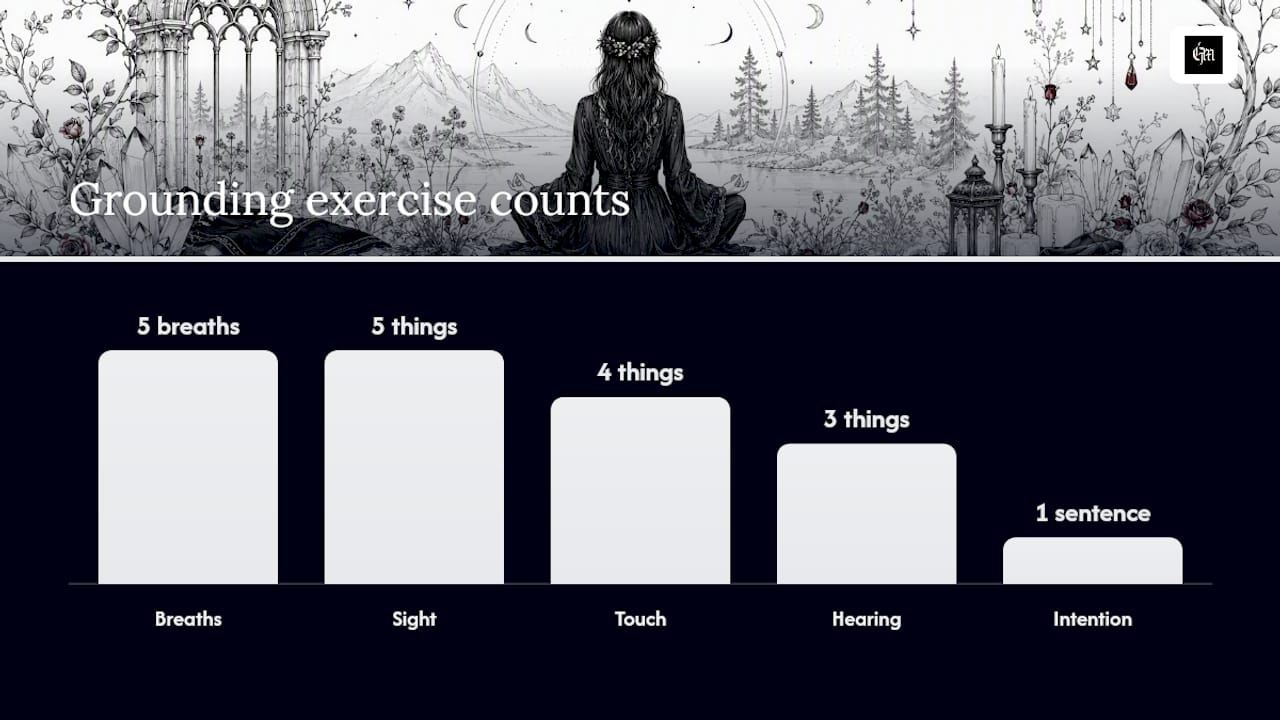
This 5–4–3–2–1 sensory check stabilizes attention and is the same technique recommended in trauma-informed care for nervous system regulation. It works whether you frame it spiritually or not.
A starter routine over a week with daily short sessions
A structured daily practice builds grounding, intention, and simple ritual skill faster than sporadic longer sessions. Here is a first week:
- Day 1: Grounding exercise only. Journal how it felt.
- Day 2: Grounding + one cleansing action (open a window, light a candle, or ring a bell).
- Day 3: Grounding + write one clear intention in your journal.
- Day 4: Grounding + a five-minute candle ritual using yesterday’s intention.
- Day 5: Grounding + read one chapter of a beginner text.
- Day 6: Grounding + spend ten minutes in nature with no phone.
- Day 7: Review your journal entries. Note what felt right and what felt forced.
Book of Shadows: what to record after each session
Your Book of Shadows is a practice journal, not a decorative object. After every working, write:
- Date and moon phase (even approximate)
- What you did (ritual, spell, meditation, study)
- Your emotional state before and after
- Any symbols, images, or words that came up
- Outcome notes (revisit in one to two weeks)
- What you would change next time
Beginner resources consistently identify journaling as the single most important tool for tracking results and building skill. The pattern you see across thirty entries will tell you more about your practice than any book.
What tools and altar items do you actually need to start?
Very little. A candle and a notebook cover most beginner rituals. Everything else is optional until you know it serves your specific practice.
Essentials
- A journal or notebook (your Book of Shadows)
- One candle (any color, any size)
- Salt (table salt works; it is used for cleansing and boundary-setting)
- A small bowl of water (for cleansing and elemental representation)
- A quiet place where you will not be interrupted for ten minutes
That is the full starter kit. Total cost: under $5 if you already have a notebook and a candle.
Optional additions (add when you know why)
- Crystals (start with one; clear quartz is versatile)
- Incense or a bell (for cleansing and opening/closing rituals)
- An athame or wand (ceremonial tools; not needed for beginner work)
- Tarot or oracle cards (useful for reflection, not required)
- Altar cloth, statuary, or deity images (meaningful, not functional)
Pro Tip: Before buying any tool, ask: “What will I actually do with this?” If the answer is “display it,” that is décor, not practice. Check the mindful buyer’s guide before adding anything to your cart.
Setting a starter altar in a small or shared space
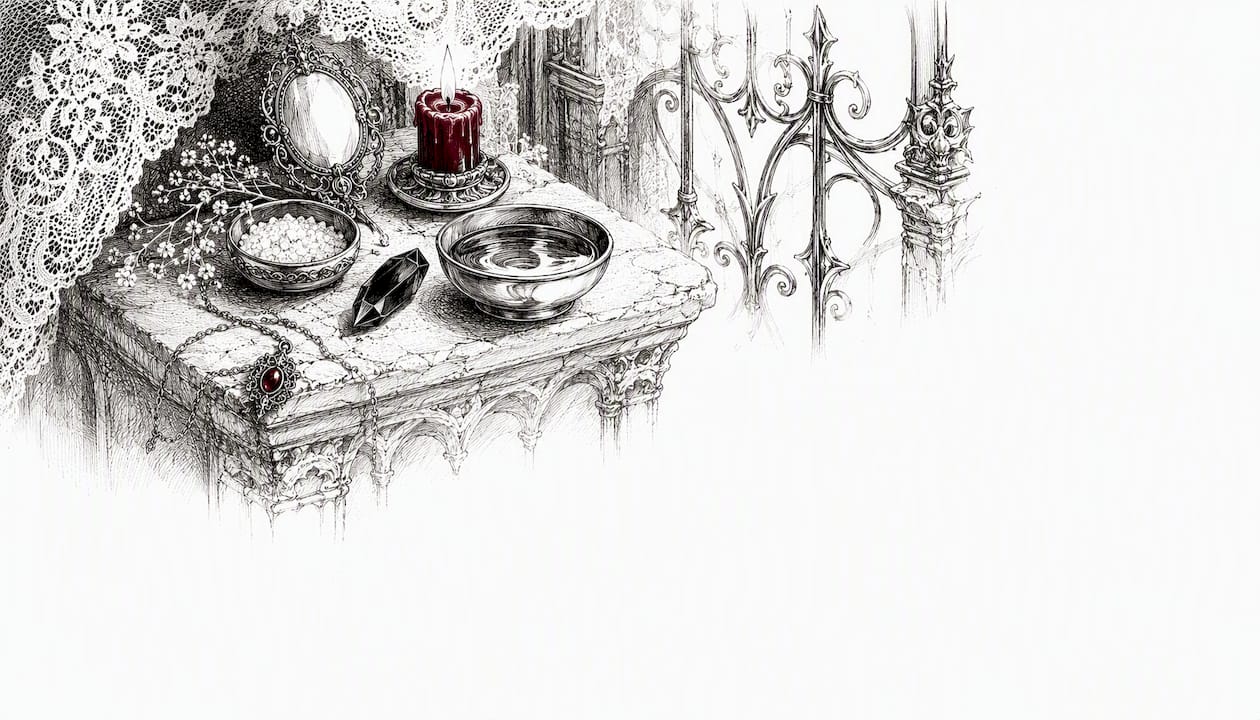
An altar does not need to be permanent or visible to others. A windowsill, a corner of a desk, or a wooden tray you slide under your bed all work. The key elements are the four classical directions or elements (earth/salt, water/bowl, fire/candle, air/incense or open window) plus one personal object that anchors the space to you. For a portable altar setup in a shared living situation, a small box or tin that holds your candle, salt, and journal is completely sufficient.
Ethical sourcing matters here. Avoid white sage bundles from mass retailers (it is a plant sacred to specific Indigenous nations and frequently harvested unsustainably). Use locally grown herbs, garden rosemary, or cedar instead. Skip items made from protected animal parts. Prioritize handmade and handcrafted occult items from independent makers when you do buy.
How do you cast a simple beginner spell or ritual?
A spell is a structured ritual with a clear intention. The structure matters more than the words. Historical magical texts, including the Greek Magical Papyri, show that effective ritual has long followed a consistent pattern: invocation, petition, and closing. Modern beginners can use the same skeleton.
A first-night candle ritual: step by step
- Ground yourself using the 5–4–3–2–1 exercise above.
- Cleanse the space by opening a window, ringing a bell, or lighting incense.
- State your intention aloud. One sentence, present tense, specific. Example: “I call clarity into my decision about [X].”
- Light the candle. Hold your hands near the flame (safely) and visualize the intention as already real.
- Sit quietly for five minutes. Notice what comes up. Do not force it.
- Write in your journal while the candle is still burning: what you felt, what you saw in your mind, any words or images.
- Close the working. Say “it is done” or “so mote it be” or any phrase that signals completion to you. Blow out or snuff the candle.
- Record the date and moon phase in your journal.
Spell template
- Intention statement: One sentence, present tense, specific, and harm-free.
- Symbolic action: Lighting a candle, tying a knot, burying an object, writing and burning a word.
- Duration: Most beginner spells are single sessions. Note a follow-up date (one to two weeks) to check outcomes.
- Closing phrase: Spoken aloud. Signals to your mind that the working is complete.
Safety checklist before you begin
- Physical safety: Never leave a burning candle unattended. Keep fabric away from the flame. Have water nearby.
- Psychological safety: Do not perform ritual when you are in acute emotional crisis. Ground first, always.
- Consent: Do not cast spells intended to influence another person’s will without their knowledge. This applies to love spells, binding spells, and “luck” spells directed at others.
- Outcomes: Magic is not a substitute for action. A clarity spell works best alongside journaling and real-world decision-making.
What ethical and safety issues should beginners watch for?
Ethics in witchcraft are not optional extras. They are the foundation of a practice that does not harm you or others.
Core ethical checklist
- Consent first: Do not cast spells targeting another person without their explicit agreement. This includes love spells, binding spells, and healing spells directed at someone else.
- Harm avoidance: The Wiccan Rede (“harm none”) and the Threefold Law are the most widely cited ethical heuristics in beginner materials. You do not have to adopt them literally, but the underlying principle, that coercive or manipulative magic tends to backfire, is worth taking seriously.
- Cultural appropriation: Research the origin of any practice before adopting it. Smudging with white sage, working with Santería orishas, or using Hoodoo rootwork without cultural connection or study is appropriation. Use herbs from your own region. Study traditions from the outside before borrowing from them.
- Harm-free sourcing: Do not use animal parts from protected species. Avoid items with unclear provenance.
- No illegal activity: Witchcraft does not exempt you from U.S. law. Do not use ritual to justify or facilitate illegal acts.
Legal and medical caution
Witchcraft is not a substitute for medical or mental health care. If you are experiencing a mental health crisis, contact the 988 Suicide and Crisis Lifeline (call or text 988 in the U.S.). If you have a medical condition, consult a licensed physician. Herbal preparations used in ritual are not regulated as medicine by the FDA and should not replace prescribed treatment.
Pro Tip: If a ritual or meditation session surfaces strong trauma reactions, flashbacks, or dissociation, stop the session and ground yourself immediately. If those reactions persist, speak with a licensed therapist before continuing. Some practitioners find that trance or intense visualization work can activate trauma responses, especially early in practice. There is no shame in pacing yourself.
Simple protection practices are more useful for beginners than elaborate shielding rituals. A bell, a short spoken boundary (“only what serves my highest good enters this space”), or a brief visualization of light around your body is sufficient for most beginner work. Overly elaborate protection rituals can create a mindset of fear rather than clarity.
How long does it take to build a practice, and what does it cost?
Timeline milestones
- Days 1–7: You learn the grounding exercise, complete your first ritual, and start your journal. The practice feels unfamiliar but manageable.
- Weeks 2–4: Daily practice becomes habit. You notice patterns in your journal. You have tried at least one cleansing and one intention-setting working.
- Weeks 4–8: You have enough journal entries to see what works for you. You may start exploring a specific tradition or deepening one technique.
- Months 3–6: Your practice has a recognizable shape. You know your preferred tools, your best ritual time of day, and at least one area you want to study further.
- Months 6–12: You have completed a seasonal cycle, observed at least a few lunar phases intentionally, and developed a personal ethical framework. This is a real, functioning practice.
A 30-day structured plan of five to fifteen minutes per day can reliably build the foundational skills of grounding, intention, and simple ritual within the first month.
Starter budget
Pro Tip: Spend your first $20 on a good journal and one reliable book. Consumables (candles, herbs, salt) are more useful than decorative objects. You will know what tools you actually need after thirty days of practice; buying before then is mostly guesswork.
Where can you learn more and find a trustworthy community?
Starter book list
- “Wicca: A Guide for the Solitary Practitioner” by Scott Cunningham — The most widely recommended entry point for Wiccan-influenced practice. Clear, non-dogmatic, and practical.
- “The Spiral Dance” by Starhawk — A foundational feminist witchcraft text with strong ritual structure and community ethics.
- “Witchcraft Today” by Gerald Gardner — The historical source text for modern Wicca; useful for understanding where the tradition came from.
- “The Witch’s Book of Self-Care” by Arin Murphy-Hiscock — Accessible and grounded in daily practice rather than elaborate ritual.
- “Braiding Sweetgrass” by Robin Wall Kimmerer — Not a witchcraft book, but essential reading for anyone working with plant magic and land-based practice; teaches reciprocity and ethical relationship with the natural world.
Museum and institutional resources
The Salem Witch Museum in Salem, Massachusetts, offers interpretive history of the 1692 trials and the broader cultural history of witchcraft in America. Their recommended reading list is a reliable starting point for historical context. The Peabody Essex Museum, also in Salem, holds significant collections of material culture related to folk magic and the occult.
Vetting teachers and local groups
Online communities (Reddit’s r/witchcraft, local Facebook groups, Discord servers) are common first stops but require scrutiny. Prefer groups and teachers that:
- Are transparent about their curriculum and background
- Do not pressure members to buy specific products or pay high fees
- Welcome questions and disagreement
- Have verifiable references or a public track record
- Do not claim exclusive access to “true” witchcraft or secret lineages
Walk away from any teacher who demands secrecy before you have agreed to anything, charges large upfront fees for “initiation,” or discourages you from seeking outside perspectives.
How do you choose supplies mindfully and avoid the collecting trap?
The biggest mistake beginners make is buying before they know what they need. Social media accelerates this: an algorithm that shows you beautiful altar setups will make you feel like you need all of it. You do not.
Curation checklist before any purchase
- Do I know what I will use this for? If the answer is vague, wait.
- Do I know who made it and how? Prefer makers who are transparent about materials and sourcing.
- Is this material ethically sourced? Check for protected species, unsustainable harvesting, or cultural appropriation concerns.
- Does this replace something I already have? A kitchen herb is often as effective as a specialty product.
DIY alternatives that work just as well
- Rosemary from your grocery store replaces most cleansing herb bundles.
- A glass of tap water serves as a ritual water bowl.
- A piece of paper and a pen replace specialty spell papers.
- A kitchen knife (kept separate from cooking use) can serve as a ritual blade.
- Homemade candles or birthday candles work for short rituals.
For readers who want to go deeper on the craft side, the step-by-step witchy accessories guide covers how to make your own ritual items from basic materials.
Pro Tip: Keep a “purchases and results” section in your journal. Note what you bought, why, and whether it actually changed your practice. After three months, you will have a clear picture of what earns its place on your altar and what was just pretty. That record is more useful than any shopping guide. For vetted, independently made supplies when you are ready to buy, the best witchcraft supplies guide at Goth covers ethical sourcing and what to look for.
What the “practice first” approach actually means in practice
The most common mistake I see beginners make is treating witchcraft as a collection rather than a discipline. Someone spends two months curating an altar, buys every crystal recommended on TikTok, and then wonders why nothing feels meaningful. The altar looks right. The practice never started.
What actually works is embarrassingly simple: pick one thing and do it every day for thirty days. Not thirty different things. One. A grounding exercise, a morning candle lighting, a nightly journal entry. The repetition is where the skill lives. After thirty days, you will know more about your own practice than any book can tell you, because you will have thirty data points from your own experience.
The journal is the real tool. Not the athame, not the crystal grid, not the hand-poured candle. The journal is where you notice that your rituals work better on Tuesday evenings, that rosemary makes you feel more focused than lavender, that your intentions land cleaner when you write them by hand. That knowledge is yours. No one can sell it to you.
Start small. Stay consistent. Trust the data you collect over the opinions you read online.
Where to find curated starter supplies for your practice
When you know what you need, sourcing matters. Goth.Market is a curated marketplace built around independent makers and artisans working in the witchcraft, occult, and alternative space. Unlike mass-market retailers, the vendors here are vetted for craft quality and material transparency, which means you are less likely to end up with a white sage bundle harvested irresponsibly or a crystal of unknown origin.

For beginners, the most useful categories on Goth.Market are:
- Ritual candles: Hand-poured, often herb-infused, from independent chandlers who list their materials.
- Journals and Book of Shadows notebooks: Designed for practice use, not just display.
- Starter herb kits: Curated bundles of ethically sourced herbs for cleansing and kitchen magic.
- Ritual bowls and small altar tools: Handmade ceramics and metalwork that carry maker provenance.
Practice comes first. The shop is for when you have done thirty days of journaling and know exactly what you want to add. When that moment arrives, Goth for handmade, independently sourced starter items that match your actual practice.
Sources
- Witchcraft Explained: Foundations of Magic (Beginner Guide)
- Complete 30-Day Beginner Witch Practice - START HERE – Panaprium
- Beginner Witchcraft: The Complete Guide to Starting Your Practice in 2026
- Salem Witch Museum
FAQ
What does a beginner witch actually need to start?
A journal, one candle, salt, and a bowl of water cover everything a beginner needs for foundational ritual work. Intention and consistency matter far more than tools. Most experienced practitioners recommend starting with these basics and adding items only after you know what your practice specifically calls for.
What do you need to start a ritual?
A clear intention, a grounded state of mind, and one symbolic action (lighting a candle, writing a word, tying a knot) are enough for a complete beginner ritual. The structure that has worked across centuries, as seen in sources like the Greek Magical Papyri, is simple: open the space, state the intention, perform the symbolic action, and close. Physical tools are optional.
How long does it take to develop a real witchcraft practice?
Most beginners have a recognizable, functioning practice within three to six months of daily work. The first month builds the core habits (grounding, journaling, simple ritual). Months two through six develop personal style, preferred tools, and a clearer ethical framework. A 30-day plan of five to fifteen minutes per day is enough to establish the foundational skills.
Is witchcraft dangerous for beginners?
Witchcraft carries minimal physical risk when basic fire safety is observed and ritual work is kept grounded. The main psychological risk for beginners is performing intense trance or visualization work without adequate grounding, which can surface anxiety or, in people with trauma histories, dissociative responses. Always ground before and after sessions, and consult a licensed therapist if ritual work consistently triggers strong emotional reactions.
Do I have to follow a specific tradition like Wicca?
No. Wicca is one tradition among many, and solitary eclectic practice (drawing from multiple sources without formal initiation) is the most common starting point. The legitimacy of a practice comes from consistency, ethical awareness, and personal meaning, not from lineage or tradition membership.
How do I avoid cultural appropriation in my practice?
Research the origin of any practice before adopting it. White sage smudging, Hoodoo rootwork, and Santería are culturally specific traditions with living communities who have asked that outsiders approach with study and respect rather than casual borrowing. Use herbs native to your own region, study traditions from the outside before drawing from them, and prioritize practices with no specific cultural gatekeeping (candle magic, journaling, lunar observation) while you learn.