

Gothic Fiction Influence on Modern Storytelling Explained
TL;DR:
- Gothic fiction influences modern literature, film, and art through its themes of psychological dread and dark settings. Its core elements, originating from 18th-century works like Walpole’s The Castle of Otranto, have evolved to explore internal fears and societal critique. The genre remains relevant today by adapting its atmospheric style to diverse media and cultural contexts.
Gothic fiction influence is defined as the lasting impact of the genre’s core elements, including medieval settings, psychological dread, and moral ambiguity, on literature, film, and artistic expression across three centuries. The genre began with Horace Walpole’s The Castle of Otranto in 1764, and its foundational tropes have never stopped reshaping how storytellers build tension, construct atmosphere, and probe the darker corners of human nature. Understanding what is gothic fiction influence means recognizing a force that runs far deeper than haunted castles and supernatural villains. It is the psychological and cultural engine behind modern horror, literary fiction, cinema, and even fashion.
What is gothic fiction influence and where did it begin?
Gothic fiction influence originates in the late 18th century, when Horace Walpole published The Castle of Otranto in 1764 and established the genre’s core tropes: archaic medieval settings, emotional intensity, supernatural occurrences, and a pervasive atmosphere of dread. That single novel created a template that writers have been building on ever since. The golden age of Gothic fiction ran from the late 18th century through the late 19th century, producing authors like Ann Radcliffe, Matthew Lewis, Mary Shelley, and Bram Stoker.
Gothic Revival architecture played a direct role in shaping the genre’s visual and thematic identity. Writers borrowed the language of crumbling abbeys, vaulted corridors, and shadowed towers from real buildings and used them as psychological mirrors for their characters. The genre was also a deliberate reaction against Enlightenment rationalism. Where the Enlightenment prized reason and order, Gothic fiction celebrated chaos, irrationality, and the terror of the unknown.
The core characteristics that defined the genre from the start include:
- Dark, gloomy settings such as castles, ruins, and isolated manors
- Supernatural or inexplicable phenomena that blur the line between reality and nightmare
- Atmosphere of terror, suspense, and mounting dread
- Themes of madness, moral ambiguity, and emotional extremity
- Oppression, particularly of women, and the abuse of power
Pro Tip: When reading early Gothic novels like Ann Radcliffe’s The Mysteries of Udolpho, pay attention to how the setting itself functions as a character. The architecture does not just frame the story. It embodies the protagonist’s psychological state.
How has Gothic fiction evolved across centuries?
Gothic fiction has adapted over centuries, moving from external supernatural horrors to internal psychological anxieties. That shift is the key reason the genre has stayed relevant. A story about a literal ghost is time-bound. A story about guilt, repressed trauma, and the terror of one’s own mind is permanent.
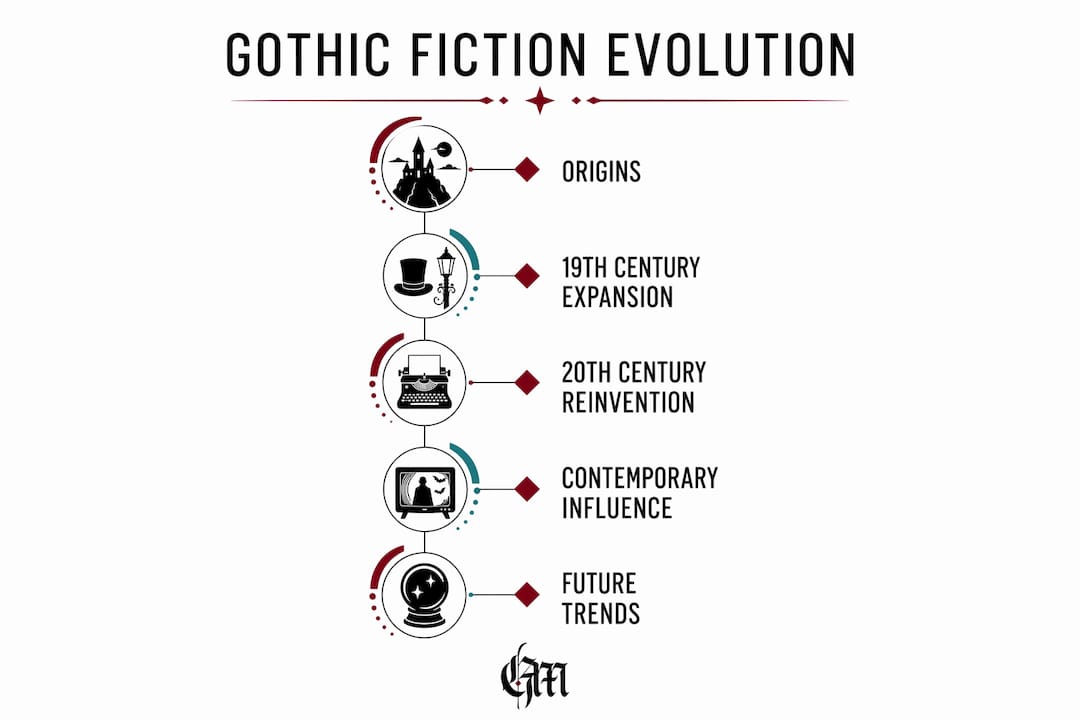
The evolution follows a clear arc:
- 18th century origins. Walpole, Radcliffe, and Lewis established the external Gothic: castles, villains, and supernatural events as the primary source of fear.
- 19th century deepening. Mary Shelley’s Frankenstein and Edgar Allan Poe’s short fiction shifted focus toward the psychological. The monster became a projection of the creator’s guilt. The haunted house became a haunted mind.
- 20th century Modernist absorption. Writers like Virginia Woolf and James Joyce incorporated Gothic themes to explore trauma and fractured identity. Gothic elements appeared inside stream-of-consciousness narratives rather than medieval settings.
- American Gothic and Southern Gothic. Edgar Allan Poe is a founding figure of American Gothic. Southern Gothic writers like Flannery O’Connor and William Faulkner replaced European castles with decaying plantation homes, using haunted settings to critique power, class, and racial violence.
- Contemporary Gothic. Angela Carter’s The Bloody Chamber and Shirley Jackson’s The Haunting of Hill House demonstrate how Gothic fiction absorbed feminist theory, postcolonial critique, and psychological realism without losing its atmospheric power.
Gothic fiction’s flexibility to reinvent itself across cultural contexts is the defining reason it has outlasted nearly every other 18th-century literary movement. It is a chameleon genre. It absorbs the anxieties of each new era and reflects them back in amplified form.
Pro Tip: Southern Gothic is one of the most underrated entry points for students new to the genre. Flannery O’Connor’s short stories deliver Gothic intensity in under 30 pages, making the psychological mechanics easy to study without committing to a full novel.
What are the key characteristics that define Gothic fiction’s impact?
Gothic fiction characteristics prominently include dark settings, supernatural occurrences, terror and suspense, moral ambiguity, and the exploration of madness and passion. These elements collectively distinguish Gothic from closely related genres, and understanding the distinction clarifies why Gothic’s influence is so specific and so durable.
The table below compares Gothic fiction with horror and fantasy across the dimensions that matter most for understanding its influence:
| Dimension | Gothic fiction | Horror | Fantasy |
|---|---|---|---|
| Primary source of fear | Psychological dread and the sublime | Physical threat and shock | External conflict or evil |
| Setting function | Reflects protagonist’s inner state | Creates danger | Builds a separate world |
| Moral framework | Ambiguous, often unresolved | Good vs. evil | Usually clear moral order |
| Supernatural role | Blurs reality and psyche | Literal threat | Literal world-building element |
| Central concern | Identity, repression, trauma | Survival | Adventure or destiny |
The psychological element of dread and sublime tension, reflecting human reason’s breakdown, is the deepest Gothic influence. Gothic represents fears of the self and the subconscious rather than literal ghosts. That is why a Gothic novel can unsettle you in ways that a straightforward horror story cannot. The fear is not outside the protagonist. It is inside them, and by extension, inside you.
Gothic fiction also uses “the sublime,” a concept borrowed from Edmund Burke and Immanuel Kant, to isolate characters and force psychological revelation. The sublime is the feeling of awe mixed with terror inspired by vast architecture or overwhelming nature. Modern practitioners use this as a structural narrative device, placing characters in environments so large or so threatening that their rational defenses collapse.
How does Gothic fiction influence contemporary storytelling?
Gothic fiction’s influence on contemporary storytelling is direct, traceable, and wide. The genre did not fade. It migrated into new media and new cultural contexts while keeping its psychological core intact.
In contemporary literature, writers like Donna Tartt (The Secret History), Paul Tremblay, and Carmen Maria Machado use Gothic architecture, unreliable narrators, and psychological dread as primary tools. Machado’s In the Dream House is a memoir structured like a Gothic novel, using the haunted house as a metaphor for an abusive relationship. That is Gothic influence operating at its most sophisticated.
In cinema, Gothic architectural motifs translate into claustrophobic framing, shadow work, and settings that represent psychological entrapment rather than literal danger. Directors like Guillermo del Toro (Crimson Peak, Pan’s Labyrinth) and Robert Eggers (The Witch, The Lighthouse) build films around Gothic principles. The setting is never just a location. It is a manifestation of the protagonist’s psyche.
Gothic influence also runs through comics and graphic novels. Neil Gaiman’s Sandman series draws directly from Gothic fiction’s themes of mortality, identity, and the supernatural. The visual medium amplifies Gothic atmosphere in ways prose cannot.
Educational research highlights Gothic literature as a tool for adolescents to explore identity and moral development through its blend of reality and the inexplicable. Gothic tropes like the damsel in distress are used in classrooms to discuss power and gender imbalance. The genre teaches critical thinking about social structures through the language of fear and mystery.
Gothic aesthetics have also shaped fashion and material culture. The dark aesthetic traditions rooted in Gothic literary history now drive entire subcultures and product markets, from clothing to jewelry to home decor. The visual grammar of Gothic fiction, all black lace, iron crosses, and Victorian silhouettes, is inseparable from the literary tradition that created it.
What misconceptions exist about Gothic fiction’s influence?
The most common misconception about Gothic fiction is that its influence is primarily about supernatural horror. Ghosts, vampires, and monsters are surface features. The real influence runs through psychology, social critique, and the examination of repressed desire.
“Gothic represents the conflict between reason and chaotic impulses in cultural narratives.” The genre was originally a pejorative label, used to dismiss works as barbaric or medieval. That rejection of Enlightenment rationalism became the genre’s greatest strength, giving it permission to explore everything polite society refused to examine.
A second misconception is that Gothic fiction is a fixed style frozen in the 18th century. The genre is defined by adaptability. Gothic fiction uniquely bridges the gap between rational Enlightenment ideals and emotional, irrational narratives, allowing exploration of repressed desires and fears across every era. Southern Gothic, psychological horror, and Gothic-inflected literary fiction all prove that the form changes while the core concern, the terror of what lies beneath rational surfaces, stays constant.
The third misconception is that Gothic’s moral and social critiques are secondary to its atmosphere. They are not. The genre has always used darkness as a lens for examining oppression, class, gender, and the abuse of power. That critical function is central to its influence, not incidental to it.
Key Takeaways
Gothic fiction’s influence is defined by its psychological depth and adaptability, not by its supernatural surface features, making it one of the most durable forces in literary and cultural history.
| Point | Details |
|---|---|
| Origins in 1764 | Horace Walpole’s The Castle of Otranto established the tropes that define Gothic influence today. |
| Psychological core | The deepest Gothic influence is dread and the sublime, not literal monsters or ghosts. |
| Adaptive across centuries | Gothic absorbed Modernism, American regionalism, and feminist theory without losing its identity. |
| Contemporary reach | Gothic shapes modern film, literary fiction, comics, education, and fashion aesthetics. |
| Misconception corrected | Gothic influence is primarily psychological and social, not supernatural horror. |
Why Gothic fiction’s power is harder to kill than any vampire
I have spent years reading Gothic fiction across its full historical range, from Walpole to Machado, and the thing that strikes me most is how badly the genre is underestimated by people who have only encountered its surface. Students often arrive expecting cobwebs and jump scares. What they find, if they read carefully, is one of the most psychologically sophisticated traditions in Western literature.
The visual Gothic, the aesthetic of black clothing, Victorian architecture, and occult imagery, is real and valid. But it is downstream of something much older and more demanding. The Gothic aesthetic exists because the Gothic literary tradition created a visual language for psychological states that ordinary realism could not express. When you wear a piece of Gothic jewelry or decorate a room in dark Victorian style, you are participating in a tradition that goes back to the 18th century’s most radical literary experiment.
What I find most undervalued is Gothic fiction’s role as social criticism. Flannery O’Connor used grotesque Southern Gothic imagery to expose the violence beneath American respectability. Angela Carter used fairy-tale Gothic to dismantle gender mythology. These writers were not decorating their work with darkness. They were using darkness as the only honest language available for what they needed to say.
My honest recommendation: read one Gothic novel outside your comfort zone this year. If you know the classics, try Carmen Maria Machado’s In the Dream House. If you are new to the genre, start with Shirley Jackson’s We Have Always Lived in the Castle. Both will change how you see the genre and how you see the world it reflects.
— Rey
Gothic literary aesthetics, made wearable at Goth
Gothic fiction’s visual language, all dark architecture, occult symbols, and Victorian intensity, has always been more than a literary device. It is a living aesthetic that people carry into their daily lives through fashion, jewelry, and decor.

Goth curates products built directly from that tradition. Whether you are drawn to the dark fashion roots of Gothic literary aesthetics or looking for standout Gothic accessories that reflect the genre’s psychological depth, Goth connects you with independent creators who take the tradition seriously. Every piece on the platform carries the weight of a centuries-old aesthetic. Browse the full collection at Goth.Market and find something that speaks to the darker, more honest part of your imagination.
FAQ
What is Gothic fiction influence in simple terms?
Gothic fiction influence is the impact of the genre’s core elements, including psychological dread, dark settings, and moral ambiguity, on modern literature, film, and art. It began with Horace Walpole’s The Castle of Otranto in 1764 and continues shaping storytelling today.
How does Gothic fiction differ from horror?
Gothic fiction uses dark settings and supernatural elements primarily to explore psychological states, identity, and social critique. Horror focuses on physical threat and shock, while Gothic fiction’s fear is rooted in the mind and in repressed desires.
What are the main Gothic fiction characteristics?
The main characteristics are dark or gloomy settings, supernatural occurrences, atmosphere of terror and suspense, moral ambiguity, and themes of madness and passion. These elements collectively distinguish Gothic fiction from fantasy or straightforward horror.
How did Gothic fiction influence modern literature?
Modernist writers like Virginia Woolf and James Joyce incorporated Gothic themes to explore trauma and fractured identity. Contemporary authors like Carmen Maria Machado and Donna Tartt use Gothic structure and atmosphere as primary narrative tools.
What is Southern Gothic and how does it relate to Gothic fiction?
Southern Gothic is an American adaptation of Gothic fiction that replaces European castles with decaying plantation homes and uses haunted settings to critique power, class, and racial violence. Edgar Allan Poe is its founding figure, and writers like Flannery O’Connor developed it into a distinct form of social criticism.