

Candle Color Meanings: A Practical Guide for Ritual Work
Candle colors are symbolic correspondences you light to focus a specific intention, from love and prosperity to protection and release. Match the color to your goal whenever you can, and reach for white when the right shade isn’t on hand. Pairing two colors layers intentions in a single working. The full reference and a step-by-step way to choose follow below.
TL;DR:
- White candles are the most versatile substitute for any chosen color and are recommended for beginners as they can handle most intentions.
- Pairing colors, such as green with gold or black with white, enhances the effectiveness of the ritual by layering or balancing specific energies.
- Most practitioners associate candle colors with overlapping frameworks like elements, planetary influences, and chakras, but these mappings are flexible and open to personal adaptation.
- When selecting a candle color, clearly define your intention and consider emotional tone, burn duration, and whether you’re attracting or releasing energy.
- Safety precautions include placing candles on stable surfaces, never leaving them unattended, trimming wicks, and storing unused candles away from direct light to preserve their efficacy.
Table of Contents
- What Do Candle Colors Mean? A Quick Reference
- How Do Color Correspondences Work in Candle Magic?
- How Should I Choose a Candle Color for My Ritual?
- What Candle Color Combinations Work Well Together?
- What Safety and Care Steps Should I Follow?
- How Does Goth Curate Ritual Candles and Styling?
- What Actually Matters More Than the Color Chart?
- Where Can You Find Curated Ritual Candles?
- Sources
- FAQ
What Do Candle Colors Mean? A Quick Reference
Every color on this list carries a working meaning drawn from decades of practitioner tradition, not a fixed law carved in stone. Use it as a starting point, then adjust based on what resonates with your own practice.
- White: Purification, new beginnings, clarity, and the universal substitute for any color you don’t have. Associated with the moon and spirit; burn one during a fresh-start ritual or a full moon cleansing.
- Black: Banishing, protection, and absorbing unwanted energy, not “evil” as pop culture suggests. Tied to Saturn and the earth element; light one to seal a protection working or pull negativity out of a space.
- Red: Passion, courage, physical energy, and strong desire. Linked to Mars, fire, and the root chakra; use it for a working meant to ignite motivation or romantic attraction.
- Pink: Self-love, friendship, and gentle emotional healing. Ties to Venus and the heart chakra; light one when a working needs tenderness rather than intensity.
- Green: Money, growth, fertility, and abundance. Associated with earth and Venus; a classic choice for a job-offer or garden-blessing ritual.
- Blue: Peace, communication, healing, and truth. Connected to Jupiter, water, and the throat chakra; burn one before a difficult conversation.
- Purple: Psychic ability, wisdom, and spiritual power. Linked to the crown chakra and higher planetary influences; useful for divination or meditation work.
- Yellow or gold: Confidence, success, intellect, and solar energy. Tied to the sun and Mercury; light one before an exam or a public-speaking moment.
- Orange: Creativity, ambition, and quick change. Associated with the sacral chakra; good for a career-shift or creative-block working.
- Brown: Grounding, home, animals, and stability. Tied to earth energy; use it for a working focused on a house or a pet’s wellbeing.
- Gray or silver: Neutrality, contemplation, and glamour magic. Linked to the moon’s reflective quality; helpful when a situation calls for balance rather than a strong push either way.
- Lavender, turquoise, and indigo: Subtler variations on purple, blue, and psychic work, often used for dream work, intuition, and calming an anxious mind.
Practitioner guides consistently name white as the go-to substitute when the “correct” color isn’t available, which is part of why so many beginner kits start there.
Pro Tip: If you only own one color, make it white. It’s flexible enough to stand in for almost any working while you build out your collection.
How Do Color Correspondences Work in Candle Magic?
Color correspondences work as attention-focusing conventions, not fixed rules handed down from an unquestionable source. When you light a green candle for money, the color itself doesn’t do the work; it gives your mind a clear symbol to anchor around while you set intention.
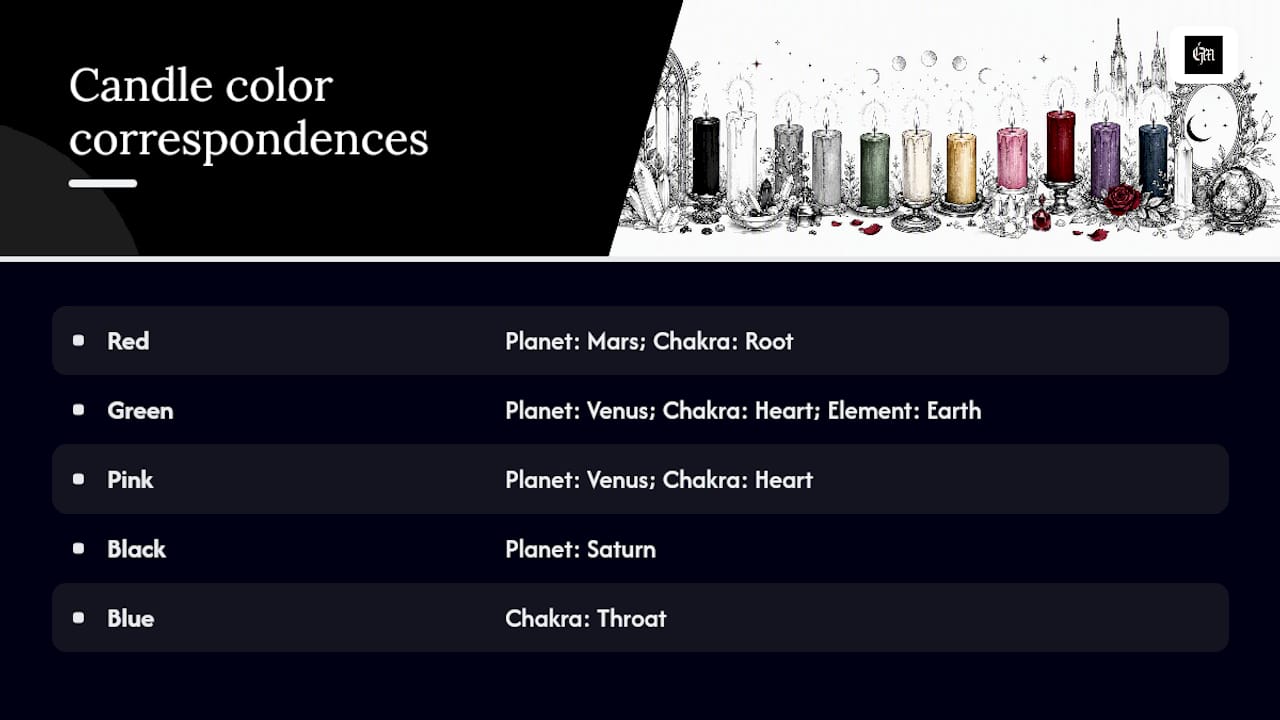
Most modern systems map colors to three overlapping frameworks: elements (fire, water, earth, air), planetary influences (Mars for red, Venus for green and pink, Saturn for black), and chakras (root for red, heart for green and pink, throat for blue). These cross-references show up consistently across practitioner guides, which is why a green candle so often gets tagged with both “earth” and “heart chakra” in the same breath.
Worth knowing: today’s color charts are largely a systematization of scattered folk and conjure traditions, formalized in 20th-century practitioner literature. Treat any list, including this one, as a working reference you’re free to adapt.
How Should I Choose a Candle Color for My Ritual?
Pick your color by working through a short sequence rather than guessing.
- Name the intention plainly. “I want a raise” is more usable than “I want abundance in general.”
- Choose your primary color based on the closest match in the reference above.
- Add a supporting color if you want to layer a secondary effect, like courage alongside love.
- Dress or carve the candle if your practice includes it: carve a word or sigil, then anoint with a corresponding oil.
- Check your setup for safety before lighting, including burn time and how long you can realistically supervise it.
Ask yourself four questions before you strike the match: What outcome am I after? What emotional tone fits (fierce vs. gentle)? Is this a quick working or a long burn over several nights? Am I trying to attract something or release it? Attraction workings lean toward warm colors (red, orange, gold); release workings lean toward black or white.
Pro Tip: New to candle magic? Stick to white plus one other color until you’ve run a few workings. It keeps the symbolism simple and the setup fast.
What Candle Color Combinations Work Well Together?
Pairing colors lets one candle set the primary intention while a second amplifies or balances it.
- Green + gold: Prosperity plus recognition, a natural fit for a promotion or business launch.
- Red + pink: Passion plus tenderness, common in relationship and self-love workings.
- Black + white: Banish first, then purify, useful as a two-step release-and-cleanse sequence.
- Blue + light blue: Deep healing supported by gentle communication.
- Purple + indigo: Psychic work reinforced with dream and intuition focus.
- Orange + yellow: Creative ambition paired with the confidence to act on it.
These pairings and their rationale appear consistently in practitioner ritual templates, including a green-and-gold spread for a job interview and a red-and-pink pairing lit together for a relationship-repair working.
What Safety and Care Steps Should I Follow?
Set every candle on a stable, non-flammable tray, never leave it burning unattended, and keep it well clear of curtains, hair, and loose fabric. If a working affects another person, get their consent first and steer clear of intentional harm. For upkeep, trim the wick before each burn, snuff rather than blow out to avoid scattering smoke, and store unused candles away from direct light so the wax doesn’t fade.
How Does Goth Curate Ritual Candles and Styling?
Goth curates witchy and occult supplies from independent makers, plus styling guides like Witchy Home Decor Ideas for a Mystical Space for arranging your altar space.
What Actually Matters More Than the Color Chart?
Most guides to candle color meanings treat the chart as the whole story. It isn’t. The chart is a vocabulary, not a spellbook, and the research behind it backs that up: these color lists are systematizations of folk traditions that different authors have organized differently over the decades. Two respected sources will disagree on what turquoise means, and that’s not a flaw. It’s a sign the system was built by many hands, not handed down whole.
What the conventional advice underweights is intention clarity. A vague goal lit under the “perfect” color still produces a vague working. A precise goal lit under an imperfect substitute, even a plain white candle, tends to outperform it. If you take one thing from this guide, prioritize naming your intention with real specificity before you touch the color question at all.
The pairing concept also deserves more attention than it usually gets. Most beginners fixate on finding the single right color and skip the layering entirely, when a supporting candle is often what makes a working feel complete.
— Rey
Where Can You Find Curated Ritual Candles?
Goth stocks ritual candles, altar tools, and occult jewelry from independent makers who understand the difference between mass-market and meaningful. Every listing comes from a small creator specializing in dark and witchy aesthetics, not a factory catalog.

If you’re building out a color collection for your practice, the Goth marketplace is a straightforward place to start, whether you need a single white pillar or a full spectrum for layered workings. Browse the current ritual candle listings and pick your first few colors today.
Sources
This guide draws on Grimoire’s candle magic guide for color lists and the substitution rule, Shadow Grimoire for element and chakra mappings, Esoteric Universe for pairing templates, and WitchcraftForBeginners for beginner palettes and safety guidance. For candle selection beyond ritual use, Wick & Glow’s guide to meditation candles is a useful companion resource.
- Candle Magic: A Witch’s Guide | Grimoire
- Candle magic: A beginner’s guide to candle colors and their meanings - Shadow Grimoire
- Candle Color Meanings: Magic, Intentions & Spells | Esoteric Universe
- Candle Magic 101: Colors, intentions and your first spell - WitchcraftForBeginners
FAQ
What is the meaning of each candle color?
Each color maps to a common intention: white for purification, black for banishing, red for passion, green for money, blue for peace, purple for psychic work, and yellow or gold for confidence and success. Pink, orange, brown, and gray cover love, creativity, grounding, and neutrality respectively.
Can I use a white candle instead of any color?
Yes. White is widely treated as the universal substitute across practitioner traditions, so it works when the specific color you need isn’t available.
Are black candles evil or dangerous to use?
No. Black candles are used for banishing, protection, and absorbing unwanted energy, and practitioner texts are explicit that this isn’t the same as causing harm.
What colors should a beginner start with?
Most beginner guides recommend starting with white, green, pink, and black, since that small palette covers the majority of common intentions like cleansing, money, love, and protection.
Can I combine two candle colors in one ritual?
Yes, combining colors lets a primary candle set the main intention while a second color amplifies or balances it, such as green with gold for prosperity or black with white for a release-and-cleanse sequence.
Do candle color meanings change between traditions?
Yes. Color correspondences are systematizations of varied folk and conjure traditions, so lists differ slightly between authors and practices; treat any chart, including this one, as an adaptable working reference rather than a fixed rule.
How long should a ritual candle burn?
There’s no universal rule, but never leave it burning unattended, and only let it burn as long as you can stay nearby to supervise it safely on a stable, non-flammable surface.