

One Candle, Not Five: Handmade Black Candle Decor for Gothic Altars
Black candle decor means ritual and altar candles built for protection work, banishing, and shadow work, not the mainstream taper you’d find at a wedding centerpiece display. It covers tapers, pillars, skull candles, and votives made by independent artisans for gothic and witchy home altars. The core use case: protection, banishing, and dark-aesthetic centerpieces that carry symbolic weight, not just ambiance. This category brings together practitioners with makers who understand the difference.
TL;DR:
- Black candles used for ritual purposes are made in specific shapes like tapers, pillars, skulls, and votives, each serving different ritual durations and intentions.
- Safe and effective styling involves starting with a single focus candle on heatproof surfaces, then building balanced clusters with contrasting textures and colors, avoiding clutter.
- Burns should always be supervised, with emphasis on trimming wicks, using proper surfaces, and respecting the symbolism to honor tradition and ensure safety.
- Handmade candles with natural waxes like soy or beeswax burn cleaner and longer, and fully pigmented wax maintains a consistent black appearance during the entire burn.
- Sourcing from small, independent makers ensures authenticity, intention, and quality, which enhances the ritual significance beyond simple mass-market products.
Table of Contents
- What Types and Forms of Black Candles Work for Ritual and Gothic Decor?
- How Should I Style Black Candles in Gothic Home Decor and on Altars?
- How Do I Use Black Candles Safely and Respectfully in Ritual Work?
- What Materials, Scents, and Sourcing Cues Should I Look For When Buying Handmade Black Candles?
- Why Curated Black Candle Decor Matters: A Note From the Author
- Where Can I Shop Curated Black Candle Decor?
- Sources
- FAQ
What Types and Forms of Black Candles Work for Ritual and Gothic Decor?
Shape dictates function more than most people realize. A black candle carries variable symbolic meanings across traditions, ranging from protection and grounding to mourning, and the form you choose should match the work you’re doing, not just the shelf you’re styling.
Tapers burn fast and controlled, which makes them ideal for timed spellwork where you want a candle to finish within a single sitting. Pillars run longer, sometimes for days, and suit sustained intentions like extended banishing work or a centerpiece you want burning through an entire ritual weekend. Votives are compact and disposable by design, perfect for one-off cleansings where you don’t want a half-burned candle lingering as a reminder of unfinished business. Jar candles trade portability for containment; the glass catches drips and makes them the safer pick for altars near fabric or paper.
Then there’s the novelty category. Skull candles have become a defining decorative element in gothic decor precisely because they blend symbolism with visual drama, and plenty of collectors buy them purely as sculptural pieces, never intending to light the wick at all.
Finish matters too:
- Matte black wax absorbs light and photographs beautifully on an altar cloth, but shows fingerprints and dust faster than glossy finishes.
- Carved or sanded surfaces catch shadow in a way flat wax never does, especially under candlelight itself.
- Painted or dyed details (silver veining, bone white accents) add contrast but can flake if the candle sits near heat sources before you burn it.
- Fully pigmented wax burns cleaner than surface-coated wax, which matters if you’re doing focused work and don’t want colored soot drifting into the room.
The material underneath the color affects your ritual experience directly. Paraffin burns hotter and can carry more soot; soy and beeswax burn slower and cleaner, which changes how long a taper actually lasts on your altar.
How Should I Style Black Candles in Gothic Home Decor and on Altars?
Start with one focal candle before you build a cluster. A single pillar candle on a black altar cloth, lit alone, does more visual and ritual work than five scattered votives competing for attention. Once you understand how a solo piece reads in your space, expand outward.
Arrangement patterns that actually work:
- Single focus — one substantial pillar or skull candle as the room’s anchor point, surrounded by negative space rather than clutter.
- Clusters of three — an odd number reads as intentional rather than accidental, and varying heights (a votive, a pillar, a taper) creates visual rhythm.
- Mirrored pairs — two identical tapers flanking a central object (a mirror, a deck of cards, a small statue) reinforces symmetry, which gothic decor leans on heavily.
Surface choice changes everything about how safe and striking the arrangement looks. Heatproof trays in slate, cast iron, or dark ceramic protect your altar table and add texture without competing with the candle itself. Skip ornate candelabra if you’re working with dripless pillars; a simple black metal riser often reads more intentional than an overly baroque holder. Reflective surfaces, like a small obsidian mirror or dark glass tray, double the visual impact of a single flame at night, which is a cheap trick that makes one candle look like a full display.
On palette: pair black with deep burgundy, aged brass, or bone white rather than stacking black on black on black, which flattens the whole arrangement under low light. Texture does the heavy lifting when color variation is minimal, so mix rough (stone, dried botanicals) with smooth (glass, polished wax).
A quick styling checklist before you light anything:
- Choose your candle form based on ritual duration, not just looks.
- Pick a heatproof surface rated for direct flame contact.
- Build your arrangement (single, cluster, or pair) before adding secondary decor.
- Add one or two contrasting textures or colors, no more.
- Step back and check the sightline from where you’ll actually sit during ritual.
Pro Tip: Photograph your altar setup before you light the candles. If the arrangement looks intentional in a still photo, it’ll read even stronger once the flame is moving and casting shadow.
For more layout ideas, guides on dark decor for a moody, gothic-inspired home cover palette pairing in more depth.
How Do I Use Black Candles Safely and Respectfully in Ritual Work?
Never leave a burning candle unattended, full stop. That’s the rule that matters most, and it’s the one people break first when a ritual runs long or gets interrupted.
Beyond that baseline, a few practices reduce real risk:
- Burn on a heatproof surface. Glass, ceramic tile, and metal trays all work. Wood, fabric altar cloths, and paper do not, even briefly.
- Trim the wick before each burn. A long or bent wick throws a taller flame and drips faster, which matters more on carved or dressed candles where wax pools unevenly.
- Watch oil-anointed candles closely. Anointing oils can flare when they hit an open flame, so keep dressed candles away from draping fabric and never leave them near open windows.
- Control drips on carved or textured candles by burning them in a container or on a plate with a raised edge, since sculptural detail often means uneven wax flow.
Respectful practice matters as much as physical safety. Black candles are frequently used for protection, banishing, and transformation rather than anything sinister, and treating that symbolism with intention rather than spectacle honors the traditions it comes from. Be mindful that some candle magic practices draw from specific diasporic or closed traditions; borrowing imagery without context can flatten meaning that belongs to a specific lineage.
When a ritual candle burns down, disposal deserves the same care as the lighting did. Some practitioners bury remaining wax, others return it to earth or water depending on the intention behind the original work, and many simply let it cool fully before discarding it with intention rather than treating it as ordinary trash.
A short safety checklist: heatproof surface, trimmed wick, attended flame, controlled drip zone, cooled wax before disposal.
What Materials, Scents, and Sourcing Cues Should I Look For When Buying Handmade Black Candles?
Wax type changes both burn quality and ritual feel. Soy wax burns cooler and cleaner, which suits longer sessions where you’re sitting near the flame for extended shadow work. Beeswax burns slowest of the common options and carries a faint natural honey note even when unscented, which some practitioners find grounding and others find distracting during focused ritual. Paraffin burns hotter and often cheaper, but produces more soot, a real consideration if you’re burning near light-colored altar cloths. Many makers now blend soy and beeswax to balance clean burn with a firmer pillar shape.
How the black gets into the wax matters more than most buyers realize. Surface-dyed candles look striking when new but can reveal lighter wax underneath as they burn down, breaking the visual continuity mid-ritual. Fully pigmented wax burns black straight through and tends to release less irritating smoke, since the coloring agent is distributed rather than concentrated on the surface.
On scent, many practitioners favor unscented or lightly scented candles for shadow work and meditation, since strong fragrance can pull focus away from the work itself. Save heavily scented candles for ambiance pieces rather than focused ritual use.
When evaluating a handmade candle before buying, look for:
- Clear ingredient listings (wax type, wick material, any additives).
- Stated burn-time estimates as provided by the maker.
- Maker notes explaining batch size or production method.
- Wick type disclosure (cotton, braided, or wood), since this affects soot and drip behavior.
Goth.Market curates exactly these kinds of small-batch, maker-forward listings, and its blog on candle color meanings offers a practical rundown of how different hues correspond to different intentions if you’re building out a full ritual kit rather than a single candle.
Why Curated Black Candle Decor Matters: A Note From the Author
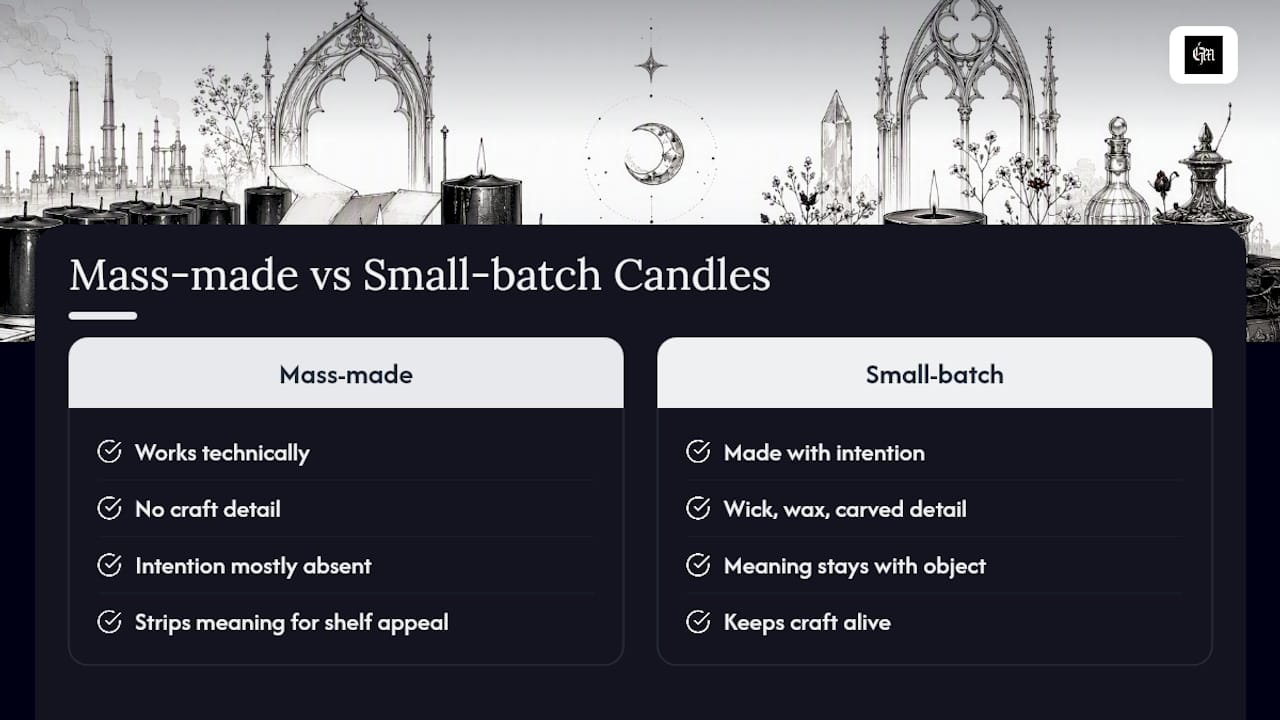
I spend a lot of time in gothic and witchy spaces online, and the thing that separates a real altar from a styled photo op is almost always the sourcing. Mass-produced black candles do the job, technically. But they carry none of the intention a small-batch maker builds into wick placement, wax blend, or the carved detail on a skull candle’s brow.
Buying from independent creators keeps that craft alive and keeps meaning attached to the object instead of stripping it out for shelf appeal. Prioritize intention over spectacle, and always burn safely. The candle should serve the ritual, not the other way around.
— Rey
Where Can I Shop Curated Black Candle Decor?
Some marketplaces specialize in handmade, ritual-ready pieces instead of mass-market substitutes. These curate independent makers across candles, altar bundles, and dark home decor, providing work from people who understand what a shadow-work candle needs versus a display piece.

Expect to find hand-poured black tapers and pillars, sculptural skull candles, altar bundle sets, and heatproof ritual trays, all from small-batch creators rather than factory runs. If you want more grounding before you buy, the gothic home decor essentials checklist walks through what a well-stocked altar or dark-styled room actually needs, and pairs well with holder options like the candelabra and candle holder collection if you’re building out display pieces alongside your ritual candles. Browse the current Goth to see what independent makers have available this season.
Sources
- Black Candle — The Infinite Wiki
- Black Candle Meaning in Witchcraft: Uses, Spells & Color Magic | Lunary
- 8 Ways to Use Black Candles in Witchcraft (DIY With Pictures)
- The Allure of Skull Candles: History, Symbolism & Modern Gothic Décor – Gothic Darling
- Black Candles and Their Meanings in Witchcraft - Centre of Excellence
FAQ
What does black candle decor actually mean?
It refers to ritual and gothic altar candles, tapers, pillars, skull candles, and votives used for protection, banishing, and dark-aesthetic display, not standard black home decor candles sold for general ambiance. The distinction matters because ritual candles are chosen for burn behavior and symbolic use, not just color matching a room.
What is the ritual meaning behind black candles?
Black candles are widely used for protection, banishing, grounding, and mourning across different traditions. In modern occult and Wiccan practice, they’re often tied to Saturday and Saturn correspondences and used specifically for banishing negative energy.
Are skull candles meant to be burned or just displayed?
Both, depending on the maker and your intention. Many gothic decorators keep sculpted novelty candles like skull candles as permanent centerpieces to preserve the artisan detail, while others burn them deliberately as part of a themed ritual.
What surface should I burn ritual candles on?
Always use a heatproof surface: glass, ceramic tile, stone, or metal trays. Fabric altar cloths, wood, and paper are not safe direct-contact surfaces, even for short burns.
Should I choose scented or unscented black candles for ritual work?
Unscented or lightly scented candles are generally preferred for shadow work and meditation, since strong fragrance can distract from focused ritual intention. Save heavily scented options for decorative or ambiance-only use.
How should I dispose of a black candle after ritual use?
Let the candle cool completely before handling the remains. Some practitioners bury leftover wax or return it to natural elements as part of the ritual’s closing, following respectful disposal guidance tied to the original intention.
Where can I find handmade black candles instead of mass-produced ones?
Some curated marketplaces feature independent makers who disclose ingredients, wick type, and burn-time estimates, key cues for identifying genuine small-batch candles. Their blog resources often cover styling and safety for readers building a full altar setup.
What wax type burns cleanest for extended ritual sessions?
Soy and beeswax generally burn cooler and cleaner than paraffin, producing less soot during longer sessions. Fully pigmented wax also tends to burn more evenly than surface-dyed candles, which can reveal lighter wax as they melt down.