

Why Embrace Niche Aesthetics: Benefits and Inspiration
TL;DR:
- Niche aesthetics serve as tools for emotional regulation, social belonging, and authentic identity construction. Engaging deeply with these visual systems stimulates the brain, reduces stress, and fosters community connection. Authentic participation emphasizes understanding a culture’s roots and evolving practices over superficial trend-following.
If you’ve ever felt drawn to a visual style that most people don’t quite get, you already understand why embrace niche aesthetics matters more than it looks on the surface. Niche aesthetics, the term researchers and cultural critics use for tightly defined visual and lifestyle systems tied to specific subcultures, are far more than decoration. They are tools for emotional regulation, social belonging, and identity construction. The pull you feel toward dark romanticism, whimsygoth, or cottagecore isn’t superficial taste. It’s your nervous system responding to something real.
Table of Contents
- Key Takeaways
- Why embrace niche aesthetics: the psychology behind the pull
- Niche aesthetics as community and identity
- How niche aesthetics evolve over time
- How to adopt niche aesthetics authentically
- My perspective on living inside a niche aesthetic
- Explore your aesthetic at Goth
- FAQ
Key Takeaways
| Point | Details |
|---|---|
| Aesthetics affect brain chemistry | Just 45 minutes of aesthetic engagement measurably lowers cortisol and reduces stress. |
| Style is social currency | Niche aesthetics function as identity signals that attract like-minded communities and filter out mismatches. |
| Authenticity beats uniformity | Deep participation in niche culture matters more than copying a visual look without understanding its values. |
| Evolution keeps it real | Treating your aesthetic as a living practice prevents stagnation and performative engagement. |
| Small rituals create big shifts | Incorporating aesthetic elements daily builds emotional resilience and creative flexibility over time. |
Why embrace niche aesthetics: the psychology behind the pull
The science here is more interesting than most people realize. Neuroaesthetics, the field studying how the brain processes beauty and style, has found that humans are biologically wired to seek aesthetic experiences. This isn’t a preference. It’s a neurological need. When you engage with a visual world that resonates with you, whether through fashion, art, or your home environment, your brain disrupts rigid mental patterns and builds psychological resilience.
That matters especially now. Aesthetic practices actively counteract the grinding fatigue that comes from overconsumption of social media and algorithmically flattened content. Niche aesthetics give you something that a trending sound or a viral video cannot: a coherent world with consistent values, textures, and emotional tones you chose.
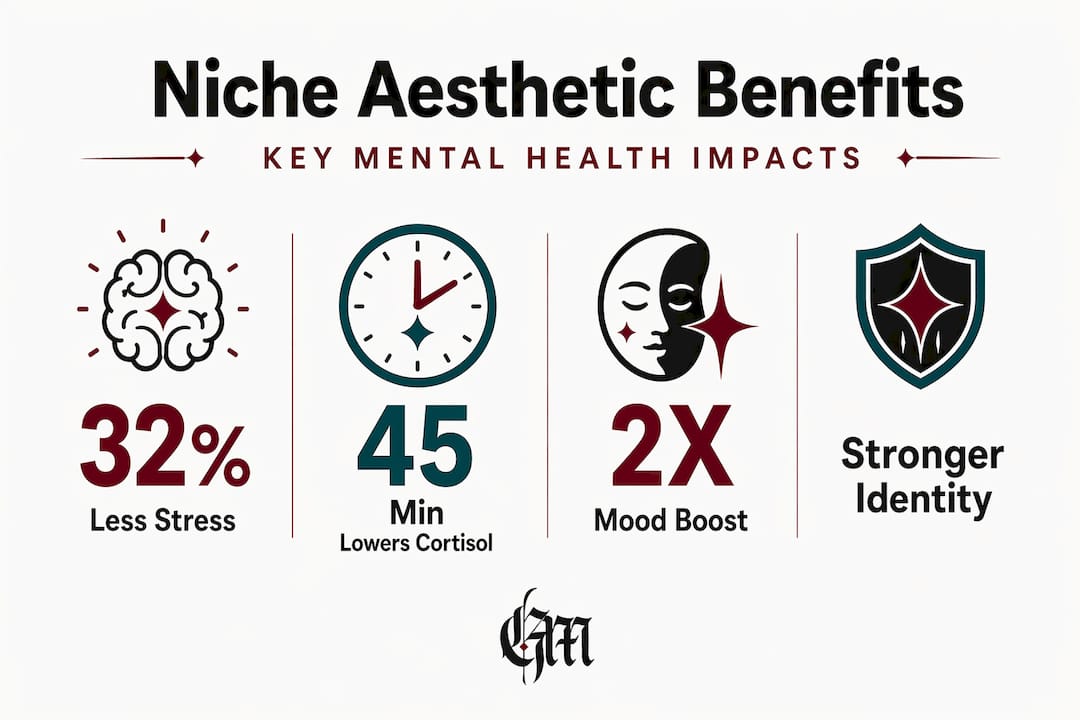
The physiological evidence supports this. Research shows that 45 minutes of art-making significantly lowers cortisol levels, the stress hormone most associated with anxiety and burnout. You don’t need to be creating gallery work for this to apply. Arranging your space according to a dark, moody aesthetic you love, choosing a piece of occult jewelry that holds personal meaning, or styling an outfit that aligns with your interior emotional world all activate the same neural circuits. Active participation in aesthetic life literally remodels how your brain processes stress and social connection.
The concept of “emotional maximalism” is worth naming here. Unlike the current cultural push toward minimalism and productivity optimization, niche aesthetics often celebrate richness, symbolism, and layered meaning. Gothic aesthetics, for example, don’t shy away from death, darkness, or complexity. That emotional honesty is itself a form of psychological relief for people who feel flattened by relentless positivity.
Pro Tip: Start a five-minute daily aesthetic ritual. This could be lighting a specific candle, choosing jewelry with personal symbolism, or arranging your desk with objects that reflect your visual world. Consistency with small rituals builds the neurological pathways that link aesthetic engagement to calm and creative flow.
Niche aesthetics as community and identity
When Etsy reported that search volume for whimsy-related items rose by at least 50% from 2025 to 2026, the numbers weren’t just tracking a trend. They were tracking a collective emotional signal. People weren’t buying mushroom earrings and celestial prints because an influencer told them to. They were reaching for a language that described how they wanted to feel and who they wanted to be around.
Cultural strategists describe aesthetics as social currency, a kind of résumé that signals your values, sensibilities, and the communities you belong to before you say a word. This is especially true in alternative subcultures. The way someone styles a gothic look, the specific reference points they draw from, and the obscure independent creators they support all communicate their depth of engagement. It signals authenticity. It opens doors to people who share the same codes.
Niche aesthetics also function as inclusion filters, drawing in people who share values while naturally excluding those who don’t. Studies of niche community dynamics show this filtering creates loyal, deep communities rather than broad but shallow audiences. This matters because belonging is one of the most powerful psychological needs humans have. You can explore how aesthetics shape subculture identity in ways that go far beyond the clothes you wear.
The distinction between performative trend-following and genuine niche participation is real, and it’s worth understanding clearly:
| Trend-following | Authentic niche participation |
|---|---|
| Adopts visual cues from what’s currently viral | Develops aesthetic vocabulary from personal history and values |
| Drops the style when it stops trending | Evolves the aesthetic alongside personal growth |
| Treats aesthetic as a costume | Treats aesthetic as a living, expressive system |
| Seeks external validation | Seeks community resonance and personal meaning |
| Surface-level interest in the look | Deep engagement with the culture, history, and community |
The difference isn’t about gatekeeping. It’s about the longevity and emotional payoff of your engagement. Authentic participation compounds. Trend-following exhausts.
How niche aesthetics evolve over time
Here’s where most people get stuck. They discover an aesthetic that resonates, build an identity around it, and then treat it as a fixed destination. The gothic aesthetic becomes a checklist. The whimsygoth aesthetic becomes a uniform. And then something goes flat.
Over-rigid adherence to aesthetic rules limits personal growth and authenticity. The most alive practitioners of any niche aesthetic are the ones who treat it as a dynamic practice rather than a fixed costume. They go deeper into the history, the obscure references, the philosophical underpinnings. A person who started with mainstream gothic fashion eventually discovers Victorian mourning jewelry, then 18th-century memento mori, then contemporary artists working in that tradition. Each layer adds richness.
Cultural analysts describe hyper-niche expertise as the distinguishing marker of authentic community membership. This isn’t about snobbery. It’s about the difference between wearing a symbol you understand and wearing one you’ve only seen on a product page. The depth of your knowledge is what makes the aesthetic yours.
A few practices that keep your aesthetic engagement alive and authentic:
- Trace the lineage. Look past the Pinterest boards and find the art movements, literary traditions, or historical subcultures your aesthetic draws from.
- Follow independent creators, not trends. The most interesting aesthetic territory is always being explored by small artists and makers before it reaches mainstream platforms.
- Let it cross-contaminate. Allowing your gothic sensibility to intersect with your love of sci-fi or botanical illustration creates something genuinely personal rather than generically recognizable.
- Document your evolution. Keeping a visual journal or archive of what resonates with you over time reveals patterns you wouldn’t otherwise notice.
Pro Tip: When you feel your aesthetic interest going stale, don’t abandon it. Go deeper instead. Find the one book, artist, or historical period your aesthetic traces back to and spend a week there. Depth almost always reignites what breadth cannot.
How to adopt niche aesthetics authentically
Knowing you want to explore alternative or niche aesthetics is the beginning. Knowing where to start without getting overwhelmed by trend pressure or community gatekeeping is the practical challenge. Here’s a framework that actually works:
-
Start with emotional resonance, not appearance. Ask yourself what feelings a particular aesthetic produces in you, not whether it looks impressive. Dark, moonlit imagery might evoke calm for you. Ornate, Victorian symbolism might feel like coming home. Follow the emotion first.
-
Research the roots before you buy anything. Before you invest in a wardrobe or redecorate your space, spend time understanding where your chosen aesthetic comes from. This builds genuine knowledge and prevents you from spending money on pieces that won’t hold meaning.
-
Find the communities, not just the content. There is a significant difference between following aesthetic hashtags and joining communities where people discuss the deeper values of a shared visual world. Look for forums, Discord servers, independent marketplaces, and local groups.
-
Choose quality and intention over quantity. One piece of jewelry that you chose because it holds personal symbolic meaning will do more for your sense of identity than a cart full of trend-driven items. Goth’s curated approach to alternative aesthetics is built on exactly this principle.
-
Accept that your aesthetic will shift. Committing to exploration means accepting that what resonates at 22 may not resonate at 28. This isn’t inconsistency. It’s growth. The niche aesthetics significance lies partly in how they mark different chapters of your internal life.
Niche aesthetics provide stability and legibility in a cultural environment that changes faster than most people can process. When everything feels uncertain and interchangeable, having a coherent visual and emotional world to return to is genuinely grounding. That’s not shallow. That’s a real human need being met with intention.
My perspective on living inside a niche aesthetic
I’ve watched a lot of people approach alternative aesthetics the wrong way, myself included early on. I came to gothic and dark aesthetics through the visuals first, the black clothing, the silver jewelry, the atmospheric imagery. For a while, I wore it like a costume. It looked right from the outside but felt hollow.
What changed it for me was going deeper into the actual cultural history. When I started reading about Victorian mourning practices, the philosophical relationship between dark romanticism and emotional honesty, and the independent artists who were doing genuinely strange and meaningful work in this space, the aesthetic stopped being a look and became a lens. I started seeing the world differently, not just dressing differently.
The uncomfortable truth I’ve learned is that performative aesthetics exhaust you. They require constant maintenance and external validation. Genuine aesthetic engagement gives energy back. It makes you more creative, more grounded, and more connected to people who share real values rather than just a color palette.
What I tell anyone starting out: resist the urge to get the aesthetic “right.” There is no right. There’s only deeper. Go there instead.
— Rey
Explore your aesthetic at Goth
If this resonates and you’re ready to move beyond browsing toward actual expression, Goth has done the curation work for you. The platform connects independent creators with people who care about genuine alternative aesthetics, not mass-produced approximations of them.

Whether you’re drawn to gothic symbolism, dark romanticism, or the softer edges of whimsy blended with darkness, the gothic jewelry collection is a strong place to start. Each piece comes from independent makers who understand what these symbols mean. For those exploring the lighter but still deeply weird intersection of magic and whimsy, the whimsygoth collection offers exactly the kind of intentional curation that supports real aesthetic exploration rather than trend chasing.
FAQ
What does “niche aesthetic” actually mean?
A niche aesthetic is a tightly defined visual and lifestyle system tied to a specific subculture, with its own symbols, values, and community codes. Unlike broad trends, niche aesthetics carry meaning that goes beyond appearance and signal membership in a particular cultural world.
Why choose niche aesthetics over mainstream style?
Niche aesthetics offer deeper emotional resonance and community belonging than mainstream fashion cycles. Research shows that aesthetic engagement reduces cortisol and builds psychological resilience, benefits that trend-following rarely delivers.
Can anyone embrace niche aesthetics, or is it exclusive?
Anyone can engage authentically with a niche aesthetic. The key is approaching it with genuine curiosity and respect for its roots rather than treating it as a costume. Authentic niche participation is about depth of engagement, not gatekeeping based on appearance.
How do niche aesthetics help with mental health?
Consistent engagement with a personal aesthetic practice lowers stress hormones, counteracts digital fatigue, and provides emotional grounding. The niche aesthetic benefits extend beyond style into measurable psychological wellbeing.
How do I start exploring alternative aesthetics without feeling overwhelmed?
Begin with emotional resonance rather than appearance. Identify what feelings a visual world produces in you, research its cultural roots, and find communities rather than just content feeds. Starting with one intentional object or practice is more effective than trying to overhaul your entire wardrobe at once.