

Pendulum Dowsing for Beginners: Practitioner Checklist, Two Week Test
Pendulum dowsing is a simple yes/no divination method where you hold a weighted object on a chain or string and read its swing for answers. The movement is widely explained by the ideomotor effect: small, involuntary muscle responses triggered by your subconscious, guided by focused intention. Your first move is easy. Pick up any weight on a string, hold it still, ask a question you already know the answer to, and watch what happens.
TL;DR:
- The ideomotor effect drives pendulum movement, meaning subconscious muscle responses cause the swings, not external energies or forces.
- Proper calibration involves asking the pendulum to show yes, no, and maybe responses repeatedly until consistent movement patterns emerge unique to each user.
- Questions should be clear, binary, and focused on one variable at a time, with a set timeframe to improve answer accuracy during initial practice.
- Using pendulums ethically requires setting intentions, avoiding sensitive or professional topics, and refraining from relying on it for medical or legal decisions.
Table of Contents
- What Is Pendulum Dowsing and Why Does the Pendulum Move?
- How Do I Choose a Beginner-Friendly Pendulum?
- How Should I Cleanse and Set an Intention for My Pendulum?
- How Do I Calibrate a Pendulum to Know Yes, No, and Maybe?
- How Should I Phrase Questions and Run My First Session?
- Why Does a Pendulum Move and What Are Its Limits?
- What Are Short Expert Tips and a Checklist From a Goth.Market Practitioner?
- What Are the Ethical Considerations for Responsible Pendulum Use?
- How Do Practitioners Use Pendulums in Everyday Spiritual Practice?
- Where Can I Buy Beginner Pendulums and Kits?
- Sources
- FAQ
What Is Pendulum Dowsing and Why Does the Pendulum Move?
Pendulum dowsing works because your hand isn’t actually still, even when it feels like it is. Micro-tremors in your fingers, driven by subconscious signals, translate into visible swing patterns once amplified by a hanging weight. This is the ideomotor effect, and it’s the leading explanation dowsers and researchers point to when describing how a still hand produces motion.
That doesn’t make the practice meaningless. Think of the pendulum less like a fortune-telling device and more like a stethoscope for your own gut instincts. It amplifies signals you might otherwise ignore or talk yourself out of. Practitioners often describe it as a way to hear what they already know but haven’t consciously admitted, according to guidance from Llewellyn Worldwide.
The standard term for this practice is pendulum dowsing, sometimes shortened to just “dowsing,” a word borrowed from the older tradition of using rods to locate water or minerals. Applied to a hand-held pendulum, the same yes/no logic carries over into personal questions, decision checks, and energy work.
How Do I Choose a Beginner-Friendly Pendulum?
Skip the shopping rabbit hole. Most beginners overthink the material and underthink the feel. What matters more is a comfortable weight and a swing you can actually see clearly in a quiet room.
A few starting points that work well for nearly everyone:
- Clear quartz is a common neutral recommendation because it doesn’t carry strong symbolic associations that might bias your reading.
- Simple metal cones or bullet-shaped weights tend to produce a crisper, more decisive swing, since material affects the feel of the motion.
- Wood pendulums swing more gently, which some beginners find easier to read without over-analyzing tiny movements.
- Aim for a weight around .5 to 3 ounces on a 6 to 9 inch chain. Lighter or shorter setups tend to feel jumpy; heavier or longer ones can feel sluggish.
If you don’t own a pendulum yet, don’t wait to start. A ring tied to a piece of thread or a bead on a shoelace works fine for calibration practice. Upgrade later once you know what swing style you prefer. A curated pendulum selection makes the choice easier once you’re ready to commit to a piece you’ll use regularly.
How Should I Cleanse and Set an Intention for My Pendulum?
Cleansing clears whatever energetic residue you believe a pendulum picks up from past handling, shipping, or storage. It also serves a practical purpose: it’s a ritual reset that puts you in the right headspace before a session.
Common cleansing methods include:
- Running cool water over the pendulum (skip this for wood, certain porous stones, or anything with glued components).
- Resting it in moonlight or morning sunlight overnight or for a few hours.
- Passing it briefly through smudge smoke.
- Simply holding it and breathing out any absorbed energy with clear intention, useful when water or smoke isn’t practical.
Once cleansed, set your intention with something short: “I ask that this pendulum give clear, honest answers for my highest good.” Say it once, out loud or silently, before every session.
Pro Tip: Cleanse new pendulums immediately after purchase, then again after any emotionally intense session, heavy daily use, or if answers suddenly feel muddled.
How Do I Calibrate a Pendulum to Know Yes, No, and Maybe?
Calibration is the single most important step beginners skip, and it’s the reason so many people give up after a confusing first try. You’re training yourself to recognize your own pendulum’s unique language, not learning a universal code.
- Sit comfortably, rest your elbow on a table, and let the pendulum hang still, about two inches above a flat surface.
- Say out loud, “Show me yes,” then wait. Don’t force movement; let it happen on its own.
- Once a clear pattern emerges, whether a clockwise circle, a forward-and-back swing, or a diagonal motion, note it as your yes.
- Repeat the exact process for “Show me no,” then for “Show me maybe.”
- Test each response two or three more times to confirm consistency before moving on.
Movement patterns vary wildly between people. Some get clockwise for yes, others get side-to-side. There’s no wrong answer here, only your answer, and personal variation is expected rather than a sign you’re doing it incorrectly.
If nothing happens, don’t force it. Relax your hand, take a short break, drink some water, and try again with a shorter chain length. Fatigue and tension are the two most common blockers for new dowsers.
How Should I Phrase Questions and Run My First Session?
Bad questions ruin good pendulums. The single biggest mistake beginners make is asking vague, compound, or emotionally loaded questions the pendulum was never built to answer.
Stick to these rules:
- Keep it binary: the answer must be yes or no, not a range or a feeling.
- Ask about one variable at a time. “Should I take this job and move to a new city?” is two questions disguised as one.
- Add a timeframe when relevant: “Will this decision benefit me within the next year?” instead of leaving it open-ended.
- Only ask questions you genuinely don’t already know the answer to. Asking something you already believe strongly biases the swing.
For your first real session, find a quiet room, support your elbow on a table, and hold the pendulum with a relaxed, neutral hand. Ask your question once, wait for a clear pattern, and write the answer down immediately in a notebook or notes app.
Then build a short testing habit. A two-week verifiable-question practice is a widely recommended way to gauge whether your readings are showing real signal or just noise. Ask things you can check afterward: “Is my keys in my left coat pocket?” or “Did I leave the stove on?” Log each answer, verify it, and tally your accuracy. Over 7 to 14 days, you’ll start to see whether your calibration is holding up under real conditions, or whether you need to recalibrate. For question phrasing beyond yes/no basics, tarot’s approach to precise questions offers useful crossover lessons, since both practices live or die on how clearly you ask.
Why Does a Pendulum Move and What Are Its Limits?
The honest answer is that no one has proven the pendulum detects anything external. The ideomotor effect, tiny involuntary muscle movements triggered by subconscious cues, remains the working explanation among practitioners and researchers alike, and it’s worth taking seriously rather than dismissing.
That reframes what the tool is actually good for. A pendulum works best as a binary mirror for intuition you already have access to, not a device for predicting complex outcomes like stock prices or someone else’s private thoughts. Treat “maybe” swings as feedback that your question needs rephrasing or that you’re too emotionally invested to get a clean read, not as a mystical shrug.
Accuracy also depends heavily on conditions you control. Fatigue skews results. Anger or anxiety skews results. Even having someone watching over your shoulder can subtly change your grip tension and throw off the swing, according to practitioner guidance on mental state. Poor question phrasing causes more failed readings than any material or technique choice you’ll make.
What Are Short Expert Tips and a Checklist From a Goth.Market Practitioner?
Before dowsing on anything sensitive, run this three-question check: Can I? May I? Should I? If any answer comes back no, stop. This isn’t superstition; it’s a standard safeguard among experienced dowsers that prevents drained energy and unreliable answers, especially on topics involving other people or medical and legal matters.
A simple session checklist:
- Cleanse the pendulum and set your intention.
- Calibrate yes, no, and maybe if it’s been a while since your last session.
- Run the Can I? May I? Should I? check.
- Ask your verifiable, single-variable question and record the answer.
- Close the session with a brief thank you or grounding breath.
Readers building a broader practice around this kind of ritual work might also explore starting a witchcraft practice for context on how pendulum work fits into a larger personal system.
Pro Tip: Keep a dedicated notebook just for pendulum sessions. Reviewing it monthly reveals patterns in your accuracy that a single session never will.
— Rey
What Are the Ethical Considerations for Responsible Pendulum Use?
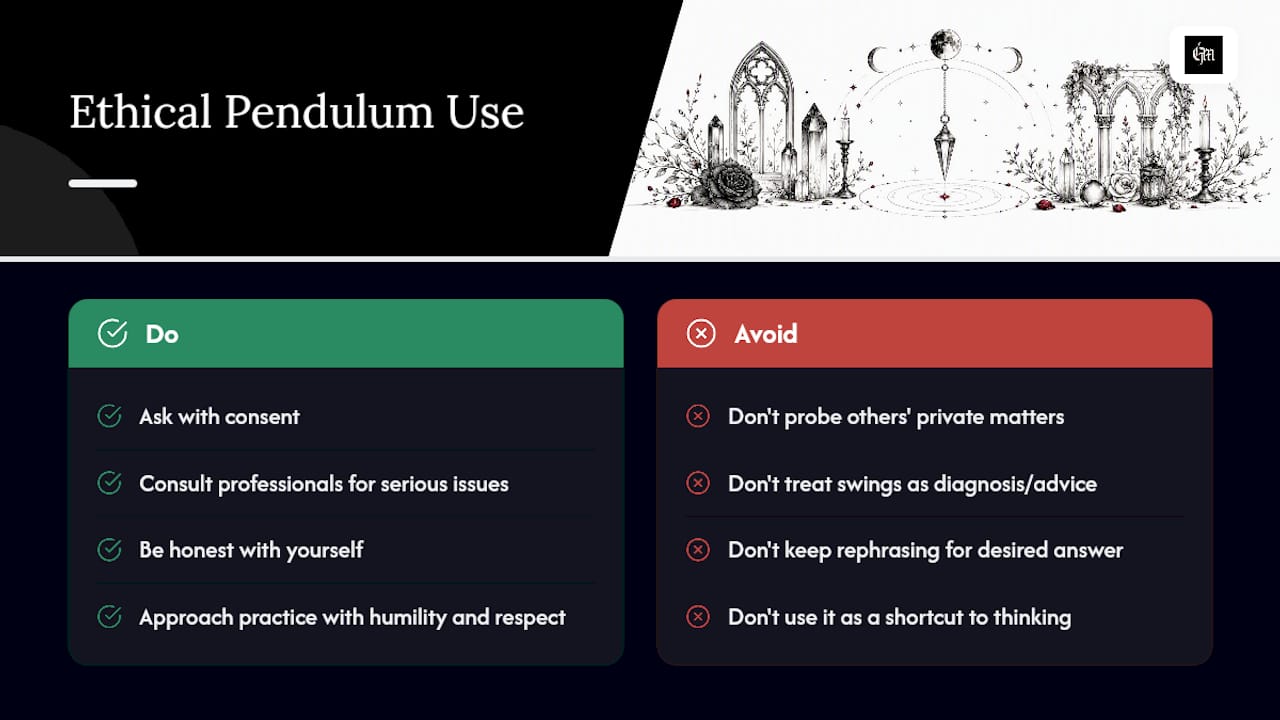
Dowsing carries real ethical weight once you move past casual personal questions. Asking a pendulum about someone else’s private decisions, health, or relationships without their knowledge crosses a line most experienced practitioners avoid, even when curiosity feels harmless in the moment.
Medical, legal, and financial questions deserve particular caution. A pendulum swing is not a diagnosis, a legal opinion, or investment advice, and treating it as one risks real harm. If a question touches on something a licensed professional should handle, get that professional involved and use the pendulum, if at all, only for how you feel about the situation, not as a substitute for expertise.
Honesty with yourself matters just as much as honesty with others. It’s tempting to keep asking a question until the answer matches what you wanted to hear. That’s not dowsing anymore; that’s confirmation bias wearing a costume. If you notice yourself rephrasing a question three or four times hoping for a different swing, that’s a signal to step away, not to keep pushing.
Respect extends to the practice’s origins, too. Dowsing traditions borrow from centuries of folk knowledge across many cultures. Approaching it with curiosity and humility, rather than treating it as a party trick, keeps the practice meaningful rather than hollow. The goal is better self-awareness and clearer decision-making, not a shortcut around the hard work of actually thinking things through.
How Do Practitioners Use Pendulums in Everyday Spiritual Practice?
Most dowsers I’ve spoken with about their routines don’t reserve the pendulum for big life decisions. It shows up in smaller, daily moments: a quick check before choosing between two errands, an alignment question during meditation, or a way to sense whether a room’s energy feels heavy before starting ritual work.
There’s also a therapeutic cousin worth knowing about: somatic pendulation, a technique used in trauma-informed body work that shifts attention between a difficult sensation and a safe, resourced feeling to build nervous system regulation. It’s practiced gently and with attention to safety, and it shares the same rhythmic, back-and-forth logic that makes hand-held pendulum work feel intuitive to so many people.
None of this replaces medical, legal, or financial advice. Use pendulum work as a complement to your own judgment, not a substitute for it. If you’re building out a starter kit, browsing beginner pendulum supplies is a reasonable next step once you’ve practiced calibration on a basic weight and string.
Where Can I Buy Beginner Pendulums and Kits?
Goth.Market carries a curated range of starter pendulums built for exactly the calibration and practice routine covered above. Neutral clear quartz pieces, simple metal cones, and full starter kits with a carrying pouch and cleansing notes are sold directly by independent vendors who specialize in occult and witchcraft supplies, not mass-produced imports.
When you’re browsing, pay attention to three things: listed weight, chain or cord length, and any vendor notes about material sensitivity (some stones shouldn’t touch water, for example). A neutral starter, something without heavy symbolic baggage, gives you the clearest read while you’re still learning your own swing patterns. Many listings include care instructions and cleansing guidance straight from the maker, which saves you the guesswork of matching a method to the material.
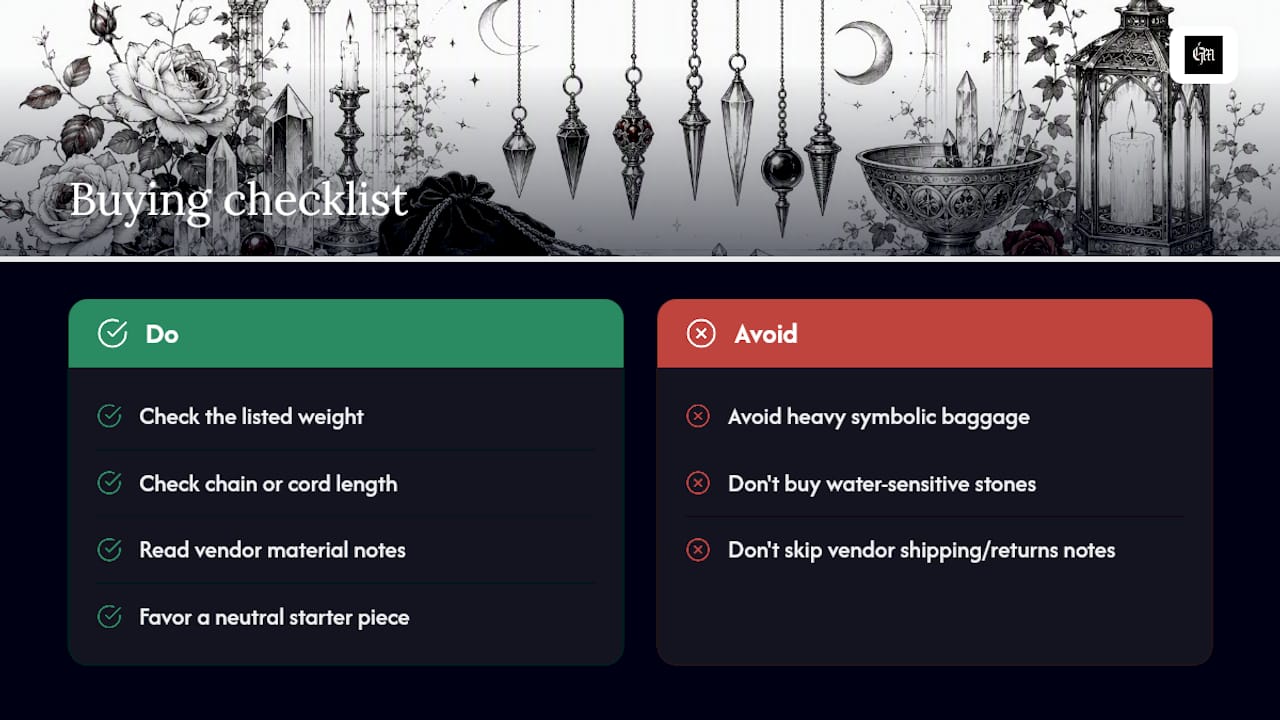
Curious about wearable pieces that double as makeshift pendulums, or want to round out your ritual space? Check the full occult jewelry and supply selection on Goth.Market, browse vendor notes on returns and shipping before you buy, and pick one piece to start practicing with this week.
Sources
- How to Use a Pendulum | Llewellyn Worldwide, Ltd.
- Pendulum Dowsing - Canadian Society of Dowsers
- Pendulation somatic exercise | PsychKit
- A Spiritual Guide on How to Use a Pendulum | Learn Religions
FAQ
What should I say before using my pendulum?
Set a short, clear intention out loud or silently, such as asking for honest and accurate answers for your highest good. Many practitioners also run the Can I? May I? Should I? check before any sensitive question to confirm the topic is appropriate to dowse.
What are the four laws of a pendulum?
There’s no single universally agreed “four laws” framework in mainstream dowsing literature, and definitions vary by teacher or tradition. If you encounter this phrase, treat it as one practitioner’s personal system rather than an established standard, and focus instead on the calibration and question-phrasing basics covered above.
How accurate is pendulum dowsing?
Accuracy isn’t proven or measurable in a scientific sense; the movement is best explained by the ideomotor effect, your own subconscious muscle response rather than an external force. Running a personal accuracy tally with verifiable questions over one to two weeks is the most honest way to gauge how reliable your own readings tend to be.
How do I learn pendulum dowsing?
Start by calibrating your yes, no, and maybe responses, then practice daily with simple, verifiable questions you can check afterward. A two-week practice routine of short daily sessions builds both skill and confidence faster than sporadic, unstructured attempts.
Can I use any object as a pendulum, or do I need a special one?
Any small weight on a string or chain works, including a ring on thread or a bead on a shoelace. Material affects the feel of the swing, but comfort and clarity matter more than crystal type when you’re just starting out.
Why is my pendulum not moving or giving inconsistent answers?
The most common causes are a tense hand, fatigue, or a chain that’s too long or too short for a clean swing. Relax your grip, rest for a few minutes, adjust the chain length, and recalibrate your yes/no/maybe before trying again.
Can pendulum dowsing answer medical or legal questions?
No. Pendulum work should never replace professional medical, legal, or financial advice, and questions in those categories deserve a qualified professional’s input first. Use the pendulum only for how you feel about a situation, not as a diagnostic or decision-making substitute in high-stakes matters.