

3 Simple Templates for Moon Phase Meanings and the 29.5 Day Cycle
Moon phase meanings map the 29.5-day lunar cycle onto a repeatable rhythm: new moon for setting intentions, waxing moon for building momentum, full moon for peak energy and assessment, and waning moon for release and rest. Each of the eight phases carries its own symbolic role in ritual practice, from journaling prompts to small altar rituals. This guide breaks down what each phase means, how to plan a simple month-long practice around it, and where astronomy ends and symbolism begins.
TL;DR:
- The lunar cycle’s eight phases each serve distinct symbolic roles, from planting intentions at the new moon to resting during the waning crescent, guiding a simple monthly practice.
- Exact timing of phases varies by location, so consult specific moonrise and moonset data to align rituals with astronomical reality, especially for group ceremonies.
- The full moon occurs once every month, making it common and not inherently more powerful, while phenomena like blue moons or supermoons are rare but purely astronomical events.
- Moon sign interpretations add nuance but are best introduced after mastering the basic phase rhythm, as they introduce additional complexity and variables.
- Using moon cycles for reflection and goal-setting is effective without a spiritual framework, and minimal tools like a journal and calendar are sufficient to start a personal practice.
Table of Contents
- What Do the Eight Moon Phases Mean?
- How Can I Plan a Simple Month-Long Moon Practice?
- What Is the Astronomical Basis Behind Moon Phase Timing?
- How Does a Moon Sign Change the Meaning of a Phase?
- How Have Different Cultures Interpreted Moon Phases?
- What Common Myths Get Told About Moon Phases?
- How Do I Actually Use This in Practice?
- Where Can I Find Moon-Themed Ritual Pieces?
- Sources
- FAQ
What Do the Eight Moon Phases Mean?
Every lunar month cycles through eight recognizable phases, and each one has picked up its own symbolic job over centuries of folk practice. None of this is prescriptive. Think of these as starting points you adapt, not rules you follow.
New Moon. The sky shows no illuminated moon at all, because the moon sits between Earth and the sun with its lit side facing away from us. Symbolically, this is the blank page: the moment for planting an intention before anything has sprouted. Try this: write a single sentence starting with “I am beginning…” and tuck it somewhere you’ll see it in two weeks. A dark candle or a small obsidian piece on your altar reinforces the “starting from nothing” feeling, if that kind of object helps you focus.
Waxing Crescent. A thin sliver appears in the western sky after sunset, growing a little each night. This phase symbolizes early momentum. It’s the friend who shows up to help you carry the first few boxes. Journaling prompt: “What’s one small action that moves my new-moon intention forward this week?” Keep it to one action. Overcommitting here is the most common way people abandon a lunar practice by day five.
First Quarter. Half the visible disk is lit, and the moon sits high in the evening sky around sunset. This is the traditional “friction point” phase, symbolizing the tension between the intention you set and the resistance you’re now meeting. Adapt or push through? That’s the actual question this phase poses. A short ritual: list one obstacle and one workaround, out loud, before bed.
Waxing Gibbous. More than half lit, almost full, this phase symbolizes refinement rather than raw effort. You’re not starting anymore, you’re adjusting. Try a “what am I missing” journal entry rather than a new goal. Some practitioners use this phase for editing, revising, or fine-tuning a project rather than launching one.
Full Moon. The moon rises at sunset and sits opposite the sun, fully illuminated, according to NASA’s overview of lunar phases. This is the culmination phase, the one most cultures agree on: peak visibility, peak energy, and traditionally the moment for celebration, illumination, or release, depending on which tradition you’re drawing from. Two valid uses here: celebrate what you built, or burn a piece of paper naming what you’re ready to release. Both are legitimate; pick based on where you actually are.
Waning Gibbous. Just past full, still bright, this phase symbolizes gratitude and disseminating what you’ve learned. Some call it the “teaching moon.” A simple practice: write down one thing this cycle taught you and share it with someone, even briefly.
Last Quarter (Third Quarter). Half lit again, but now on the opposite side from first quarter. This phase symbolizes release and forgiveness, the clearing-out before the cycle resets. A five-minute exercise: list three things (habits, grudges, clutter) you’re ready to let go of, then physically discard or delete one of them.
Waning Crescent. A thin sliver again, this time rising just before dawn. This is the rest phase, the one people skip most often because it doesn’t produce anything visible. Symbolically, it’s the fallow field. Journaling prompt: “What do I need to rest from before the next new moon?” No action item. That’s the point.
One timing note worth flagging: the new moon isn’t just symbolically invisible, it’s actually invisible from Earth most of the time, while the full moon is the one phase reliably visible at a predictable time (sunset) almost anywhere with a clear horizon. That difference shapes when group rituals actually work logistically.
How Can I Plan a Simple Month-Long Moon Practice?
A lunar-month practice doesn’t need to be elaborate. It needs to be repeatable, which is the part most people get wrong by starting too big in week one.
- New moon (day 1). Write one intention sentence: “This cycle, I am focusing on ___.” Keep it to under 15 words.
- Waxing crescent through first quarter (days 2 to 9). Pick one action per week that moves the intention forward. Log it in three lines: what you did, what got in the way, what you’ll try next.
- First quarter check-in (around day 7 or 8). Ask yourself three questions: Is this intention still accurate? What’s the one obstacle? What’s one workaround? Adjust the intention if needed. That’s normal, not failure.
- Full moon (around day 14 or 15). Assess. Either celebrate progress with a small ritual (lighting a candle, reading your journal entries aloud) or do a release ritual if the intention has run its course early.
- Waning phases (days 16 to 26). Do the clearing work: the third-quarter release list, the gratitude note, whatever needs letting go before the next cycle.
- Waning crescent (final days). Rest. Skip the journaling if you want. This is deliberate downtime built into the structure.
Pro Tip: Exact phase timing shifts by a day or two each month and depends on your location, so don’t rely on memory or a generic monthly guess. Check a moonrise and moonset calculator or an astronomy site for your specific date and time zone, and never use lunar symbolism as your sole basis for a major legal or financial decision. Ritual timing is a personal framework, not a substitute for professional advice.
The three templates worth keeping on hand: the one-line intention sentence, the three-question check-in, and the five-minute release list. Everything else in a lunar practice is optional decoration around those three tools.
What Is the Astronomical Basis Behind Moon Phase Timing?
The moon is always half lit by the sun. What changes is our angle of view as the moon orbits Earth, and that full orbit, called a lunation, takes about 29.5 days according to the Lunar and Planetary Institute’s SkyTellers program. That 29.5-day cycle is where the eight-phase framework comes from, and it’s the same cycle astronomers, educators, and ritual practitioners are all technically referring to, even when they mean very different things by it.
29.5 days is the number to remember: it’s the length of one full lunation, from new moon to new moon, and it’s the basis for every phase calendar and moon-tracking app you’ll encounter.
Moonrise and moonset patterns shift predictably with each phase. A first-quarter moon rises around noon and sets around midnight, sitting high in the evening sky, while a full moon rises at sunset and sets at sunrise, according to NASA’s Space Place. That’s why full-moon rituals held at sunset tend to feel more dramatic: the timing lines up with when the moon is actually visible for most people.
One distinction worth knowing: “new moon” and “dark moon” get used interchangeably in casual conversation, but some practitioners split them. Dark moon refers to the one or two nights right before the moon becomes visible again as a crescent, treated as a slightly different, more introspective window than the exact astronomical new moon moment. Astronomy gives you the scheduleable fact. Symbolism is the interpretive layer you build on top of it.
How Does a Moon Sign Change the Meaning of a Phase?
A moon sign refers to the zodiac constellation the moon is passing through on a given day, separate from its phase. The simplest way to think about it: phase tells you when, sign tells you how. A new moon is always a beginning, but a new moon in Aries pushes toward bold, fast, action-oriented beginnings, while a new moon in Pisces favors intuitive, creative, or emotionally-driven ones. A new moon in Virgo, by contrast, tends to favor practical, detail-focused intentions over sweeping ones.
If you’re new to this, skip the sign layer entirely for at least one full cycle. Get comfortable with phase-only practice first. Adding moon signs before the basic rhythm feels automatic just gives you more variables to track and more reasons to quit. Layer it in once the new-moon-to-new-moon structure feels like second nature.
How Have Different Cultures Interpreted Moon Phases?
Moon symbolism didn’t originate with modern witchcraft. Agricultural calendars across ancient Babylon, Egypt, and China tracked lunar months to time planting and harvest, long before anyone framed it as spiritual practice. The full moon in particular shows up across unrelated cultures with strikingly similar associations: harvest, culmination, and heightened visibility, which makes sense given it’s the one phase visible at a predictable hour almost everywhere.
Modern Wiccan and neo-pagan traditions popularized the specific new-moon-to-full-moon ritual structure many people use today, but they borrowed heavily from older folk astrology and agrarian calendars rather than inventing the framework from scratch. Chinese lunar calendars, by contrast, organize entire festivals (including the Mid-Autumn Festival) around the full moon’s timing rather than treating it as one ritual moment among many. Hindu and Islamic calendars use lunar cycles structurally, for calculating months and religious observances, which is a different use case entirely from Western moon-phase ritual work.
The takeaway: the eight-phase framework is astronomically universal, but the meaning attached to each phase is not. What you’re practicing when you do a “release ritual” on the last quarter moon is closer to a modern synthesis than an unbroken ancient tradition, and that’s fine. Most spiritual practices are living things, not museum pieces.
What Common Myths Get Told About Moon Phases?
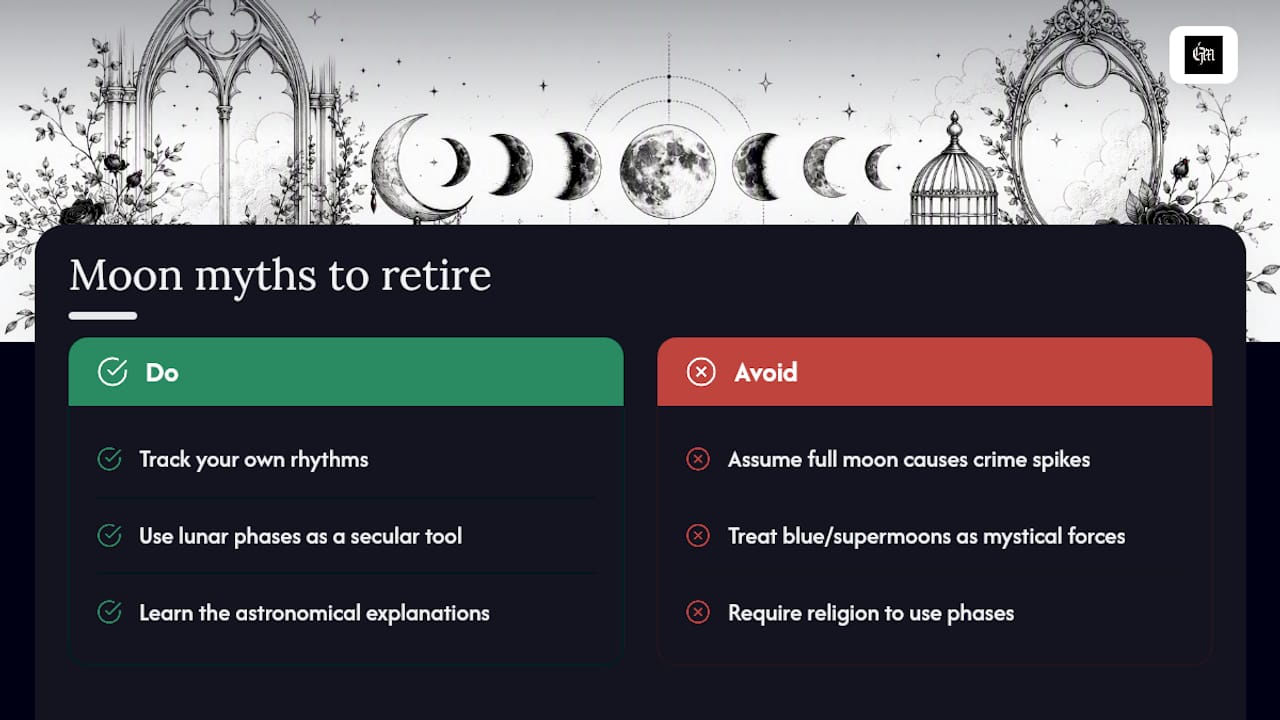
The biggest misconception: that a full moon is astronomically rare or unusually powerful compared to other phases. It isn’t. A full moon happens every lunation, roughly every lunar month, like clockwork. What is genuinely less common is a “blue moon,” defined as a second full moon within one calendar month, which happens roughly every two and a half years, and a “supermoon,” which occurs when a full moon coincides with the moon’s closest approach to Earth in its orbit, according to National Geographic’s coverage of full moons. Both have clean astronomical explanations. Neither is mystical.
Another persistent myth: that the moon’s phase causes measurable spikes in crime, hospital admissions, or erratic behavior. Large-scale reviews of hospital and crime data have repeatedly failed to find a reliable link, despite the popularity of the “lunar effect” idea. That doesn’t mean the full moon doesn’t affect you personally. Plenty of people report better sleep or a mood shift around it, and there’s nothing wrong with tracking your own patterns. It just means the effect isn’t the universal, provable phenomenon folklore claims it to be.
A third myth worth retiring: that you need a religious framework to use moon phases meaningfully. Treating the lunar cycle as a structure for marking beginnings, progress, and rest works as a secular mindfulness tool just as well as a spiritual one. The calendar doesn’t care what you believe about it.
How Do I Actually Use This in Practice?
I keep this simple: one intention written down at the new moon, a three-line check-in every week, and a deliberate rest period during the waning crescent when I don’t journal at all. That’s the entire system. Everything else I’ve read about moon phase meanings over the years, the elaborate correspondences, the phase-specific candle colors, the sign layering, is optional seasoning on top of that basic structure.
Where people go wrong isn’t skepticism, it’s over-engineering. They try to track eight phases, four elements, twelve signs, and a correspondence chart in month one, and they quit by the second new moon because it feels like homework. The framework only works if it’s lighter than your resistance to doing it. Start with the phase alone. Add texture later, if you want it at all. For readers who want more on the symbolism behind specific pieces, Goth and its breakdown of witchy design motifs both go deeper into how symbols translate into physical objects.
— Rey
Where Can I Find Moon-Themed Ritual Pieces?
You don’t need a single object to run this practice. A blank notebook and a phone calendar cover the essentials. That said, plenty of people find that a physical object, something you touch during the new-moon check-in or wear through the waning phase, makes the practice feel more deliberate rather than just another to-do list item.
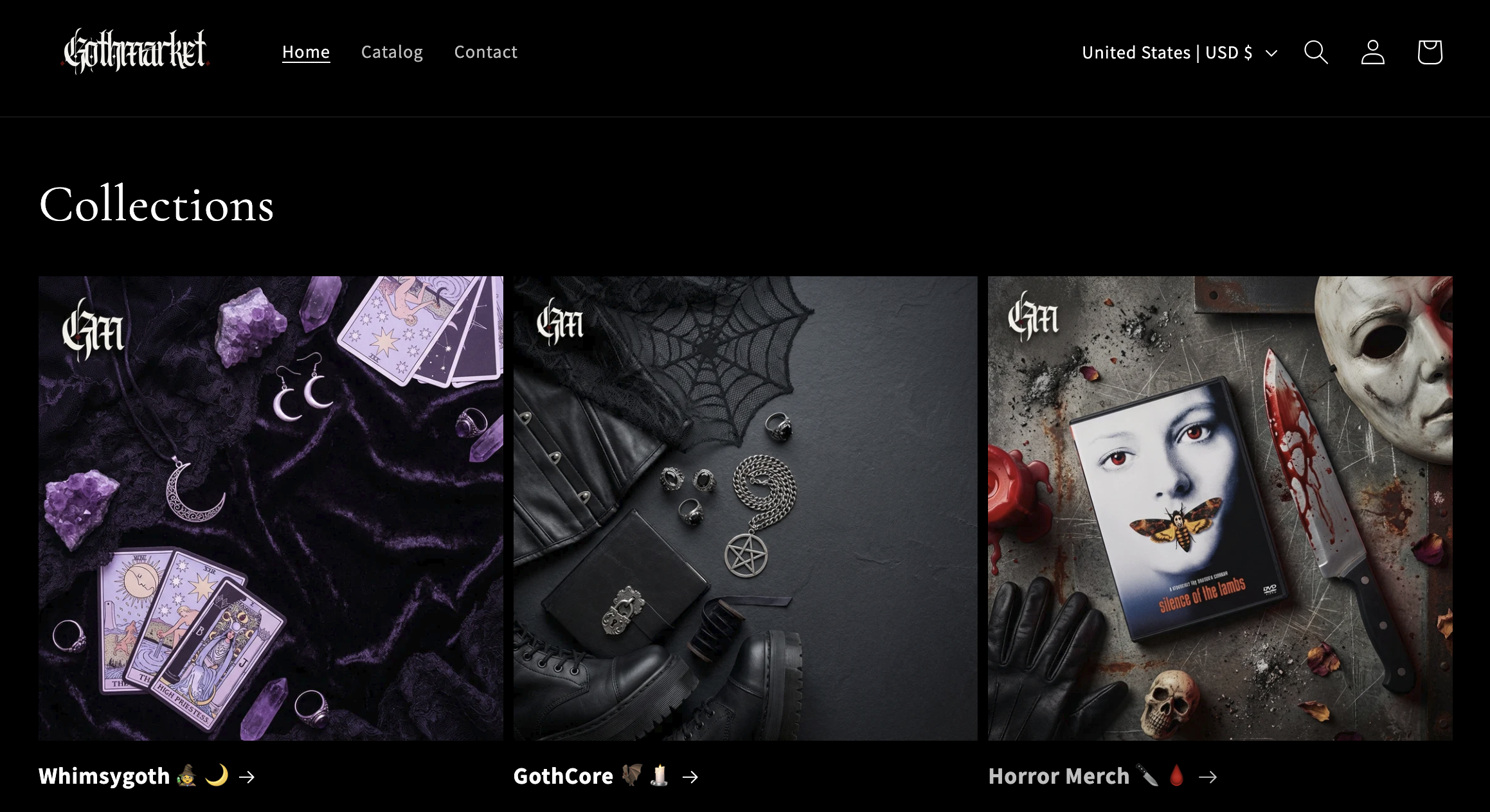
An online marketplace carries moon phase jewelry made by independent creators, from crescent pendants to full-moon phase rings, alongside altar cloths, taper candles, and small charms sized for a nightstand or a shelf. Every piece comes from an independent vendor working in gothic and occult design rather than a mass-market supplier, so what you find tends to look nothing like what’s on a big-box shelf. If you’re partial to lunar-inspired fiction and art as well, Maroon House Press’s lunar-themed collection is worth a look for the creative side of moon symbolism. If you want to browse curated ritual pieces to build out your own new-moon-to-full-moon practice, start with Goth and see what fits your altar.
Sources
- Moon phases — NASA Science
- Moon phases — LPI SkyTellers
- Moon phases — NASA Space Place
- Full moon — National Geographic
FAQ
What is the most powerful moon phase?
Most traditions point to the full moon as the most symbolically potent phase, since it’s the point of peak illumination and peak visibility in the cycle. Astronomically, though, no phase is more “powerful” than another. Each one plays a distinct role, and the new moon is arguably just as important since it’s where every intention actually starts.
Which moon phase is the rarest?
No standard phase is rare since all eight occur every single lunation. What’s actually rare is a blue moon, a second full moon within one calendar month, which happens roughly every two and a half years, and a supermoon, which requires a full moon to align with the moon’s closest orbital approach to Earth.
What moon phase are we in right now and what does it mean?
Check a current lunar calendar or moon-tracking app for today’s exact phase, since it shifts daily and depends on your date. Once you know the phase, match it to the eight-phase meanings in this guide: new moon for beginnings, full moon for culmination, and the phases in between for building, refining, releasing, or resting.
How do moon phases affect emotions?
Large studies on hospital admissions and crime data have not found a consistent, provable link between moon phase and behavior. Many people still notice personal shifts in sleep or mood around the full moon in particular, and tracking your own patterns in a journal is a reasonable way to find out if that’s true for you.
What’s the difference between waxing and waning phases?
Waxing means the illuminated portion of the moon is growing, moving from new toward full, and it’s associated with building, growth, and forward action. Waning means the illuminated portion is shrinking, moving from full back toward new, and it’s associated with release, clearing, and rest.
What does moon jewelry symbolize?
Moon jewelry, whether a crescent pendant, a full-moon disc, or a piece showing all eight phases in sequence, typically symbolizes cycles, intuition, and the wearer’s connection to a personal rhythm of change. Many people choose a piece tied to the phase they were born under or the phase they most associate with their current life stage.
Do I need to be a witch to use moon phase rituals?
No. Tracking the lunar cycle for intention-setting and reflection works as a secular mindfulness practice, with no religious framework required. Many people use the new-moon-to-full-moon structure purely as a personal goal-setting rhythm, similar to how others use a weekly planner.
What’s the difference between a new moon and a dark moon?
Astronomically, they refer to the same exact moment: when the moon sits between Earth and the sun, invisible from Earth. Some practitioners distinguish “dark moon” as the one or two nights just before the new moon becomes visible again, treating it as a slightly more introspective window than the precise new moon.