

Crystal Correspondences for Practitioners: Meanings and Care Notes
Crystal correspondences are the traditional system of matching specific stones to intentions, chakras, and elements based on color, energy, and cultural precedent. Rose quartz corresponds to love, black tourmaline to protection, clear quartz to amplification, and amethyst to spiritual clarity. These pairings come from centuries of ritual practice and color symbolism rather than laboratory testing.
TL;DR:
- The effectiveness of crystal correspondences relies on cultural symbolism and tradition, not scientific validation, requiring personal intuition for best results.
- Choosing the right stone involves prioritizing the intention, verifying treatment disclosures, and selecting the appropriate form for daily use or ritual practices.
- Be cautious about physically incompatible stones, such as soaking selenite in water, and avoid pairing conflicting intentions like high-energy citrine with calming amethyst.
- Most popular crystals like amethyst, clear quartz, and rose quartz are durable enough for regular handling, but soft or treated stones need careful care and storage.
- Reputable sources disclose treatment details, and buyers should focus on provenance and mineral properties to ensure the stone matches its symbolic purpose.
Table of Contents
- What Are Crystal Correspondences, Exactly?
- How Are Crystal Meanings and Correspondences Determined?
- How Do You Choose the Right Crystal for a Ritual?
- Which Crystals Should Not Be Combined?
- Which Crystals Match the Seven Chakras?
- How Do You Care for and Verify Crystals Safely?
- What Do the Most Popular Crystals Mean? An A-Z Reference
- How Does Goth.Market Approach Crystal Correspondences?
- Where Can You Find Curated Occult Crystals and Ritual Jewelry?
- Sources
- FAQ
What Are Crystal Correspondences, Exactly?
A quick reference chart is the fastest way to match an intention to a stone, so here’s one built around the eight goals practitioners search for most. Each entry lists a primary pick, a backup or two, and the color or elemental tag that explains the logic behind the pairing.
- Love and self-worth: Rose quartz (pink, Water), Garnet (deep red, Fire), Rhodonite (pink and black, Water)
- Protection: Black tourmaline (black, Earth), Obsidian (black, Fire/Earth), Hematite (metallic gray, Earth)
- Grounding: Hematite (metallic, Earth), Smoky quartz (brown, Earth), Black tourmaline (black, Earth)
- Abundance: Citrine (golden, Fire), Pyrite (metallic gold, Earth), Green aventurine (green, Earth)
- Clarity and focus: Clear quartz (colorless, Ether), Fluorite (purple/green, Air), Labradorite (blue flash, Water)
- Intuition: Moonstone (white/gray sheen, Water), Labradorite (iridescent, Water), Amethyst (purple, Ether)
- Calm and stress relief: Amethyst (purple, Air), Blue lace agate (pale blue, Air), Selenite (white, Ether)
- Courage: Garnet (red, Fire), Carnelian (orange, Fire), Tiger’s eye (golden brown, Fire)
Clear quartz shows up as an honorable mention in almost every category. Practitioners call it a “master stone” because it’s said to amplify whatever intention it’s paired with rather than carrying one fixed meaning of its own, a point echoed across most major crystal reference guides.
Statistic Callout: A large share of the citrine sold commercially is actually heat-treated amethyst or smoky quartz. Natural citrine exists but is far less common on the market, and the AGTA Gemological Information Manual notes that heat treatment is standard industry practice requiring disclosure. If you’re buying citrine specifically for its “natural sunlight” correspondence, ask the seller whether it’s heat-treated. Both versions work symbolically for most practitioners, but purists who want untreated stones for correspondence work should always ask first.
One thing worth flagging: these mappings aren’t universal law. Different traditions assign different stones to the same intention, and that’s normal, not a contradiction.
How Are Crystal Meanings and Correspondences Determined?
Correspondences get built from four overlapping systems, not one formula, as explained in Your Galactic Signature Meaning: Decode Your Cosmic Identity. Color resonance is the most intuitive: a red stone like garnet reads as fire and vitality, a blue stone like lapis reads as calm and communication, largely because these color associations mirror the chakra color spectrum used in energy healing.
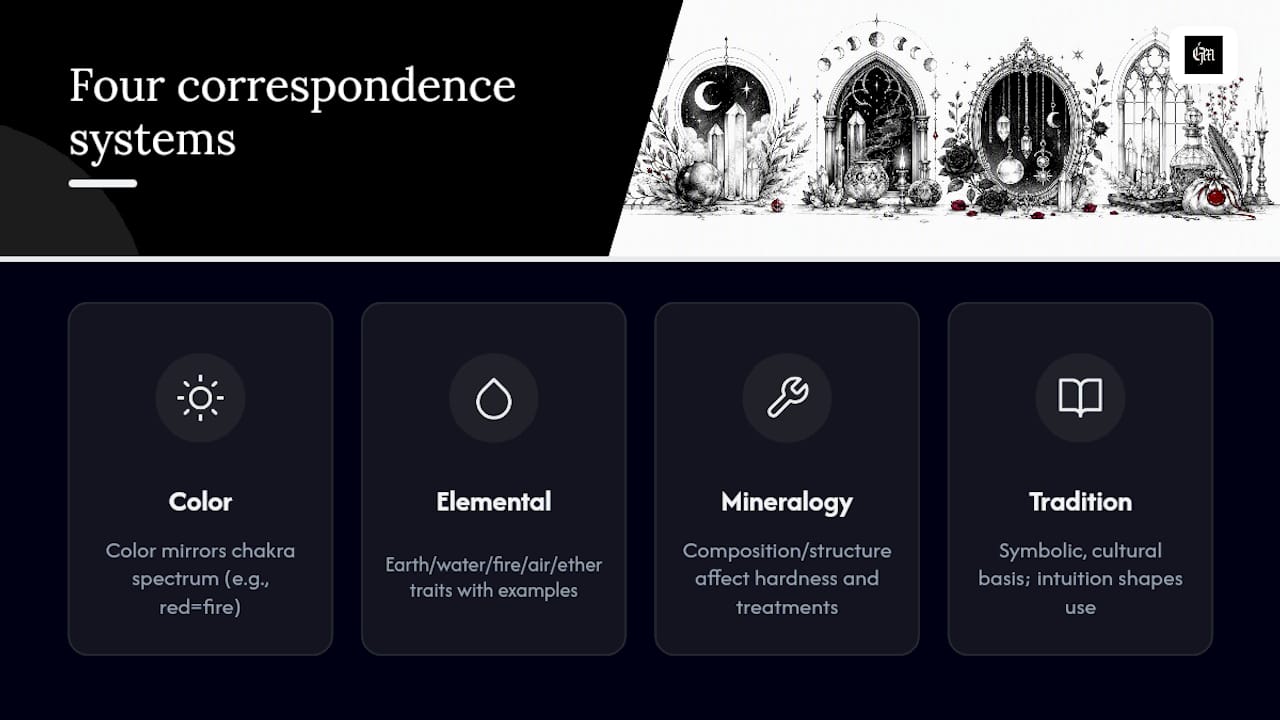
Elemental affinity layers on top of color. Earth stones (hematite, black tourmaline) tend to be dense and grounding. Water stones (moonstone, labradorite) often have a sheen or flow to their appearance. Fire stones (carnelian, garnet) run warm in tone. Air stones (amethyst, fluorite) are often lighter or translucent, and Ether stones (clear quartz, selenite) are typically colorless or white, standing in for the unseen or spiritual plane.
Mineralogy matters more than most beginners expect. A stone’s chemical composition and crystal structure determine its hardness, clarity, and how it reacts to treatments like heat or irradiation. These processes can shift a stone’s color entirely, which is why treatment disclosure matters for correspondence work: a heat-treated stone still carries meaning, but some practitioners specifically want the untreated version to match traditional charts, as reference gemology sources point out.
None of this is scientifically validated. Correspondences are symbolic and cultural, built on tradition and repeated use rather than tested cause and effect, and intuition plays a real role in how individual practitioners adapt them.
How Do You Choose the Right Crystal for a Ritual?
Start with the intention, not the stone. Decide what you’re actually trying to do, whether that’s protection, love, grounding, or clarity, then pull two or three candidates from a quick reference chart instead of grabbing the prettiest rock on the shelf.
- Define the intention first. Write it down in one sentence before you shop.
- Shortlist 2 to 3 stones using color, element, and chakra tags as your filter.
- Check the Mohs hardness. Selenite and calcite score around 2 to 3.5, meaning they scratch easily and shouldn’t sit loose in a bag with harder stones, per USGS mineral data.
- Ask about treatments and provenance. A transparent seller will tell you if a stone is heat-treated, dyed, or irradiated.
- Decide the form. Raw chunks suit altar work, tumbled stones suit pocket carrying, and jewelry settings suit stones you want on your body daily.
Pro Tip: If you’re buying for daily wear, choose a harder stone (quartz-family, garnet, tourmaline) over a soft one like selenite or calcite. Soft stones chip and dull fast against skin, clothing, and metal settings.
Once you know the form you want, checking how a piece is set and cared for matters just as much as the stone itself.
Which Crystals Should Not Be Combined?
Pairing rules run on two tracks: symbolic and physical. Symbolically, complementary intentions blend well, and clear quartz can be added to almost any pairing to amplify the combined effect.
- Good pairing: Rose quartz (love) with hematite or black tourmaline (grounding), for opening the heart without becoming overwhelmed.
- Good pairing: Black tourmaline (protection) with clear quartz or fluorite (clarity), for a shielded but clear-headed working.
- Physical caution: Never soak selenite in water. It’s a form of gypsum and will dissolve or flake.
- Physical caution: Avoid making gem elixirs (water infused directly with stones) unless you know the mineral is non-toxic and non-porous, since crystal safety references flag several common minerals as risky for direct water contact.
- Symbolic mismatch: Pairing a high-energy stone like citrine with a deeply calming stone like amethyst for the same ritual can feel muddled; pick one dominant intention per working.
Which Crystals Match the Seven Chakras?
Chakra mapping gives each of the seven energy centers a primary stone based on color correspondence, and most practitioner guides land on a similar starter set.
- Root chakra: Red jasper or black tourmaline. Grounding, red/black tones anchor to the earth element.
- Sacral chakra: Carnelian. Orange tone matches creativity and emotional flow.
- Solar plexus chakra: Citrine. Golden color ties to confidence and personal power.
- Heart chakra: Rose quartz. Soft pink resonates with compassion and self-love.
- Throat chakra: Lapis lazuli. Deep blue supports clear communication.
- Third eye chakra: Amethyst. Purple links to intuition and insight.
- Crown chakra: Clear quartz. Colorless and said to connect to higher consciousness.
This starter set appears consistently across chakra and gemstone guides, though some traditions swap in alternates like moonstone for the sacral chakra or selenite for the crown. A simple five-minute practice: lay the seven stones along your body from root to crown while lying down, breathe slowly, and hold your attention on each chakra for about 30 seconds before moving to the next.
How Do You Care for and Verify Crystals Safely?
Water, sun, and heat exposure damage certain stones outright, and a few carry real toxicity risks worth knowing before you handle or store them.
- Water-sensitive: Selenite (dissolves), Malachite, Turquoise, and Opal (can crack or lose luster).
- Sun-sensitive: Amethyst and Rose quartz can fade with prolonged direct sunlight.
- Toxicity caution: Malachite and Galena contain copper or lead compounds. Never make elixirs or let them contact food or drink, per crystal safety reference notes.
- Treatment disclosure: Heat treatment, irradiation, and dyeing are common in the gem trade and legal to sell, but reputable sellers disclose them, per gemological trade standards.
- Cleaning: Wipe most stones with a soft, dry cloth. Skip water for the sensitive stones listed above and store softer stones separately to avoid scratching.
Statistic Callout: The Mohs hardness scale, developed to rank mineral scratch resistance, puts quartz-family stones (amethyst, citrine, clear quartz) at 7, while selenite sits around 2, according to USGS mineral data. That five-point gap is why the two should never be stored loose in the same pouch.
What Do the Most Popular Crystals Mean? An A-Z Reference
This mini-directory covers the stones people search for most, matching what readers expect from a crystal glossary: a fast meaning, a chakra or element tag, and a care note.
- Amethyst: Spiritual clarity and calm; Third eye chakra / Air; can fade in direct sunlight.
- Black Tourmaline: Protection and grounding; Root chakra / Earth; very durable, safe for daily carry.
- Citrine: Abundance and confidence; Solar plexus chakra / Fire; often heat-treated, ask before buying “natural.”
- Clear Quartz: Amplification and clarity; Crown chakra / Ether; durable, safe near water briefly but not for soaking.
- Garnet: Courage and vitality; Root chakra / Fire; hard and durable, good for jewelry.
- Labradorite: Intuition and transformation; Third eye chakra / Water; moderately durable, avoid harsh chemicals.
- Moonstone: Intuition and new beginnings; Sacral chakra / Water; can scratch, store separately from harder stones.
- Obsidian: Protection and shadow work; Root chakra / Fire and Earth; glassy, chips easily on edges.
- Rose Quartz: Love and compassion; Heart chakra / Water; can fade in strong sun, otherwise low maintenance.
- Selenite: Cleansing and clarity; Crown chakra / Ether; never expose to water, it will dissolve.
- Carnelian: Creativity and courage; Sacral chakra / Fire; durable, good for everyday wear.
- Lapis Lazuli: Communication and truth; Throat chakra / Air; moderately soft, avoid harsh cleaning agents.
- Hematite: Grounding and focus; Root chakra / Earth; magnetic in some forms, keep away from electronics.
- Fluorite: Mental clarity and focus; Third eye chakra / Air; soft and brittle, handle gently.
- Smoky Quartz: Grounding and stress relief; Root chakra / Earth; durable, good for daily use.
- Pyrite: Abundance and willpower; Solar plexus chakra / Fire and Earth; avoid moisture, it can oxidize.
- Tiger’s Eye: Courage and personal power; Solar plexus chakra / Fire; durable and easy to wear daily.
- Rhodonite: Emotional healing; Heart chakra / Water; moderately soft, store away from harder stones.
- Green Aventurine: Luck and abundance; Heart chakra / Earth; durable, low maintenance.
- Blue Lace Agate: Calm communication; Throat chakra / Air; durable, minimal care needed.
How Does Goth.Market Approach Crystal Correspondences?
Author Rey writes Goth.Market’s crystal content by cross-referencing traditional correspondence charts against gemological sourcing notes, because a stone’s symbolic meaning and its physical properties both matter to buyers. Goth.Market’s community sellers are asked to disclose treatments and provenance directly in listings, so shoppers can weigh a stone’s tradition-based meaning alongside real information about what they’re actually purchasing. Treat any chart, including this one, as a starting point. Intuition and personal practice still count.
— Rey
Where Can You Find Curated Occult Crystals and Ritual Jewelry?
An online marketplace solves the problem this guide addresses: finding stones and jewelry where listings provide clear details about the items. Instead of scrolling generic mass-market shops with vague “healing crystal” labels, you get curated pieces from independent sellers who write real descriptions, covering the stone, its correspondence, and, where relevant, how it was treated.

Shoppers browsing for ritual crystals, occult jewelry, or dark-aesthetic decor can find community-focused catalogs featuring sellers knowledgeable about their materials. If you’re ready to build out an altar set or find a piece that matches the correspondence you just picked, Goth and filter by the intention or stone type you settled on above.
Sources
For physical properties and mineral safety, the USGS gemstones and minerals report is the most reliable government-backed reference. For treatment disclosure standards, the AGTA Gemological Information Manual covers what reputable sellers should tell you. For deeper chakra and elemental theory, the gemstone guide for energy healing and Crystals.com’s meaning guide both offer solid starting points beyond this article.
- AGTA Gemological Information Manual (2026)
- Crystals
- Crystal Reference Chart: Meanings, Chakras, Colors & Safety | Crystal Meanings
- Crystals and Chakras · A Gemstone Guide for Energy Healing
FAQ
What Does Each Crystal Symbolize?
Each crystal’s symbolism comes from a mix of color, element, and cultural tradition. Rose quartz symbolizes love through its pink Water tone, black tourmaline symbolizes protection through its dense black Earth tone, and clear quartz symbolizes amplification and clarity because it’s colorless and associated with the Ether element.
Which Crystals Should Not Be Together?
Selenite should never contact water, and soft or porous stones shouldn’t be stored loose with harder stones like quartz or garnet, since the harder stone will scratch the softer one. Symbolically, avoid combining high-energy stones like citrine with deeply calming ones like amethyst in the same working, since the intentions can cancel each other out.
What Are the 7 Main Types of Crystals?
There’s no single fixed list of “7 main crystals,” but a common starter set used across chakra mapping includes clear quartz, amethyst, rose quartz, citrine, black tourmaline, carnelian, and lapis lazuli. This set covers all seven chakras and most common intentions like love, protection, clarity, and abundance.
What Are the 12 Crystals Often Referenced in Guides?
Different sources define popular crystal groups differently, so there isn’t one agreed-upon canonical list. Most expanded reference charts build on the seven-chakra starter set above and add stones like moonstone, labradorite, garnet, obsidian, selenite, and hematite to round out a broader working collection.
How Do You Cleanse and Charge a Crystal?
Wipe most stones with a soft, dry cloth rather than water, especially for water-sensitive stones like selenite or malachite. Many practitioners also charge stones under moonlight or place them near (not directly under) selenite, which is traditionally believed to cleanse other stones without needing sunlight or water.
Can You Use Crystals Safely if You Have No Prior Experience?
Yes, most tumbled or jewelry-grade crystals are safe to hold, carry, or place on an altar with no special training. The main risks are physical, like scratching soft stones or exposing water-sensitive ones to moisture, not any danger from the stone’s energy itself.
Is There Scientific Evidence Behind Crystal Healing?
No controlled scientific evidence supports crystal healing as a physical treatment mechanism. Crystal correspondences function as a symbolic and traditional framework for focusing intention, built on color, cultural precedent, and repeated ritual use rather than tested cause and effect.