

Ring Size Guide: How to Measure Accurately at Home
Measure your finger’s circumference with a narrow paper strip or a reusable plastic belt sizer, not the outside of an existing ring. A US size 7, one of the most common women’s sizes, has an interior diameter of about 17.3 mm and a circumference of around 54.4 mm. A size 10, common for men, measures roughly 19.8 mm across and 62.1 mm around.
If you print a paper sizer, check it before you trust it:
- Print at 100% scale, never “fit to page.”
- Measure the sizer’s printed sample line (usually 50 mm or 0.7 in) with a ruler.
- If that line reads short or long, reprint or switch to the strip method.
Key Takeaways
Accurate ring sizing at home comes down to measuring finger circumference with a verified tool, confirming the reading twice, and checking any printed sizer against a ruler before trusting it.
| Point | Details |
|---|---|
| Use circumference, not outside dimensions | Measure the finger’s circumference with a paper strip or belt sizer, not the outside of a ring. |
| Verify any printed sizer | Measure the printed calibration line against a ruler before cutting out a paper sizer. |
| Confirm with a second method | Cross-check a paper strip reading against a belt sizer or an existing ring’s interior diameter. |
| Adjust for knuckles and wide bands | Size up for bands wider than 6 mm and for a knuckle notably larger than the finger base. |
| Browse sized pieces on Goth.Market | Goth.Market lists specific sizing notes on curated rings, including wider styles that run snug. |
Table of Contents
- How Do You Convert Ring Measurements to a US Size?
- What’s the Best Way to Measure Ring Size at Home?
- How Do You Check a Printable Ring Sizer for Errors?
- What Do You Do About Knuckles, Wide Bands, or Temperature?
- What’s the Average Ring Size for Women and Men?
- How Do UK, European, and Japanese Ring Sizes Compare to US Sizes?
- What Actually Matters Most When You Size a Ring at Home?
- Sources
- FAQ
How Do You Convert Ring Measurements to a US Size?
Once you have a circumference or diameter in millimeters, converting to a US size is a lookup, not a calculation. Standard US sizing runs from about size 3 up to size 13.5 at most retailers, though some vendors stock a narrower range.
| US Size | Diameter (mm) | Circumference (mm) |
|---|---|---|
| 3 | 14.1 | 44.2 |
| 4 | 14.9 | 46.8 |
| 5 | 15.7 | 49.3 |
| 6 | 16.5 | 51.9 |
| 7 | 17.3 | 54.4 |
| 8 | 18.1 | 57.0 |
| 9 | 19.0 | 59.5 |
| 10 | 19.8 | 62.1 |
| 11 | 20.6 | 64.6 |
| 12 | 21.4 | 67.2 |
| 13 | 22.2 | 69.7 |
If your measurement falls between two rows, round up rather than down. A snug ring is harder to live with than a slightly loose one, since a loose ring can still be worn with a resizing bead while an overly tight one has to go back to the jeweler immediately. Treat this chart as a strong starting point, then cross-check it against the specific seller’s own size chart before you order. Manufacturing tolerances vary enough between brands that a “7” from one designer can measure closer to a 6.75 from another.
What’s the Best Way to Measure Ring Size at Home?
Three methods cover almost every situation: the paper strip, the plastic belt sizer, and measuring a ring you already own; for detailed measurement techniques, see our silver bracelet size guide for the right fit. Each has a slightly different use case, and using two of them together is the fastest way to catch a mistake.
- Cut a paper strip. Cut a strip of paper about 5 to 7 mm wide and 4 inches long. Wrap it around the base of your finger where a ring would normally sit, mark where the end overlaps, then lay the strip flat and measure the distance to that mark in millimeters. That number is your circumference; match it to the chart above.
- Use a reusable plastic belt sizer. Thread the pointed end through the buckle slot, slide it onto your finger, and pull it snug the way you’d tighten a belt. This method tends to be the most repeatable of all the home options because the loop closes evenly every time, unlike a paper strip that can twist or stretch slightly as you handle it.
- Measure an existing ring’s interior diameter. Lay a ring that already fits flat on a ruler and measure straight across the inside, from one inner edge to the opposite inner edge. This only works well for a ring that fits the same finger you’re sizing. Do not use it to size a ring for a different finger, since finger diameters vary noticeably from hand to hand.
Before you settle on a number, run through a short checklist: measure at a normal room temperature rather than right after a cold walk outside, take at least two readings on separate occasions, and confirm you measured the actual finger the ring will be worn on rather than a similar-looking neighbor.
Pro Tip: Measure with two different methods, like the paper strip and the belt sizer, and only trust the result if both agree within half a size. If they don’t, take a third measurement rather than splitting the difference.
How Do You Check a Printable Ring Sizer for Errors?
Printable ring sizers fail for one reason more than any other: the printer or browser quietly resized the page. Browser “shrink to fit” settings and printer margins can shrink a PDF by a few percent without any visible warning, which is enough to throw off every size marked on the page.
Before you cut anything out:
- Print at 100% scale or “actual size,” never “fit to printable area.”
- Measure the sizer’s calibration line, typically 50 mm or 0.7 in, with a ruler or the long edge of a standard credit card.
- If the line measures off by even a millimeter or two, discard that printout and reprint from a different app or device.
If your printer keeps producing bad scaling, skip paper entirely and use the strip or belt sizer instead. When the ring is expensive or can’t be resized later, a jeweler’s mandrel measurement is worth the trip regardless of what your printed sizer says.
What Do You Do About Knuckles, Wide Bands, or Temperature?
Most sizing complaints trace back to one of three things: a knuckle bigger than the finger base, a wide band, or measuring at the wrong temperature. Each has a specific fix.
- Big knuckle, smaller base: Measure both the knuckle and the base of the finger, then test the compromise with a belt sizer so the ring passes over the knuckle with mild resistance but still sits securely lower down.
- Wide bands: A flat band wider than about 6 mm sits against more skin surface than a thin band, which makes it feel tighter at the same nominal size. Consider sizing up half a size to a full size for chunky statement rings or wide wedding bands.
- Temperature swings: Fingers swell in heat and humidity and shrink in cold, sometimes by close to half a size. Measure at normal room temperature, repeat the measurement at a different time of day, and if two readings disagree, go with the larger one.
Rigid materials like titanium, tungsten, and stainless steel can’t be resized after the fact the way gold or silver can. If you’re ordering in one of those metals, or spending real money on a piece with stones set close to the shank, get a jeweler’s in-person measurement instead of relying entirely on a home method.
Pro Tip: If your knuckle and base measurements differ by more than half a size, ask the seller whether the piece can be resized later. Some alternative metals used in gothic and occult jewelry, including certain steel alloys, cannot be adjusted once cast.

How does ring style change what size you actually need?
A flat, delicate band and a heavy, ornate signet ring can need different sizes even on the same finger, because a taller or wider profile presses differently against the skin than a thin one does.
- Chunky, high-profile designs (skull rings, wide occult signets) often feel tighter than their marked size suggests, so lean toward sizing up.
- If you plan to stack multiple rings on one finger, leave extra room; two snug rings side by side compress the skin more than either does alone.
- Whenever possible, test-fit with a ring of similar width and profile before ordering, not just any ring you happen to own. Goth.Market’s guide to ring stacking covers spacing and sizing for layered looks in detail.
What’s the Average Ring Size for Women and Men?
The average ring size for women sits around size 7, while the average for men lands closer to size 10. Those averages are useful for gift shopping when you can’t get a direct measurement, but they’re starting points, not guarantees. A partner with narrow hands might wear a 5.5, and someone with broad hands might need a 12 or higher regardless of gender.
Size 7 corresponds to roughly 17.3 mm across and 54.4 mm around, per the earlier conversion chart. Size 10 measures about 19.8 mm across and 62.1 mm around. Those two sizes are worth memorizing if you shop for jewelry often, since they anchor the rest of the chart: everything smaller steps down by roughly 0.8 mm of diameter per half size, and everything larger steps up by the same increment.
If you’re buying a gift and can’t measure the recipient directly, a workable trick is borrowing a ring they already wear on the intended finger and measuring its interior diameter, or comparing it against a ring you own of a known size. Neither is perfect, but both beat guessing off the average alone. Screen-based and augmented-reality sizing apps have crept into this space too, but they typically carry an accuracy margin of plus or minus a quarter to half a size because of inconsistent screen calibration across phones. Treat any app result as a rough estimate to confirm with a physical measurement, not a final answer.
How Do UK, European, and Japanese Ring Sizes Compare to US Sizes?
Ring sizing isn’t standardized globally, which matters the moment you buy from an overseas maker or a marketplace that lists creators from multiple countries. The US and Canada use a numeric scale, often with half and quarter sizes. The UK and Australia use a letter scale running roughly A through Z, with letters and half letters marking finer gradations. Continental Europe measures the interior circumference directly in millimeters, so a “54” European size means the ring’s inside circumference measures 54 mm, which happens to align closely with a US size 7. Japan uses yet another numbered scale, generally running from about 1 to 27, where higher numbers correspond to larger diameters.
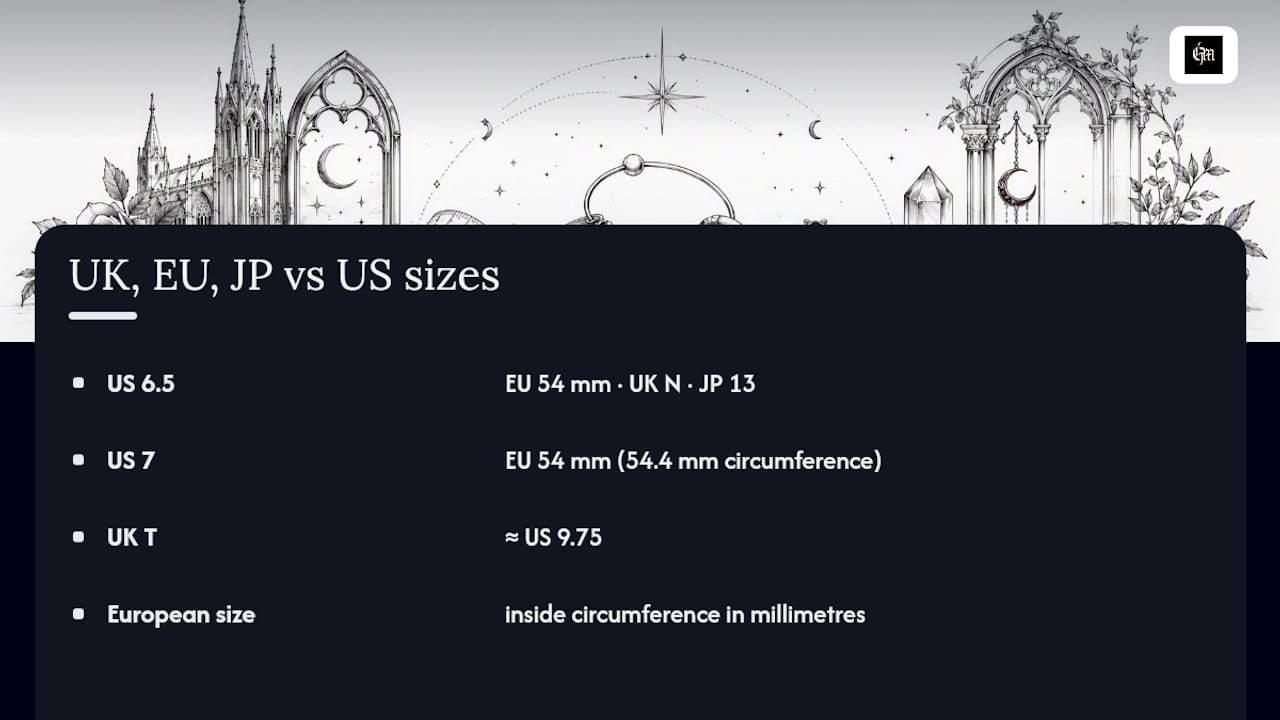
Because European sizing is really just circumference in millimeters, it’s the easiest system to convert without a lookup chart. A US size 7 at 54.4 mm circumference rounds to a European 54. A UK size N roughly corresponds to a US size 6.5, while a UK size T lands close to a US 9.75. Japanese size 13 sits near a US size 6.5 as well, though the two scales don’t align in a perfectly linear way across every range.
The safest approach when ordering internationally is always to convert through millimeters rather than trying to match a letter or number directly across systems, since two countries can use the same label for genuinely different diameters. Keep your own circumference measurement on hand, in millimeters, and you can translate it into any of these systems on demand.
What Actually Matters Most When You Size a Ring at Home?
Most sizing guides bury the one step that actually prevents returns: verifying the print scale before you trust any printed tool. People skip it because it feels like an extra chore, then wonder why a “perfectly measured” ring arrives too tight.
The conventional advice to “just measure with string” isn’t wrong, but it’s incomplete on its own. String stretches, paper can shift while you mark it, and a single reading from either method deserves a second confirmation before you commit to an order, especially for a ring that can’t be resized later. I’d rather see someone take two imperfect measurements with different tools than one confident measurement with just one.
If you take away one habit from this guide, make it this: measure twice, with two different methods, at a normal temperature, and only trust the result when both agree. Everything else, from knuckle adjustments to international conversions, is secondary to getting that baseline number right.
— Rey
Goth.Market: Where to Find Curated Rings and Sizing Help
Goth.Market carries curated rings from independent creators working in gothic, occult, and alternative styles, from delicate stacking bands to heavy statement signets that call for careful sizing. Every product page lists the specific sizing details for that piece, so you’re not guessing based on a generic chart alone.

Once you’ve got your circumference measurement in hand, browse the Goth to find a piece that fits both your style and your finger. If you’re building a stacked look, check the sizing notes on pieces like the retro heavy metal street ring before you order, since wider profiles like that one often run a touch snugger than their listed size suggests.
Sources
FAQ
How do I figure out my ring size?
Wrap a narrow paper strip or a reusable plastic belt sizer around the base of your finger, mark where it overlaps, and measure that length in millimeters against a conversion chart. Take the measurement twice, ideally with two different methods, since a single reading is more prone to error than a confirmed one.
How big is a size 7 ring?
A US size 7 ring has an interior diameter of about 17.3 mm and a circumference of roughly 54.4 mm. It’s the most common ring size among women, though actual sizes vary widely by hand.
Can I measure my ring size with my phone?
You can use a phone camera or an augmented-reality sizing app, but these tools typically carry an accuracy margin of plus or minus a quarter to half a size due to inconsistent screen calibration. Use a phone method as a rough starting point, then confirm with a physical paper strip or belt sizer before ordering.
How big is a size 10 ring in inches?
A US size 10 ring has an interior diameter of about 19.8 mm and a circumference of about 62.1 mm. Men’s average ring size sits close to this size.
Why did my printed ring sizer give me the wrong size?
Most printed ring sizers fail because a printer or browser setting like “fit to page” quietly shrank the page. Always print at 100% scale and measure the sizer’s calibration line, typically 50 mm or 0.7 in, with a ruler before trusting the result.
Should I size up for a wide ring band?
Yes, generally. Bands wider than about 6 mm press against more of the finger’s surface and tend to feel tighter than a thin band at the same nominal size, so sizing up half a size to a full size is a common adjustment for chunky or statement-style rings.
Does finger size change with age or temperature?
Finger size can shift with temperature, time of day, weight changes, and certain health conditions like arthritis or fluid retention, sometimes by close to half a size. Measure at room temperature and repeat the measurement on a different day to get a reliable baseline.
How do US ring sizes compare to UK or European sizes?
European sizes measure the ring’s interior circumference directly in millimeters, so a US size 7 (54.4 mm circumference) converts to roughly a European size 54. UK sizes use a letter scale, where a US 7 corresponds to approximately UK size O, though exact conversions can shift slightly by brand.