

Mall Goth Aesthetic: 5 US Mall Staples That Prove It's Its Own Style
Mall goth is a late-1990s to mid-2000s style that pairs mass-retail goth signifiers, band tees, chains, platform boots, with nu-metal and industrial music influences. It got its name from where it was bought, mostly Hot Topic, not from any single band or scene. Two things set it apart from traditional goth: its retail origins and its musical lineage. The current revival, driven largely by nostalgia on social media, is more open and inclusive than the original wave ever was.
TL;DR:
- Most mall goth outfits revolve around key pieces like platform boots, band tees, fishnets, and hardware accessories, which can all be sourced cheaply from thrift stores.
- Building an authentic look focuses on good fit and statement footwear, rather than chasing specific vintage brands or items from 2003.
- The musical foundation of mall goth differs from traditional goth, emphasizing nu metal and industrial artists like Korn and Marilyn Manson over 1980s post-punk.
- The revived interest in mall goth on social media is more inclusive, blending DIY customization and small-batch pieces from independent makers.
- Shopping at retail chains like Hot Topic made the aesthetic accessible to suburban teens, but today it is often curated through online marketplaces and secondhand sources.
Table of Contents
- What Are the Origins of Mall Goth, and When Did It Peak?
- What Are the Core Fashion Staples of Mall Goth?
- How Does Mall Goth Music Differ From Traditional Goth?
- How Do You Build a Mall Goth Outfit Today?
- What Does Curating Mall Goth Fashion Actually Look Like?
- How Does Mall Goth Overlap With Scene and Emo Fashion?
- What DIY Touches Are Common in Mall Goth Fashion?
- Is Mall Goth a Lesser Version of Goth, or Its Own Thing?
- Where Can You Shop Curated Mall Goth Pieces Online?
- Sources
- FAQ
What Are the Origins of Mall Goth, and When Did It Peak?
Mall goth took shape in suburban America between roughly 1995 and 2008, according to Wikipedia’s history of the subculture. It grew up alongside the American shopping mall itself, which by the mid-1990s had become the default hangout for teenagers with nowhere else to go and a little bit of allowance money to spend.
Hot Topic is the reason this look became a recognizable “thing” instead of a scattered handful of kids in black. The chain started stocking band merchandise and alternative accessories in mall food-court corridors across the country, and that retail strategy made alternative fashion accessible to suburban teens who had no access to indie boutiques or underground scenes. You could walk in with $40 and walk out looking like you belonged to something.
The look faded as nu metal’s commercial wave receded in the late 2000s, but it never really died. It went dormant, then came roaring back:
- TikTok and Instagram users in the late 2010s and 2020s revived mall goth as a Y2K-adjacent nostalgia aesthetic.
- Millennials who grew up shopping at Hot Topic started recreating (and remixing) their old looks for a new audience.
- Gen Z discovered the aesthetic secondhand, often without knowing its retail history, and made it their own.
What Are the Core Fashion Staples of Mall Goth?
Mall goth has a recognizable uniform, and most of it traces back to a short list of brands and silhouettes that showed up on every mall rack in the early 2000s. If you’re trying to identify the aesthetic or build it from scratch, start here.
- Tripp NYC pants. Bondage-strap trousers with buckles, zippers, and chains became the single most identifiable bottom in the subculture.
- Band tees. Faded, oversized shirts rapping nu-metal and industrial acts anchored nearly every outfit.
- Fishnets. Worn on arms, under ripped jeans, or layered under shorts, fishnets added texture without much cost.
- Oversized hoodies. Usually black, sometimes with skulls or chain-print graphics, layered over tees.
- JNCO jeans. Absurdly wide-legged pants that overlapped with skater and raver crowds as much as with goth.
Footwear and hardware did as much identity work as the clothing. Platform boots, especially Demonia’s stacked-sole styles, gave the look its signature height and stomp. Studded belts, wallet chains looping from a back pocket to a front loop, and layered chokers finished the silhouette.
Makeup and hair carried their own rules. Heavy, smudged black eyeliner (never precise, always a little raccoon-eyed) was the baseline. Hair got streaked or fully dyed in unnatural colors, and Manic Panic was the brand nearly everyone used, since it was sold right next to the band tees at the same mall counter.
Pro Tip: If you only budget for two pieces, make them boots and a chain accessory. A platform boot and a single visible chain read as mall goth instantly, even over otherwise plain clothing.
How Does Mall Goth Music Differ From Traditional Goth?
Traditional goth traces its roots to post-punk bands from the late 1970s and early 1980s. Mall goth runs on a completely different soundtrack: nu metal and industrial rock. Korn, Slipknot, and Marilyn Manson sat at the center of the mall goth playlist, not Siouxsie and the Banshees or Bauhaus.
That musical split explains a lot of the friction between the two groups. Trad goths often saw mall goths as latecomers riding a watered-down, commercialized version of something with deeper roots.
- The word “poseur” got thrown around constantly, usually aimed at kids whose whole look came from one store rather than years of scene involvement.
- Retail origin, not lack of enthusiasm, was often the real complaint: buying a “goth starter kit” off a rack felt inauthentic to people who’d built their look piece by piece over years, a dynamic explored in academic writing on subculture and retail.
- The modern revival has softened that gatekeeping considerably, with far more room now for people to claim the aesthetic without proving scene credentials first.
How Do You Build a Mall Goth Outfit Today?
Building a convincing mall goth look doesn’t require chasing down 2003-era JNCOs on eBay, though you can if that’s your thing. The structure matters more than any single item.
- Pick your silhouette contrast. Pair something baggy with something fitted, oversized hoodie with skinny jeans, or fitted band tee with wide-leg pants. Two loose pieces at once usually reads sloppy instead of intentional.
- Anchor the outfit with footwear. Platform boots do more visual work than anything else you’ll wear. Spend real money here if you’re spending it anywhere.
- Add one hardware piece, not five. A single chain, a choker, or a studded belt reads as styled. Stack all three and it can tip into costume territory.
- Thrift the basics, invest in the statement pieces. Band tees, plain hoodies, and fishnets are easy secondhand finds. Save your budget for boots and outerwear that need to hold up structurally.
- Update it with a Y2K lens. Mixing in low-rise layering, butterfly clips, or a slightly softer, more blended eye look keeps the outfit from feeling like a costume rental.
Where you shop matters as much as what you buy. Independent makers now produce chain jewelry, patched jackets, and small-batch band-style tees that give the same silhouette without relying on identical mass-produced pieces. Combining a thrifted or vintage tee with a piece from a smaller maker is a practical way to balance authenticity with budget.
Pro Tip: Don’t buy everything new at once. Start with boots and one hardware piece, then build the rest of the wardrobe over a few weeks from thrift stores. The outfit will feel more like yours and less like a costume.
What Does Curating Mall Goth Fashion Actually Look Like?
Curating for the dark and alternative side of fashion means constantly separating the pieces with real staying power from the ones that only look right in a single photo. Tripp-style pants, platform boots, and chain hardware keep showing up because they solve a styling problem, not because a trend cycle demands them.
Independent creators bring something mass retail never could: pieces made in small runs, with actual craftsmanship in the hardware and stitching, instead of a warehouse running the same mold ten thousand times. That’s the whole premise behind prioritizing independent makers over identical big-box stock.
The “poseur” label did real damage to a lot of people who just wanted to wear something dark and feel like themselves. Nobody owes anyone a scene resume to wear fishnets and a chain. If the look makes you feel like you, that’s the only credential that matters.
Self-expression shouldn’t require passing a gatekeeping test first.
How Does Mall Goth Overlap With Scene and Emo Fashion?
Mall goth didn’t develop in a sealed bubble. It grew up next to scene and emo kids in the exact same mall food courts, often shopping the exact same stores, which is a big part of why the aesthetics blur together so easily today.
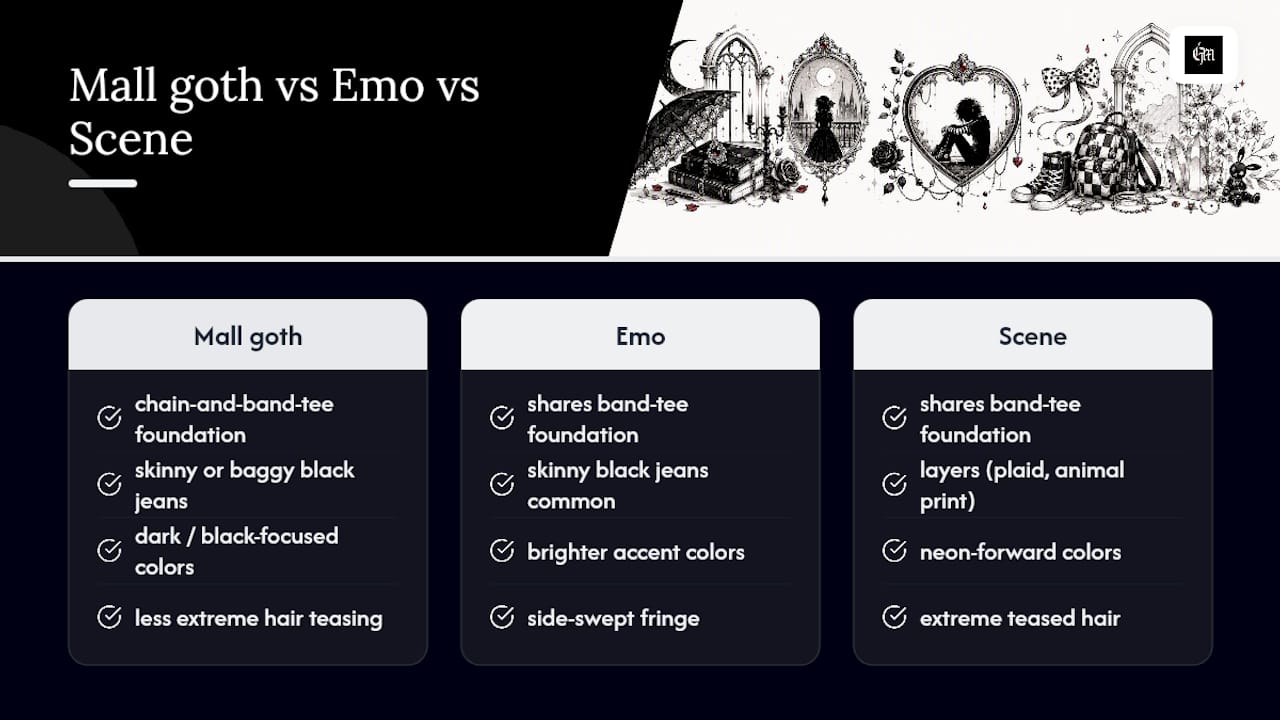
Emo fashion shared mall goth’s love of skinny (or occasionally baggy) black jeans and band tees, but leaned toward brighter accent colors, side-swept fringe, and studded belts worn looser and lower. Scene kids pushed things further into neon territory, teasing hair to extreme heights and layering plaid, glitter, and animal print over a base that still owed a debt to the same chain-and-band-tee foundation.
The musical lines blurred too. A single teenager’s playlist in 2004 might run from Slipknot straight into My Chemical Romance without any sense of contradiction, and that crossover in taste showed up directly in the closet. JNCOs, fishnets, and platform boots got mixed with emo’s signature messenger bags and studded belts constantly, because retailers like Hot Topic stocked all three subcultures on adjacent racks.
That overlap is exactly why “mall goth vs. emo” is such a common point of confusion today. The honest answer is that they were never fully separate categories. They were overlapping wardrobes shaped by the same handful of mall stores, split more by music preference and social circle than by any hard style boundary. Modern revival content on TikTok tends to blend the two even further, often labeling an outfit “mall goth” or “emo” almost interchangeably based on the day’s mood rather than any strict rulebook.
What DIY Touches Are Common in Mall Goth Fashion?
Mall goth has always had a scrappy, homemade streak underneath the store-bought foundation, even during its most commercial peak. Kids customized cheap basics because a plain hoodie or a pair of jeans from a department store cost a fraction of what the mall’s specialty shops charged.
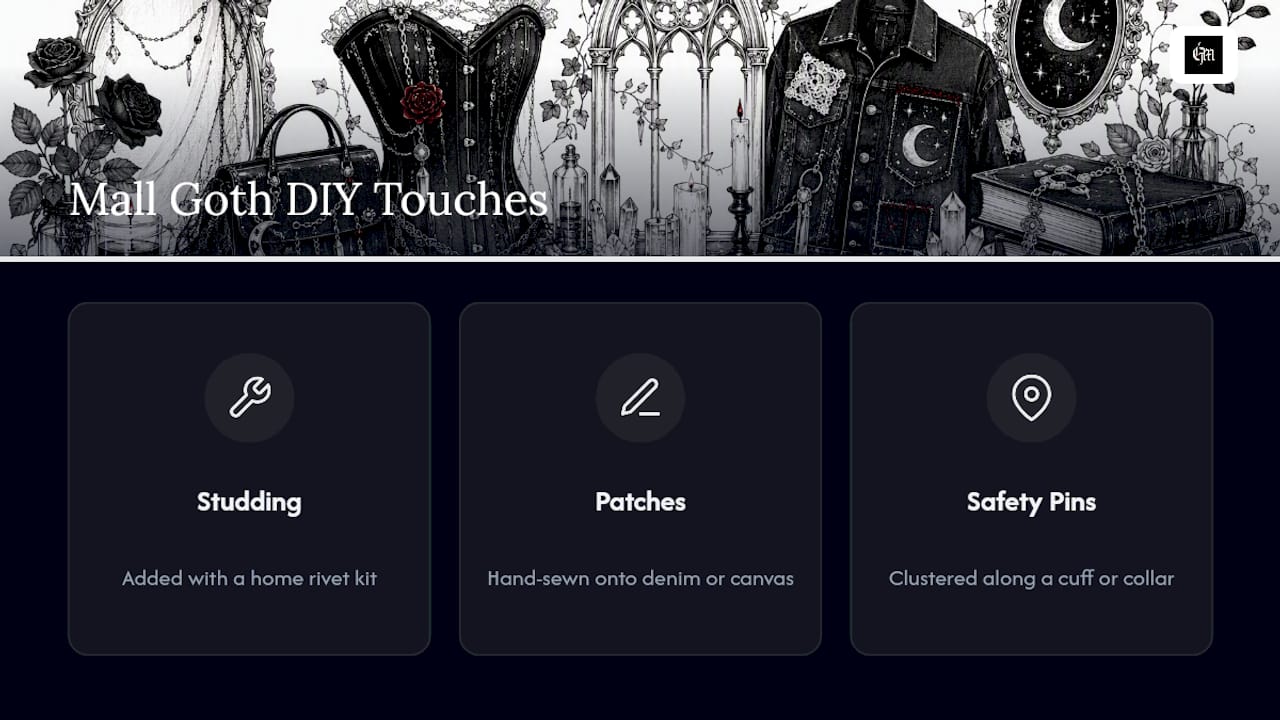
Studding your own belt or jacket with a home rivet kit was common, as was hand-sewing patches onto denim or canvas bags. Safety pins held together more DIY mall goth outfits than any single retailer’s product line, whether they were functional repairs or purely decorative, clustered along a cuff or collar.
Chain crafting is another staple that’s carried straight into the modern revival. Buying loose chain by the foot from a hardware store and adding your own clasps costs a fraction of a pre-made accessory and lets you set the exact length and drape you want. Fishnets get customized too, deliberately ripped, layered in contrasting colors, or dyed to match a specific outfit.
Bleaching and dyeing band tees at home, distressing jeans with sandpaper or a razor, and hand-lettering patches with fabric paint all fall into the same category: taking something inexpensive from a mainstream store and reworking it until it reads as personal rather than off-the-rack. That instinct, take a mass-market item and make it yours, might be the most consistent thread running through mall goth’s entire history, and it’s a big part of why independent makers doing small customized runs fit so naturally into the aesthetic today.
Is Mall Goth a Lesser Version of Goth, or Its Own Thing?
Treating mall goth as a diluted, “fake” version of traditional goth misreads what actually happened. It wasn’t goth with the substance removed. It was a distinct hybrid that ran on different music, different retail channels, and a different generation’s economic reality, kids with mall allowance money instead of access to underground scenes.
The conventional wisdom, that authenticity requires DIY effort and scene tenure, undersells how much creativity showed up inside mall goth’s own constraints. Customizing a cheap hoodie with a home rivet kit takes just as much intent as sewing a corset from scratch. The retail origin made the look accessible, not automatically hollow.
Readers building or reviving this look today should prioritize fit and footwear over chasing exact 2003 brand names. A convincing silhouette, built from a genuine mix of thrifted basics and a few well-made statement pieces, will always beat a head-to-toe outfit assembled purely for nostalgia points. Buy the boots. Skip the guilt about not owning original JNCOs.
— Rey
Where Can You Shop Curated Mall Goth Pieces Online?
An online marketplace exists to help find pieces that fit mall goth staples, such as chains, platform silhouettes, and dark layering, without settling for identical mass-produced stock or spending weeks hunting resale sites.
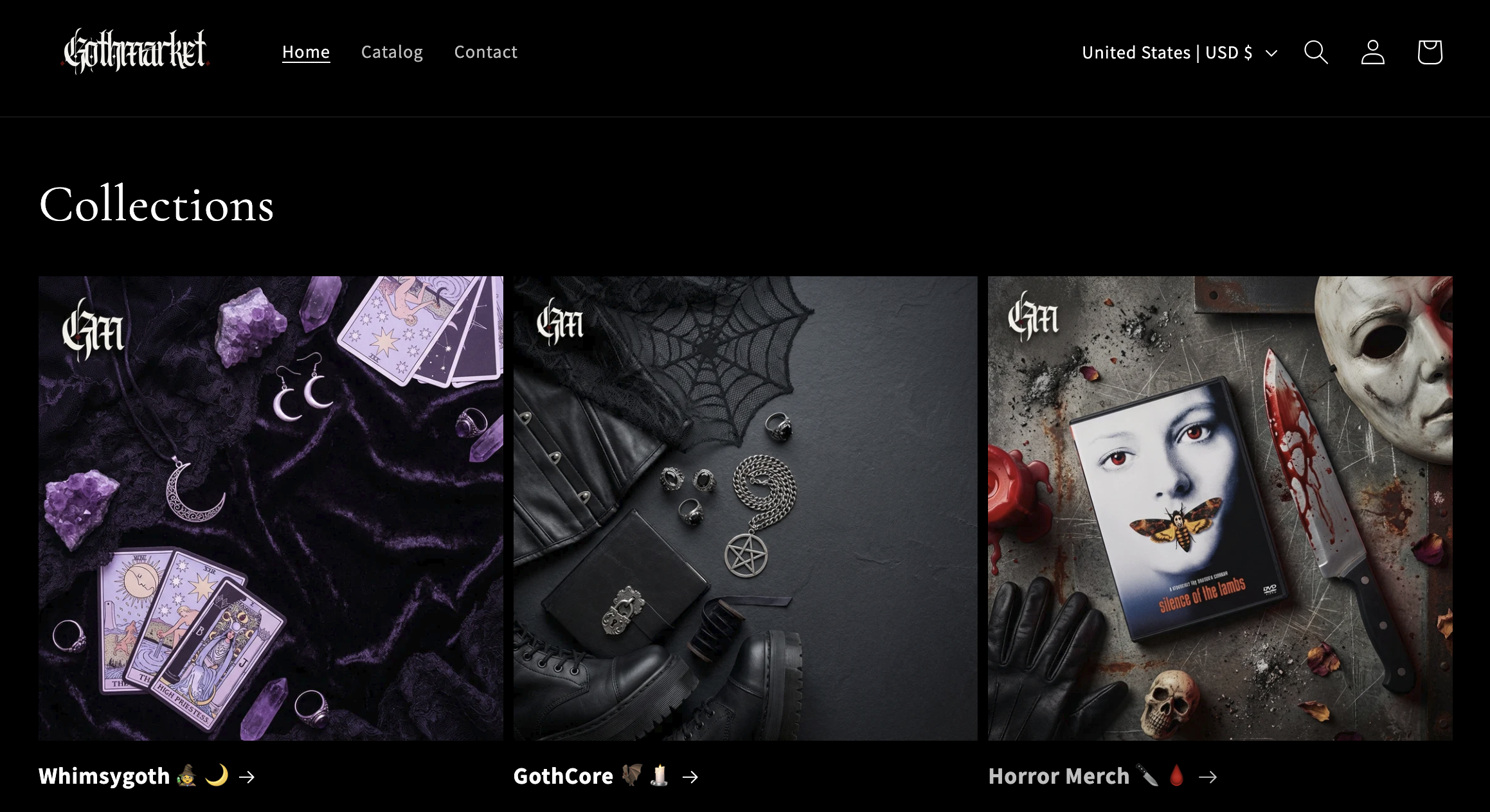
The GothCore 🦇 🕯️ collection covers the core wardrobe pieces discussed throughout this guide: band-style tees, layered black basics, and hardware accents that map directly onto the mall goth silhouette. If you’re leaning into a softer, more mystical update on the aesthetic, Whimsigoth 🧙♀️ 🌙 blends dark styling with witchy, nature-influenced details that modernize the look past its 2000s roots. And for one-off, small-batch pieces from independent makers, the Curated Finds collection rotates regularly, so you’re not buying the exact same chain choker as everyone else on your feed.
Browse the GothCore collection to start building your outfit around the staples covered above, or check Whimsigoth if you want a look with a little more layered mysticism.
Sources
FAQ
What Is the Mall Goth Style, Exactly?
Mall goth is a mass-retail interpretation of goth fashion built around pieces like Tripp pants, band tees, fishnets, and platform boots, sold heavily through stores like Hot Topic. Its music leans nu metal and industrial rather than the post-punk roots of traditional goth.
What’s the Difference Between Goth and Mall Goth?
Traditional goth grew out of 1980s post-punk music and DIY scene culture, while mall goth emerged in the late 1990s around nu-metal and industrial music sold through suburban mall retail. The core difference is origin: hand-built subculture versus a store-accessible version of similar dark aesthetics.
Does Mall Goth Mean Poser?
“Poseur” was a common insult used by traditional goths against mall goths, largely because the look could be bought as a complete outfit from a single store rather than assembled over years. That gatekeeping has faded considerably, and most modern commentary treats mall goth as its own legitimate hybrid subculture rather than a fake version of something else.
Is Mall Goth Still Goth?
Yes, in the sense that it shares goth’s dark visual language, black clothing, dramatic makeup, moody aesthetics, but it draws on a different musical family tree and retail history. Whether it counts as “real goth” depends on how strictly you define the term, but most current writing treats it as a related, distinct subculture rather than a subset.
What’s the Difference Between Mall Goth and Emo?
The two overlapped heavily because both shopped the same mall stores in the mid-2000s. Emo leaned toward brighter accent colors and swept fringe, while mall goth stayed closer to head-to-toe black with heavier hardware, though many outfits at the time genuinely blended both.
Why Is Mall Goth Popular Again?
The revival is driven largely by nostalgia among millennials who grew up with the look, combined with TikTok and Instagram trends that reintroduced Y2K and early-2000s alternative style to a younger audience. Current commentary also notes the revival is more racially and gender-inclusive than the original wave.
What Shoes Are Considered Mall Goth?
Platform boots are the defining mall goth footwear, with brands like Demonia producing the stacked-sole styles most associated with the look. Chunky creepers and lace-up combat boots are common alternatives that hit a similar silhouette.
Can You Build a Mall Goth Outfit on a Budget?
Yes. Thrift stores are reliable sources for band tees, plain hoodies, and fishnets, which lets you save your budget for higher-impact pieces like boots or a well-made chain accessory. Curated marketplaces that feature independent makers, including collections on Goth, also offer small-batch alternatives to mass-produced basics without requiring a full-price wardrobe overhaul.