

Hang Heavy Mirrors Safely: Renters & Homeowners, Use 2x Rated Hardware
Mount into studs with lag screws or a French cleat for the heaviest mirrors. When studs aren’t in the right spot, a Toggler SnapToggle rated for the load is your best bet on drywall. For lighter heavy pieces up to about 65 pounds, a no-drill option like the 3M CLAW works well for renters who can’t drill into studs at all.
TL;DR:
- When hanging a heavy mirror, use multiple anchors or lag screws into studs for items over 50 pounds to ensure safety and stability.
- The 3M CLAW can hold up to 65 pounds without drilling into studs, making it suitable for renters with lightweight mirrors in non-stud walls.
- For mirrors between 20 to 50 pounds on drywall, a Toggler SnapToggle provides strong support when studs are unavailable or misaligned.
- Always verify your mirror’s weight and wall condition first, and choose hardware rated at least double the mirror’s weight for safety.
- In cases over 100 pounds, professional installation or mounting to wall blocking is recommended to prevent safety hazards.
Table of Contents
- What Tools Do You Need to Hang a Heavy Mirror?
- Which Hanging Method Matches Your Mirror’s Weight and Wall?
- How Do You Actually Install Each Type of Mount?
- How Do You Know Your Mirror Mount Is Actually Safe?
- Why Trust This Guidance, and How Does Décor Style Affect Mounting?
- What Does This Guide Get Right That Most Advice Misses?
- Want a Lighter Mirror That Skips the Hardware Guesswork Entirely?
- Sources
- FAQ
What Tools Do You Need to Hang a Heavy Mirror?
Before you touch a drill, weigh your mirror. A bathroom scale works fine, or check the manufacturer spec sheet if you still have the box. This number decides everything else, since guessing at “it feels like 40 pounds” is how mirrors end up on the floor.
Next, measure the distance between the D-rings, keyholes, or cleat points on the back of the frame. Transfer those exact measurements onto a piece of paper and hold it against the wall to mark your drill points. This trick saves you from drilling test holes directly into drywall.
Run a stud finder across the area and mark stud edges with painter’s tape. No stud finder handy? A push pin pressed into an inconspicuous spot tells you a lot: it glides through drywall paper easily and hits resistance fast on plaster or lath.
Gather these before you start:
- Stud finder (electronic or magnetic)
- 4-foot level (a laser level helps for wide mirrors)
- Drill with bits sized for your anchors
- Tape measure and pencil
- A helper (heavy mirrors are a two-person job, always)
Which Hanging Method Matches Your Mirror’s Weight and Wall?
Weight and wall type together determine your hardware, not just weight alone. A 40-pound mirror on solid plaster behaves differently than the same mirror on crumbling drywall in a 1970s rental.
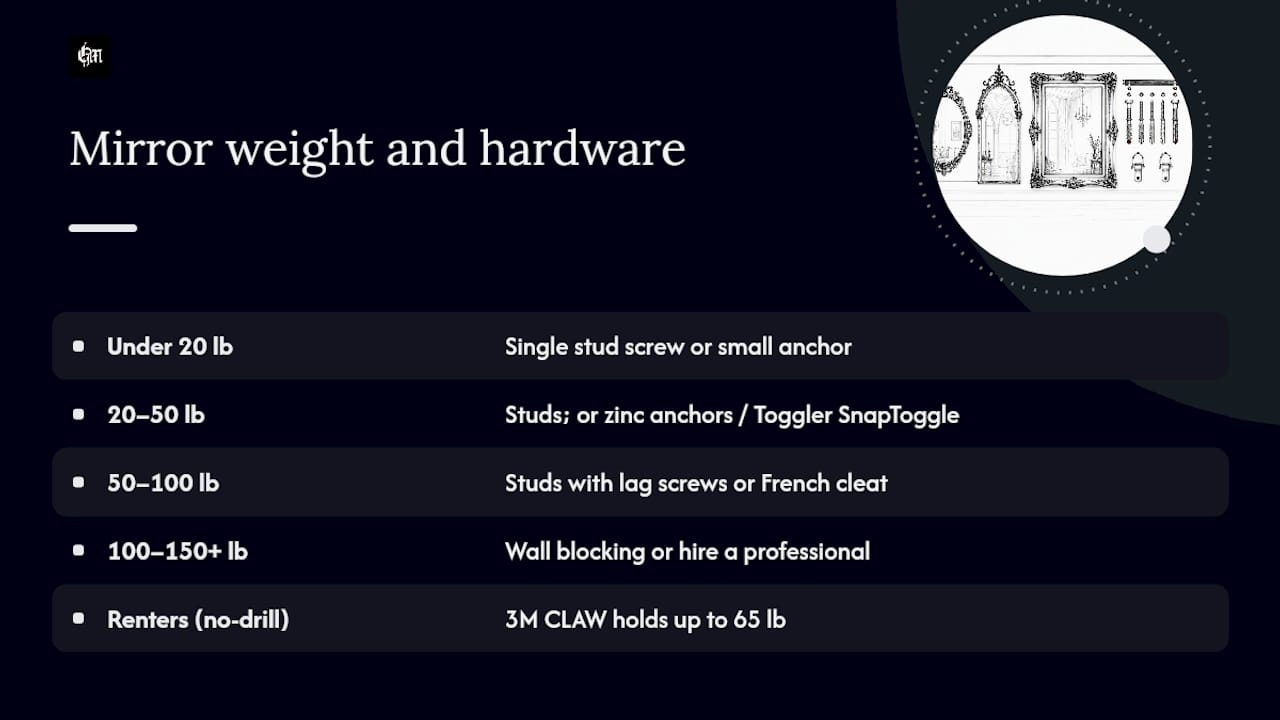
Under 20 pounds: A single stud screw or a small drywall anchor handles this easily. You have room for error here.
20 to 50 pounds: Studs are still the best target, but zinc self-drilling anchors or a single Toggler SnapToggle work well when studs don’t line up with your frame’s hanging points.
50 to 100 pounds or more: This is where you commit to studs, proper lag screws, or a French cleat spanning multiple studs. Don’t cut corners here.
Over 100 to 150 pounds: Mount to wall blocking if you’re renovating, or bring in a professional installer. Taskrabbit’s guidance on mirror hanging suggests calling in help once you cross this range, especially on masonry or aging plaster where anchor performance gets unpredictable.
Renters facing a no-drill mandate have real options, but they come with a ceiling. The 3M CLAW system holds up to 65 pounds without studs or large holes, which covers a lot of standard wall mirrors but not your oversized statement piece.
Wall condition can override everything above. Crumbly, water-damaged, or repeatedly patched drywall won’t hold rated anchors even if the math says it should. Old plaster over horsehair lath needs different anchors than modern drywall, and poured concrete or brick calls for masonry sleeves, not the toggle hardware described below.
How Do You Actually Install Each Type of Mount?
Here’s the process for the four methods that cover almost every situation you’ll run into.
Mounting into studs:
- Locate the stud center with your stud finder and confirm with a small pilot hole.
- Drill a pilot hole slightly smaller than your lag screw’s diameter, typically a 3/16 inch bit for a 1/4 inch screw.
- Drive the lag screw in at a slight upward angle, leaving about a quarter inch exposed for the D-ring or wire.
- Level the mirror, then pull down firmly for 10 to 15 seconds to confirm the mount holds under real tension.
French cleat: A French cleat spreads the mirror’s weight across multiple studs instead of concentrating it at two points, which is why professionals default to it for anything wide or heavy. Screw the wall-side cleat into at least two studs, angled edge facing up and out. Attach the matching cleat piece to a sturdy horizontal support on the mirror’s back, not just the frame’s thin edge. Hook the mirror onto the wall cleat, then rock it gently to confirm both angled edges have fully seated.
Toggler SnapToggle: Drill a hole sized to the toggle’s specification (usually 1/2 inch), thread the strap through and fold the toggle wings flat, then push the assembly through the drywall until it springs open on the other side. Pull back firmly to seat it against the wall’s interior, then drive the screw in until snug, leaving enough exposed for your D-ring. SnapToggle anchors are rated for significantly higher loads than plastic anchors because the metal channel locks against the drywall’s backside rather than just gripping the paper facing. For mirrors on two anchors, space them to match your D-rings exactly and remember each anchor needs to independently support half the total weight.
3M CLAW: Position the hanger, press the two mounting points against the wall, and drive the included screws by hand, no drill needed. Confirm your mirror’s weight sits comfortably under 65 pounds before relying on this method for anything permanent.
Pro Tip: Skip picture wire on anything over 20 pounds. Wire concentrates force at a single point and stretches over time, while D-rings mounted directly to sturdy backing distribute the load evenly and stay level longer.
How Do You Know Your Mirror Mount Is Actually Safe?
Choose hardware rated for roughly double your mirror’s actual weight. That safety margin absorbs shear stress from door slams, foot traffic vibration, and the slow sag that happens over months, not just the static weight sitting on the wall the day you hang it.
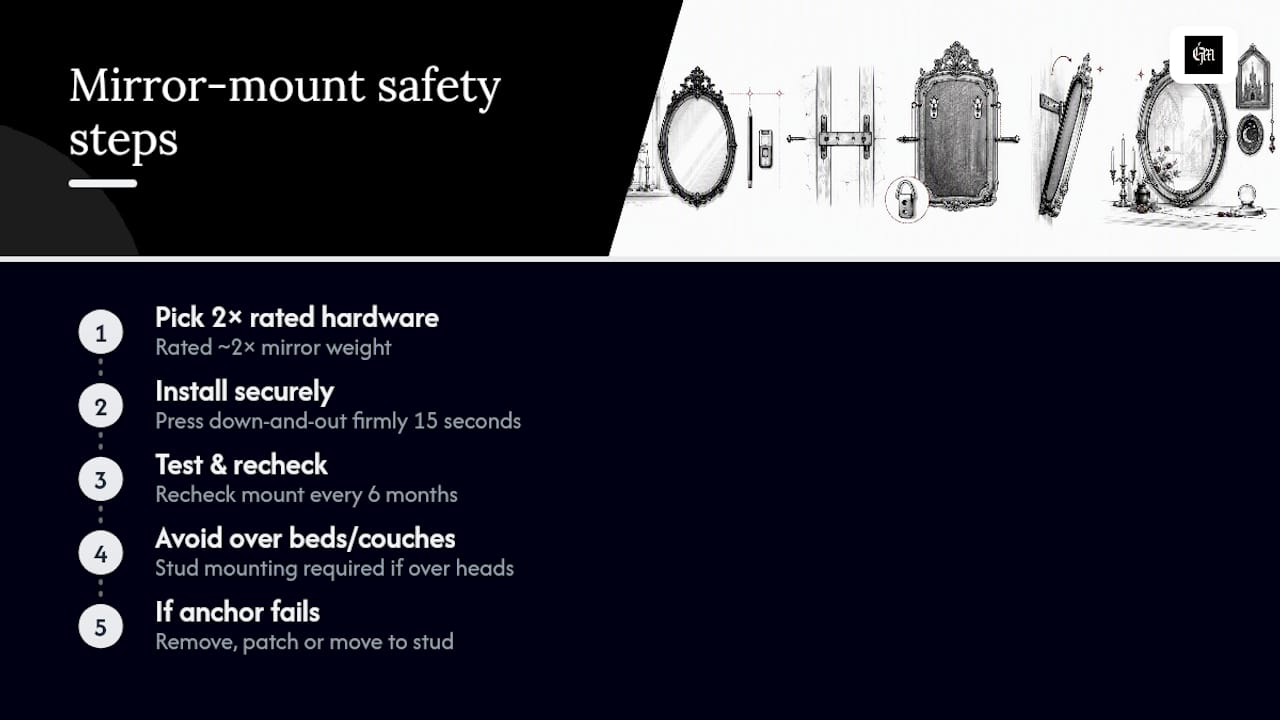
Once installed, apply firm downward and outward pressure for a full 15 seconds before you walk away. Recheck the mount every six months, especially after temperature swings that cause drywall to expand and contract.
Avoid hanging heavy mirrors directly over beds, couches, or anywhere someone’s head rests for extended periods, unless the mount goes into solid studs. If you can’t avoid that placement, the stud requirement isn’t optional. Improperly mounted heavy items are a documented safety hazard for people and pets, particularly in households with kids or older residents.
If an anchor feels loose or you notice drywall crumbling around the screw, stop. Remove the mirror, patch and reinforce the area, or move to a stud location before rehanging.
Why Trust This Guidance, and How Does Décor Style Affect Mounting?
Goth.Market built its guides on the same principle we apply to curating gothic and alternative home décor: fragile, ornate, or oversized pieces need mounting advice that matches their actual construction, not generic tips. Rey, who writes on decorative display for Goth.Market, focuses specifically on how frame depth and finish affect real-world hanging decisions.
A few things that change your approach:
- Deep baroque or ornate frames shift the mirror’s center of gravity forward, adding leverage against your anchors.
- Backing paper or foam board hides D-ring condition, so check it’s intact before you trust it.
- Antiqued or foiled finishes are often heavier per square inch than plain glass mirrors of the same size.
For layout help once your mirror is secured, our gallery wall layout guide covers spacing and eye-level placement.
What Does This Guide Get Right That Most Advice Misses?
Most mirror-hanging content treats weight as the only variable that matters, then buries the actual hardware specs three paragraphs after a story about someone’s grandmother’s mirror. That’s backwards. The wall matters as much as the weight, and renters especially get shortchanged by generic advice that assumes everyone can drill into studs whenever they want.
The overrated piece of conventional wisdom here is “just use picture wire and two hooks.” That combination fails constantly on anything over 15 or 20 pounds, not because the hooks are cheap, but because wire concentrates stress at one point instead of spreading it.
What actually matters, in order: know your exact weight, know your wall, then pick hardware rated well above what the math requires. Skimping there is how a beautiful piece ends up as broken glass on the floor.
— Rey
Want a Lighter Mirror That Skips the Hardware Guesswork Entirely?
If drilling into studs and calculating anchor ratings sounds like more commitment than your wall (or your lease) can handle, going lighter is a legitimate strategy. Choosing a smaller framed piece or a pre-hung mirror cuts your installation risk down to something a single 3M CLAW or SnapToggle can handle without a second thought.

Goth.Market’s GothCore 🦇 🕯️ collection features dark-aesthetic mirrors and wall décor sized for exactly this kind of straightforward hang. Meanwhile, Curated Finds rotates in smaller framed pieces and display accessories that pair well with a gallery-style layout instead of one oversized statement mirror. If you’re drawn to a softer, dreamier look, the Whimsigoth 🧙♀️ 🌙 collection has lighter framed options too. Whatever you pick, check the listed dimensions and estimated weight against your wall type before you buy, and browse the collections to find a piece that fits both your space and your actual mounting options.
Sources
FAQ
Can I hang a 20 lb mirror on drywall?
Yes, a 20 pound mirror is well within range for a single quality drywall anchor or a stud-mounted screw. A basic self-drilling zinc anchor or one Toggler SnapToggle comfortably clears this weight with margin to spare.
How do you hang a 100 lb mirror on drywall?
For 100 pounds, use a French cleat spanning at least two studs, or multiple Toggler SnapToggle anchors rated to jointly exceed double the mirror’s weight. Studs are strongly preferred at this weight, and a single small anchor should never carry a mirror this heavy alone.
How heavy is too heavy to hang a mirror yourself?
Once a mirror crosses roughly 100 to 150 pounds, professional installation guidance recommends bringing in a pro or mounting to dedicated wall blocking, particularly on masonry or aging plaster. Below that range, a careful DIY install using studs or rated anchors is generally safe.
What should you hang a heavy mirror with?
Studs paired with lag screws or a French cleat offer the strongest hold for heavy mirrors. When studs aren’t available, a Toggler SnapToggle rated for at least twice the mirror’s weight is the next best option on drywall.
Is the 3M CLAW strong enough for a heavy mirror?
The 3M CLAW is rated to hold up to 65 pounds without drilling into studs, which covers many standard wall mirrors but not oversized or extra-heavy pieces. Always confirm your mirror’s exact weight against that limit before relying on it.
Do I need two anchors for a heavy mirror?
Most mirrors over 20 pounds hang more securely on two anchors spaced to match the D-rings, since each anchor then only needs to independently support half the load. Space them precisely using a paper template so you don’t end up drilling extra holes.
Can I hang a heavy mirror without drilling into studs?
Yes, within limits. A Toggler SnapToggle rated for your mirror’s weight works well in drywall without hitting a stud, and the 3M CLAW handles no-drill installs up to 65 pounds for renters who can’t drill at all.