

Aristocrat Goth Style: What It Is and How to Wear It
TL;DR:
- Aristocrat goth style is a dark, tailored fashion inspired by 19th-century European aristocracy and Japanese visual kei culture. It emphasizes structured garments, androgyny, and strict etiquette, with quality fabric and precise tailoring being essential. The style values elegance, formal conduct, and antique accessories over casual or costume-like clothing.
Aristocrat goth style is defined as a dark, tailored fashion aesthetic that draws from 19th-century European aristocracy, filtered through Japanese visual kei culture and Gothic Revival sensibility. The look centers on androgyny, formal silhouettes, and a mood of vampiric elegance rather than punk rebellion. Aristocrat goth is a Japanese street fashion that emulates the upper-class dress of the 1800s, with key garments including high-collared shirts, jabots, frock coats, waistcoats, and long skirts or tailored trousers in black, navy, purple, and wine. What separates it from every other gothic substyle is its insistence on etiquette, grooming, and conduct as part of the aesthetic itself. This is not a costume. It is a philosophy worn on the body.
What is aristocrat goth style in terms of fashion elements?
The core wardrobe of gothic aristocrat style is built around structured, formal garments that communicate refinement before a single word is spoken. Every piece serves a purpose, and nothing is accidental.
The color palette stays dark, anchored in black with silver, navy, deep purple, and rich wine as accent tones. Bright colors and pastel motifs have no place here. The palette signals gravity and restraint, not whimsy.
Signature garments
The most recognizable aristocrat goth outfit pieces are:
- High-collared shirts and jabots: The jabot, a cascading ruffle at the throat, is one of the style’s most distinctive signatures. It references 18th and 19th-century formal menswear directly.
- Frock coats and waistcoats: Structured outerwear with a long, tailored cut defines the silhouette. A well-fitted frock coat is the single most important investment in this wardrobe.
- Long skirts and tailored trousers: Both are acceptable regardless of the wearer’s gender. Aristocrat goth is explicitly androgynous, and silhouette matters more than gendered convention.
- Gloves and elegant hats: Wide-brimmed hats, top hats, and fitted gloves complete formal looks and reinforce the aristocratic reference.
Accessories and motifs
Accessories incorporate roses, crosses, fleur-de-lis, and brass buttons in luxe materials. Antique-style jewelry in silver or aged gold works best. Avoid plastic or obviously mass-produced pieces. The motifs carry symbolic weight: the rose signals romantic melancholy, the cross references Gothic Revival architecture and spirituality, and the fleur-de-lis nods to European heraldry.
Pro Tip: Invest in one statement accessory before building out your wardrobe. A quality antique-style brooch or a well-made jabot transforms a basic black shirt into a genuine aristocrat goth look.
Fabric quality is non-negotiable. Velvet, brocade, silk, and fine wool read as authentic. Polyester blends undermine the entire effect, regardless of how well the garment is cut.
How did aristocrat goth develop and what shaped it?
The aristocrat goth aesthetic did not emerge from Western post-punk clubs. Its roots are specifically Japanese, and understanding that origin changes how you read every element of the style.
The development of aristocrat goth follows a clear cultural arc:
- Visual kei origins: The Japanese visual kei music scene of the 1980s and 1990s produced musicians who treated fashion as performance art. Elaborate, gender-bending stage costumes drew from European historical dress and created a new visual vocabulary.
- Mana and Moi-même-Moitié: The style was popularized by musician Mana’s brand Moi-même-Moitié, which codified the aesthetic into a recognizable fashion system. Mana’s work established the androgynous, aristocratic silhouette as a deliberate artistic statement.
- Gothic Revival influence: 19th-century Gothic Revival architecture and fashion provided the historical template. The pointed arches, dark grandeur, and romantic melancholy of the Revival translated directly into clothing choices.
- Philosophical layering: The style absorbed an ethos of formal conduct, romantic idealism, and aristocratic behavior. Wearing the clothes without adopting the attitude is considered incomplete by practitioners.
The “goth” in aristocrat goth refers to mood and ambiance rather than music culture. The style aims to evoke antique grandeur and gothic melancholy, not allegiance to any particular band or scene. That distinction matters because it explains why aristocrat goth practitioners often have little connection to Western goth music communities.
The style’s Japanese origin also explains its emphasis on precision and presentation. Visual kei culture prizes meticulous grooming and exact styling. Those values carried directly into aristocrat goth’s strict dress codes.
How does aristocrat goth differ from Victorian goth and Gothic Lolita?
These three styles share visual territory but operate on different principles. Confusing them is the most common mistake fashion newcomers make.
Aristocrat goth vs. Gothic Lolita
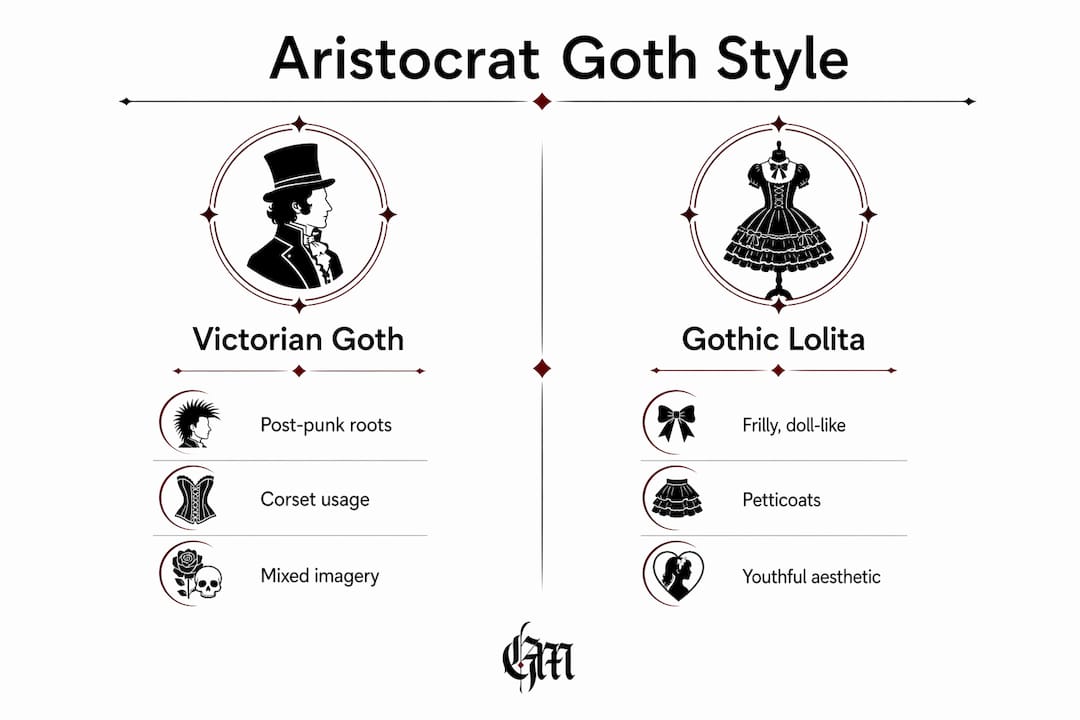
Gothic Lolita, also called GothLoli, prioritizes a doll-like, frilly aesthetic with petticoats, lace, and a deliberately “cute” presentation. Aristocrat goth rejects cuteness entirely. Aristocrat favors androgyny and mature elegance over the frilly, childlike silhouette of Lolita. The two styles share Japanese origins and some overlapping motifs, but their emotional registers are completely different. Lolita is sweet darkness. Aristocrat is cold, formal darkness.
Aristocrat goth vs. Victorian goth
Victorian goth draws from Western post-punk culture and uses Victorian imagery as one element among many. Aristocrat goth treats Victorian and Gothic Revival dress as the primary template, not a reference point. Aristocrat fashion requires strict grooming and dress etiquette that most Western gothic styles do not enforce. Victorian goth tolerates more improvisation. Aristocrat goth does not.
The corset question
Corsets appear frequently in Victorian goth and dramatic gothic looks. In aristocrat goth, they are largely absent or carefully minimized. Corsets are less prominent in aristocrat fashion, and many practitioners actively avoid them because they disrupt the clean, tailored silhouette that defines the style. A structured coat or waistcoat achieves the same visual effect without the theatrical connotations.
Ideology as the real dividing line
The distinction between aristocrat and other gothic styles lies in ideology as much as clothing. Western goth often celebrates societal rejection and raw individualism. Aristocrat goth emphasizes politeness, elegance, and formal conduct. The two philosophies produce very different communities and very different wardrobes.
Pro Tip: If you are building your first aristocrat goth outfit and you own a corset, set it aside. Focus on a well-fitted waistcoat and structured coat first. The silhouette will be cleaner and more accurate to the style.
How to start styling an aristocrat goth outfit
Building a genuine aristocrat goth wardrobe takes patience and selectivity. The style rewards careful choices over fast accumulation.
Start with these foundational pieces:
- A tailored black shirt with a high collar: This is your base layer for almost every look. Fit matters more than any other factor.
- A quality waistcoat: Single-breasted, in black or deep navy, with subtle texture. Brocade or fine wool works well.
- A long skirt or tailored trousers: Choose based on the silhouette you want, not on gender convention. Both are correct.
- A structured coat or frock coat: This is the most visible piece and the one that communicates the style most clearly to observers.
Successful aristocrat goth wardrobes rely on custom or carefully sourced garments because mass-produced gothic apparel rarely meets the fit and fabric standards the style demands. Vintage shops, specialty tailors, and curated alternative fashion marketplaces are better sources than fast fashion retailers.
Accessorize with intention. A cross pendant in aged silver, a rose brooch, or a pair of fitted gloves adds symbolic depth without overwhelming the look. Check out gothic accessories for 2026 for pieces that align with the aristocrat aesthetic. Avoid stacking too many motifs. One or two symbolic pieces read as deliberate. Five read as costume.
Many aristocrat goth practitioners avoid mass-market gothic clothes, preferring custom or high-quality Japanese brands and vintage pieces. Poor fit or low-quality fabric contradicts the aesthetic’s entire philosophy. A single well-made garment outperforms a wardrobe full of cheap approximations.
Pro Tip: Before buying any new piece, ask whether it could plausibly appear in a 19th-century aristocrat’s wardrobe. If the answer is no, it probably does not belong in an aristocrat goth outfit.
Key Takeaways
Aristocrat goth style succeeds when tailoring, fabric quality, and ideological commitment work together. The clothing alone is not enough.
| Point | Details |
|---|---|
| Core definition | Aristocrat goth is a dark, tailored aesthetic rooted in 19th-century European aristocracy and Japanese visual kei culture. |
| Essential garments | Frock coats, jabots, waistcoats, and high-collared shirts form the foundation of every authentic look. |
| Avoid corsets | Corsets disrupt the clean aristocrat silhouette; structured coats and waistcoats are the correct alternative. |
| Quality over quantity | Custom or carefully sourced garments are standard practice; mass-produced gothic wear rarely meets the style’s fit requirements. |
| Ideology matters | Politeness, formal conduct, and aristocratic etiquette are as central to the style as any clothing choice. |
Why aristocrat goth is the most disciplined style in alternative fashion
I have followed alternative fashion for a long time, and aristocrat goth stands apart from every other substyle for one reason: it demands more from you than your wardrobe. Most fashion communities accept that you wear the clothes and the identity follows. Aristocrat goth reverses that. The behavioral code extends beyond fashion to formal conduct, politeness, and a presentation standard that shapes every detail of how you move through a room.
That is either a barrier or a draw, depending on who you are. For fashion enthusiasts who find most alternative styles too casual or too reactive, aristocrat goth offers something rare: a complete aesthetic system with real historical depth. The Japanese visual kei origins give it a precision that Western goth rarely achieves. The Gothic Revival references give it genuine intellectual weight.
The androgyny is also worth naming directly. Aristocrat goth is one of the few alternative styles where androgynous presentation is not a subversion of the rules. It is the rule. That makes it genuinely welcoming to people who find gendered fashion categories limiting. The style does not ask you to choose a side. It asks you to be elegant.
My honest opinion is that most people who try aristocrat goth and abandon it do so because they underestimate the fit requirement. They buy the right garments in the wrong size and wonder why the look does not land. Tailoring is not optional here. It is the entire point.
— Rey
Where to find quality aristocrat goth pieces
Finding authentic aristocrat gothic clothing requires moving past mass-market retailers. The style’s standards for fit and fabric quality are specific enough that most generic gothic shops fall short.
Goth curates a selection of gothic fashion and accessories built for alternative fashion enthusiasts who take their aesthetic seriously. From gothic clothing and accessories to symbolic jewelry and statement outerwear, the marketplace connects you with independent creators who understand the difference between a costume and a wardrobe. If you are building an aristocrat goth look from the ground up, starting with well-made accessories is a practical first step. Explore elevated gothic accessories that complement the tailored, formal silhouette this style demands.
FAQ
What is the difference between aristocrat goth and Gothic Lolita?
Aristocrat goth emphasizes androgyny and mature, tailored elegance, while Gothic Lolita focuses on a doll-like, frilly, and deliberately cute aesthetic. Both styles have Japanese origins, but their emotional registers and silhouettes are entirely different.
What defines aristocrat goth style?
Aristocrat goth is defined by dark, formal tailoring inspired by 19th-century European aristocracy, combined with an ethos of strict grooming, elegant conduct, and androgynous presentation rooted in Japanese visual kei culture.
Can anyone wear aristocrat goth fashion?
Yes. Aristocrat goth is explicitly androgynous, meaning garments like long skirts and frock coats are worn regardless of gender. The style prioritizes silhouette and elegance over gendered dress conventions.
Are corsets part of aristocrat goth outfits?
Corsets are generally avoided in aristocrat goth because they disrupt the clean, tailored silhouette the style requires. Structured waistcoats and frock coats are the preferred alternatives for shaping the look.
Where do aristocrat goth accessories come from?
Common aristocrat goth accessories include roses, crosses, fleur-de-lis motifs, and antique-style jewelry in silver or aged gold. Practitioners typically source pieces from specialty retailers, vintage markets, or curated alternative fashion platforms rather than mass-market stores.