

What Is Mori Goth Aesthetic? Your 2026 Style Guide
TL;DR:
- Mori Goth, also called Dark Mori, blends Japanese forest-inspired fashion with gothic darkness and witchy symbols. It emphasizes natural fabrics, layered silhouettes, and earthy accessories for a personal, introspective style rooted in nature.
Mori Goth aesthetic, formally known as Dark Mori, is a fashion and lifestyle style that fuses the soft, forest-inspired layers of Japanese Mori Kei with gothic darkness, witchy symbolism, and earthy introspection. Where Mori Kei reaches for whimsy, Mori Goth pulls toward shadow. The result is a deeply personal style built on flowing silhouettes, natural fabrics, occult accessories, and a quiet connection to the natural world. Dark Mori is gaining popularity as a sustainable, emotionally rich alternative to mainstream trends, resonating with people who want self-expression without performance. This guide breaks down exactly what defines the style, where it came from, and how to wear it authentically.
What is the Mori Goth aesthetic and where did it come from?
Mori Goth is the darker, moodier evolution of Mori Kei, a Japanese fashion movement whose name translates literally to “forest girl.” Mori Kei emerged in Japan in the mid-2000s, built around soft earth tones, loose layering, and a romanticized connection to woodland life. The aesthetic spread through online communities and eventually gave rise to several darker variants, with Dark Mori (the recognized term for what many now call Mori Goth) being the most prominent.
Dark Mori evolved from the Mori Girl movement but incorporated gothic and witchy elements alongside darker color palettes. Critically, this evolution had nothing to do with the gothic music scene. Dark Mori is a visual and lifestyle aesthetic, not a music subculture. That distinction separates it from traditional goth, which carries strong ties to post-punk and deathrock music.
The style also draws from European witchcraft imagery and folklore, though its structural roots remain Japanese. Two closely related aesthetics, Strega and Black Forest fashion, share similar visual territory. Strega draws from European witch archetypes and folklore, whereas Mori Goth retains its Japanese forest fashion foundation. Think of them as cousins rather than the same style.
Key cultural influences shaping Mori Goth include:
- Japanese Mori Kei: The direct parent aesthetic, emphasizing layering, natural fabrics, and forest imagery
- Gothic fashion traditions: Dark color palettes, occult symbolism, and Victorian silhouette references
- Witchcraft and folk mysticism: Bone motifs, herbal imagery, and esoteric accessories
- Slow living philosophy: A rejection of fast fashion and trend cycles in favor of intentional, meaningful dressing
What are the key fashion elements of Mori Goth style?
Mori Goth fashion is built on a specific visual grammar. Get the core elements right, and the aesthetic reads clearly. Miss them, and it collapses into generic dark boho.
Color palette and fabrics
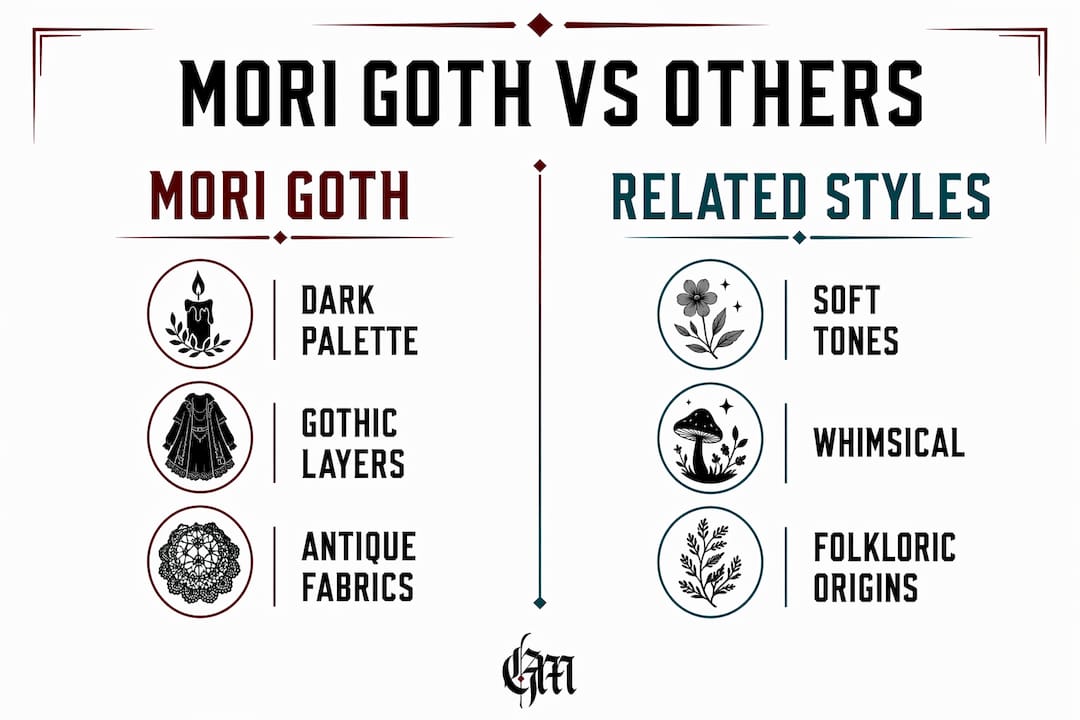
The palette runs dark. Black, deep forest green, burgundy, charcoal, and muted jewel tones form the foundation. This contrasts sharply with the cream, beige, and warm brown tones of standard Mori Kei. Occasional lighter layers appear underneath darker outer pieces, creating visual depth rather than a flat all-black look.
Natural fabrics are non-negotiable. Dark Mori fashion integrates antique fabrics and nature motifs through heavy layering and thematic accessories. Linen, cotton, raw silk, and loosely woven wool all work well. Synthetic fabrics undercut the tactile, handmade quality the aesthetic depends on.
Silhouettes and layering
Mori Goth silhouettes favor asymmetry, volume, and movement. Flowing maxi skirts, waterfall cardigans, oversized linen blouses, and draped shawls are all core pieces. Layering is the defining technique. A typical outfit might combine a long underskirt, a shorter dark dress over it, a loose cardigan, and a shawl or wrap on top.
Mori Goth style prioritizes loose, layered silhouettes comfortable for nature-oriented lifestyles. That practicality is intentional. The style is meant to be worn outdoors, in forests, on long walks, not just photographed indoors.
Accessories and footwear
Accessories carry significant weight in Mori Goth. Mori Goth accessories include antique-inspired jewelry, bone motifs, occult symbols, and handmade items. Rosaries worn as necklaces, dried flower crowns, twig brooches, and layered chain jewelry all fit the aesthetic. The goal is to look like you gathered your jewelry from a forest floor and an old apothecary cabinet.
Footwear stays flat and practical. Victorian-style lace-up boots, worn leather ankle boots, and simple flat oxfords all work. High heels contradict the grounded, nature-connected ethos entirely. This is one area where Mori Goth diverges most visibly from traditional gothic fashion, which often favors platform boots and dramatic heels.
Pro Tip: Layer your accessories the same way you layer your clothing. Stack rings, mix necklace lengths, and combine textures like wood, bone, and oxidized metal for a look that feels collected rather than coordinated.
How does Mori Goth differ from Mori Kei, cottagecore, and Strega?
These four aesthetics share visual DNA but carry distinct philosophies. Confusing them is easy. Understanding the differences sharpens your ability to dress intentionally.
| Aesthetic | Core mood | Color palette | Cultural roots | Key distinction |
|---|---|---|---|---|
| Mori Kei | Whimsical, gentle | Cream, beige, warm earth tones | Japanese | Lighthearted forest fantasy |
| Mori Goth (Dark Mori) | Introspective, moody | Black, dark green, burgundy | Japanese with gothic influence | Gothic darkness meets forest living |
| Cottagecore | Romanticized, escapist | Soft pastels, florals | Western European fantasy | Fantasy of rural life |
| Strega | Mysterious, witchy | Black, gray, deep earth | European folklore | Witch archetype, European folk roots |
Dark Mori is a moody evolution of cottagecore that focuses on realistic solitude and earthy palettes rather than fantasy escape. That distinction matters. Cottagecore imagines a perfect pastoral life. Mori Goth accepts the wildness, the decay, and the quiet strangeness of actual forests.
Mori Kei and Mori Goth share the same structural approach to dressing, but the emotional register is completely different. Mori Kei feels like a sun-dappled afternoon. Mori Goth feels like dusk in November.
Strega and Dark Mori are sibling styles sharing witchy aesthetics but differing in folkloric origins. If you find yourself drawn to European witch imagery and darker, more structured silhouettes, Strega may suit you better. If the Japanese forest girl foundation resonates, Mori Goth is the more natural fit. Many people wear both without strict allegiance to either, which is entirely consistent with the style’s ethos.
How to build an authentic Mori Goth wardrobe
Building a Mori Goth wardrobe well takes patience. The aesthetic rewards slow accumulation over bulk buying.
-
Start with thrifting. Curated thrifting focused on asymmetry and natural fibers is the most effective way to build this wardrobe. Vintage and secondhand shops regularly carry the linen blouses, wool cardigans, and long skirts the style requires. Prioritize texture and silhouette over brand or condition.
-
Anchor with key silhouettes. Every Mori Goth wardrobe needs at least one long dark skirt, one oversized cardigan or shawl, and one loose-fitting dark blouse. These three pieces create the foundation for dozens of layered combinations.
-
Add depth through layering pieces. Seek out underskirts, slips, and lightweight long-sleeve base layers in dark or neutral tones. These pieces rarely photograph well alone but transform every outfit they go under.
-
Build your accessory collection slowly. Bone jewelry, antique lockets, dried botanical pieces, and occult symbol pendants all contribute to the look. Handmade and one-of-a-kind pieces carry more visual weight than mass-produced alternatives. Goth carries a curated selection of occult-inspired accessories that fit directly into this aesthetic.
-
Choose footwear that works outdoors. Flat leather lace-up boots are the single most versatile footwear choice for this style. They read as historical, practical, and aesthetically consistent with the forest-dwelling ethos.
-
Incorporate lifestyle elements. Mori Goth extends beyond clothing. Nature walks, journaling, foraging, and slow mornings with tea and books all align with the aesthetic’s philosophy. The style is a way of moving through the world, not just a way of dressing.
Pro Tip: When thrifting, ignore color first and focus on silhouette and fabric. A cream linen blouse dyes beautifully to dark gray or forest green with cold-water fabric dye, giving you the right shape in the right color for a fraction of the cost.
Readers building their first gothic wardrobe essentials will find that many core dark wardrobe pieces translate directly into Mori Goth layering with minimal adjustment.
Key Takeaways
Mori Goth, formally called Dark Mori, is a Japanese-rooted aesthetic that layers gothic darkness, witchy symbolism, and natural fabrics into a deeply personal, introspective style.
| Point | Details |
|---|---|
| Dark Mori is the formal name | Mori Goth and Dark Mori refer to the same aesthetic; knowing both terms helps with research and community. |
| Natural fabrics define the look | Linen, cotton, and raw silk are non-negotiable; synthetic materials undercut the tactile quality of the style. |
| Flat footwear is intentional | Practical lace-up boots replace heels, reflecting the style’s nature-oriented, grounded philosophy. |
| Thrifting builds the best wardrobe | Curated secondhand shopping focused on silhouette and texture outperforms buying new for this aesthetic. |
| It differs from cottagecore and Strega | Mori Goth accepts wildness and solitude where cottagecore romanticizes and Strega draws from European folklore. |
Why Mori Goth resonates more than most aesthetics
I have followed gothic and alternative fashion for a long time, and Mori Goth stands out for one reason most style commentary misses. It does not ask you to perform. Traditional goth has a strong visual code that can feel like a test. Cottagecore became a trend cycle. Mori Goth, at its core, is about dressing for yourself in a forest where no one is watching.
The flexible, personal expression at the heart of this aesthetic is its greatest strength. Strict gatekeeping directly contradicts what Dark Mori is about. You do not need to own every piece or follow every rule. You need to understand the philosophy and let it guide your choices.
What I find genuinely useful about this style is its practicality. The layering system means you can dress for cold mornings and warm afternoons without changing your entire outfit. The flat footwear means you can actually walk in it. The natural fabrics mean the clothes age beautifully rather than degrading. These are not aesthetic accidents. They are the result of a style philosophy built around real life in natural environments.
The emotional depth of Mori Goth also sets it apart. It holds space for melancholy, for solitude, for the beauty of decay and dormancy. That is not darkness for shock value. It is an honest acknowledgment that the natural world contains shadow as much as light, and that dressing in alignment with that truth feels more authentic than pretending otherwise.
— Rey
Goth’s curated picks for your Mori Goth wardrobe
Putting together a Mori Goth wardrobe means finding pieces that balance gothic depth with natural, layered comfort. Goth brings together independent creators and alternative fashion vendors who specialize in exactly that intersection.
From flowing dark skirts and linen layers to gothic fashion essentials built for real wear, the collections at Goth reflect the same values the aesthetic demands: authenticity, craftsmanship, and a rejection of mass-market sameness. Whether you are building your first dark wardrobe or adding depth to an existing one, the marketplace connects you with pieces that carry genuine character.
FAQ
What is the difference between Mori Goth and Dark Mori?
Mori Goth and Dark Mori are the same aesthetic. Dark Mori is the original and more widely recognized term within the community, while Mori Goth is the common search-friendly label used online.
Is Mori Goth connected to the gothic music scene?
No. Dark Mori is a visual and lifestyle aesthetic with no ties to gothic music subcultures. It focuses on internal self-expression and nature mysticism rather than music scene identity.
What fabrics work best for Mori Goth outfits?
Linen, cotton, raw silk, and loosely woven wool are the best choices. Natural fabrics age well, layer comfortably, and carry the tactile quality the aesthetic requires.
How is Mori Goth different from cottagecore?
Dark Mori shifts from the fantasy escape of cottagecore toward introspective, grounded aesthetics using darker tones and layered textures. Cottagecore romanticizes rural life; Mori Goth accepts its wildness and solitude.
Where do I find Mori Goth clothing and accessories?
Thrift stores and vintage shops are the best starting points for clothing. For curated gothic and occult accessories that fit the aesthetic, Goth connects buyers with independent creators specializing in alternative and dark styles.