

1868 Planchette Collectibles: Authenticate Originals Before You Buy
A planchette is a small, heart or teardrop-shaped pointer once used for automatic writing and, later, Ouija-style talking boards. For collectors, the key distinction is age and purpose: genuine 19th-century writing planchettes from makers like Kirby & Co. are scarce and historically significant, while most planchettes sold today, including well-crafted artisan pieces found through curators on specialized marketplaces, are modern reproductions or decorative interpretations rather than period instruments.
TL;DR:
- Most authentic 19th-century planchettes date from the 1868 American craze and are identifiable by brass casters, solid hardwood, and maker marks from companies like Kirby & Co.
- Reproductions and artisan reproductions often feature stamped plastic wheels, laser-cut fiberboard, or artificially distressed finishes that lack genuine age marks.
- Provenance from auctions, museum collections, or detailed documentation significantly increases a planchette’s value and authenticity.
- Functional antique planchettes require precise balance, stable pencil clamps, and materials like bone or rubber wheels; wear and construction flaws affect usability.
- Curated marketplaces and specialist dealers provide more reliable sources for authentic, documented, or well-made reproduction planchettes compared to unverified online listings.
Table of Contents
- What are the origins and historical timeline of the planchette?
- How do collectors identify and authenticate planchettes?
- Where should collectors look to buy or research planchettes and related items?
- How should collectors care for, store, and display planchettes?
- What are typical market values and price ranges for planchette collectibles?
- What are the common fakes and how can you spot them?
- What is the significance of planchettes in spiritualism and occult practices?
- Why do planchettes matter to collectors and how should collecting priorities reflect that?
- Where can you find curated planchette-style pieces and related occult collectibles?
- Where can you go for further research on planchette history?
- Sources
- FAQ
What are the origins and historical timeline of the planchette?
The planchette has a surprisingly exact birthday. The first recorded use of an automatic writing device traces to Paris on June 10, 1853, decades before spiritualism became a parlor pastime in the United States. The device crossed the Atlantic and, by the summer of 1868, had become a full-blown commercial craze in American shops.
That 1868 boom is the single most important date for any collector to know, because it marks when planchettes went from a niche spiritualist tool to a mass-produced novelty. Bookshops and stationers sold them cheaply and in volume, which means a lot of what survives from that era is thin, lightly built, and not especially rare on its own. What matters more than sheer scarcity is context and maker identity.
A few manufacturer names come up again and again in period sources, auction catalogs, and museum records:
- G.W. Cottrell — one of the major sellers during the 1868 rush, frequently cited in advertisements of the period.
- Kirby & Co. — another prominent name tied to the original planchette wave, often found on trade cards and retail packaging.
- Selchow & Righter — a manufacturer whose name recurs in later records and auction listings as the market shifted toward talking boards.
That shift matters historically. Writing planchettes, the wheeled, pencil-holding devices meant to trace out words on paper, were the serious spiritualist instrument of the 1850s through 1880s. Pointer-style boards, what became the Ouija, commercialized around 1890 and pulled popular attention away from the writing form entirely. Anything genuinely predating 1890 in writing-planchette form carries more historical weight than the pointer-style pieces that followed it into mass production.
How do collectors identify and authenticate planchettes?
Authentication starts with the hardware, not the wood grain. A functional writing planchette needs precise balance so it can glide under a sitter’s fingers without drifting on its own, and makers achieved that through three small feet, careful weight distribution, and a stable pencil clamp rather than a crude two-wheel setup. If a piece you’re evaluating can’t hold a pencil steady or wobbles unnaturally, that’s a construction flaw worth noting before you consider the price.
Work through these checks in order when you’re evaluating a piece in person or from photos:
- Examine the casters and clamp. Period pieces typically use brass casters, small wheels made of bone or early rubber, and a thumb-screw pencil clamp. Stamped plastic wheels or a glued-in pencil holder point to a later reproduction.
- Check the wood. Original planchettes favor solid hardwoods, often quarter-sawn for stability, while cheap modern copies lean on laser-cut fiberboard or plywood.
- Look for maker marks. A stamped name, a paper label, or packaging that matches known trade cards from Kirby & Co. or G.W. Cottrell adds real provenance weight.
- Assess the wear pattern. Genuine age shows as perished rubber, slightly cupped thin planks, or chipped glass on the rarer glass-bodied models. Uniform, sanded-looking distress or artificially darkened wood usually signals a piece staged to look older than it is.
- Cross-reference advertising. Period trade cards, magazine ads, and retail packaging from the 1868 craze can corroborate a seller’s claims about age and origin.
Pro Tip: Ask any seller claiming a 19th-century piece for close-up photos of the underside and the pencil clamp mechanism before you buy. Reproductions almost always cut corners in the parts that don’t show in a staged front-facing photo.
If a listing lacks any documentation and the price feels too good for a supposedly antique piece, request a conservation report or additional angles before committing. Serious sellers won’t hesitate to provide either.
Where should collectors look to buy or research planchettes and related items?
Sourcing well matters as much as identifying well, since the venue often tells you how much documentation to expect.
- Auctions and estate sales tend to offer the strongest paper trail. Always request a provenance statement and a written condition report before bidding, since planchettes rarely get a close visual inspection during a live auction preview.
- Specialist dealers and museum deaccessions can be excellent sources for documented pieces, particularly when a dealer specializes in spiritualist or Victorian ephemera. Ask directly whether the item has ever been part of a museum collection; institutions like the Baltimore Museum of Industry have exhibited rare planchettes, and past exhibition history adds real credibility.
- Independent artisan makers and curated marketplaces are the right call when you want a functional, well-built piece rather than a fragile antique. Specialized platforms curate artisan and reproduction occult objects rather than mass-market imports, which is useful when you want something display-ready without gambling on unverifiable age claims.
- Online marketplaces and niche collector forums require the most caution. Vet sellers by their return policy, feedback history, and whether they’ll answer specific questions about construction and provenance before you pay.
Whichever channel you choose, the questions stay the same: who owned it, where did it come from, and can the seller show you rather than just tell you.
How should collectors care for, store, and display planchettes?
Preservation for planchettes follows the same logic as any small wooden or mixed-material antique: control the environment before you touch the surface.
- Keep pieces out of direct sunlight and away from windows or vents where temperature and humidity swing quickly, since that’s what causes wood to cup and varnish to craze.
- Clean only with a soft brush or a museum-grade cloth. Household solvents, furniture polish, and anything with alcohol can strip original finishes permanently.
- Store unused pieces in a padded box lined with acid-free tissue, and if you’re shipping one, pack the pointer end separately from the base to prevent pressure cracks.
- For display, use a small stand that supports the full base rather than balancing the piece on an edge, and label the provenance nearby so the history travels with the object.
Pro Tip: Don’t panic over minor cupping in a thin antique plank or slightly perished rubber on old wheels. These are normal signs of material age, and aggressive restoration often destroys more collector value than it restores.
What are typical market values and price ranges for planchette collectibles?
Prices swing enormously depending on what you’re actually buying: a documented 1868 original, a later mass-market piece, or a modern artisan reproduction. Common, undocumented period planchettes with heavy wear tend to sit at the lower end of the antique market, while pieces with intact original boxes, maker marks, or period advertising material command significantly more from serious collectors.
Condition and completeness drive value more than age alone. A glass-bodied planchette from the 1868 novelty wave is inherently fragile and chips easily, so an intact example with its original box and accessories is often among the most valuable survivors from that period, simply because so few made it through 150 years without damage.
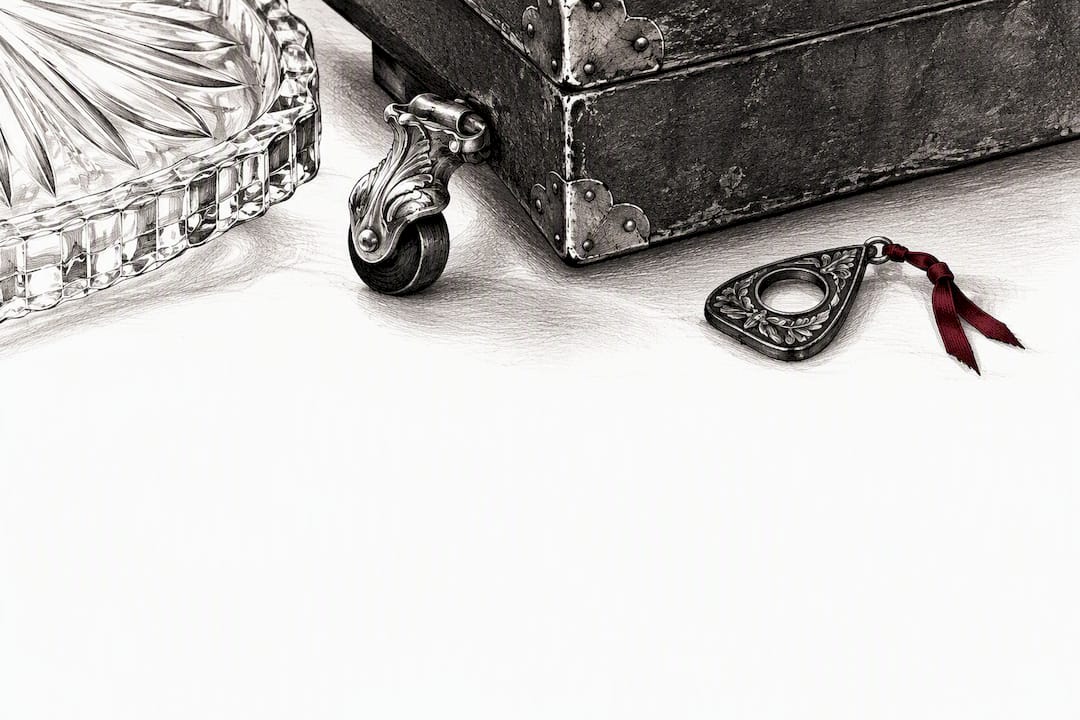
Modern reproductions and artisan-made planchettes occupy a different price bracket entirely. These aren’t competing with antiques on rarity, but on craftsmanship: a well-balanced piece with brass fittings and quarter-sawn hardwood, built to actually function as intended, costs more to produce than a mass-market decorative version and is priced accordingly. Buyers should treat these as functional art objects rather than investments, since they carry no historical premium.
The honest takeaway for anyone pricing a piece is that provenance and documentation move the number far more than surface condition. A rough-looking original with a verifiable trade card can out value a pristine but undocumented piece of similar age.
What are the common fakes and how can you spot them?
The most common fake isn’t a forged antique. It’s an undisclosed modern reproduction sold as period without any claim of age at all until a buyer assumes otherwise. Watch for these patterns specifically.
Stamped plastic wheels or nubs instead of brass casters and bone or early rubber wheels are the fastest tell that you’re looking at a later production piece, not an 1868 original. Laser-cut fiberboard grain looks suspiciously uniform compared to the natural variation in quarter-sawn hardwoods that period and quality artisan makers favor.
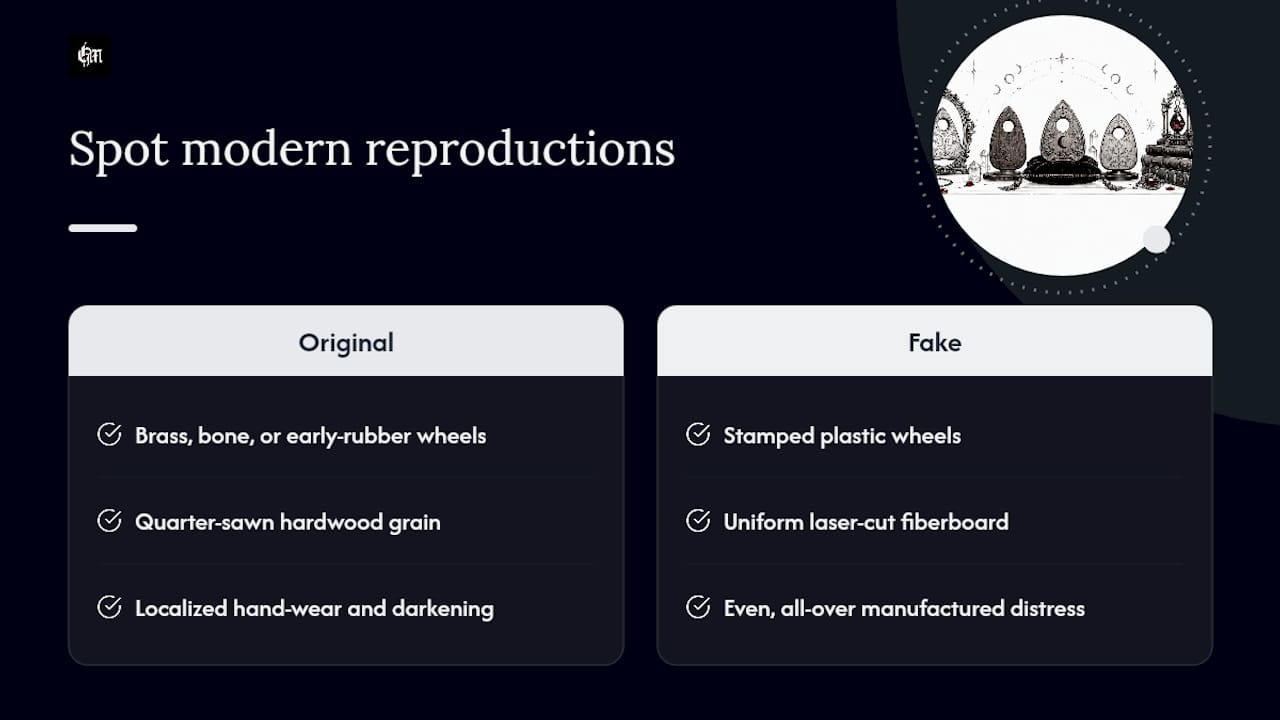
Artificially distressed finishes are another giveaway. Genuine age produces uneven wear concentrated where hands actually touched the piece, cupping in thin original planks, and natural darkening from decades of light exposure. Manufactured distress tends to be applied evenly across the whole surface, which looks wrong once you know to look for it.
Be skeptical of any seller who pairs vague claims (“family heirloom,” “found in an estate”) with no maker marks, no packaging, and no willingness to provide extra photos. Genuine period pieces usually have at least one verifiable detail, whether that’s a stamped name, a matching trade card, or an exhibition history you can check against museum records. When none of that exists, treat the asking price as decorative, not historical.
What is the significance of planchettes in spiritualism and occult practices?
Before it was a novelty, the planchette was a serious tool of the American and European spiritualist movement, used in seances to receive messages believed to come from the deceased. Writing planchettes held that role for decades, predating the talking board by a wide margin and functioning as a legitimate instrument of practice rather than a party game.
That status changed once pointer-style boards commercialized around 1890 and shifted the culture from writing tools toward the letter-and-symbol boards familiar today. The writing planchette didn’t disappear so much as it got eclipsed, which is exactly why an original example from before that shift carries more weight for collectors focused on spiritualist history specifically.
For today’s occult and metaphysical collectors, that lineage is part of the appeal. A planchette isn’t just an antique curiosity. It’s physical evidence of a specific belief system and a specific cultural moment when Americans in enormous numbers turned to a small wooden pointer to talk to the dead. Owning one, original or well-made reproduction, connects a collection to that history rather than treating it as generic decor.
Why do planchettes matter to collectors and how should collecting priorities reflect that?
The line between a serious spiritualist artifact and a later parlor novelty gets blurred constantly in casual listings, and that’s where collectors lose money. A worn, mass-produced 1868 example with a matching trade card tells you more about American cultural history than a flawless but undocumented piece from the same decade.
Provenance is what elevates a planchette from curiosity to artifact. Context matters as much as construction, which is why curators who vet materials, maker marks, and condition honestly, rather than simply flipping stock, serve collectors better than volume-focused sellers. Curators who vet materials, maker marks, and condition honestly, rather than simply flipping stock, serve collectors better than volume-focused sellers.
— Rey
Where can you find curated planchette-style pieces and related occult collectibles?
Specialized marketplaces focused on dark, occult, and alternative aesthetics, where independent artisans and curators do the vetting before items get listed, provide an alternative to hunting scattered estate sales and unverified online listings.
Curated collections on specialized platforms are natural starting points for collectors chasing unique, vetted objects rather than mass-market imports, and often feature artisan-made planchette-style pieces and complementary occult decor. If you’re building out a broader spiritualist or Victorian-inspired display, Related themed collections on these platforms often carry decor and jewelry that pair naturally with a planchette centerpiece.
None of this replaces doing your own provenance homework on a genuine antique. What it does is give you a reliable source for the reproduction, artisan, and decorative pieces that make up most of today’s planchette market. Browse Curated Finds to see what’s currently available.
Where can you go for further research on planchette history?
Three sources are worth bookmarking if you’re serious about provenance work. Harvard Library’s piece on the planchette before the Ouija covers the 1853 origin and the 1868 American craze in detail. The site planchettes.com offers deep material and construction breakdowns useful for identification. The Wikipedia entry on the planchette is a solid starting point for the broader timeline and maker names.
Beyond those three, check museum archives and auction house catalogs directly. Institutions that have exhibited spiritualist artifacts often publish provenance notes that can help you cross-reference a piece you’re considering.
Sources
- Before the Ouija there was the planchette — Harvard Library
- Planchettes — Automatic-Writing Planchettes, Talking Boards, and the Long History of the Little Board
- Planchette — Wikipedia
FAQ
What exactly is a planchette collectible?
A planchette collectible is a small pointer device, historically used for automatic writing and later for talking boards, that collectors seek out for its age, maker history, or craftsmanship. Genuine 19th-century examples date to the 1853 Paris origin and the 1868 American craze, while most items sold today are modern reproductions or artisan-made decorative pieces.
How can I tell if my planchette is antique or a reproduction?
Check the casters, wheels, and pencil clamp first. Original pieces typically use brass casters and bone or early rubber wheels, while reproductions often rely on stamped plastic or laser-cut fiberboard. Maker marks, period packaging, and matching trade cards from names like Kirby & Co. or G.W. Cottrell add further confirmation.
What is the difference between a writing planchette and a Ouija planchette?
A writing planchette holds a pencil and traces words directly onto paper, while a Ouija-style pointer glides across a printed board of letters and symbols. Pointer-style boards commercialized around 1890, decades after the original writing planchette had already established itself as a spiritualist tool.
Are original 19th-century planchettes rare?
Some are, but not all. The 1868 craze produced a large volume of mass-market planchettes sold cheaply in bookshops and stationers, so plain surviving examples aren’t automatically scarce. What’s genuinely rare is a piece with intact documentation, original packaging, or unusual materials, like an intact glass-bodied model from that same year.
Where is the best place to buy a planchette for collecting?
It depends on what you want. Auctions and estate sales offer the strongest provenance trail for antiques, specialist dealers can supply documented period pieces, and curated marketplaces like Goth’s Curated Finds are a reliable option for vetted artisan and reproduction pieces without the guesswork of unverified online listings.
Can I use an antique planchette, or is it just for display?
You can use one, but functionality depends on its construction and condition. A well-built piece needs precise balance and a stable pencil clamp to work as intended, and antique examples with perished rubber wheels or cupped wood may no longer perform reliably, which is a reason some collectors keep originals as display pieces and use modern artisan replicas for actual sessions.
How much does a collectible planchette typically cost?
Prices vary widely based on age, documentation, and materials, with undocumented period pieces at the lower end and rare, intact, or well-documented examples commanding far more. Modern artisan reproductions are priced according to craftsmanship and materials rather than historical rarity, so check current listings directly for accurate figures.
What should I avoid when buying a planchette online?
Avoid listings with vague age claims, no maker marks, and no willingness from the seller to provide extra photos or a condition report. Uniform, evenly applied “aging” on the wood or finish is a common sign of artificial distress rather than genuine wear from decades of use.