

Goth Friendly Chokers That Fit: Measure 14–16 Inches and Pick Extenders
A choker sits at 14 to 16 inches, snug against the base of your neck, and getting it right comes down to one move: measure your neck circumference with a soft tape, then add 0 to 2 inches depending on how tight you want it to sit. If you’re between sizes or unsure, buy a choker with a 2 to 3 inch extender so you can adjust the fit after it arrives instead of guessing before you order.
TL;DR:
- Most chokers are designed to be 14 to 16 inches long, with an extender chain allowing adjustments up to approximately 19 inches for versatility.
- Accurate measurement involves wrapping a flexible tape or string around the base of your neck, adding 0 to 2 inches depending on your preferred fit.
- Wider and more ornate chokers tend to suit longer, slender necks, while delicate chains are better for shorter or wider necks to maintain balanced proportions.
- Materials like chain, leather, or fabric affect stretchability; chain chokers are fixed while fabric and leather can loosen over time, requiring tighter initial sizing.
- Adjustable styles with extender chains are recommended for most wearers to accommodate natural neck size changes and avoid sizing mistakes.
Table of Contents
- What Are the Standard Choker Lengths and Where Do They Sit?
- How Do You Measure Your Neck for a Choker at Home?
- Does Your Neck Shape Change Which Choker Length You Should Buy?
- What Materials and Construction Details Affect How a Choker Fits?
- How Do You Style and Layer a Choker for Different Looks?
- Why Trust This Guide and How Does Goth.Market Help You Find the Right Fit?
- What Actually Matters More Than the Perfect Measurement
- Where Can You Buy Chokers With Verified Length and Extender Sizing?
- Sources
- FAQ
What Are the Standard Choker Lengths and Where Do They Sit?
Chokers are the shortest necklace category, and everything about how they look depends on those few inches of difference. A 14 to 16 inch choker sits right at the base of the neck, which is why it reads as the most graphic, face-framing length in any jewelry box. Go up to 18 inches and you’ve left choker territory for princess length, which drapes just below the collarbone. Push to 20–24 inches and you’re in matinee range, sitting well below the collar for a completely different silhouette.
That gap between 16 and 18 inches matters more than it sounds. A small difference in length can be the difference between a piece that hugs your throat and one that floats loosely over your collarbone, so if you’re shopping online without trying it on first, don’t round up “close enough.”
| Length | In Centimeters | Where It Sits | Best For |
|---|---|---|---|
| 14 in | 14 inches | Tight collar, upper throat | Snug fit, smaller neck circumference, dramatic statement pieces |
| 15 in | 15 inches | Base of the neck | Most versatile choker length, fits the average adult neck |
| 16 in | 16 inches | Base of neck, slightly relaxed | Fuller necks or anyone who prefers a looser choker feel |
| 16 in + 2–3 in extender | 40.5–48 cm | Adjustable base-of-neck to lower throat | Uncertain sizing, gifting, layering with other pieces |
Most retail chokers today ship with a 2 to 3 inch extender chain, which turns a fixed 16 inch chain into a range that covers roughly 16 to 19 inches. That single feature solves the biggest frustration with choker shopping: buying a fixed-length piece that’s a half inch too tight to close comfortably. If a listing doesn’t mention an extender, assume it’s a fixed length and measure carefully before you commit.
How Do You Measure Your Neck for a Choker at Home?
You need one of three things: a soft sewing tape measure, a piece of string or ribbon with a ruler, or (in a pinch) a strip of paper. A metal tape measure from your toolbox won’t curve around your throat properly, so skip it.
Here’s the exact method:
- Stand up straight and relax your shoulders. Slouching or tilting your chin changes the measurement by a surprising amount.
- Wrap the tape around the base of your neck, roughly where a crew neck t-shirt collar sits, not higher up near your jaw.
- Slide two fingers between the tape and your skin. This is the same two-finger rule jewelers use for ring sizing, and it’s the fastest way to check you haven’t pulled the tape too tight.
- Read the number where the tape overlaps, then round to the nearest quarter inch.
- Add 0 to 2 inches to that number depending on your preferred fit. Add nothing for a snug choker that sits right against your skin, or add the full 2 inches for a piece that hangs with a little room to move.
If you don’t have a flexible tape, a piece of string works just as well. Wrap it around your neck at the same spot, mark where it overlaps, then lay it flat against a ruler.
For context, the average adult female neck measures 13 to 14 inches around, while male necks typically run 14 to 16 inches. That means a woman with a 13.5 inch neck who wants a snug fit should look for a 14 inch choker, while someone with a 15 inch neck who wants room to breathe should target 16 to 17 inches, ideally with an extender.
Before you check out, run the ribbon test. Cut a length of ribbon or string to your target size, tie it around your neck at the spot where the choker will sit, and look in the mirror. This step catches problems a tape measure alone can’t, because it shows you the actual visual weight of the length, not just a number. If you can preview the width too, cut the ribbon to match the choker’s material width. That gives you a real sense of how a wide band will shorten the look of your neck before you’ve spent a dollar.
Pro Tip: Do the ribbon test while wearing the neckline you plan to pair the choker with. A length that looks perfect against bare skin can sit completely differently over a turtleneck or a scoop-neck top.
Does Your Neck Shape Change Which Choker Length You Should Buy?
Yes, and this is where most sizing charts stop short. Circumference gets you in the right ballpark, but neck width, length, and personal proportion decide whether a choker actually flatters you once it’s on.
Stylists generally recommend thinner chokers for wider or shorter necks and wider, more ornate designs for long, slender necks, since a bold band on a shorter neck can visually swallow the space between your jaw and collarbone. Here’s how that plays out by build:
- Petite or slender necks: A 14 inch choker in a delicate chain or thin ribbon keeps proportions balanced without overwhelming a smaller frame.
- Average necks: 15 inches is the sweet spot for most people, wide enough to layer a pendant, snug enough to read as a true choker.
- Fuller or shorter necks: 16 inches with an extender gives breathing room, and a slimmer band (under half an inch wide) avoids the “squeezed” look a thick, rigid collar can create.
- Long, slender necks: This is the one build that can carry a wide, ornate band like the claw-detail choker styles without it looking heavy, since the extra neck length balances the visual weight.
Width does more damage to proportion than length does. A wide, rigid choker, think a two-inch leather cuff or a chunky metal collar, visually shortens whatever neck it’s on, because it fills the space where your eye would otherwise see skin. That’s a deliberate effect if you’re going for a dramatic, architectural look, but it’s a mistake if you’re self-conscious about a shorter neck and reach for an ornate wide band expecting it to elongate anything. It won’t.
On a 14 inch choker, expect the piece to sit almost like a second collar, visible even under most crew necks. At 15 inches, it settles right at the base of the throat with a touch of movement. At 16 inches, especially with an extender pulled out, you get a slightly lower, more relaxed drape that reads less severe and more everyday-wearable.
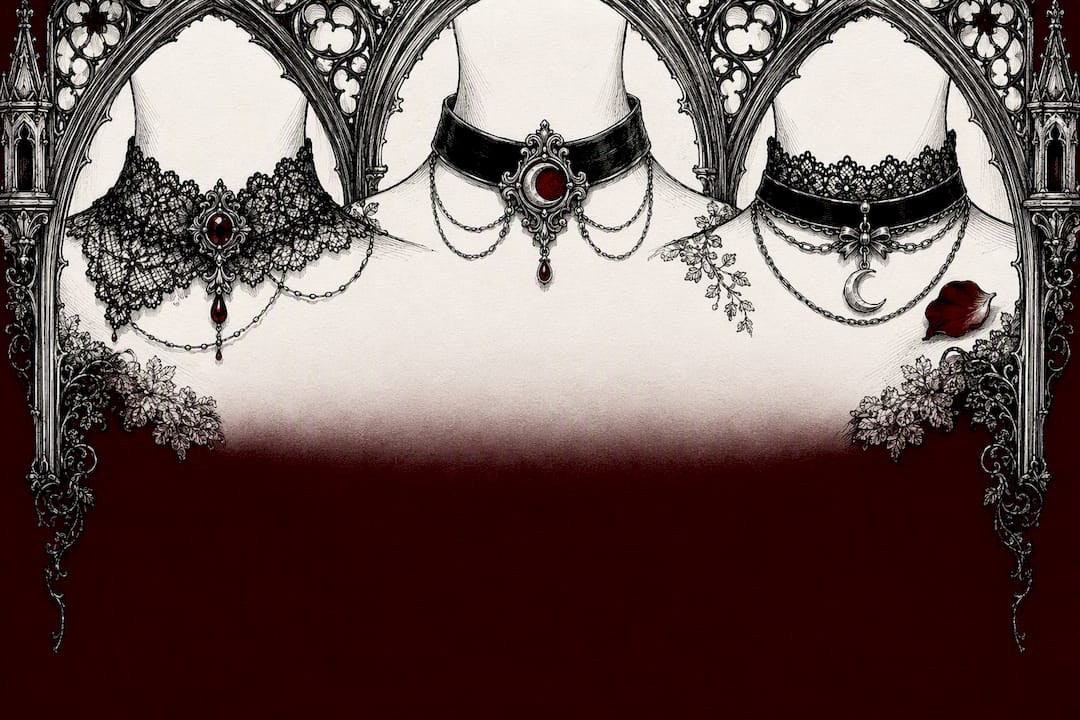
If you’re genuinely unsure which length suits you, buy adjustable. A choker with a 2 to 3 inch extender and a pendant that hangs slightly below the chain, rather than a rigid all-around band, gives you room to correct for sizing mistakes and still looks intentional at multiple lengths.
What Materials and Construction Details Affect How a Choker Fits?
The number on your measuring tape is only half the equation. What the choker is made of decides whether that number holds true after the first wear, or the tenth.
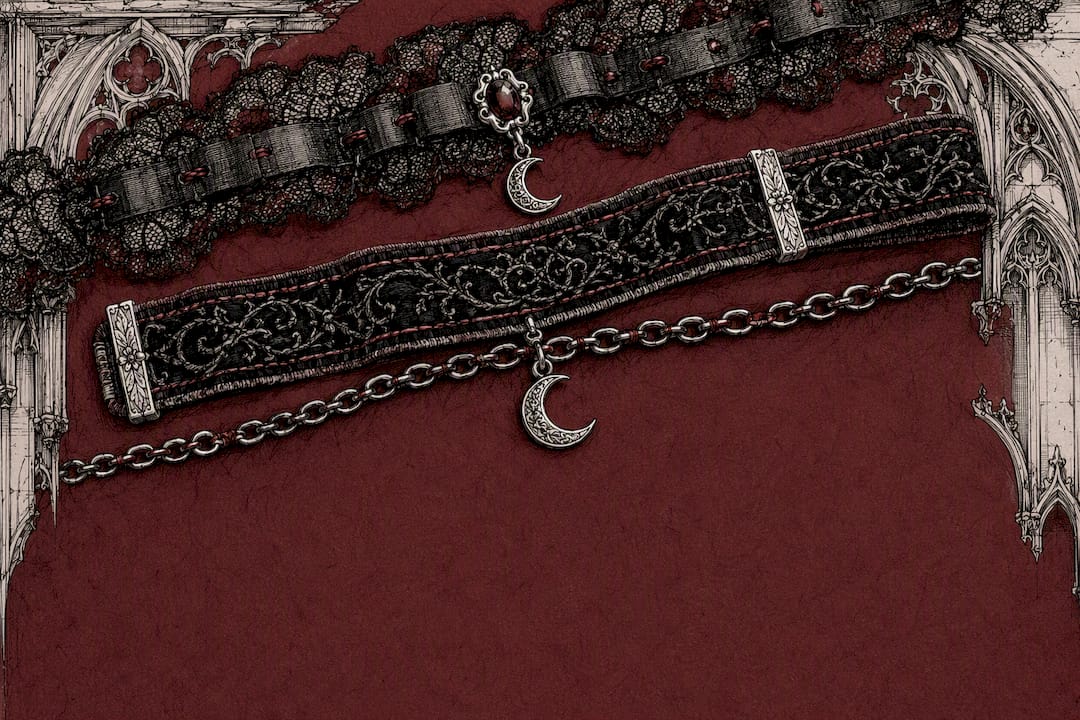
Chain chokers (metal links) don’t stretch or compress, so the size you buy is the size you’ll always have, aside from whatever range the extender gives you. They’re the most predictable option if you’ve measured carefully.
Ribbon and fabric chokers are the opposite story. Woven or corded materials can compress slightly over time as fibers settle, which means a fabric choker that fit perfectly on day one might sit a touch looser after a few months of wear.
Leather chokers tend to stretch with body heat and wear, so a leather band that feels snug out of the box often loosens slightly within the first few weeks. Buy leather a touch tighter than you think you need.
Rigid metal collars (solid, non-flexible bands) have zero give, which makes exact measurement critical since there’s no extender or stretch to bail you out if you’re off by half an inch.
A few practical notes on adjustability and care:
- Look for listings that specify extender chain length and minimum clasp position, not just “adjustable,” since those two details determine your actual usable range.
- Lobster clasps and spring rings are the most common closures and both support extender chains easily.
- Store leather and fabric chokers flat rather than hung, since hanging accelerates stretch and distortion in materials that already have some give.
- If you have sensitive skin, check the metal composition before buying. Nickel is the most common trigger for contact reactions in costume jewelry, so surgical steel, titanium, or plated brass are safer bets for daily wear.
How Do You Style and Layer a Choker for Different Looks?
Chokers work best with necklines that leave the throat and upper chest visible. Strapless, scoop, and V-neck tops let a choker sit as the clear focal point instead of competing with a collar. High necklines and turtlenecks are the one style choice to avoid entirely, since the choker either disappears under the fabric or bunches awkwardly against it.
Layering follows a simple rule of spacing:
- Start with your choker at 14 to 16 inches as the anchor piece.
- Add a second necklace at 18 inches (princess length) so it sits a couple of inches below the choker without crowding it.
- Add a third piece at 20 to 24 inches (matinee) if you want a fuller, tiered look, letting each layer breathe with visible space between chains.
For alternative and gothic styling specifically, contrast is what makes a choker read as intentional rather than accidental. Pair a delicate lace or ribbon choker like a minimalist lace set with a chunkier layered chain to play soft against hard. A single dramatic pendant, like a moon charm on a fine chain choker, gives the eye one clear focal point instead of competing with a busy outfit.
Whether you want a snug collar or a relaxed choker is really a question of intent. A tight-fitting band reads as bold and architectural, more of a statement than an accessory. A slightly loosened choker with the extender let out reads as everyday wearable, the kind of piece you forget you’re wearing by lunchtime.
Why Trust This Guide and How Does Goth.Market Help You Find the Right Fit?
This guide draws on established sizing conventions from fine jewelry retailers and stylist recommendations, cross-checked against the measuring methods jewelers actually teach. The practical framework, measure, add ease, buy adjustable, comes directly from how professional sizing guides approach the same problem in rings, bracelets, and other fitted jewelry.
Goth.Market built its own Necklace Length Guide specifically because generic sizing charts don’t account for how alternative and gothic styles use chokers differently, often as the visual anchor of an outfit rather than a subtle accent. Every choker listing on the platform includes exact chain length and extender range, so you’re never guessing based on a product photo.
Before you check out on any product page, run through this:
- Does the listing specify a base length in inches, not just “one size”?
- Is there an extender, and how many inches does it add?
- Does the material (leather, fabric, chain) match your fit expectations for stretch or compression over time?
- Does the closure type match what’s described (lobster clasp, spring ring, tie-back)?
What Actually Matters More Than the Perfect Measurement
Here’s the uncomfortable truth about choker sizing: most people spend twenty minutes agonizing over whether they’re a 14 or a 15, then buy a fixed-length chain with no extender and no way to correct the mistake. That’s backwards. The measurement matters, but the adjustability matters more, because your neck size isn’t static. It changes slightly with posture, with weight fluctuation, with what you’re wearing it over.
The conventional advice treats choker sizing like ring sizing, find the exact number and lock it in. But a choker sits against soft tissue and moves with your breathing and your jaw, not around a fixed bone like a finger. That’s exactly why the ribbon test exists, and why I’d rather see someone buy a 16 inch choker with a generous extender than agonize over hitting 15.25 inches precisely.
If you take one thing from this guide, take this: buy adjustable whenever the style allows it. Reserve fixed-length, no-extender pieces for chains you’ve already tested in person, at a market stall, in a mirror, on your actual neck. Everything else is a guess dressed up as precision.
— Rey
Where Can You Buy Chokers With Verified Length and Extender Sizing?
Goth.Market lists exact chain length and extender range on every choker product page, so you’re buying against real numbers instead of a photo and a hope. That single detail, knowing whether a “16 inch” choker actually extends to 19 inches or stays fixed, is usually the difference between a piece that fits and one that gets returned.
Start by using the site’s length filters to narrow listings down to your measured range, then cross-reference against the Necklace Length Guide if you’re torn between two sizes. For anyone who wants room to adjust after the fact, look at pieces like the layered chain choker set, which combines multiple lengths in one purchase so you can test proportion without ordering three separate items. Browse the current collection at Goth and filter by adjustable styles to find a choker that matches the measurement you just took.
Sources
The numeric ranges and measuring techniques in this guide come from a handful of sources worth bookmarking if you want to go deeper:
- Necklace length chart — Blue Nile
- Choker necklace size guide — AJLuxe
- How to choose a choker necklace — wikiHow
- The ultimate necklace length guide — Adore Pearl
FAQ
What size should a choker be?
A standard choker measures 14 to 16 inches, sitting snugly at the base of the neck. To find your size, measure your neck circumference and add 0 to 2 inches depending on whether you want a tight or slightly relaxed fit.
Is a 20 inch necklace a choker?
No, a 20 inch necklace falls into matinee length, which sits well below the collarbone rather than at the throat. Chokers top out around 16 inches; anything from 18 to 24 inches is princess or matinee length instead.
Is a 17 inch necklace a choker?
A 17 inch necklace sits at the edge between choker and princess length, usually resting just below the base of the neck rather than tight against it. Many people wearing a 16 inch choker with its extender pulled to the maximum end up around 17 to 18 inches, which drapes more loosely than a true snug choker.
How do I convert my neck measurement into a choker size?
Measure your neck circumference at the base of your throat, then add 0 to 2 inches based on desired fit. Someone with a 14 inch neck who wants a snug choker should order a 14 to 15 inch piece, while the same person wanting room to move should look for 15 to 16 inches with an extender.
Why is the choker considered a sexualized accessory?
Chokers draw visual attention to the neck and throat, an area with cultural associations tied to vulnerability and adornment dating back centuries, which has shaped their reputation in fashion and media. Today they function primarily as a styling choice that frames the face and collarbone, and their popularity across everyday, formal, and alternative fashion has moved well beyond any single cultural association.
What tools do I need to measure for a choker at home?
You need a soft sewing tape measure, or a piece of string and a ruler if you don’t have one. Wrap it around the base of your neck, slide two fingers underneath to avoid over-tightening, and read the measurement where it overlaps.
Should I buy a choker with an extender or a fixed length?
Buy adjustable whenever the style allows it. Most chokers now include a 2 to 3 inch extender chain, which lets you fine-tune the fit after your order arrives instead of returning a piece that’s a half inch off.
Do chokers fit differently depending on neck shape?
Yes. Stylists generally recommend thinner, more delicate chokers for wider or shorter necks and reserve wide, ornate bands for long, slender necks where the extra length balances the visual weight. A wide rigid choker on a shorter neck tends to shorten it further rather than flattering it.