

Identify 12 Lace Types Fast for Fashion and Gothic Styling
Lace types are named forms of openwork textile classified by how they’re made, whether bobbin, needle, machine, crochet, knitted, or tatted, and by their visible ground and motifs. This guide walks through the most common named laces, including Chantilly, Alençon, and Guipure, shows you what to look for under a hand lens, and covers how to wash each one without wrecking it.
TL;DR:
- Hand washing in cool water is safest for most lace types, with synthetic lace being the only exception that may be machine washable on a delicate cycle.
- Needle lace and true bobbin lace are rare and expensive due to their slow, handcrafted production process, making them highly valued among collectors and bridal markets.
- Identifying lace technique first and fiber content second prevents common mistakes that can damage delicate or improperly cared-for lace.
- Guipure and dense, corded lace tend to retain detail better under dark fabrics, making them preferable for gothic and alternative fashion applications.
- Machine-made laces like Raschel are more durable and affordable, often better suited for frequent wear or washing, compared to handmade and vintage options.
Table of Contents
- What are the main lace types you’ll actually encounter?
- How is lace actually made?
- How do you wash lace without ruining it?
- How do you tell similar lace types apart?
- What lace works best for gothic and alternative fashion?
- What does years of looking at lace teach you that most guides skip?
- Where can you find lace-accented pieces without hunting down raw yardage?
- Sources
- FAQ
What are the main lace types you’ll actually encounter?
Most lace on the market today falls into a manageable set of named categories, and once you can spot the tells for each one, identification gets fast. Here’s what to look for, piece by piece.
Chantilly lace is bobbin-made, built on a fine hexagonal net ground, and known for delicate floral or scroll motifs outlined in a slightly heavier silk thread called cordonnet. Traditionally black or ivory silk, it shows up constantly in bridal veils, mantillas, and overlay panels because it drapes rather than stiffens.
Alençon lace is needle lace with solid, densely worked motifs set against a sheer net ground, often finished with a raised, buttonhole-stitched cord edge around each flower. It originated in France as a needle-made alternative to Venetian lace, and its weight makes it a favorite for bridal bodices and statement appliqués rather than trims.
Guipure lace skips the net entirely. Motifs are joined directly to each other by connecting bars or “brides” instead of resting on mesh, so when you hold it to light you see solid shapes floating in open space. It’s sturdy, doesn’t fray easily, and works well on necklines and structured garments.
Bobbin lace is a broad category rather than a single pattern. It’s made by braiding and twisting threads wound on wooden bobbins around a pattern of pins, producing continuous, flowing designs with no visible seams between motif and ground. Chantilly, Mechlin, Valenciennes, and Brussels lace are all bobbin techniques, distinguished mostly by their ground density and motif style rather than construction method.
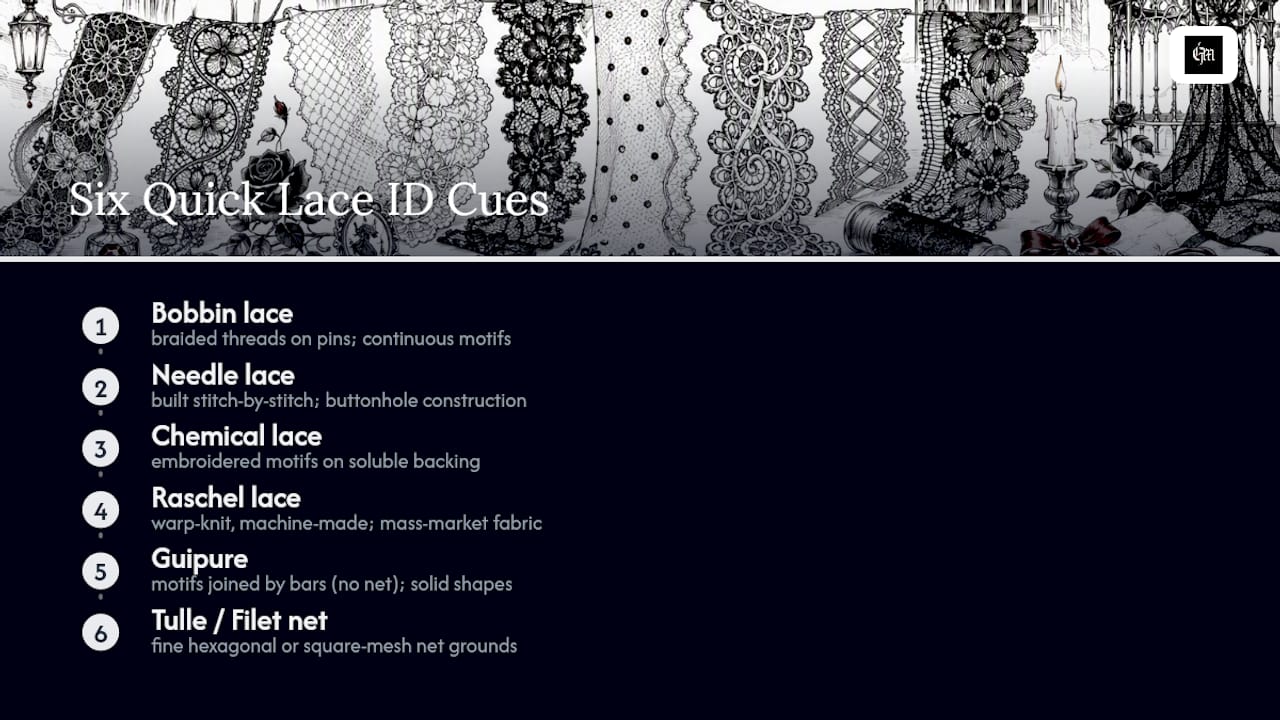
Needle lace is worked entirely with a needle and thread, one buttonhole stitch at a time, building up both the motifs and any connecting ground from scratch. According to Sewport, needle lace is widely regarded as highly intricate and is most often handmade, which contributes to its high value among collectors and the bridal market.
Chemical lace, also called machine embroidered lace, starts as an embroidered motif stitched onto a soluble backing fabric. Once the backing dissolves or is burned away, only the thread motif remains. Sewport notes that modern versions often use water soluble or heat soluble backers instead of harsher chemicals, but the visual signature stays the same: crisp, embroidery-like motifs with no separate ground thread structure.
Raschel lace is warp-knit on specialized machines and dominates contemporary ready-to-wear because it’s durable, affordable, and fast to produce at scale. It’s the lace most likely stitched into a mall-brand slip dress or a costume trim, and Sewport lists it among the most common laces in modern apparel.
Tulle and filet lace describe simple net grounds, either fine hexagonal tulle or the knotted square-mesh filet, sometimes left bare and sometimes embroidered afterward with darned motifs.
Crochet lace, including Irish crochet, is built with a hook in small worked motifs, often three-dimensional roses or shamrocks, then joined by chain-stitch bars.
Knitted lace uses standard knitting needles and yarn-over increases to create openwork patterns, common in shawls and heavier home textiles rather than garment trims.
Cutwork isn’t lace in the strictest sense but gets grouped with it constantly: it’s fabric with cut-out sections finished by hand or machine embroidery around the edges, leaving solid ground between open spaces.
Tape lace and Battenberg lace use a woven or machine-made tape arranged into a pattern and then joined with needle-lace stitches or bars, giving a bold, dimensional look often seen on table linens and heavier trims.
Tatting is made with a small shuttle looping and knotting thread into rings and chains, producing a distinctly geometric, almost crystalline texture used mostly for edgings and doilies.

Corded lace and beaded or embroidered lace aren’t separate construction techniques so much as finishing touches, a heavier outline thread or hand-sewn beads applied to an existing net or motif base, common on bridal appliqués.
How is lace actually made?
Construction technique explains almost everything about a lace’s price, drape, and durability. Here’s the short version of each method:
- Bobbin lace braids threads around pins on a pillow, producing continuous motifs with no applied pieces. Look for slightly irregular thread tension as a sign of hand work.
- Needle lace builds every stitch with a single needle, including the ground bars. It’s the slowest method and, per Sewport, the most valued by collectors.
- Machine or chemical lace embroiders motifs onto a soluble backing that later dissolves away, leaving thread shapes with no woven ground.
- Crochet and knitted lace rely on hooks or needles working yarn into loops, giving a bulkier hand than bobbin or needle work.
- Tatting knots thread with a shuttle into rings, producing a firm, geometric texture unlike any woven lace.
Mixed laces combine techniques, most often a machine-made tape or embroidered motif appliquéd onto machine net. Handmade bobbin and needle lace hold the most collector value precisely because each is slow, one piece at a time, and impossible to mass-produce identically per the taxonomy Wikipedia documents across historical lacemaking centers.
How do you wash lace without ruining it?
Fiber content decides almost everything about care, but the safest default is hand-washing in cool water regardless of what the lace is made from. TextileTuts recommends washing lace in cool water using a gentle, enzyme-free liquid detergent, since enzyme formulas built for protein stains can degrade delicate fibers over repeated washes.
- Soak briefly, agitate minimally, and never wring or twist the fabric.
- Cotton and linen lace tolerate a slightly firmer hand than silk, which needs the coolest water and shortest soak.
- Rayon and viscose lace lose strength when wet, so support the piece fully while moving it.
- Synthetic nylon or polyester lace is the one real exception. TextileTuts notes it can go in a machine on a delicate 30°C cycle, but only when the care label explicitly says so and is confirmed by the manufacturer’s instructions.
Pro Tip: Mechanical action, not detergent choice, is what tears lace apart. Rubbing, wringing, and machine agitation cause more irreversible damage than almost any cleaning product. Dry flat on a white towel rather than hanging, and steam on a hanger instead of ironing directly whenever possible. For anything antique or inherited, The Lace Museum advises testing color fastness first and consulting a textile conservator before attempting a full clean, since some staining is simply irreversible once it’s set.
How do you tell similar lace types apart?
- Examine the ground first. A hexagonal net points to Chantilly or Brussels; connecting bars with no net at all signal Guipure.
- Look for a raised cord outlining each motif; that heavier thread usually marks Alençon or corded lace.
- Check whether motifs are joined to the ground seamlessly (bobbin, needle) or appliquéd on top (tape, chemical lace).
- Compare edges: soft scalloped borders suggest hand or bobbin work, while clean straight edges often mean machine-cut chemical lace.
- Feel the thread. Slight irregularities in thickness are a handmade signature; uniform, glossy thread usually means machine production.
Hold the piece up to a window and look for uneven tension in the stitches; perfect uniformity almost always means machine-made.*
What lace works best for gothic and alternative fashion?
Chantilly and Guipure hold their detail under black fabric far better than fine tulle grounds, which tend to vanish into shadow under low light. When sourcing for layered dark-fashion pieces, Rey looks for corded outlines and dense motifs that photograph clearly, and always checks fiber content before recommending care to buyers of lace panel dresses and similar pieces.
What does years of looking at lace teach you that most guides skip?
Most lace guides treat every type as equally worth chasing, and that’s backwards. If you’re building a wardrobe or a sourcing list, needle lace and true bobbin lace deserve the premium they command, but Raschel and other machine laces aren’t a compromise, they’re often the smarter buy for anything that gets worn hard or washed often.
The overlooked mistake is treating fiber content as an afterthought to pattern. A gorgeous Guipure motif in a cheap polyester blend behaves nothing like the same pattern in cotton or silk, and care routines that work for one will ruin the other. Buyers fixate on the visual style of a lace and skip the fiber tag entirely, then wonder why a hand-wash left their trim stiff or their appliqué frayed at the edges.
If there’s one thing worth doing differently, it’s this: identify the technique first, check the fiber second, and only then decide how to care for it. That order solves most of the mistakes people make with lace, whether they’re shopping bridal or building a layered gothic look from scratch.
— Rey
Where can you find lace-accented pieces without hunting down raw yardage?
Sourcing raw lace and matching it to a pattern takes real time, and getting fiber content and technique right is only half the job. Some marketplaces curate finished pieces from independent designers who have already made those calls, so what you’re browsing may be lace-accented clothing built and finished, not fabric you still have to sew.

The GothCore collection regularly features Guipure and corded lace panels on dresses and separates suited to darker, structured looks, while pieces with softer tulle and floral bobbin-style trims tend to show up more often in Whimsigoth listings. Items from independent creators may offer curated, harder-to-find lace work instead of the same machine-lace basics sold more broadly. Browse the current GothCore drop and see what’s listed this week.
Sources
- What is Lace Fabric: Properties, How its Made and Where | Sewport
- How To Wash Lace Fabric Without Damage - TextileTuts
- How should I clean my lace? — The Lace Museum (PDF)
- Lace — Wikipedia
FAQ
How many types of lace are there?
There’s no single fixed number since lace gets classified by technique, pattern name, and regional origin all at once, but most textile references list around a dozen major categories: bobbin, needle, chemical or machine, crochet, knitted, tatted, cutwork, and tape lace, each with several named variants underneath them like Chantilly or Alençon.
What are the 12 different types of lace?
A commonly cited list includes Chantilly, Alençon, Guipure, Venetian point, Mechlin, Valenciennes, Brussels, Battenberg, Raschel, tulle, filet, and tatted lace. Definitions vary by source, and some references group Mechlin, Valenciennes, and Brussels together as bobbin lace variants rather than counting them separately.
What are some different styles of lace?
Styles range from delicate floral bobbin laces like Chantilly to bold, net-free Guipure and dense, hand-worked Alençon. Machine-made styles like Raschel and chemical lace dominate everyday apparel, while crochet and tatted styles show up more in trims, doilies, and vintage-inspired garments.
What are the different types of old lace?
Antique and historical lace usually falls into needle lace (Venetian point, Alençon) and bobbin lace (Mechlin, Valenciennes, Brussels, Chantilly), both entirely handmade before machine production became widespread. These older pieces need the most careful handling, and The Lace Museum recommends testing color fastness and consulting a conservator before any cleaning attempt.
Is handmade lace worth more than machine-made lace?
Yes, generally. Needle lace and true bobbin lace take far longer to produce and show slight irregularities that machines can’t replicate, which Sewport identifies as the main reason handmade pieces command higher prices among collectors and bridal buyers. Machine lace like Raschel costs less and holds up better to frequent wear and washing.
Can you machine wash lace?
Almost never, with one exception. TextileTuts states that only modern synthetic lace with a care label explicitly permitting machine wash should go in a machine, and even then on a delicate 30°C cycle. Every other lace type, including cotton, silk, and rayon, should be hand-washed in cool water to avoid mechanical damage.
Does Goth.Market sell lace fabric by the yard?
No, Goth.Market doesn’t sell raw lace yardage. The marketplace curates finished garments and accessories from independent creators, many featuring lace accents, through collections like GothCore and Whimsigoth, rather than selling fabric for home sewing projects.
What’s the easiest way to tell bobbin lace from needle lace?
Bobbin lace shows continuous, flowing motifs with no visible seam between pattern and ground, since threads are braided together on a pillow the whole time. Needle lace is built stitch by stitch with a single needle, so motifs often show slightly more rigid, buttonhole-stitched edges and a raised cord outline, especially in styles like Alençon.